
新概念英语第二册Lesson26课件
- 格式:pptx
- 大小:817.27 KB
- 文档页数:8

Lesson25
课后练习
一、 选择
1. At dinner, I asked her if she_____ her dinner.
A is enjoying B was enjoying C enjoys D enjoyed
2. But she had to_____ the company and_____ a man in order to get a job.
A lie to, pretended to be B lie, pretended to be
C lie to, pretended being D lie, pretended as
3. I would appreciate_____ back this afternoon.
A you to call B you call C you calling D you‟re calling
4. She pretended_____ me when I passed by.
A not to see B not seeing C to not see D having not seen
5. My brother often say something______.
A interest B interesting C interested D interestingly
6. When I______ last night, I______ nobody in my living room.
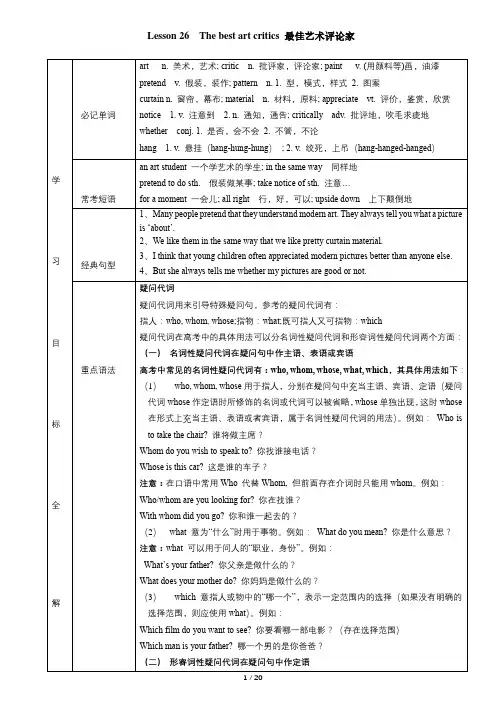
1 / 20 Lesson 26 The best art critics 最佳艺术评论家 学 习 目 标 全 解 必记单词 art n. 美术,艺术; critic n. 批评家,评论家; paint v. (用颜料等)画,油漆 pretend v. 假装,装作; pattern n. 1. 型,模式,样式 2. 图案 curtain n. 窗帘,幕布; material n. 材料,原料; appreciate vt. 评价,鉴赏,欣赏 notice 1. v. 注意到 2. n. 通知,通告; critically adv. 批评地,吹毛求疵地 whether conj. 1. 是否,会不会 2. 不管,不论 hang 1. v. 悬挂(hang-hung-hung) ; 2. v. 绞死,上吊(hang-hanged-hanged) 常考短语 an art student 一个学艺术的学生; in the same way 同样地 pretend to do sth. 假装做某事; take notice of sth. 注意… for a moment 一会儿; all right 行,好,可以; upside down 上下颠倒地 经典句型 1、 Many people pretend that they understand modern art. They always tell you what a picture is ‘about’. 2、We like them in the same way that we like pretty curtain material. 3、I think that young children often appreciated modern pictures better than anyone else. 4、But she always tells me whether my pictures are good or not. 重点语法 疑问代词 疑问代词用来引导特殊疑问句,参考的疑问代词有: 指人:who, whom, whose;指物:what;既可指人又可指物:which 疑问代词在高考中的具体用法可以分名词性疑问代词和形容词性疑问代词两个方面: (一) 名词性疑问代词在疑问句中作主语、表语或宾语 高考中常见的名词性疑问代词有:who, whom, whose, what, which,其具体用法如下: (1) who, whom, whose用于指人,分别在疑问句中充当主语、宾语、定语(疑问代词whose作定语时所修饰的名词或代词可以被省略,whose单独出现,这时whose在形式上充当主语、表语或者宾语,属于名词性疑问代词的用法)。例如: Who is to take the chair? 谁将做主席? Whom do you wish to speak to? 你找谁接电话? Whose is this car? 这是谁的车子? 注意:在口语中常用Who 代替Whom, 但前面存在介词时只能用whom。例如: Who/whom are you looking for? 你在找谁? With whom did you go? 你和谁一起去的? (2) what 意为“什么”时用于事物。例如: What do you mean? 你是什么意思? 注意:what 可以用于问人的“职业,身份”。例如: What’s your father? 你父亲是做什么的? What does your mother do? 你妈妈是做什么的? (3) which 意指人或物中的“哪一个”,表示一定范围内的选择(如果没有明确的选择范围,则应使用what)。例如: Which film do you want to see? 你要看哪一部电影?(存在选择范围) Which man is your father? 哪一个男的是你爸爸? (二) 形容词性疑问代词在疑问句中作定语 2 / 20 重点语法 常考的形容词性疑问代词有:whose,what,which。Whose通常指人,what,which通常指物。例如: Whose umbrella is this? 这是谁的伞? What job do you want to do? 你想做什么工作? Which team won? 哪个队赢了? 教材全解 教材全解 1. Many people pretend that they understand modern art. They always tell you what a picture is ‘about’. 有很多人装成很懂现代艺术的样子,总是告诉你一幅画的“意思”是什么。 pretend that…及 tell you what… 都是宾语从句,that及各种疑问句都可以引导宾语从句,其具体形式如下: (1) 在及物动词后面作宾语。 Tom thinks that English is beautiful. Do you know when he will arrive? (2) 在双宾语动词后作直接宾语。 He told me where the post office is. I assure you that such things will never happen again. (3) 在介词后面作宾语。 That depends on how hard you work. They reached agreement about when they should set out. (4) 在某些形容词后面做宾语。 I’m afraid that I can’t come. I’m sure that he will pass the exam. (5) that 引导单个宾语从句时,一般可以省略。 I pretended I was reading.; He thinks the picture is good. 2. We like them in the same way that we like pretty curtain material. 我们喜爱它们就像我们喜爱漂亮的窗帘布一样。 in the same way that/as : 像……一样,正如……一样。用来表示比较。 I am crazy about American movies in the same way that you like baseball. She like singing in the same way that I like swimming. 3. I think that young children often appreciated modern pictures better than anyone else. 我觉得小孩子们往往比任何人都更能欣赏现代绘画。 对比else 和other: a) else作为“其他的”讲时,往往只能紧跟在不定代词(anything,someone,etc.)或特殊疑问词后面使用。 What else do you want?; I want nothing else but this pen. other 作为“其他的”讲时,往往修饰名词,放在名词前面。the other 指“已提到过的其余部分”。 He prefers this coffee to other kinds. One of the children is reading, the others are doing exercises. appreciate的用法: 3 / 20 释义:vt. 感激,欣赏 (过去式:appreciated;过去分词:appreciated; 现在分词:appreciating) 用法:appreciate sb. doing sth. 感谢某人做某事 appreciate sth./v-ing sth. 喜欢个东西/感激某事 注意: 后接if或when从句时习惯上要先接it,其后不直接跟if或when引导的从句,若语义上需要接这类从句,需借助it。 例:I appreciate your kindness. 谢谢你的好意。 We shall appreciate hearing from you again. 能再次收到你的来信,我们将十分感激。 I would appreciate it very much if you would help me with it. 如果你能帮助我做这件事,我会十分感激。 We really appreciate it when she offered to help.她来帮忙了,我们十分感激。 4. But she always tells me whether my pictures are good or not. 但她总能说出我的画是好还是坏。 a) 连接词whether … or not…“是否”,表示选择,在宾语从句中可以与if… or not 替换。 I wonder if/whether you can help me or not. I don’t care if she will apologize to me or not. b) whether 还可以引导主语从句、表语从句、介词宾语从句和同位语从句,但if不可以,whether 后面可以紧接or not,if 后面不能紧接or not,只能分开用。 I don’t care whether or not she will apologize to me. Whether he will come or not has nothing to do with me. 5. I’m hanging this picture on the wall. 我正把这幅画挂到墙上去。 hang 的用法: 1. v. 悬挂(hang-hung-hung) Please hang the picture on the wall. He ran a nail into the wall to hang his painting. 2. v. 绞死,上吊(hang-hanged-hanged) The king has merely given the politicians enough rope to hang themselves. (巧记方法:上吊需要一把椅子,hanged后面的-ed就像一把椅子一样,这样记忆,就不会混淆了) 词组搭配:hang around 闲荡,悠闲地消磨时间 hang on 坚持不放弃;打电话时不挂断;稍待(等待一会时间) hang out [俚语] 消磨时间,无所事事,闲荡 hang together 团结一致,紧密结合 All she did was hang around ogling the men in the factory. Just hang on a tick, we may be able to help. We can just hang out and have a good time. We must all hang together, or assuredly we shall all hang separately. 4 / 20 Lesson 27 A wet night 雨夜 学 习 目 标 全 解 必记单词 tent n.帐篷; field n.田地,田野; smell (smelled or smelt, smelled or smelt) v.闻起来 wonderful adj. 极好的; campfire n. 营火,篝火; creep (crept, crept) v. 爬行 sleeping bag 睡袋; comfortable adj. 舒适的,安逸的; soundly adv. 香甜地 leap (leapt, leapt) v. 跳跃,跃起; heavily adv. 大量地; stream n. 小溪 form v. 形成; wind (wound, wound) v. 蜿蜒; right adv. 正好 常考短语 late in the afternoon 快到傍晚的时候; put up= set up 搭起 in the middle of a field 在田野中间; as soon as 一……就…… cook a meal/ meals 做饭; smell good 闻起来很香; tell stories 讲故事 begin to rain 开始下雨; begin shouting 开始大喊大叫; put out the fire 扑灭火 creep into the tent 爬进帐篷; wake up 醒来; be full of 充满 经典句型 1、 Late in the afternoon, the boys put up their tent in the middle of a field. 2、As soon as this was done, the cooked a meal over an open fire. 3、They were all hungry and the food smelled good. 4、After a wonderful meal, they told stories and sang songs by the campfire. 5、The boys felt tired so they put out the fire and crept into their tent. 6、In the middle of the night, two boys woke up and began shouting. 7、They all leapt out of their sleeping bags and hurried outside. 8、It was raining heavily and they found that a stream had formed in the field. 9、The stream wound its way across the field and then flowed right under their tent. 重点语法 同源副词 某些副词有两种形式,一种形式与其形容词形式同形、另一种形式带后缀-ly,在使用中要特别留意两者在意思上的差异。 与形容词同形的副词 “形容词+后缀ly”形式的副词 hard(努力地) hardly(几乎不) near(临近) nearly(几乎) most(最) mostly(大多数) short(突然) shortly(立刻,不久) late(晚) lately(最近) wide(广阔地) widely(广泛地,普遍地) deep(表示空间深度) deeply(表示感情等抽象意义上的深度) high(空间高度) highly(表示程度,相当于much) free(免费) freely(无限制地) 例句:1、 They tried hard to succeed. 他们努力工作以获得成功。 It was so dark that I could hardly see anything.天那么黑,以至于我几乎什么都看不见。 2、 You have come too late. 你来得太晚了。 What have you been doing lately? 你近来在干些什么? 3、 He pushed the stick deep into the mud. 他把棍子深深插入泥土中。 Father was deeply moved by the film. 父亲被这部电影深深感动了。
Lesson25
课后练习
一、 选择
1. At dinner, I asked her if she_____ her dinner.
A is enjoying B was enjoying C enjoys D enjoyed
2. But she had to_____ the company and_____ a man in order to get a job.
A lie to, pretended to be B lie, pretended to be
C lie to, pretended being D lie, pretended as
3. I would appreciate_____ back this afternoon.
A you to call B you call C you calling D you‟re calling
4. She pretended_____ me when I passed by.
A not to see B not seeing C to not see D having not seen
5. My brother often say something______.
A interest B interesting C interested D interestingly
6. When I______ last night, I______ nobody in my living room.
NCE2026.txt
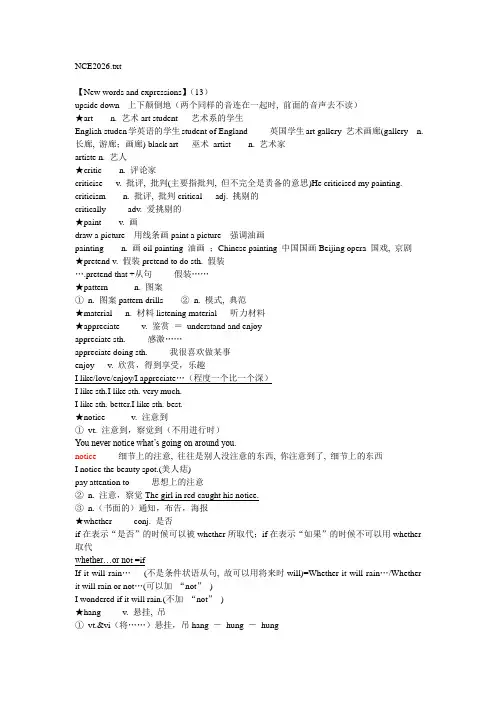
【New words and expressions】(13)
upside down 上下颠倒地(两个同样的音连在一起时, 前面的音声去不读)
★art n. 艺术art student 艺术系的学生
English studen学英语的学生student of England 英国学生art gallery 艺术画廊(gallery n.
长廊, 游廊;画廊) black art 巫术 artist n. 艺术家
artiste n. 艺人
★critic n. 评论家
criticise v. 批评, 批判(主要指批判, 但不完全是责备的意思)He criticised my painting.
criticism n. 批评, 批判critical adj. 挑剔的
critically adv. 爱挑剔的
★paint v. 画
draw a picture 用线条画paint a picture 强调油画
painting n. 画oil painting 油画 ;Chinese painting 中国国画Beijing opera 国戏, 京剧
★pretend v. 假装pretend to do sth. 假装
„.pretend that +从句 假装„„
★pattern n. 图案
① n. 图案pattern drills ② n. 模式, 典范
★material n. 材料listening material 听力材料
★appreciate v. 鉴赏 = understand and enjoy
appreciate sth. 感激„„
appreciate doing sth. 我很喜欢做某事
enjoy v. 欣赏,得到享受,乐趣