
外研版英语九年级上册 Module 6 Problems
- 格式:pptx
- 大小:45.68 MB
- 文档页数:67


第 1 页 共 15 页
1.学生自学生词,并记住单词拼写和拼读。
2.预习课本,找出重点短语和句式。
3.读、记后完成学案中自学导练作业。
第 2 页 共 15 页 Step 1情景导入
T:Do you have any problems in your life or in your study?
S1:I always fail the exams.
S2:I’m worried about my math.
S3:My parents always stop me from playing football.
S4:I spend too much time playing computer games.
S5…
T:Do you want to know Tony’s problems?
Ss:Yes, we do.
Step 2 完成教材 Activities 1,2 的任务
1.Listen and decide what Tony’s problem is. Use the words in the box to help you. (Activity
1)
(1)学生个体活动,浏览方框内的词汇,阅读三个选项,预测对话内容。
(2)学生听录音,完成选择。
(3)教师点名,个体回答,全班核对答案。
2.Listen again and check (√) the true sentences. (Activity 2)
(1)学生个体活动,浏览各个语句,明确任务。
(2)再次听录音,判断语句正误。
(3)圈划错误信息,尝试纠错。
(4)教师点名,个体回答,全班核对答案并改正错误的句子。
Step 3完成教材Activities 3的任务
1.Listen and read. Now work in groups. Discuss what the problem is between Tony and his father.
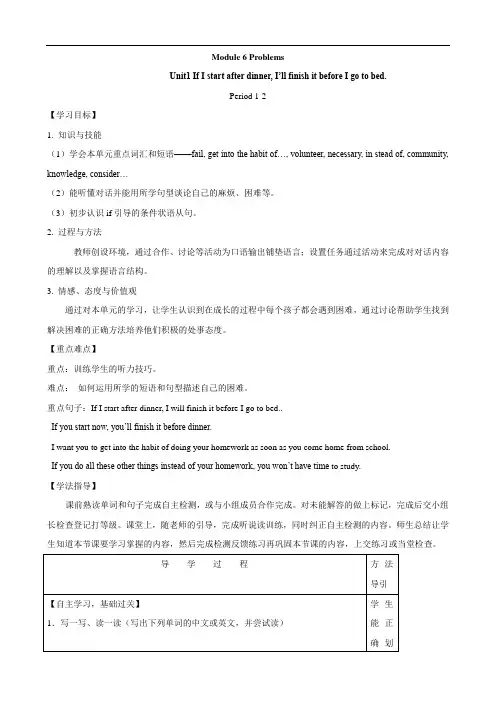
Module 6 Problems
Unit1 If I start after dinner, I’ll finish it before I go to bed.
Period 1-2
【学习目标】
1. 知识与技能
(1)学会本单元重点词汇和短语——fail, get into the habit of…, volunteer, necessary, in stead of, community,
knowledge, consider…
(2)能听懂对话并能用所学句型谈论自己的麻烦、困难等。
(3)初步认识if引导的条件状语从句。
2. 过程与方法
教师创设环境,通过合作、讨论等活动为口语输出铺垫语言;设置任务通过活动来完成对对话内容的理解以及掌握语言结构。
3. 情感、态度与价值观
通过对本单元的学习,让学生认识到在成长的过程中每个孩子都会遇到困难,通过讨论帮助学生找到解决困难的正确方法培养他们积极的处事态度。
【重点难点】
重点:训练学生的听力技巧。
难点: 如何运用所学的短语和句型描述自己的困难。
重点句子:If I start after dinner, I will finish it before I go to bed..
If you start now, you’ll finish it before dinner.
I want you to get into the habit of doing your homework as soon as you come home from school.
If you do all these other things instead of your homework, you won’t have time to study.
【学法指导】
课前熟读单词和句子完成自主检测,或与小组成员合作完成。对未能解答的做上标记,完成后交小组长检查登记打等级。课堂上,随老师的引导,完成听说读训练,同时纠正自主检测的内容。师生总结让学生知道本节课要学习掌握的内容,然后完成检测反馈练习再巩固本节课的内容,上交练习或当堂检查。

初中英语 重点短语(Module 6 Problems)
学生基本能够掌握本模块重点短语,并尝试用新学知识点造句。
重点:be able to do, instead of, use … for, take off, no longer,
be angry with somebody, tell somebody the truth, at least, after all
难点:词组在句子中的实际应用。
知识梳理:
【短语学习】
1. be able to do能够做某事
I work in the library and I am also able to read books there.
我在图书馆工作,而且在那里我还能读到一些书。
be able to do表示“能够做某事”,之前我们学习过有类似含义的单词还有can,二者的区别:can只能用于一般现在时和一般过去时(could);而be able
to可以用于各种时态。
You will be able to use it very well.
She will be able to drive a car soon.
They can finish it on time.
翻译句子:
我希望你能参加这个聚会。
答案:I hope you will be able to join the party. 思路分析:be able to和将来时的结合。
2. instead of替代
If you do all these other things instead of your homework, you won’t have time to study.
如果你不去做作业,而是做这些其他方面的事情,你就没有时间去学习了。
instead of后面所能跟随的词性有若干种。
Can you go there instead of me?

1 外研版英语九年级上册Module 6 Problems
一.单项选择(每小题1分,共10分)
1. As students, we should ________ our seat to the old and sick on the crowded bus.
A. lend B. offer C. bring D. take
2. Tony’s mother has warned him ________ up.
A. stay B. not staying C. don’t stay D. not to stay
3. Last Sunday, my grandfather came ______ with a kite.
A. around B. on C. round D. at
4. It is a shame ________such a mistake.
A.make B.to make C.making D. makes
5. You won’t make progress________ you work hard.
A. if B. unless C. when D. that
6. I am so busy. Don't refuse________ me, will you?
A. to help B. helping C. help D. helps
7. There is going to ________ a sports meeting next week. If it ________, we'll have to cancel(取消) it.
A. Be; will rain B. have; will rain C. be; rains D. have; rains