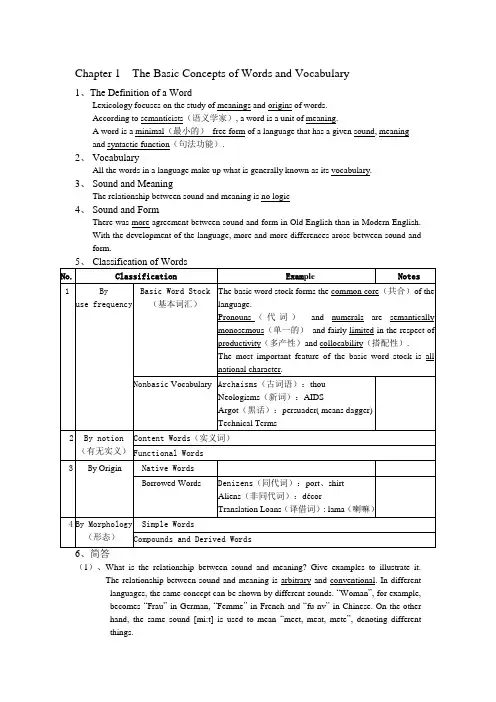
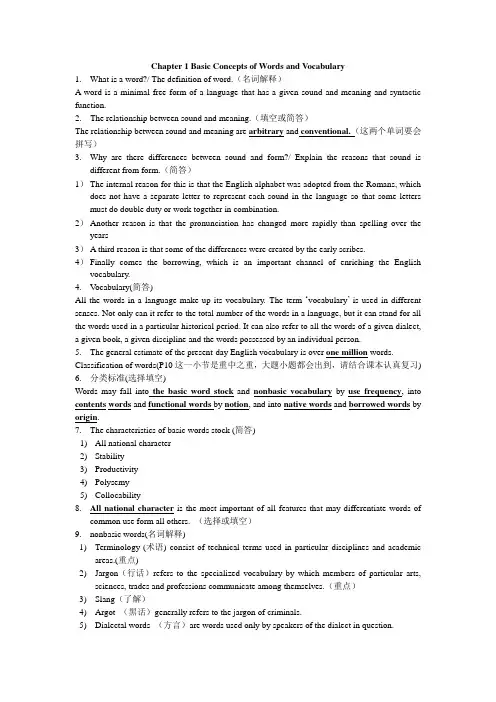
Chapter 1 Basic Concepts of Words and Vocabulary1.What is a word?/ The definition of word.(名词解释)A word is a minimal free form of a language that has a given sound and meaning and syntactic function.2. The relationship between sound and meaning.(填空或简答)The relationship between sound and meaning are arbitrary and conventional. (这两个单词要会拼写)3.Why are there differences between sound and form?/ Explain the reasons that sound isdifferent from form.(简答)1)The internal reason for this is that the English alphabet was adopted from the Romans, which does not have a separate letter to represent each sound in the language so that some letters must do double duty or work together in combination.2)Another reason is that the pronunciation has changed more rapidly than spelling over the years3)A third reason is that some of the differences were created by the early scribes.4)Finally comes the borrowing, which is an important channel of enriching the English vocabulary.4.V ocabulary(简答)All the words in a language make up its vocabulary. The term ‘vocabulary’ is used in different senses. Not only can it refer to the total number of the words in a language, but it can stand for all the words used in a particular historical period. It can also refer to all the words of a given dialect,a given book, a given discipline and the words possessed by an individual person.5.The general estimate of the present-day English vocabulary is over one million words. Classification of words(P10这一小节是重中之重,大题小题都会出到,请结合课本认真复习)6.分类标准(选择填空)Words may fall into the basic word stock and nonbasic vocabulary by use frequency, into contents words and functional words by notion, and into native words and borrowed words by origin.7.The characteristics of basic words stock (简答)1)All national character2)Stability3)Productivity4)Polysemy5)Collocability8.All national character is the most important of all features that may differentiate words ofcommon use form all others. (选择或填空)9.nonbasic words(名词解释)1)Terminology (术语) consist of technical terms used in particular disciplines and academicareas.(重点)2)Jargon(行话)refers to the specialized vocabulary by which members of particular arts,sciences, trades and professions communicate among themselves.(重点)3)Slang(了解)4)Argot (黑话)generally refers to the jargon of criminals.5)Dialectal words (方言)are words used only by speakers of the dialect in question.6)Archaisms (古语)are words or forms that were once in common use but are now restrictedonly to specialized or limited use.7)Neologisms(新词)are newly-created words or expressions, or words that have taken onnew meanings.(重点)10.Content words denote clear notions and thus are known as notional words. (名词解释或填空)11.Functional words do not have notions of their own. (名词解释或填空)12.Content words include nouns, verbs, adjectives, adverbs and numerals.13.Functional words are also called empty words or form words. They include prepositions,conjunctions, auxiliaries, articles and pronouns.14.the functions of native words:Native words form the mainstream of the basic word stock and stand at the core of the language. Therefore, what is true of the basic word stock is also true of native words.15.Apart from the characteristics mentioned of the basic word stock, in contrast to borrowedwords, native words have two other features: (选择填空或简答)1)Neutral in style2)Frequent in use 要注意native words一共有5+2=7个特点16.外来语的分类:(选择填空或简答)According to the degree of assimilation and manner of borrowing, we can bring the loan-words under four classes.1)denizens2)aliens3)Translation-loans4)Semantic-loans17.Denizens are words borrowed early in the past and now well assimilated into the Englishlanguage. (名词解释)18.Aliens are borrowed words which have retained their original pronunciation and spelling. (名词解释)19.课本第20页练习中的选择、判断、填空都要仔细看,可能会出到原题Chapter 2 The Development of The English Vocabulary1.英语的三个发展阶段及其时间(简答,填空,选择,三个阶段及其时间都要记住)1)Old English (450-1150)2)Middle English (1150-1500)3)Modern English (1500-up to now)2.Now people generally refer to Anglo-Saxon as Old English (选择,填空)3.Old English has a vocabulary of about 50,000 to 60,000words. It was highly inflectedlanguage just like modern German. (古英语的特点,选择,填空)4.Middle English retained much fewer inflection. If we say that Old English was a fullendings, Middle English was one of leveled endings.(中期英语的特点,选择,填空)5.In modern English, word endings were mostly lost with just a few exceptions. It can beconcluded that English has evolved from a synthetic language (Old English) to the present analytic language. (现代英语的特点,选择,填空)6.There are three main sources of new words:1)the rapid development of modern science and technology2)social, economic and political changes3)the influence of other cultures and languages7.Modes of vocabulary development (重点,简答)1)Creation2)Semantic change3)Borrowing8.Creation is the most important way of vocabulary expansion.9.第33页课后题中的天空、判断好好看看Chapter 3 Word Formation 11.morpheme: the morpheme is ‘the smallest functioning unit in the composition of words.’ (名词解释)2.allomorphs: Some morphemes are realized by more than one morph according to theirposition in a word. Such alternative morphs are known as allomorphs.(名词解释)3.types of morphemes (要求会画42页的表)4.free morpheme: Morphemes which are independent of other morphemes are considered to befree. (名词解释)5.We might see that free morphemes are free root.6.bound morphemes: morphemes which cannot occur as separate words are bound. (名词解释)7.bound root: a bound root is that part of the word that carries the fundamental meaning just likea free root. It is a bound form and has to combine with other morphemes to make words. (名词解释)8.what is affixes? Illustrate it with examples. 论述题,这是个重点,课本第41页整页,按上课时画的来回答9. A root is the basic form of a word which cannot be further analyzed withhold total loss ofidentity. (名词解释)10.A stem may consist of a single root morpheme as in iron or of two root morphemes as in acompound like handcuff. It can be a root morpheme plus one or more affixational morphemes as in mouthful, underestimate.11.we will use stem only because it can replace root and also refer to any form which is largerthan a root.12.第44页课后题三个都要好好看一下Unit 4 Word Formation II1.The expansion of vocabulary in modern English depends chiefly on word-formation. Themost productive are affixation, compounding and conversation.(选择,填空)2.Affixation is generally defined as the formation of words by adding word-forming orderivation affixes to stems. This process is also known as derivation. (名词解释)3.Prefixation is the formation of new words by adding prefixes to stems. (名词解释)4.Prefixes do not generally change the word-class of the stem but only modify its meaning.(前缀的特点)5.We classify prefixes on a semantic basis into nine groups:1)Negative prefixes:2)Reversative prefixes3)Pejorative prefixes: mal-, mis-, pseudo-4)Prefixes of degree or size5)Prefixes of orientation and attitude6)Locative prefixes7)Prefixes of time and order8)Number prefixes9)Miscellaneous prefixes(这九种及其例子都要记住,选择题给出例子要知道是属于哪种前缀)6.Suffixes is the formation of new words by adding suffixes to stems. (名词解释)7.Suffixes has only a small semantic role, their primary function being to change thegrammatical function of stems. In other words, they mainly change the word class. (后缀的特点)8.记住几种后缀及其例子,给出一个后缀要选出是什么意义的后缀pounding: Compounding, also called composition, is the formation of new words byjoining two or more stems. Words formed in this way are called compoundings.(名词解释)pounds can be written solid, hyphenated and open.11.Characteristics of compounds/ The differences between compounds and free words (简答)1)Phonetic features2)Semantic features3)Grammatical features12.动词复合词的两种构成形式:(简答)1)Conversation2)Backformation13.Conversation is the formation of new words by conversation words of one class to anotherclass. (名词解释)14.短语动词转换成名词的两种方法:1)Words like hand-out, stand-by are all converted from phrasal verbs. Such conversation isvery common in English. The examples cited here keep their original order, hand-out from hand out, stand-by from stand by.2)Sometimes, when a phrasal verb is turned into a noun, the verb and particle should beinverted.15. Characteristics of full conversation: a noun fully converted from an adjective has all the characteristics of nouns. It can take an indefinite article or –(e) to indicate singular or plural number.16. 熟记以下例子,给出例子,要知道是属于完全转类,一般出选择题或判断题:Common adjectives:a white; a native; finals; drinkables; a liberal; a Republican; necessaries; valuablesParticiples and others:a given; a drunk; young marrieds; newly-weds17. Characteristics of words partially conversation:Nouns partially converted from adjectives do not possess all the qualities a noun does. They must be used together with definite articles. What’s more, they retain some of the adjective features18. 部分转类例子(同16)the poor, the rich, the young, the wounded, the poorer, the more affluent, the most corrupt19. Blending is the formation of new words by combining parts of two words or a word plus a part of another word. (名词解释)20. Four groups of blends(简答)1) head + tail2) head +head3) head +word4) word +tail21. examples: (选择或判断,要求同前)motel (head + tail)sitcom(head + head)medicare (head +word)22. clipping is to shorten a longer word by cutting a part off the original and using what remains instead. (名词解释)23. Four common types of clipping (简答)1) Front clipping2) Back clipping3) Front and back clipping4) Phrase clipping24. examples(要求同前)quake, phone (front clipping)flu, fridge, (front and back clipping)pub, pop, zoo (phrase clipping)25. Acronymy is the process of forming new words by joining the initial letters of names of social and political organizations or special noun phrases and technical terms.(名词解释)26. Initialisms are words pronounced letter by letter. (首字母缩略词)Acronyms are words formed from initial letters but pronounced as a normal word. (首字母拼音词)27. examples:VOA, c/o, p.c. TV (Initialisms)AIDS, N-bomb (Acronyms)28. Back-formation is the method of creating words by removing the supposed suffixes.(名词解释)29. examples:donate, beggar, babysitter (back-formation)30. Words from Proper Names include names of people, names of places, names of books and trade names.31. examples:Faraday, Ohm, Volta, Quixote (names of people)China (names of places)Utopia, odyssey, Babbit (names of books)Nylon, orlon, Dacron, rayon (trdaenames)31.课本第73页练习,选择,填空和判断都要仔细看Chapter 5 Word Meaning1.Reference is the relationship between language and the world. (名词解释)2.Concept, which is beyond language, is the result of human cognition, reflecting the objectiveworld in the human mind. It is universal to all men alike regardless of culture, race, language and so on whereas meaning belongs to language, so is restricted to language use. (名词解释)3.Sense denotes the relationships inside the language. (名词解释)4.注意1、2、3的区别5.Motivation accounts for the connection between the linguistic symbol and its meaning. As weknow, the relationship between the word-form and meaning is conventional and arbitrary, and most words can be said to be non-motivated. That is, the connection of the sign and meaning does not have a logical explanation. Nevertheless, English does not have words whose meanings can be explained to a certain extent. (名词解释或简答)6.Four motivations:(简答)1)Onomatopoeic motivation (拟声理据)2)Morphological motivation (形态理据)3)Semantic motivation (语义理据)4)Etymological motivation (词源理据)7.types of meaning 要会画表8.grammatical meanings refers to that part of the meaning of the word which indicatesgrammatical concept or relationships such as part of speech of words (nouns, verbs, adjectives, adverbs), singular and plural meaning of nouns, tense meaning of verbs and their inflectional forms. (名词解释)9.Lexical meaning and grammatical meaning make up the word-meaning. It is known thatgrammatical meaning surfaces only in use. But lexical meaning is constant in all the content words within or without context as it is related to the notion that the word conveys. Lexical meaning itself has two components: conceptual meaning and associative meaning.10.Conceptual meaning (also known as denotative meaning ) is the meaning given in thedictionary and forms the core of word-meaning. (名词解释)11.概念意义的特点:constant and relatively stable12.Associative meaning is the secondary meaning supplemented to the conceptual meaning. (名词解释)13.four types of associative meaning: connotative, stylistic, affective and collective.(填空,选择或简答)14.connotative meaning refers to the overtones or associations suggested by the conceptualmeaning. (名词解释)15.stylistic meaning: Apart from their conceptual meanings, many words have stylistic features,which make them appropriate for different contexts. (名词解释)16.stylistic meaning normally classify into formal, neural and informal.17.examples:domicile (very formal, official) residence(formal)abode(poetic)home(general)diminutive (very formal) tiny (colloquial)wee(colloquial, dialectal)记住这些例子,要知道这些是说的词的”stylistic meaning”18.affective meaning: Affective meaning indicated the speaker’s attitude towards the person orthing in question. (名词解释)19.Words that have emotive values may fall into two categories: appreciative or pejorative.20.collocative meaning: this meaning consists of the associations a word acquires in itscollocation.21.课本第92页课后题选择,填空,判断Chapter 6 Sense Relations and Semantic Field1.论述题(按课堂上讲答)Please illustrate two approaches to polysemy with examples.The problem of interrelation of the various meanings of the same word can be dealt with from two different angles: diachronic approach and synchronic approach.2.The development of word-meaning from monosemy to polysemy follows two courses,traditionally known as radiation and concatenation.3.Homonyms are generally defined as words different in meaning but either identical both insound and spelling or identical only in sound or spelling. (名词解释)4.Types of Homonyms (简答)1)Perfect homonyms2)Homographs3)Homophones5.Perfect homonyms are identical both in sound and spelling, but different in meaning. (名词解释)6.Homographs are words identical only in spelling but different in sound and meaning. (名词解释)7.Homophones are words identical only in sound but different in spelling and meaning. (名词解释)8.Homophones constitute the largest number and the most common. (填空或选择)9.Origins of Homonyms (简答)1)Change in sound and spelling2)Borrowing3)Shortening10.Differentiation of Homonyms from Polysemants (难点,这个课本上整段都要仔细看,不一定会出什么形式的题)Perfect homonyms and polysemants are fully identical with regard to spelling and pronunciation. This creates the problem of differentiation. 1) The fundamental difference between homonyms and polysemants lies in the fact that the former refers to different words which happen to share the same form and the latter is the one and same word which has several distinguishable meanings. 2) One important criterion is to see their etymology. 3) The second principle consideration is semantic relatedness. 4) In dictionaries, a polysemant have meanings all listed under one headword whereas homonyms are listed as separate entries. 11.Synonyms: one of two or more words in the English language which have the same or verynearly the same essential meaning. In other words, synonyms share a likeness in denotation as well as I part of speech. (名词解释)12.Synonyms can be classified into two major groups: absolute synonyms and relativesynonyms.13.Absolute synonyms: Absolute synonyms also known as complete synonyms are words shichare identical in meaning in all its aspects, i.e. both in grammatical meaning and lexical meaning, including conceptual and associative meaning.14.Discrimination of synonyms:(论述或简答,注意如果出简答题,则不用举例子,直接答每一段的前一句话就行,但如果是论述,以下都答)The differences between synonyms boil down to three areas: denotation, connotation, and application.1)Difference in denotation. Synonyms may differ in the range and intensity ofmeaning. For example,timid and timorous are synonymous, but the former isapplied to both the state of mind in which a person may happen to be at the moment,and to the habitual disposition, and the latter only to the disposition. Therefore,timid has a wider range of meaning than timorous.2)Difference in connotation. By connotation we mean the stylistic and emotivecoloring of words. For example, among the group of policeman, constable, bobbyand cop. Policeman and constable are stylistically neutral, yet the former is usedboth in British English and American English while the latter is only British. B obbyis colloquial, used only in British English and cop is slangy.3)Difference in application. Many words are synonymous in meaning but different inusage in simple terms. They form different collocations and fit into differentsentence patterns. For example, answer and let are synonyms, but we allow sb to dosth and let sb do sth.15.Antonymy (同上题,简答或论述,另外这里面的例子要记住,选择填空或判断中出现要知道属于哪一类反义词)Antonymy is concerned with semantic opposition. Antonyms can be defined as words which are opposite in meaning. There are a variety of ‘oppositeness’. They can be classified into three major groups.1)Contradictory terms. These antonyms truly represent oppositeness of meaning. Theyare so opposed to each other that they are mutually exclusive and admit nopossibility between them. The assertion of one is the denial of the other. In otherwords, if one of the pair is true, then the other cannot be. For example, an animal iseither dead or alive, and there exists no such a case where the animal is both deadand alive. The same is applicable to present/absent, male/female, boy/girl, true/false,same/different and so on.2)Contrary terms. Antonyms of this type are best viewed in terms of a scale runningbetween two poles or extremes. Antonyms such as rich/poor, old/young, big/smallrepresent two points at both ends of the pole. The two opposites are gradable andone exists in comparison with the other. (other examples: old/young, open/close,rich/poor, hot/cold, beautiful /ugly这几个答大题是不用写,小题时认识就行)3)Relative terms. This third type consist of relational opposites such as parent/child,husband/wife, predecessor/successor, employer/employee, sell/buy, give/recive. 16.Hyponymy 这部分题量不多,记住其中的例子,可能会出选择、填空或判断,比如flower是rose 的什么词?答案:superordiante17.Semantic field这一部分也是出小题,比如给出一堆蔬菜名称,问这是什么语义场,答案a field of vegetable. 或者其他的语义场,fruit, color, relatives and so on.仔细看一下课本上的例子18.课本123页课后题,选择,填空,判断Chapter 7 Changes in Word Meaning1.Word-meaning changes by modes of extension, narrowing, degradation, elevation, andtransfer. Of these, extension and narrowing by far the most common.2.Extension is a process by which a word which originally had a specialized meaning has nowbecome generalized. (名词解释)3.Narrowing is a process by which a word of wide meaning acquires a narrower or specializedsense. (名词解释)4.examples: meat, wife, girl (例子要求同前)5.Elevation refers to the process by which words rise from humble beginnings to position ofimportance. (名词解释)6.Degradation or pejoration of meaning is the opposition of semantic elevation. It is processwhereby of good origins fall into ill reputation or non-affective words come to be used in derogatory sense.(名词解释)7.examples: silly, knave, criticize8.Transfer: words which were used to designate one thing but later changed to mean somethingelse have experienced the process of semantic transfer.(名词解释)9.causes of changes (简答)1)Extra-linguistic factorsa.historical reasonb.class reasonc.psychological reason2) Linguistic factorsa. shortening of phrasesb. borrowingc. analogyChapter 8 Meaning and Context1.linguistic context : Context is used in different sense. In a narrow sense, it refers to the words,clauses, sentences in which a word appears. This is known as linguistic context, which may cover a paragraph, a whole chapter and even the entire book. (名词解释)2.extra-linguistic context: Context is used in different sense in a broad sense, it includes thephysical situation as well. This is called extra-linguistic or non-linguistic context, which embraces the people, time, place, and even the whole cultural background. (名词解释)3.Linguistic context can be subdivided into lexical context and grammatical context.4.Lexical context refers to the words that occur together with the word in question. Themeaning of the word is often affected and defined by the neighboring words.(名词解释)5.Grammatical context: In some case, the meaning of a word may be influenced by the structurein which it occurs. This is what we call grammatical context. (名词解释)6.The role of context: (简答)1)elimination of ambiguity2)indication of referents3)provision of clues for inferring word meaning7.Ambiguity often arises due to polysemy, homonymy and grammatical structure.8.课后习题Chapter 9 English Idioms1. Characteristics of idioms(简答)1)semantic unity2)structural stability2. Please explain the structural stability of idioms(简答)1) The constituents of idioms cannot be replaced.2) The word order cannot be inverted or changed.3) The constituents of an idiom cannot be deleted or added to, not even an article.4) Many idioms are grammatically unanalysable.3. According to grammatical functions we classify idioms into five groups.4. Idioms can be classified into 5 groups: (简答)1) Idioms nominal in nature2) Idioms adjectival in nature3) Idioms verbal in nature4) Idioms adverbial in nature5) Sentence idioms5. Idioms nominal in nature: Idioms of this class have a noun as the key word in each and function as a noun in sentences. (名词解释)6. Idioms verbal in nature can be divided into phrasal verbs and verb phrases.7. Phrasal verbs are idioms which are composed of a verb plus a prep and/or a particle. (名词解释)8. As far as sentence types are concerned, sentence idioms embrace declarative, interrogative, imperative and exclamative sentences. In terms of complexity they can be further divided into simple, compound and complex sentences.9. Idioms are generally felt to be informal.10. Apart from the stylistic features, idioms manifest apparent rhetorical colouring in such respects as of phonetic manipulation, lexical manipulation and figures of speech. (填空或简答)11. Phonetic manipulation: (1) Alliteration (2) Rhyme12. 应用举例:eat like a horse -----simileBlack sheep, a dark horse------metaphor13. Metonymy: This refers to idioms in which the name of one thing is used for that of another associated with it. (名词解释)14. 课本179页练习,选择,填空,判断,简答。