
小学英语一般将来时
- 格式:ppt
- 大小:1.34 MB
- 文档页数:31


2023年小升初语法总复习(四)一般将来时一、一般将来时的定义:表示将要发生的动作或存在的状态及打算、计划或准备做事情。
句中一般含有以下时间状语:tomorrow, next day(week, month, year...), soon, the day after tomorrow等。
二、一般将来时的句型结构:1.肯定句:(1)will+do,如:We will go shopping tomorrow.我们明天将去购物。
(1)be going to+do,如:I am going to shop tomorrow.我明天将去购物。
2.否定句:在be动词(am, is, are)后加not或情态动词will后加not,也可所写成won’t。
如:I am going to shop tomorrow.-I am not going to shop tomorrow.I will go shopping tomorrow.-I will not go shopping tomorrow.3.一般疑问句:be动词或will提到句首,some改成any,and改为or,第一、二人称互换。
如:I am going to shop tomorrow.-Are you going to shop tomorrow?I will go shopping tomorrow.-Will you go shopping tomorrow?4.特殊疑问句:特殊疑问词+一般疑问句?一般将来时中对画线部分提问有三种情况:(1)问人:Who如:I am going to school.(对画线部分提问)Who’s going to school?(2)问干什么:What...do如:My father is going to watch a race with me this afternoon.(对画线部分提问)What is your father going to do with you this afternoon?(3)问什么时候:When如:Yang Ling is going to play football tomorrow .(对画线部分提问)When is Yang Ling going to play football?【即时演练】一、用所给动词的适当形式填空。
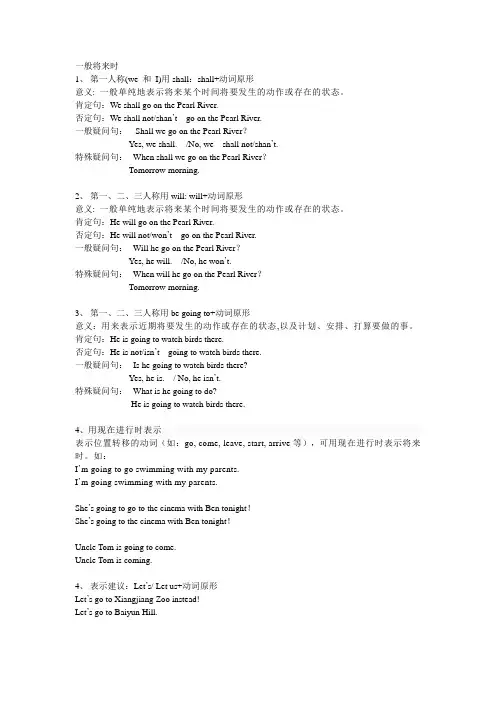
一般将来时1、第一人称(we 和I)用shall:shall+动词原形意义: 一般单纯地表示将来某个时间将要发生的动作或存在的状态。
肯定句:We shall go on the Pearl River.否定句:We shall not/shan’t go on the Pearl River.一般疑问句:-- Shall we go on the Pearl River?--Y es, we shall. /No, we shall not/shan’t.特殊疑问句:--When shall we go on the Pearl River?--Tomorrow morning.2、第一、二、三人称用will: will+动词原形意义: 一般单纯地表示将来某个时间将要发生的动作或存在的状态。
肯定句:He will go on the Pearl River.否定句:He will not/won’t go on the Pearl River.一般疑问句:--Will he go on the Pearl River?--Y es, he will. /No, he won’t.特殊疑问句:--When will he go on the Pearl River?--Tomorrow morning.3、第一、二、三人称用be going to+动词原形意义:用来表示近期将要发生的动作或存在的状态,以及计划、安排、打算要做的事。
肯定句:He is going to watch birds there.否定句:He is not/isn’t going to watch birds there.一般疑问句:--Is he going to watch birds there?--Y es, he is. / No, he isn’t.特殊疑问句:--What is he going to do?-- He is going to watch birds there.4、用现在进行时表示表示位置转移的动词(如:go, come, leave, start, arrive等),可用现在进行时表示将来时。
