
雅思模拟试卷听力部分2
- 格式:doc
- 大小:569.00 KB
- 文档页数:5
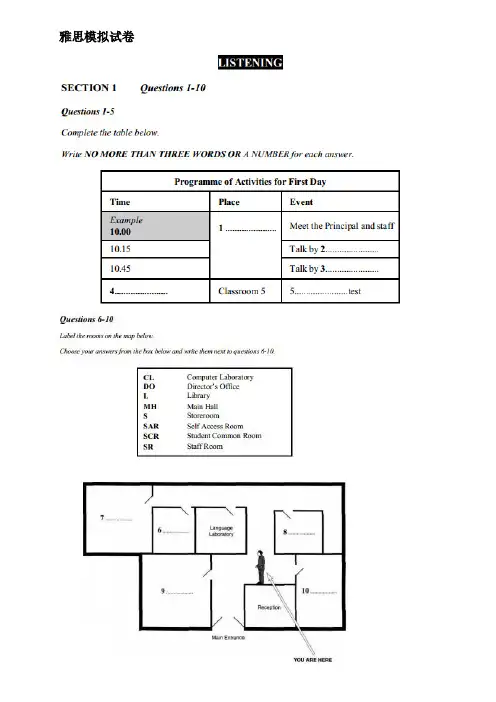
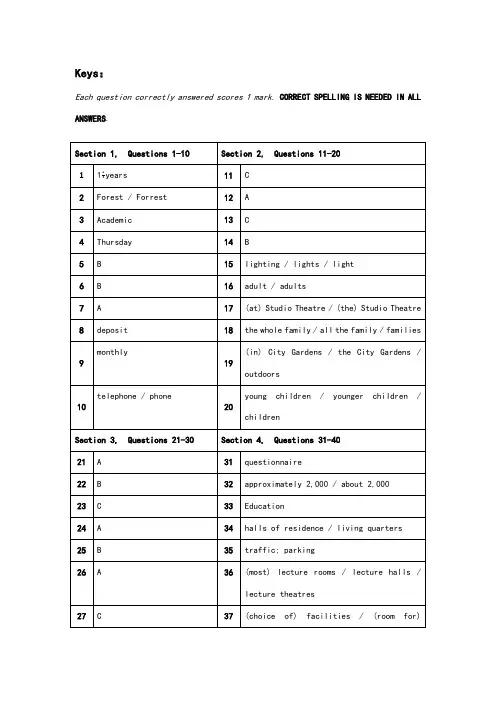
Keys:Each question correctly answered scores 1 mark. CORRECT SPELLING IS NEEDED IN ALL ANSWERS.注:Questions 35, 38 and 40 (IN EITHER ORDER, BOTH REQUIRED FOR ONE MARK)If you score…Audio ScriptsSECTION 1LYNDA: Sara, I’ve heard that you want to move into a homestay family. Is that correctSARA: Yes, that’s right. I’ve been staying with my aunt and now my cousin is arriving from Singapore and my aunt needs the room for him.LYNDA: Oh, that’s bad luck. Well, I’II need to get some particulars first. Sara, what’s your full nameSARA: Sara Lim, and that’s Sara without the ‘h’ at the end.LYNDA: Mmm. How old are you, SaraSARA: Twenty-three, only just. It was my birthday on the twenty-first of August. LYNDA: Happy birthday for yesterday. How long have you been in Australia SARA: (Q1) A year in Adelaide and six months in Sydney. I prefer Sydney. I’ve got more friends here.LYNDA: What’s your address at your aunt’s houseSARA: Flat one, five three nine (Q2) Forest Road, Canterbury. And the post code is two, o, three, six.LYNDA: OK. What are you studying nowSARA: I was studying General English in Adelaide and now I’m doing (Q3) Academic English, because I’m trying to get into Medicine next year.LYNDA: That sounds good, but it’ll take you a long time. When would you like to move out from your aunt’sSARA: My cousin arrives on Friday morning, so I’d better be out on (Q4) Thursday. LYNDA: What, the seventh of SeptemberSARA: Yes, that’s right.LYNDA: That doesn’t leave us much time. Right, OK. I need to know what kind of accommodation you’d like, so I can get you something suitableSARA: Can I (Q5) share a room with someone else I’ve been alone in my room at my aunt’s and I’ve always shared with my sister and I likethat.LYNDA: Yes, fine. That’ll save you money too. Would you like to live with a family or do you think that a (Q6) single person would be better for you I havelots of very nice single people on my books.SARA: Do you have any women living alone, retired womenLYNDA: Yes, I have quite a few whose children have grown up and left home. In fact,I have some really lovely retired ladies, living by themselves, who justlove the company of students. Most of them live in (Q7) flats, but that’snot a problem for you, is itSARA: Not at all. I’m used to that. My aunt lives in a flat too, remember. I’m not use to a big house with a garden, swimming pool, pets and all that. LYNDA: OK, fine. I know quite a bit about what you want now. I should let you know that your rent will be a hundred and sixty dollars per week. You’ll haveto pay me three hundred and twenty dollars as a (Q8) deposit before youmove in. The deposit is as insurance, in case you break something. You’llneed to pay (Q9) monthly to me, by cash or cheque, I don’t mind. You don’tneed to pay for gas, electricity or water, but you will need to pay yourproportion of the (Q10) phone bill. Most families do that on an honour system,but you’ll have to wait and seeSARA: Mmm.LYNDA: Have you got any more questions for meSARA: When will you know where I can goLYNDA: I’II work on it now, so come and see me tomorrow and I should have some news for you then.SARA: Thanks a lot.LYNDA: Goodbye. See you tomorrow – after lunch would be better for me.SARA: OK, see you then. Bye.SECTION 2GEOFFREY: Good evening, and in this week’s edition of ‘Focus on the Arts’, Jane Hemmington is going to fill us in on what’s in store for us at thisyear’s Summer Festival. Over to you, Jane.JANE: Thank you, Geoffrey. This year, the Summer Festival is the biggest we’ve ever seen, so there should be something for everybody. This is the third year they’ve run it and the timing’s slightly different: for the last couple of years it’s been around the fifth to seventeenth, but this year they wanted to allow everyone enough time to recover from the first of January celebrations and they’ve put it (Q11) at the end of the month.The programme has sensational theatre, dance and also a large number of art exhibitions, but the thing the Festival is most famous for is its great street music. For today’s report though, Geoffrey, I’m looking at some of the (Q12) theatrical events that you might like to see; in particular, at this year’s theme –circuses.I’m going to tell you about two circus performances, but there are (Q13) plenty of others in the progralmme. I’ve chosen these because they represent distinct movements within circus performance. The first is the Circus Romano from Italy. As this is a travelling circus, it follows a long tradition by performing (Q14) in a marquee–which is really like a canvas portable building, usually put up in a green space or car park, rather than in a theatre or stadium.In spite of this, Circus Romano isn’t at all like the traditional circuses I grew up with. There are no animals – just very talented clowning and acrobatic routines. The show has a lot of very funny moments, especially at the beginning, but the best part is the music and (Q15) lighting. They’re magical. At forty-five dollars it’s very expensive anyway –it’s really for (Q16) adult tastes. In fact, much of it would be wasted on children – so I suggest you leave them at home.The second circus performance is Circus Electrica at the (Q17) Studio Theatre. The purists are suggesting that this isn’t a circus at all. It’s a showcase for skills in dance and magic, rather than the usual ones you expect in a circus. With only six performers it’s a small production, which suits the venue well –the Studioonly seats about two hundred people. For my money it’s the aerial displays which are outstanding as well as the magical tricks – features which are missing from Circus Romano. An interesting feature of the show is that the performers are so young –the youngest is only fourteen. But it’s still well worth seeing: a good one for (Q18) the whole family.And finally, as it’s summer, you may wish to see some of the Festival performances that are being presented outdoors. Like the famous Mekong Water Puppet Troupe, performing in the (Q19) City Gardens this week. Now, water puppetry is amazing! It’s large puppets on long sticks, controlled by puppeteers standing waist deep in the lake. The puppets do comedy routines and there is some terrific formation dancing. This is a fantastic show and the best moment comes at the end – seeing the puppeteers. When the troupe walks up out of the water, you get this amazing feeling. It’s really hard to believe that what you’ve been watching is lifeless wood and cloth. As an adult, I had a great time, but I did note that other older people in the audience weren’t quite as taken with it as I was. It’s a must for (Q20) young children though, and that’s the audience it’s really aimed at.Well, that’s all I’ve time for today, but I’II be back next week with more news of what’s worth seeing and what it’s best to miss.SECTION 3OFFICER: Hello. Er, I’m Dawn Matthews.STUDENT: Yes, hello. I’ve been referred to you because I’m enquiring about the refresher courses that you run. I’d like to find out a bit more aboutthem.OFFICER: OK. Well, we run quite a few different short courses for students who are either (Q21)returning to study or studying part-time. Um, tell meabout your situation.STUDENT: Well, I think that I really need some help in preparing for the coming semester, especially to build up my confidence a bit and help me studyeffectively because, you see, I’ve been out in the work-force for nearlytwelve years now, so it really is a long time since I was last a student. OFFICER: Yes, it can seem like a long time, can’t it Um, well, let me start by telling you what courses we have that might suit you. Are you anundergraduate or postgraduate Arts or SciencesSTUDENT: Undergraduate, and I’m in the Business faculty.OFFICER: Right then. First of all, there’s our intensive ‘Study for Success’seminar on (Q22) the first and second of February. It’s aimed at studentslike you who are uncertain about what to expect at college, and looksat a fairly wide range of approaches to university learning, to motivateyou to begin your study and build on your own learning strategies. STUDENT: Mm, that sounds good. What are some of the strategies that are presented OFFICER: Well, we try to cover all aspects of study. Some of the strategies in writing, for example, would be improving your planning for writing,organising your thinking and building some techniques to help you (Q23)write more clearly. With reading, there’ll be sessions aimed at gettinginto the habit of (Q24) analysing material as you read it, and tips tohelp you record and remember what you have read. It really is veryimportant to begin reading confidently right from the beginning. STUDENT: Mm.OFFICER: There’s also advice on how to get the most from your lectures and practice in giving confident presentations, as well as how to prepare for exams. STUDENT: What about the motivational side of thingsOFFICER: Ah. Well, there’s a range of motivational exercises that we do to help the students feel (Q25) positive and enthusiastic about their study. Theprocess of learning and exploring a subject can lead to a whole new wayof looking at the world, and the study skills and techniques that youbuild up can be applied in all sorts of different ways.STUDENT: Actually, I…I’m very excited about the whole thing of taking up studying again but, you know, I’m a little nervous about whether I’ll manageto get everything done. I suppose it’s the same for all mature students OFFICER: Of course it is. Two of the key components of the course are (Q26) time management and overcoming procrastination. People discover that, oncethey learn to plan their days, all the work can be accomplished andthere’ll still be time for leisure.STUDENT: Is there an enrolment feeOFFICER: Well, er, oh, just a minute, let’s see . . . Ah, the cost is thirty pounds, which includes all course materials and morning tea. You have toarrange your own lunch.STUDENT: That wouldn’t be a problem. I already make sandwiches for my three kids and my wife and myself every day. I won’t have to change my routine. OFFICER: No. Now, I need to tell you that this is a very popular course and it’s essential that you (Q27) book well ahead of time. In fact, the CourseConvenor tells me that there are only five places left.STUDENT: What other course might be good for meOFFICER: There is one other that you could benefit from. It’s simply called ‘Learning Skills for University Study’and is on (Q28) threeconsecutive mornings starting on a Monday, from nine to twelve, and coststwenty-five pounds. This is aimed at upgrading the study skills mostschool-leavers have and help them cope with the increased demands ofuniversity study. It focuses mainly on making students more responsiblefor their own success.STUDENT: What sort of things are covered in this courseOFFICER: Well, basically it’s more advanced thinking, note-taking, reading and writing strategies, but also some input about (Q29) stress management. STUDENT: I think I’d be better off (Q30) starting from the basics and looking at all the strategies, don’t youOFFICER: Yes, from what you’ve told me, I think that’s more in line with your situation.STUDENT: Alright then, um, can I book a place on the ‘Study for Success’seminar course nowOFFICER: Yes. Let me just get out a registration form and take down your details.SECTION 4We’re very grateful that the Committee has agreed that a representative for the Students’ Union can present students’ suggestions about the design for the proposed new Union building. We appreciate that some of our ideas may not be feasible in the circumstances, but we do feel that it is important that the ultimate beneficiaries of the facilities should have some say in its design.If I could start by briefly explaining what steps were taken to find out student opinion and how we have arrived at conclusions. Firstly, a meeting was held in the current Union for our SU Committee to explain the options. Then we invited all students to submit written suggestions for the design, placing cards in a suggestion box. These suggestions then provided the basis for the design of a (Q31) questionnaire, which was completed by (Q32) approximately two thousand of the College students over a period of three weeks. Finally, the SU Committee collated the results and drew up a report. If I can just hand around a copy of that report. This presentation is essentially a summary and discussion of the key points of thisreport.So, in broad terms, the consensus was as follows. Firstly, regarding the crucial matter of the site, we presented the three options that you have proposed. One: in the city centre, near the Faculty of (Q33) Education; two: on the outskirts of the city, near the park, and three: out of town, near the (Q34) halls of residence. We asked students to cite reasons for and against these sites and, and there was remarkable agreement on all three. Site One was unpopular because of (Q35) traffic and parking problems. Site Two had a number of supporters, mainly because it was close to (Q36) most lecture rooms. And Site Three, out of town, near the halls of residence, was clearly the most popular because of access from living quarters. It was clear that the Union was mainly to be used after lectures. It was also felt that the large site would allow (Q37) more room for a choice of facilities.Our second area of interest was obviously the facilities: there was minimal interest in having a library on the premises, but one option seemed to be a reading room instead –more useful. We would like the current table games room to be replaced with (Q38) a small gym. And, if possible, a small swimming pool – not, of course, Olympic-sized! There was a large number of respondents in favour of a travel agent’s and insurance centre. We also request that there be the offices of the Student Counselling Centre, moving this from the Refectory. There was, however, much disagreement about whether to build a drama theatre. Just over forty per cent of the respondents were in favour, but a largish minority were strongly against it, claiming that it is (Q39) elitist and a waste of funds. Essentially the jury is out on that.Finally, given the number of unfortunate incidents in the current Union over the past few months, a strong point was repeatedly made about security. The recommendations would be at least (Q40) video surveillance and security personnelwho would check Student Union cards on request. We doubt if it would be feasible in.Well, this is the summary of the views of the student population. As I say, fuller details are given in our report but I’m happy to take any questions if you have them . . .。

雅思模拟考试题及答案听力部分:Section 1: 旅游信息1. 旅游地点的名称是?A. 蓝山B. 绿谷C. 红岩Answer: A. 蓝山2. 旅游团的出发时间是?A. 早上6点B. 早上7点C. 早上8点Answer: B. 早上7点3. 旅游团的费用包括以下哪项?A. 交通B. 住宿C. 餐饮Answer: A. 交通4. 旅游团不包括以下哪项?A. 导游服务B. 保险C. 个人消费Answer: C. 个人消费5. 旅游团的联系电话是多少?A. 0123456789B. 9876543210C. 1234567890Answer: C. 1234567890Section 2: 学术讲座6. 讲座的主题是?A. 气候变化B. 可持续发展C. 环境保护Answer: B. 可持续发展7. 讲座的地点是?A. 图书馆B. 讲堂C. 实验室Answer: A. 图书馆8. 讲座的主讲人是谁?A. 教授B. 学生C. 研究员Answer: A. 教授9. 讲座的时间是?A. 周三下午3点B. 周四下午3点C. 周五下午3点Answer: B. 周四下午3点10. 讲座的参与者需要提前准备什么?A. 笔记本B. 笔记本电脑C. 录音设备Answer: B. 笔记本电脑阅读部分:Passage 1: 城市化的影响11. 根据文章,城市化带来的主要问题是什么?Answer: 城市化导致了交通拥堵和环境污染。
12. 文章提到了哪些解决城市化问题的方法?Answer: 提倡公共交通使用和增加绿地面积。
Passage 2: 教育的重要性13. 文章认为教育对于个人发展的重要性体现在哪些方面?Answer: 教育可以提高个人技能,增强社会参与感,促进个人成长。
14. 文章提到了教育对社会的哪些积极影响?Answer: 教育可以减少犯罪率,提高社会整体的生产力。
写作部分:Task 1: 图表分析15. 描述以下图表,分析其反映的趋势和可能的原因。
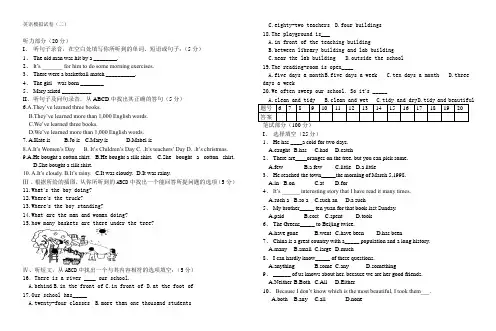
英语模拟试卷(二)听力部分(20分)I、听句子录音,在空白处填写你所听到的单词、短语或句子:(5分)1、The old man was hit by a ________.2、It’s _______ for him to do some morning exercises.3、There were a basketball match __________.4、The girl was born ________5、Mary asked __________II、听句子及问句录音,从ABCD中找出其正确的答句(5分)6.A.They’ve learned three books.B.They’ve learned more than 1,000 English words.C.We’ve learned three books.D.We’ve learned more than 1,000 English words.7. A.Kate is B.Jo is C.Mary is D.Mabel is8.A.It’s Women’s Day B. It’s Children’s Day C. .It’s teachers’ Day D. .It’s christmas.9.A.He bought a cotton shirt. B.He bought a silk shirt. C.She bought a cotton shirt.D.She bought a silk shirt.10. A.It’s cloudy.B.It’s rainy. C.It was cloudy. D.It was rainy.Ⅲ、根据所给的插图,从你所听到的ABCD中找出一个能回答所提问题的选项(5分)11.What’s the boy doing?12.Where’s the truck?13.Where’s the boy standing?14.What are the man and woman doing?15.how many baskets are there under the tree?Ⅳ、听短文,从ABCD中找出一个与其内容相符的选项填空:(5分)16.There is a river ____ our school.A.behindB.in the front ofC.in front ofD.at the foot of17.Our school has_____A.twenty-four classesB.more than one thousand studentsC.eighty-two teachersD.four buildings18.The playground is___A.in front of the teaching buildingB.between library building and lab buildingC.near the lab buildingD.outside the school19.The reading-room is open____A.five days a monthB.five days a weekC.ten days a monthD.three days a week20.We often sweep our school. So it’s _____笔试部分(100分)I、选择填空(25分)1、He has ____a cold for two days.A.caughtB.hasC.hadD.catch2、There are____oranges on the tree, but you can pick some.A.fewB.a fewC.littleD.a little3、He reached the town_____the morning of March 5,1998.A.inB.onC.atD.for4、It’s ______ interesting story that I have read it many times.A.such aB.so aC.such anD.a such5、My brother_____ ten yuan for that book last Sunday.A.paidB.costC.spentD.took6、The Greens_____ to Beijing twice.A.have goneB.wentC.have beenD.has been7、China is a great country with a_____ population and a long history.A.manyB.smallrgeD.much8、I can hardly know_____ of these questions.A.anythingB.someC.anyD.something9、______ of us knows about her, because we are her good friends.A.NeitherB.BothC.AllD.Either10、Because I don’t know which is the most beautiful, I took them___.A.bothB.anyC.allD.none11、Lucy, with her parents, ____ the film before.A.has seenB.sawC.seeD.have seen12、Would you like to go to the park with me?B._____A.Yes,please.B.Yes,I’d love to.C.No, thanks.D.I don’t think so.13、____to have supper with me?A.Do you feel likeB.Would you likeC.Will youD.Have you like14、-You have done a good job.-______A.You are welcomeB.It’s very kind of you to say soC.I don’t think soD.It’sa pleasure15、-Is that Mrs,Brown speaking?-Yes._______A.Who is that?B.Who are you?C.Who are you looking for?D.What are you speaking?16、-You look so beautiful today.-_____A.Thank youB.Not at allC.You are rightD.No, I don’t17、There are a lot of shirts in the shop.Tom can’t decide____.A.to buy which shirtB.buy which shirtC.which shirt to buyD.which shirt buy18、Your teacher must______carefully in calss.A.listenB.be listenedC.be heardD.be listened to19、-What a lovely garden!-____A.No.I don’t like it.B.What a garden!C.It isn’t lovely gardenD.Yes. It’s lovely, isn’t it?20、Don’t forget you r ticket,_____?A.will youB.don’t youC.won't youD.are you21、_____he has finished reading the book, ______ he doesn’t understand it.A.Though;butB.But; thoughC.Though; thoughD.Though;×22、I didn’t get on the bus because there ____ on it.A.is no roomB.was no roomC.was not a roomD.were no rooms23、It’s two years____I met him in Beijing last time.A.thatB.whenC.sinceD.which24、She_____ there right away.A.needn’t goB.needs goC.needs goingD.doesn’t need go25、-How much meat do you want, sir?-____A.One and a half kiloB.One and a half kilosC.one kilo and halfD.A kilo andII、完型填空。

雅思线上模拟测试题随着全球化的发展和国际化的趋势,雅思考试作为全球通用的英语水平测试,备受广大学生和工作人群的关注和重视。
为了帮助考生更好地备考雅思考试,在此提供一套线上模拟测试题,供考生练习和测试自己的英语水平。
听力部分:第一节听下面一段对话,然后回答问题1至5。
1. Where are the speakers?A. In a restaurant.B. In a library.C. In a coffee shop.2. What does the man order?A. A cup of tea.B. A cup of coffee.C. A glass of water.3. When will the woman go shopping?A. This evening.B. Tomorrow morning.C. This weekend.4. What time will the woman come to the man's house?A. At 2 o'clock.B. At 4 o'clock.C. At 6 o'clock.5. How does the man usually go to work?A. By car.B. By bus.C. By bike.第二节听下面一段对话,然后回答问题6至10。
6. What is the woman doing now?A. Watching TV.B. Cleaning the room.C. Cooking dinner.7. When does the man plan to visit his parents?A. This weekend.B. Next week.C. Next month.8. How long does it take to drive to the man's parents' house?A. About 30 minutes.B. About 1 hour.C. About 2 hours.9. Why can't they go there by train?A. There is no train station near there.B. The train is too slow.C. The train tickets are too expensive.10. What will the man buy for his parents?A. A box of chocolates.B. A bottle of wine.C. A bouquet of flowers.第三节听下面一段独白,然后回答问题11至15。