
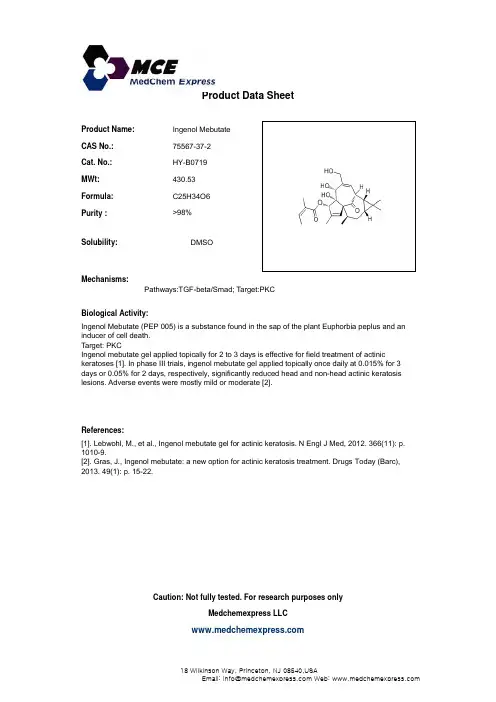
Ingenol Mebutate_75567-37-2_DataSheet_MedChemExpress
- 格式:pdf
- 大小:63.71 KB
- 文档页数:1


Endotoxin Removal Solution Catalog Number E4274Product DescriptionEndotoxins are lipopolysaccharides (LPS), a major component of the Gram-negative bacterial cell wall, and are commonly found as contaminants in plasmid DNA preparations from E. coli. Endotoxins are large, negatively charged molecules that co-purify with DNA on ion exchange and size exclusion columns and in CsCl banding. Endotoxins are extremely potent stimulators of the mammalian immune system and are toxic to primary cells and to animals. The endotoxin toxicity is an obstacle to in vitro and in vivo transfection experiments.Non-ionic detergents, traditionally used for separation of integral membrane proteins,1 can be utilized for removal of endotoxins from DNA solutions by phase separation.2The solubility behavior of a detergent in a dilute, aqueous solution at physiological salt and pH conditions is strongly dependent upon the temperature of the solution. At low temperatures, the detergent forms a clear, micellar solution, but above the cloud point temperature, the micelles form larger, turbid aggregates and ultimately fuse to form a separate phase. The lower phase is detergent-enriched and the detergent-depleted upper phase contains detergent at a concentration slightly above the critical micellar concentration (CMC). Amphiphilic and hydrophobic molecules associated with the micelles of the detergent will aggregate within the detergent-enriched phase, while the soluble, hydrophilic molecules will remain in the detergent-depleted upper phase.Extraction of endotoxin contaminated DNA solutions with the appropriate non-ionic detergent will separate the hydrophilic DNA from the amphiphilic endotoxin. The amphiphilic endotoxin will associate with the lower phase, while the DNA will remain in the upper, detergent-depleted phase.2Reagents and equipment required, but not provided • Water, Molecular Biology Reagent, Catalog Number W4502• E-TOXATE® Water, Catalog Number 2107, or Tris-EDTA (TE) buffer 100×, Catalog NumberT9285• DNA solution (0.5 ml), ~ 1 mg/ml in E-TOXATE®Water or TE buffer• 3 M sodium acetate solution, pH 7.5.• 2-Propanol, Catalog Number I9516, or Ethanol, 190 proof, Catalog Number E7148; 200 proof, CatalogNumber E7023• 70% Ethanol• E-TOXATE®reagents Kits, Catalog Numbers 210A1, 210B1 or 210C1• Ice bucket• Heat block or incubator at 37 °C• Microcentrifuge at room temperature• 1.5 or 2 ml sterile microcentrifuge tubes• Endotoxin-free pipet tips (40-200 µl, 200-1000 µl) Precautions and DisclaimerThis product is for R&D use only, not for drug, household, or other uses. Please consult the Material Safety Data Sheet for information regarding hazards and safe handling practices.StorageStore at room temperature.Note: Removal of endotoxins from DNA preparations can be performed either during the final stage of DNApreparation, or during an earlier stage.Procedures for Endotoxin RemovalDuring the final stage of DNA preparationNote: The procedure described below was performed on plasmid DNA produced in E. coli DH5α cells.• Losses of up to 50% of the DNA are expected. • Use of a DNA concentration above therecommended 1 mg/ml reduces the efficiency ofthe procedure.1. Pipette 500 µl of the DNA solution into a sterilemicrocentrifuge tube.2. Add 50 µl of the 3 M sodium acetate solution to theDNA sample.3. Incubate on ice for 5 minutes.4. Add 100 µl of cold Endotoxin Removal Solution.5. Mix thoroughly and incubate on ice for 10 minutes.The solution should be light blue and clear.6. Incubate the tube at 37 °C for 20 to 30 minutes oruntil the phases separate.7. Spin for 5 minutes at 3000 x g in themicrocentrifuge. The upper phase is colorless and clear, while the lower phase is blue.8. Carefully transfer the upper phase containing theDNA to a clean microcentrifuge tube.9. Repeat steps 4 through 8 twice.10. Add 0.6× volume of 2-propanol. Mix by inversion atroom temperature and centrifuge at 15,000 x g for30 minutes at 4 °C. Alternatively, add2.5× volumes of ethanol. Incubate overnight at –20°C or 20 minutes at –70 °C and centrifuge at15,000 x g for 30 minutes at 4 °C.11. Carefully remove the supernatant12. Wash the DNA pellet twice with cold 70% ethanol.Remove the supernatant.13. Air-dry the pellet.14. Suspend the DNA in 100 µl of endotoxin free wateror TE buffer.15. Determine DNA concentration and endotoxin levelsusing endotoxin assay reagents and compare tothe starting material. During an earlier stage of DNA preparationThis procedure is based on the alkaline lysis of E. coli DH5α cells.3 The endotoxins are removed immediately after alkaline cell lysis, neutralization, and a clarification step. The resulting high salt solution is suitable for the endotoxin removal step. It is performed under “endotoxin free” conditions. The plasticware used is either sterile and disposable, or NaOH-treated. The buffers are prepared with endotoxin free water.1. Add the Endotoxin Removal Solution (0.2× volume)to the cold, crude DNA solution.2. Incubate on ice and mix occasionally by inversionto obtain a homogenous, clear blue solution3. Incubate at 37 °C for 20 to 30 minutes until thephase separation is obvious.4. Spin for 5 minutes at low speed (3000 x g) at roomtemperature.5. Transfer the upper aqueous phase to an endotoxinfree container.6. Proceed with the DNA purification by any method.Use endotoxin-free buffers and containers. References1. Bordier, C., J. Biol. Chem., 256, 1604-1607, (1981).2. Cotten, M. et al., Gene Therapy, 1, 239-246,(1994).3. Sambrook et al., Molecular Cloning, a LaboratoryManual, 2nd Ed. p. 1.38RK,PHC 09/05-1Sigma brand products are sold through Sigma-Aldrich, Inc.Sigma-Aldrich, Inc. warrants that its products conform to the information contained in this and other Sigma-Aldrich publications. Purchaser must determine the suitability of the product(s) for their particular use. Additional terms and conditions may apply. Please see reverse side ofthe invoice or packing slip.。
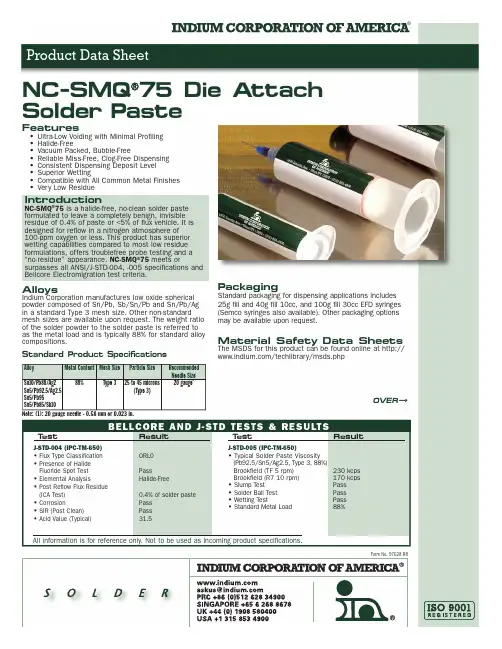
OVER—>BELLCORE AND J-STD TESTS & RESULTST est Result J-STD-004 (IPC-TM-650)• Flux Type Classifi cation ORL0• Presence of Halide Fluoride Spot Test Pass • Elemental Analysis Halide-Free • Post Refl ow Flux Residue (ICA Test) 0.4% of solder paste • Corrosion Pass • SIR (Post Clean) Pass• Acid Value (Typical) 31.5 T estResult J-STD-005 (IPC-TM-650)• Typical Solder Paste Viscosity(Pb92.5/Sn5/Ag2.5, Type 3, 88%)Brookfi eld (TF 5 rpm)230 kcps Brookfi eld (R7 10 rpm)170 kcps • Slump TestPass • Solder Ball TestPass • Wetting TestPass • Standard Metal Load88%NC-SMQ ®75 Die Attach Solder PastePackagingStandard packaging for dispensing applications includes 25g fi ll and 40g fi ll 10cc, and 100g fi ll 30cc EFD syringes (Semco syringes also available). Other packaging options may be available upon request.Material Safety Data Sheets The MSDS for this product can be found online at /techlibrary/msds.php Features • Ultra-Low Voiding with Minimal Profi ling • Halide-Free • Vacuum Packed, Bubble-Free • Reliable Miss-Free, Clog-Free Dispensing • Consistent Dispensing Deposit Level • Superior Wetting • Compatible with All Common Metal Finishes • Very Low ResidueIntroduction NC-SMQ ®75 is a halide-free, no-clean solder paste formulated to leave a completely benign, invisible residue of 0.4% of paste or <5% of fl ux vehicle. It is designed for refl ow in a nitrogen atmosphere of 100-ppm oxygen or less. This product has superior wetting capabilities compared to most low residue formulations, offers troublefree probe testing and a “no-residue” appearance. NC-SMQ ®75 meets or surpasses all ANSI/J-STD-004, -005 specifi cations and Bellcore Electromigration test criteria.Alloys Indium Corporation manufactures low oxide spherical powder composed of Sn/Pb, Sb/Sn/Pb and Sn/Pb/Ag in a standard Type 3 mesh size. Other non-standard mesh sizes are available upon request. The weight ratio of the solder powder to the solder paste is referred to as the metal load and is typically 88% for standard alloy compositions.Standard Product Specifi catio nsAlloy Metal Content Mesh Size Particle SizeRecommended Needle Size Sn10/Pb88/Ag2 88% Type 3 25 to 45 microns 20 gauge* Sn5/Pb92.5/Ag2.5 (Type 3) Sn5/Pb95 Sn5/Pb85/Sb10Note: (1): 20 gauge needle - 0.58 mm or 0.023 in.All information is for reference only. Not to be used as incoming product specifi cations.Storage and HandlingProceduresRefrigerated storage will prolong the shelf life of solder paste. The shelf life of NC-SMQ®75is 6 months at storage temperatures of -20° to +5°C. When storing solder paste contained in syringes and cartridges, they should be stored tip down. Solder paste should be allowed to reach ambient working temperature prior to use. No heating should be employed.Generally, paste should be removed from refrigeration at least 2 hours before use. Actual time to reach thermal equilibrium will vary with container size. Paste temperature should be verifi ed before use. Cartridges or syringes should be labeled with date and time of opening. DispensingNC-SMQ®75is formulated to be applied using automated high speed, high reliability, single point or multi-point dispensing equipment, but will also function in hand held applications. Highly accurate volumes can be dispensed using either pneumatic or positive displacement devices. Optimal dispensing performance is dependent on storage conditions, equipment type and set up. AtmosphereNC-SMQ®75is designed for use in a nitrogen (100 ppm oxygen or less) atmosphere.Cleaning or Residue Removal The post refl ow residue of NC-SMQ®75can be removed with commercially available solvents. The vehicle is capable of high temperature alloy refl ow without charring but in case of overheating, any charred residue can be removed with the aid of ultrasonic or mechanical agitation.QualityThe Indium Corporation of America is dedicated to producing the highest quality die attach solder paste.NC-SMQ®75is vacuum packaged by highly trained operators under controlled conditions in unique, specially designed equipment to minimize air bubbles in every syringe and cartridge. Rheology and refl ow characteris-tics as well as metal content and identity are carefully confi rmed for each lot. Also, evaluations are performed on each lot to verify dispensing performance.Recommended Profi le:The typical profi le above is designed for use with Sn10/ Pb88/Ag2 or Sn5/Pb92.5/Ag2.5 alloy in a nitrogen atmosphere (100 ppm oxygen or less). It can serve as a general guideline for establishing a profi le for your process and should be regarded as a typical example. Adjustments to this profi le may be necessary based on assembly size, thermal density, and other factors. Use of other alloys with lower or higher liquidus temperatures will also require changes.Heating and Liquidus Stage:Establish a profi le which provides a rapid heating of the assembly to the solder’s liquidus temperature. Ramp rates of 1 to 4°C/sec are recommended, but the nature of the assembly should govern the actual rate. Toachieve acceptable wetting, and to minimize voiding and intermetallics formation, the profi le must include a period of 15 to 30 seconds above the alloy’s liquidus, and a peak temperature of 10 to 20°C above liquidus. However, excessive time above liquidus (and/or excessively high temperatures above liquidus) can produce negative consequences including: charred residue, diffi cult residue removal, excessive intermetallics formation, voiding,and more.Cooling Stage:Cooling after refl ow should be as fast as practical. Thisis desired to form a fi ne-grained metallic structure. Slow cooling will result in a coarse, large grain structure that will exhibit poor thermal cycling and fatigue resistance.This product data sheet is provided for general information only. It is not intended, and shall not be construed, to warrant or guarantee the performance of the products described which are sold subject exclusively to written warranties and limitations thereon included in product packaging and invoices.。
