
Digital_Circuit_7
- 格式:ppt
- 大小:1.50 MB
- 文档页数:84


单片机常用术语单片机(Microcontroller)是一种集成了微处理器、存储器和外设接口的单个集成电路芯片。
它广泛应用于电子设备中,用于控制和执行各种任务。
在单片机领域,有一些常用术语被广泛使用,下面将对这些术语进行介绍和解释。
1. GPIO(General Purpose Input/Output)GPIO是单片机中的通用输入输出引脚。
它可以通过软件编程来控制,既可以作为输入口用来读取外部信号,也可以作为输出口用来控制外部设备。
通过控制GPIO,可以实现单片机与外部世界的交互。
2. ADC(Analog to Digital Converter)ADC是模数转换器的英文缩写,用于将模拟信号转换为数字信号。
单片机一般配备有ADC模块,可以将外部的模拟量信号转换成相应的数字量,以供后续的数字处理和分析。
3. UART(Universal Asynchronous Receiver/Transmitter)UART是一种通用的异步串行通信接口。
它用于实现单片机和外部设备之间的数据传输。
UART通过将数据位、停止位和校验位按照一定的规则进行组织,以实现数据的可靠传输。
4. PWM(Pulse Width Modulation)PWM是一种脉冲宽度调制技术。
它通过改变信号的脉冲宽度来控制某个输出端口的电平。
PWM常用于控制电机的速度、LED的亮度等应用场景,可以通过调整占空比来实现精细的控制效果。
5. I2C(Inter-Integrated Circuit)I2C是一种串行通信总线协议,由Philips公司在上世纪80年代推出。
它通过两根线路(串行数据线SDA和串行时钟线SCL)来实现多个设备之间的通信。
I2C常用于连接单片机和传感器、存储器等外设。
6. SPI(Serial Peripheral Interface)SPI是一种串行的外设接口协议,用于在单片机和外部设备之间传输数据。
它使用多线全双工模式,包括一个主设备和一个或多个从设备。
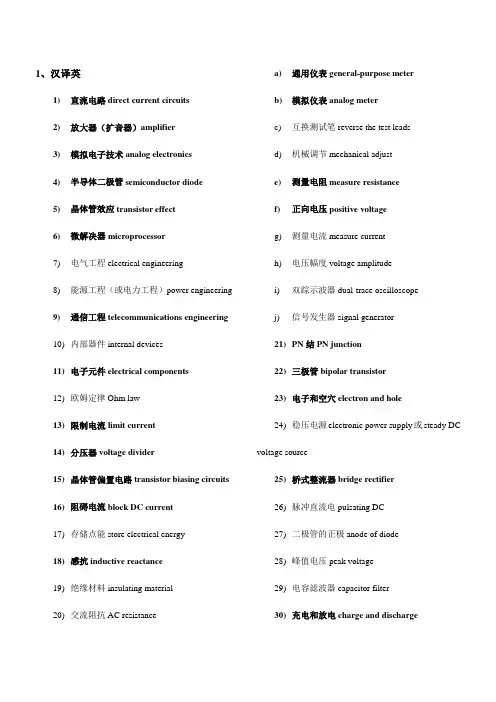
1、汉译英1)直流电路direct current circuits2)放大器(扩音器)amplifier3)模拟电子技术analog electronics4)半导体二极管semiconductor diode5)晶体管效应transistor effect6)微解决器microprocessor7)电气工程electrical engineering8)能源工程(或电力工程)power engineering9)通信工程telecommunications engineering10)内部器件internal devices11)电子元件electrical components12)欧姆定律Ohm law13)限制电流limit current14)分压器voltage divider15)晶体管偏置电路transistor biasing circuits16)阻碍电流block DC current17)存储点能store electrical energy18)感抗inductive reactance19)绝缘材料insulating material20)交流阻抗AC resistancea)通用仪表general-purpose meterb)模拟仪表analog meterc)互换测试笔reverse the test leadsd)机械调节mechanical adjuste)测量电阻measure resistancef)正向电压positive voltageg)测量电流measure currenth)电压幅度voltage amplitudei)双踪示波器dual-trace oscilloscopej)信号发生器signal generator21)PN结PN junction22)三极管bipolar transistor23)电子和空穴electron and hole24)稳压电源electronic power supply或steady DC voltage source25)桥式整流器bridge rectifier26)脉冲直流电pulsating DC27)二极管的正极anode of diode28)峰值电压peak voltage29)电容滤波器capacitor filter30)充电和放电charge and discharge31)稳压管Zener diode32)电器电子工程师学会IEEE(Institute of Electrical and Electronics Engineers)33)专业技术组织technical professional association34)基尔霍夫电压定律Kirchhoff’s V oltage Law35)电压源voltage sources36)电荷守恒定律the law of conservation of electric charge37)在每一瞬时at every instant of time38)元件两端的电压voltages across elements39)无线电传输radio transmission40)频率调制或调频frequency modulation41)频域the frequency domain42)线性电阻linear resistor43)调幅波形amplitude modulation wave44)专用集成电路(ASIC)45)快速时间响应fast response time46)有效信号valid signal47)十进制数字系统decimal system48)逻辑运算logic operation1)控制信号线the control bus2)中断线interrupt lines1)结构化语言structured language2)局部变量local variables3)副作用side effect4)汇编语言指令assembly language instructions1)静止图像still image2)阴极射线管,显像管CRT or the cathode ray tube3)像素pixel4)电子束electron beam2、英译汉1)assembler language汇编语言2)alternating current circuits交流电路3)passive electrical circuits无源电路4)three phase circuits三相电路5)digital electronics数字电子技术6)logic gates逻辑门7)3D virtual reality image三维虚拟图像8)computer programming计算机编程9)major in(在大学里)主修10)advanced programming techniques高级编程技术1)known as capacitive reactance称为容抗2)with units ohms单位为欧姆3)prevent device from burning out防止器件烧掉4)has an AC resistance to AC current对交流电流由阻抗5)adjustment with a screw用一个螺丝调节6)in the shape of a cylinder 呈圆柱形式7)block DC current,but pass AC current阻直流通交流8)to vary the inductance改变电感9)be given by the formula 由公式给出10)the RF amplifier 音频放大器1)analog multimeter模拟万用表2)extended range扩展范围3)specific meters特殊仪表4)includes the function and range switches具有功能及范围选择旋钮5)present an electronic picture呈现一幅电子图像6)display the voltage waveform显示电压波形7)appear on the screen在屏幕上出现8)phase relationships相位关系9)an example例如,作为一个例子10)in series with the circuit串连接入电路1)Semiconductor material半导体材料2)forward biased正向偏置3)depend on the external circuit resistance取决于外部电路的电阻4)excessive reverse-biased voltage过高的反偏电压5)is directly proportional to the amount ofbase current是正比于基极电流6)may even appear almost as a short几乎可当作是短路7)cause stability problems for a transistorcircuit引起晶体管电路的稳定性问题8)digital technology数字技术9)the most popular technology最常用的技术10)use two complementary typeset oftransistors N-channel and P-channel用两种互补型的晶体管——N沟道和P沟道1)equipment operation设备的运营2)device that converts AC into DC把交流电转换成直流电的器件3)the power lines电源线4)depending on the value of DC voltageneeded 根据所需要的直流电压值5) a half-wave rectifier平波整流器6)so as to produce a constant DC output从而产生一个稳定的直流输出7)in the negative side of the capacitor在电容的负极8)flow through the load流过负载9)in the forward-biased condition在加正向偏置电压的条件下10) a series(current-limiting)resistor一个串联(限制电流)电阻1)current source电流源2)under this circumstance在这种情况下3)present the second of Kirchhoff’s laws给出基尔霍夫第二定律4)introduce the concept of a “loop”引入“回路”的概念5)An alternative statement of KVLKVL的另一种表述法6)voltages algebraically sum电压代数和7)sinusoidal steady-syate response正弦稳态响应8)ordinary household voltage平常用电的电压9)time-invariant circuit时不变电路10)percentage of modulation调制比例reduce the power consumption减小消耗功率flip-flop 触发器the octal and hexadecimal systems当时钟脉冲信号来届时改变状态①直流电路direct current circuits②放大器(扩音器)amplifier③欧姆定律Ohm law④正极positive electrode⑤充电与放电Charge and discharge⑥无线电传输Radio transmission⑦模拟仪表Analogue Meters⑧模拟电子技术analog electronics⑨半导体二极管semiconductor⑩晶体管效应transistor effect⑪微解决器microprocessor⑫通信工程telecommunications engineering ⑬汇编语言assembler language⑭电子元件electrical components⑮限制电流limit current⑯分压器voltage divider⑰偏置电路biasing circuits⑱阻碍电流block DC current⑲感抗inductive reactance⑳容抗capacitive21正向电压positive voltage22扩展范围extended range23电压波形voltage waveform24连接入电路in series with the circuit25PN结PN junction 26三极管bipolar transistor27电子与空穴electron and hole28半导体材料semiconductor material29正向偏置forward biased30数字技术digital technology31桥式整流器bridge rectifier32稳压管Zener diode33电源线the power lines34在电容的负极in the negative side of the capacitor 在加正向偏置的条件下in the forward-biased condition一个串联电阻 a series (current-limiting)resistor35电压源voltage sources36在每一瞬时at every instant of time37无线电传输radio transmission38频率调制或调频frequency modulation39快速时间响应fast response time40有效信号valid signal41结构化语言structured language42局部变量local variables43副作用side effect44静止图像still image45阴极射线管pixel 46电子束electron beam1.resistors are used to limit current flowing to adevice ,thereby preventing it from burning out, as voltage dividers to reduce voltage for other circuits, as transistor biasing circuits, and to serve as circuit loads.电阻常用做限流器,限制流过器件的电流防止烧坏器件,电阻也可用作分压器,以减小其他电路电压,还可以用在晶体管偏执电路中和作为电路负载。

16Date of Issue WORLDSKILLS QUALITY ASSURANCE STANDARD Document No.TD16 Approved Technical Description – Industrial Electronics Revision1WorldSkills (International Vocational Training Organisation), by a resolution of the Technical Committee and in accordance with the Constitution, the Standing Orders and the Competition Rules, has adopted the following minimum requirements for trade No. 16 for the WorldSkills Competition:The effective date will be that date on which this document is issued, subject to approval by the Chairman of the Technical Committee.1Name and description of trade1.1The name of the trade is:Industrial Electronics1.2The Industrial Electronics Technician works in industrial or commercialenvironments and works with or studies electronics. This includes:- development- construction- design- measuring- testing- repair1.3This technical description must be known to every candidate.1.4In the event of any query or conflict within the technical descriptions, the Englishcopy will take precedence1.5Words implying masculine gender only shall include the feminine gender2Scope of work at WorldSkills Competitions2.1The practical work will test the competitors ability to:- assemble, adjust, commission, measure and test electronic equipment- carry out and document measurements on analogue and digital circuits- locate, document and repair faults in a given circuit- design or refine a design of a circuit, and construct using prototypeconstruction techniques2.2To solve theoretical tasks using mathematical and graphical methods to aTechnician Level2.3To redraw a circuit drawing schematic with Computer Aided Design.Competitors must bring their own laptop and software of their choice.3Competition Format for Practical Work3.1AssemblingAssemble a project that has to be from a kit of parts to the IPC-A-610 issue Cinternational acceptability of electronic assemblies. (Web page/main/ipca/htm. Each project should be able to fit a Euro cardstandard using DIN 41612 F64 or F32connectors, that will fit a standard backplane connector. Power points will be as follows: -A1C1+5v DigitalA2C2Digital GroundA15+5v AnalogC15+12v AnalogA16C16Analog groundA17-5v AnalogC17-12v AnalogA31C31Digital GroundA32C32+5v Digital3.2Measuring and TestingTo work with conventional measuring and testing equipment for AC, DC, digitaland analog electronics. To test, set, adjust and measure electronic components,modules and equipment. To record and analyse measured results. Boards willbe pre-built before the competition.3.3Fault Finding and RepairTo test, locate and replace faulty electronic components on a printed circuitboard, surface mount board or mixed technology board.All surface mountcomponents to have no more than four pins and Fault finding method/procedurewith results will be required. All boards will be pre-built before the competition.Each board will have at least three faults. Pin configurations and power supplywill be as 3.0.Competitors may bring their own measurement instruments.3.4Prototype DesignTo carry out a simple electronic design using given components to meet a givenspecification. Printed circuit boards should be pre-built. Resistors E24 series,0.25 watt to be available from host country.No more than 15 wire wrapconnections and no more 15 point to point connections will be required on thismodule. Pin configurations and power supply will be as 3.0.Competitors may bring their own measurement instruments.3.5The competition is modular and will be marked at the end of every module.3.6Time allowed for each module is as follows:Theory 2 hoursDrawing 2 hoursPrototype 4 hoursFault Finding 4 hoursMeasurement 4 hoursAssembly Project 3 + 3 hours4Theoretical Knowledge4.1To solve theoretical problems, using mathematical and graphical methods basedon the following:4.1.1Fundamental electronic principles:1. Basics of AC and DC technology.2. Two ports LRC networks, resistive networks with up to three meshes.3. RC oscillators.4.1.2Components in Electronics:Properties, behaviour, characteristics and application (elementary circuits) ofmechanically, electrically and physically adjustable components i.e.:-Resistors-Capacitors-Coils-Transformers-Diodes: rectifying diodes, switch diodes, zener diodes, capacitive diodes, PIN diodes-Trigger components: diac, triac, thyristor and uni-junction transistors.4.1.3Multistage and special amplifier circuits:Basic amplifier circuits (AC, DC and power amplifiers)Differential amplifiers/operational amplifiers.1. Ideal operational amplifier: (infinite input resistance, zero outputresistance and infinite open loop grain) Basic circuits with operationalamplifier, analogue adder and subtractor, differentiator, comparator,impedance transducer.2. Real operational amplifier: Offset voltage and offset current,compensation, common mode gain and rejection, temperature drift,frequency response.4.1.4Generators and Pulse shapers:1. Generators for sine wave voltage: RC, quartz, LC oscillator; wien bridgegenerator, phase generator.2. Pulse shaper: Schmitt trigger, differentiator, integrator.4.1.5Digital Electronics1. Basic logic gates.2. Level switching function, function table, pulse, diagram, circuit symbols(table in appendix).3. Properties of basic gates AND, OR, NOT, NAND, NOR, EXCLUSIVE OREXCLUSIVE NOR.4. Substituting basic NAND or NOR gates for basic gates.5. Creating switching functions from given circuits and vice versa.6. Making function table from circuit diagrams and switching functions.7. Simplifying switching networks using Karnaugh diagram or mathematicaltechniques.8. Flip-flops; RS Flip-flop, D Flip-flop, JK Master slave Flip-flop (especiallycounter circuits, shift register and frequency divider).9. Memory circuits, selection, addressing, and memory decoding volume.5Materials5.1ComponentsThe workshop master must ensure that the materials provided are completed,packed in bags and checked also for the power supply project, and range of E24,0.25w resistors from 10 ohm to 10 megohms is supplied. The host country willalso supply the back plane as per drawing –Refer Document 4.3/PD16 – Project Design Criteria5.2Other materials1. Graph paper A3 size2. Solder 60/40 type3. Approx. 5m bare wire (0.5mm diameter) per competitor4. Approx. 5m each of insulated wire (or standard wire) in five differentcolours for each competitor5. Binding/insulation tape6. Lacing string /Tie raps/heat shrink sleeving7. Hot-air fan for heat-shrink tubing5.5ClothingWork clothes must comply with relevant safety standards. Safety standardsrequire a minimum of safety glasses and covered footwear.6Workshop Installations6.1The working area should provide enough space for the competitors, experts(jury), measurement and repair area, material cupboards and wardrobes.6.2The general layout of the workshop venue will be as below, with sufficient spacefor the booth and for the competitors working area as defined in 6.3 below.Key to the layout above is:Please note that this is an example of the layout, and is not definitive. The minimum area requirements will be available.6.2.1General RequirementsThe working area should provide enough space for the competitors, expert’s (jury), measurement and repair area, material cupboards and wardrobes.Lockable cupboards must be provided for the safe keeping of the materials and the examination papers under the responsibility of the chief expert.The organizers will provide four sets of the following for the experts:1. 4 x Hot-air fan for heat-shrink tubing2. 2 x Magnifiers for experts x3 or x53. 2 x Computers4. One Laser printer6.3The personal working area for each competitor should be about 3m x 3m, andshall also allow for the equipment and machines specified in Sec. 6.4 below.6.4Measuring Instruments and Tester/ToolsThe organisers will provide the following for each competitor:1. 1x universal DVM2. 1x Function generator 1-50 MHz, sine, square, triangle3. 1x stabilized power supply (3-30V adjustable)4. Various connection cables (if necessary, coax cable with BNC plugs)5. 1x Bench Lamp6. 1x Electrostatic workstation7. 1x Calculator, non-progammableThe organizers will also provide a spare set of the above for the experts.6.5Competitors must bring all their own tools, including wire-wrapping equipment.Measurement instruments are optional.Each competitor may send his tools ahead to the host country in a light, sturdy and lockable toolbox. A complete list of the contents must accompany the toolbox for Customs clearance i6.5.1Unauthorised tools are not permitted. In case of doubt, the competitor must applyto the Jury in advance. Their decision will take into consideration technological progress and the aim of the competition.7Test Project Marking7.1The experts will decide together on the test projects, the marking criteria and thedimensional tolerances on forms 5, and 6, and they will prepare the marking list.Any Country who has a project submitted and his/her candidate gains a largerscore and all the other competitors have a low score, the average of all the lowscores will be awarded to the country competitor who submitted the project.7.2Marks:Perfect = 10 pointsVery good = 9 pointsGood = 8 pointsRather good = 7pointsSufficient = 6 pointsMedium = 5 pointsWeak = 4 pointsInsufficient = 3 pointsVery bad = 2 pointsZero = 1 point7.3RatingSection Item Maximum PointsA Theory10B Drawing10C Prototype22D Fault Finding22E Measurement22F Assembly Project15GH7.4Conversion to the 400 - 600 scale will be done by computer.8Competition Procedure8.1The competition will be worked on over all four days of the competition. Moduleswill be completed on each day for all competitors so that progressive markingcan take place, and for results to be made available each day.8.2Competitors will have time made available to familiarise themselves with materialand processes. Where processes are particularly difficult, the host country willprovide a subject matter expert to demonstrate the process and the competitorswill be given the opportunity to practice.8.3The competitors will be given all competition documents including the markingcriteria one hour prior to the commencement of the competition so that they maystudy the requirements8.4Prior to the start of the competition, each competitor will receive a detailedtimetable reflecting the timing for completion of modules.8.5Project Design, Selection and Documentation will be carried out as specified inAppendix 1PCB information is provided in Appendix 68.6Ballot Selection of Competitors Work Areas, Competition Notes and Timetable8.6.1For a total random selection procedure, the country codes should be placed inone bin and workbench numbers in another. Alphabetically the countrycompetitors will select one piece of paper from each, and this is then the startbench for that country.8.7The rules and procedures, and timetable specified in Appendix 2, 3 and 4 mustbe complied with.9Judging procedural requirements9.1The experts that attend the competition will be divided into marking groups todeal with each section of the marking criteria.9.2Every completed module will be marked on the same day in which it wascompleted.10General safety requirements10.1All competitors must use safety glasses when using any hand, power or machinetools or equipment likely to cause or create chips or fragments that may injurethe eyes10.2All competitors must wear appropriate clothing.10.3All machinery, equipment and safety clothing must comply with the safety rulesof the organising country.10.4Competitors must keep their workspace clear of obstacles and the floor spaceclean of material and equipment - any items likely to cause the competitor to trip,slip or fall.10.5Failure by the competitor to comply with safety directions or instructions mayincur penalties for safety.10.8Judges will wear the appropriate personal safety equipment when inspecting,checking or otherwise working with a competitor’s project.10.9Safety Checklist must be adhered to and is provided in Appendix 511Additional Documentation11.1The following additional documentation relates to this trade.•Nil at present11.2The following additional documentation relating to this trade has yet to be definedat the next WorldSkills Competition to be held in St Gallen in 2003.•Document TM16 – Trade Management Procedures•Document WS16 – Workshop Setup•Document PD16 – Project Design CriteriaTrade 16 Electronics - Competition ManagementThe following Countries will provide the following at the 2003 competition.Country AssemblyProject MeasuringandTestingFaultFindingandRepairDesign/PrototypeTheory1 Digital1AnalogDrawingBrazil X XCanada X X X Finland X X X Germany X X XJapan X X X Korea X X X Macao XLit X X XMorocco X X Portugal X X X X Singapore X X X Switzerland X XTaiwan x X X Tunisia x x XUnitedKingdomx x x x Project Selection GuidelinesAll competition presentations will be made in English and before any project is presented for selection they must be checked that they conform to the current rules of the world skills, and the current Technical Description. If the rules are not followed the project will not be considered for selection. All documentation must adhere to the world skills rules otherwise it will not be selected. The experts will form into a project group with other countries under the same heading. They will then select either one or a number of projects for the competition, as for the timetable as 3:7. Experts will then present their selection to the rest of the experts. Following everyone’s approval the experts will then agree a marking scheme for the project/ projects. When the competition begins, these experts manage and mark that aspect of the competition under guidance from the Chief Expert.Project DocumentationProject documentation must be brought to the competition on 3.5” floppy disc format,/CD in Microsoft Word. Where experts have used a drawing software. Experts should bring along the version of the drawing program software that they used. Paper copies should also be presented and where possible in three official languages. Where possible circuit diagrams will be used for all modules and project wording should be as brief as possible. All projects must include the following:-1. Short project brief2. Parts list3. Circuit diagram4. Data sheet pack5. Projects will only be accepted with softwareFirst Time CountriesAny Countries attending the competition for the first time should contact the Chief Expert via world skills who will then forward previous competition documentation and agree a project in advance for consideration.Competition Rules for Competitors while working on their Projects1. You must not talk to your own country expert or visitor without the presence of one other expert2. If you have a question raise your hand.3. You must not leave your workstation without permission, except to obtain wire etc from centrebench.4. If you feel ill or require anything, raise your hand.5. You may not leave the stand without an escort except at scheduled times for lunch and visitsto other stands.6. You must not touch any project other than your own.7. You may not touch any other competitors equipment.8. If you finish and leave your stand early, you must leave the stand.9. No use of mobile phones is permitted.10. No talking to any people outside the stand area while you are working on a project.Competition Timetable - Trade 16 Industrial ElectronicsDay 1Step Activity Start time Finish time 1Introduction by Chief judge9.009.159.1509.452Demonstration of assembly rack andpower supplies3Start assembly10.0013.00 4Lunch13.0014.00 5Continue with assembly of project14.0017.00 Total competition time 6.00 Day 2Step Activity Start time Finish time 1Drawing Introduction9.009.30 2Drawing/C programming9.3011.30 3Tour around venue and lunch11.3012.00 4Theory Introduction12.4513.00 5Theory13.0015.00 6Break15.0015.15 7Demonstration of Fault Finding one project15.1515.30 8Fault finding one15.3017.30 Total competition time 6.00 Day 3Step Activity Start time Finish time 1Introduction to Design Project9.0009.30 2Design & prototype09.3012.30 3Lunch12.3014.00 4Demonstration of fault finding project14.0014.15number 25Fault finding14.1516.15 6Tour around venue16.1517.00 Total competition time 5.00 Day 4Step Activity Start time Finish time9.009.151Demonstration of Measurement andTesting project2Measurement project9.1512.15 3Lunch12.1513.30 4Demonstration of C programming project13.3014.005 C programming project14.0016.00 Total competition time 5.00 Overall competition time22.00FAIRNESSAs part of World Skills each competition is required to have a fairness of competition rules for the experts, which are listed below for your comments.Before the competition startsAll experts are to be trustedExperts to believe in each other and their valuesEffective management of timeCommunicate both accurate and completeKeep communication with team members user-friendlyBe a good listenerAs a team we value the contributions of its membersReach early agreement and our goals and have contingency plansCreate a vision of success for other competitions to followWe will not make preformed judgementsRecognise issues early and open dialogue then explore for common groundIf you have a visitor to the stand he/she must not speak to the competitorsBe united in our decisionsAlways show a united front when dealing with the competitorsWhen the competitors arriveYou must not talk to your own country competitor or visitor without the presence of one otherexpertYou must not leave the stand when your competitor is away from the stand unless in the presenceof another expertNo use of mobile phones is permitted.Health and Safety Check ListList each item A to C'A' = Satisfactory'B' = Unsatisfactory but rectified immediately'C' = Unsatisfactory - remedial action required1.Are all exits from the area free of obstruction?2.Are all gangways within the area free from obstruction?3.Are all fire fighting appliances at their designated, location, and access to them notobstructed?4.Do Experts / Competitors in the area know:a) Means of escape in emergency.b) The location of fire equipment and alarm points.c) What action to take if the evacuation alarm sounds.d) The action to take if a person is seriously ill / injured.5.Is the floor surface safe?6.Are items of furniture in a sound condition e.g. lockers, tables, chairs, benches etc.7.Are cables and extension leads on electrical equipment, at the plug?8.Are electrical wall sockets secure and in good condition.9.Are the following satisfactory:a) Lightingb) Ventilationc) Temperatured) Noise levele) Extraction10.Are "fittings" in a safe state, e.g. lights, service supplies etc.11.Are all items of handling equipment in a safe condition, e.g. trolleys etc. and up to date.(In the area)?15Are all filing cabinet drawers functioning correctly, and are drawers prevented from coming out by limit stops.16Are metal cabinets free from sharp edges.17Are the tops of units free from unsuitable objects.18Is there suitable storage provided (and used) for cabinet drawer locking bars, when not in use.19If applicable, are paper guillotines properly guarded.20Does the area demonstrate a satisfactory level of decent house-keeping? e.g. steps, ladders etc. (are they in good condition)?22Are heavy items stored on low level racks.24Are all personnel trained to use appropriate equipment in this area (see supervision)25Are there necessary restrictions being enforced e.g. entry of unauthorised persons.26Are flammable liquids and chemicals stored in appropriate environment correctly, e.g.gloves, goggles etc?28Are the edges of areas marked with a hazard stripe.29Are all equipment that require guarding, fitted with secure are serviceable guards?30Is eye protection being worn in appropriate areas.32Are there other items of safety equipment avqilable for use.33Are tools in good condition.34Are all raw materials or equipment safely positioned.35Is there a list of authorised persons who may use machines or equipment?36Are waste materials correctly disposed of?37If chemicals or substances are used, are they in suitable containers that are correctly marked?38Is safety information for chemicals or substances used available and known to the user?39Are the emergency stop buttons on equipment assessable and clearly marked?41Are competitors supervised.42Are free standing gas bottles secured.43Are all tools in use in good condition.44Are free standing gas bottles secure.45If applicable, have all system components been subjected to test, is a certificate available?46If applicable, is equipment within validation.47If applicable, is pipe work adequately secured.48Are there written procedures for :-a) Setting up for test.b) Test procedure.c) Making safe after test.50Are the necessary restrictions being enforced e.g. entry of unauthorised personnel. 51Do all personnel know the main isolation controls of the services being used?52Are cables and flexible hoses correctly routed to prevent accidents or damage?53If flammable liquids or chemicals are being use, are they :-a) Of minimal quantity.b) In approved containers.c) Correctly labelled.54Have reasonable safety precautions been taken against any foreseeable occurrence whilst carrying out the test.55If applicable, is the equipment correctly bonded / earthed.56If competitors or others are working in the area, are they under full supervision. Chief Expert (Signature)....................................................APPENDIX 6Specifications for PCB cardsMechanical spec.’sThe Europe format for PCB card is specified as follow (PCB only):All Dimensions are in millimeters. Tc = 160 mmThe Europe format for PCB card with a front plateIs specified as follow (with front plate and DIN41612 connector):All Dimensions are in millimeters. Tc = 160 mmFront Plate dimensions (if needed): 40,64 mm x 128,7 mm x 2,5 mmPCB connectorEach card must be designed with a DIN41612 male 64 pins a + c (C form)connector for PCB. The reference from HARTING is: 0903.164.6921.Mechanical dimensions of the connector。