
Language Strategy
- 格式:ppt
- 大小:140.50 KB
- 文档页数:24

/elt English Language Teaching Vol. 3, No. 4; December 2010
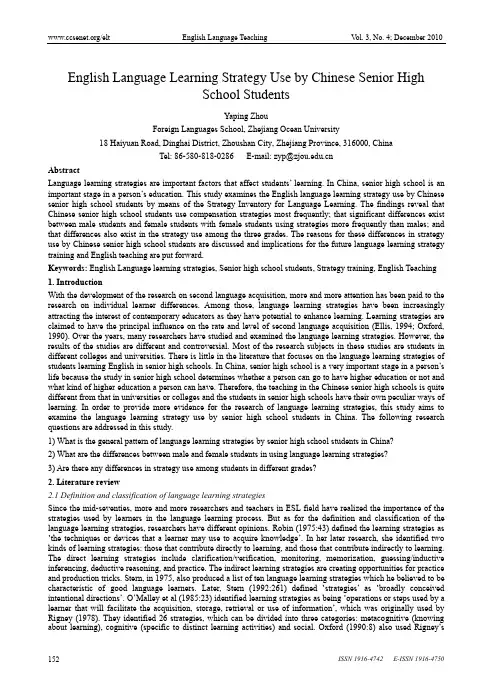
ISSN 1916-4742 E-ISSN 1916-4750 152English Language Learning Strategy Use by Chinese Senior High School Students Yaping Zhou Foreign Languages School, Zhejiang Ocean University 18 Haiyuan Road, Dinghai District, Zhoushan City, Zhejiang Province, 316000, China Tel: 86-580-818-0286 E-mail: zyp@ Abstract Language learning strategies are important factors that affect students’ learning. In China, senior high school is an important stage in a person’s education. This study examines the English language learning strategy use by Chinese senior high school students by means of the Strategy Inventory for Language Learning. The findings reveal that Chinese senior high school students use compensation strategies most frequently; that significant differences exist between male students and female students with female students using strategies more frequently than males; and that differences also exist in the strategy use among the three grades. The reasons for these differences in strategy use by Chinese senior high school students are discussed and implications for the future language learning strategy training and English teaching are put forward. Keywords: English Language learning strategies, Senior high school students, Strategy training, English Teaching 1. Introduction With the development of the research on second language acquisition, more and more attention has been paid to the research on individual learner differences. Among those, language learning strategies have been increasingly attracting the interest of contemporary educators as they have potential to enhance learning. Learning strategies are claimed to have the principal influence on the rate and level of second language acquisition (Ellis, 1994; Oxford, 1990). Over the years, many researchers have studied and examined the language learning strategies. However, the results of the studies are different and controversial. Most of the research subjects in these studies are students in different colleges and universities. There is little in the literature that focuses on the language learning strategies of students learning English in senior high schools. In China, senior high school is a very important stage in a person’s life because the study in senior high school determines whether a person can go to have higher education or not and what kind of higher education a person can have. Therefore, the teaching in the Chinese senior high schools is quite different from that in universities or colleges and the students in senior high schools have their own peculiar ways of learning. In order to provide more evidence for the research of language learning strategies, this study aims to examine the language learning strategy use by senior high school students in China. The following research questions are addressed in this study. 1) What is the general pattern of language learning strategies by senior high school students in China? 2) What are the differences between male and female students in using language learning strategies? 3) Are there any differences in strategy use among students in different grades? 2. Literature review 2.1 Definition and classification of language learning strategies Since the mid-seventies, more and more researchers and teachers in ESL field have realized the importance of the strategies used by learners in the language learning process. But as for the definition and classification of the language learning strategies, researchers have different opinions. Robin (1975:43) defined the learning strategies as ‘the techniques or devices that a learner may use to acquire knowledge’. In her later research, she identified two kinds of learning strategies: those that contribute directly to learning, and those that contribute indirectly to learning. The direct learning strategies include clarification/verification, monitoring, memorization, guessing/inductive inferencing, deductive reasoning, and practice. The indirect learning strategies are creating opportunities for practice and production tricks. Stern, in 1975, also produced a list of ten language learning strategies which he believed to be characteristic of good language learners. Later, Stern (1992:261) defined ‘strategies’ as ‘broadly conceived intentional directions’. O’Malley et al (1985:23) identified learning strategies as being ‘operations or steps used by a learner that will facilitate the acquisition, storage, retrieval or use of information’, which was originally used by Rigney (1978). They identified 26 strategies, which can be divided into three categories: metacognitive (knowing about learning), cognitive (specific to distinct learning activities) and social. Oxford (1990:8) also used Rigney’s
-----WORD格式--可编辑--专业资料-----
--完整版学习资料分享---- 2013-2014 Second Term
Test Paper for “Language Learning Strategies”
Name _______ Major _______ Scores ______
I. Explain the following terms. (20%)
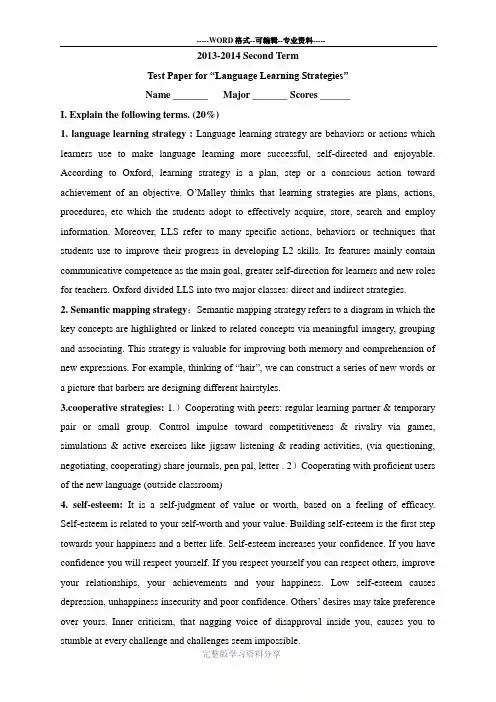
1. language learning strategy : Language learning strategy are behaviors or actions which
learners use to make language learning more successful, self-directed and enjoyable.
According to Oxford, learning strategy is a plan, step or a conscious action toward
achievement of an objective. O’Malley thinks that learning strategies are plans, actions,
procedures, etc which the students adopt to effectively acquire, store, search and employ
information. Moreover, LLS refer to many specific actions, behaviors or techniques that
students use to improve their progress in developing L2 skills. Its features mainly contain
Apr.2008,Volume 7,No.4(Serial No.58) China.USA Business Review,ISSN1537-1514,USA
A study of the influence of organization transformation strategy,
HR strategy and the degree of HR department involvement on
organization transformation:Taking the Hi・Tee enterprises
Hung Li—Meil,Yeh Hsiu—Chih2,Hu Ting—Chen3
I I.Office ofSafety,Health and Environmental Protection;Department ofHospitality Management,Hungkuang University,Taiwan;
2.Department ofHuman Resource,1NNOLUX Display Corp.,Taiwan;
3.Department ofHealth Business Administration,Hungkuang University,Taiwan)
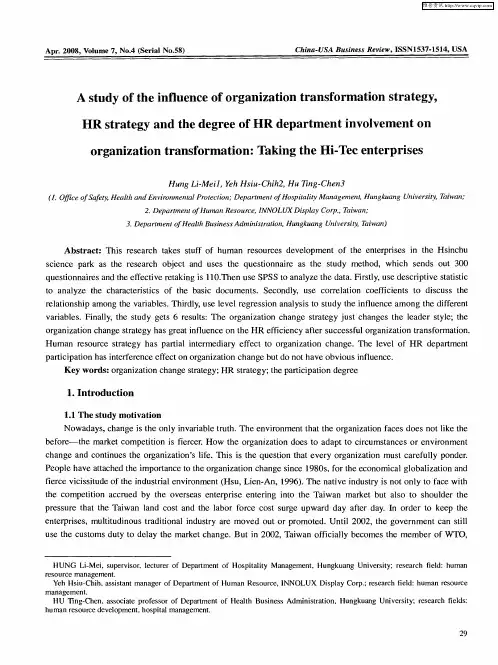
Abstract:This research takes stuff of human resources development of the enterpHses in the Hsinchu
science park as the research object and uses the questionnaire as the study method,which sends out 300
questionnaires and the effective retaking is 1 10.Then use SPSS to analyze the data.Firstly,use descriptive statistic
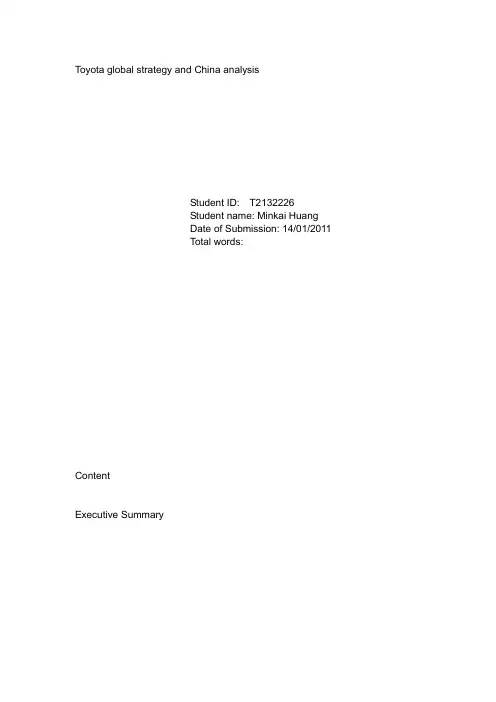
Toyota global strategy and China analysis
Student ID: T2132226
Student name: Minkai Huang
Date of Submission: 14/01/2011
Total words:
Content
Executive Summary
1. Introduction
1.1 Company History and Overview
Look back at the history of Toyota Motor Company (TMC), it was set up in
1937 by Kiichiro which was as a sector from Toyota Industries. In 1936, the
first product AA sedan is completed. After about two decades, the company
launched their main product Crown and Crown Deluxe and first export to the
United States in 1957. In 1984, Toyota joint venture with General Motors and
begin produce their cars in the USA. In 2002, the company joined the Formula
One (F1) competition. In 2003, the company produced its first Lexus and
launched Lexus GS 450h which was its first hybrid sedan model in 2006. In
1998, China Sichuan Toyota automobile Co.LTD was established and the