
完整反义疑问句课件
- 格式:ppt
- 大小:6.16 MB
- 文档页数:7

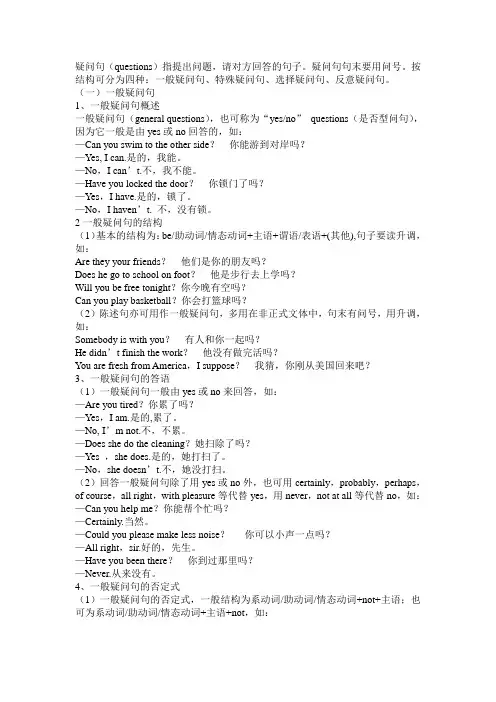
疑问句(questions)指提出问题,请对方回答的句子。疑问句句末要用问号。按结构可分为四种:一般疑问句、特殊疑问句、选择疑问句、反意疑问句。
(一)一般疑问句
1、一般疑问句概述
一般疑问句(general questions),也可称为“yes/no” questions(是否型问句),因为它一般是由yes或no回答的,如:
—Can you swim to the other side? 你能游到对岸吗?
—Yes, I can.是的,我能。
—No,I can’t.不,我不能。
—Have you locked the door? 你锁门了吗?
—Yes,I have.是的,锁了。
—No,I haven’t. 不,没有锁。
2一般疑问句的结构
(1)基本的结构为:be/助动词/情态动词+主语+谓语/表语+(其他),句子要读升调,如:
Are they your friends? 他们是你的朋友吗?
Does he go to school on foot? 他是步行去上学吗?
Will you be free tonight?你今晚有空吗?
Can you play basketball?你会打篮球吗?
(2)陈述句亦可用作一般疑问句,多用在非正式文体中,句末有问号,用升调,如:
Somebody is with you? 有人和你一起吗?
He didn’t finish the work? 他没有做完活吗?
You are fresh from America,I suppose? 我猜,你刚从美国回来吧?
3、一般疑问句的答语
(1)一般疑问句一般由yes或no来回答,如:
—Are you tired?你累了吗?
—Yes,I am.是的,累了。
—No, I’m not.不,不累。

1 反义疑问句练习
1. It’s the third time that John has been late, ____?
A. hasn’t he B. isn’t he C. isn’t it D. hasn’t it
2. Let’s take a rest, ___________.
A. will we B. shall we C. shan’t we D. won’t we
3. Let us pass, _________?
A. shan’t we B. shall we C. won’t we D. will you
4. Wait a minute, __________?
A. shall you B. will you C. do you D. don’t you
5. The suit’s finished, __________?
A. doesn’t it B. isn’t it C. haven’t you D. hasn’t it
6. He’s posted the letter, _________he?
A. isn’t B. doesn’t C. hasn’t D. wasn’t
7. They’d go with us, __________?
A. wouldn’t they B. didn’t they C. hadn’t they D. couldn’t they
8. What fresh air, ________?
A. is it B. does it C. isn’t it D. doesn’t it
9. The Emperor’s clothes became the talk of the whole city, _________?

反义疑问句
一.句型解释
反义疑问句由两部分组成:前一部分是一个陈述句,后一部分是一个简短的疑问句,两部分的人称时态应保持一致。
1.陈述部分肯定式+疑问部分否定式
2.陈述部分否定式+疑问部分肯定式 She was ill yesterday, wasn’t she? You didn’t go, did you?
二.特殊的句型
1.祈使句。祈使句后一般加上will you或won't you构成反意疑问句,用will you 多表示“请求”,用won't you 多表示提醒对方注意。例如: Let引导的祈使句有两种情况:
1) Let's...,后的反意疑问句用shall we。
例如:Let's go home, shall we/ shan't we? 回家吧,好吗?
2)Let us/me...后的反意疑问句用will you或won't you。 例如:Let me have a try, will you/won't you?
3)祈使句都用will you 或won’t you
2.当陈述部分含I think (believe, suppose...)that... 结构时,其反意疑问句须与从句的主、谓语保持一致,注意主句的主语必须是第一人称。例如: I don't think he will come, will he? 若是非第一人称,则与主句的主语相一致 He thinks that she will come, doesn’t he?
反意疑问句的陈述部分为I(We) don’t think(believe, suppose, consider)+ that从句时,从句为否定意义,问句部分的动词和主语仍与that从句保持一致且用肯定式。如:
①I don’t think that you can do it, can you? (不用do I?)
1
反义疑问句
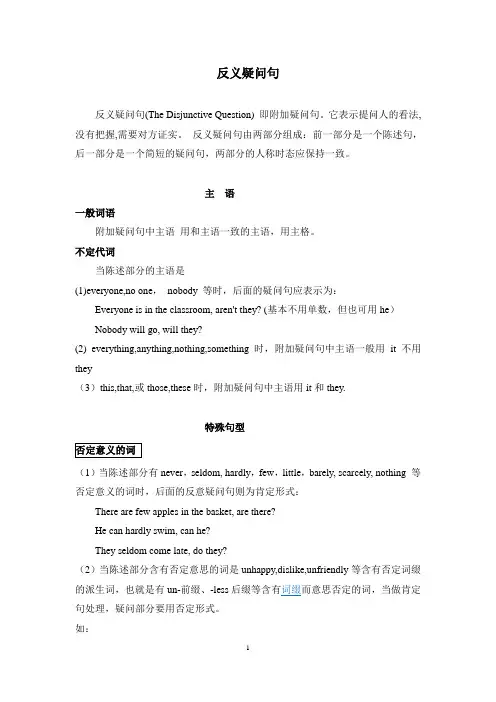
反义疑问句(The Disjunctive Question) 即附加疑问句。它表示提问人的看法,没有把握,需要对方证实。 反义疑问句由两部分组成:前一部分是一个陈述句,后一部分是一个简短的疑问句,两部分的人称时态应保持一致。
主 语
一般词语
附加疑问句中主语 用和主语一致的主语,用主格。
不定代词
当陈述部分的主语是
(1)everyone,no one, nobody 等时,后面的疑问句应表示为:
Everyone is in the classroom, aren't they? (基本不用单数,但也可用he)
Nobody will go, will they?
(2) everything,anything,nothing,something时,附加疑问句中主语一般用 it 不用
they
(3)this,that,或those,these时,附加疑问句中主语用it和they.
特殊句型
否定意义的词
(1)当陈述部分有never,seldom, hardly,few,little,barely, scarcely, nothing 等否定意义的词时,后面的反意疑问句则为肯定形式:
There are few apples in the basket, are there?
He can hardly swim, can he?
They seldom come late, do they?
(2)当陈述部分含有否定意思的词是unhappy,dislike,unfriendly等含有否定词缀的派生词,也就是有un-前缀、-less后缀等含有词缀而意思否定的词,当做肯定句处理,疑问部分要用否定形式。
如: 2
He looks unhappy,doesn't he?他看上去不高兴,不是吗?
The girl dislikes history,doesn't she?这女孩不喜欢历史,不是吗?