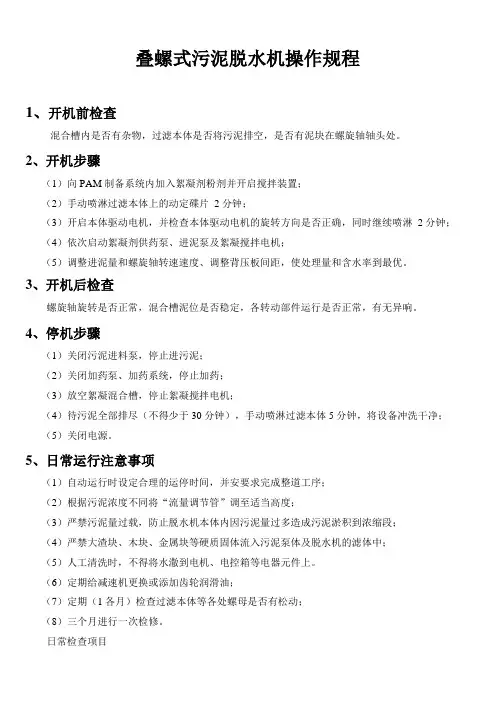
叠螺机污泥脱水机工艺流程
- 格式:doc
- 大小:16.34 KB
- 文档页数:8
叠螺机污泥脱水机工艺流程
英文回答:
## Sludge Dewatering Process Using Screw Press.
### Introduction.
Screw press sludge dewatering is a mechanical process
used to remove water from sludge, resulting in a drier,
more manageable solid. It is commonly employed in
wastewater treatment plants to reduce the volume and weight
of sludge, making it easier to handle, transport, and
dispose of.
### Process Overview.
The sludge dewatering process using a screw press
involves the following steps:
1. Sludge Conditioning: Sludge is conditioned with chemicals, such as polymers, to enhance flocculation and
improve dewatering efficiency.
2. Sludge Feeding: Conditioned sludge is fed into the
screw press through an inlet port.
3. Screw Conveying: The screw press consists of a
rotating helical screw conveyor enclosed within a
stationary perforated cylinder. As the screw rotates, it
conveys the sludge through the cylinder.
4. Pressure Build-up: The screw conveyor generates
increasing pressure as the sludge moves through the
cylinder. This pressure helps to squeeze out the water from
the sludge.
5. Water Drainage: Water squeezed out by the pressure
is drained through the perforations in the cylinder.
6. Solids Discharge: The dewatered sludge, known as
cake, is discharged at the end of the cylinder.
### Process Parameters.
The efficiency of sludge dewatering using a screw press
is influenced by various process parameters, including:
Sludge characteristics (e.g., solids content, particle
size distribution)。
Screw speed.
Temperature.
Pressure.
Chemical conditioning.
### Advantages.
The use of screw presses for sludge dewatering offers
several advantages, such as:
High dewatering efficiency.
Compact design and low space requirement.
Continuous operation.
Reduced sludge volume and weight.
Improved sludge handling and disposal.
### Applications.
Screw press sludge dewatering is widely used in various
industries, including:
Municipal wastewater treatment plants.
Industrial wastewater treatment plants.
Food processing plants.
Pulp and paper mills.
Chemical plants.
### Conclusion.
Screw press sludge dewatering is a reliable and
efficient method for reducing the volume and weight of
sludge. It is widely used in wastewater treatment
applications and offers several advantages, making it a
valuable tool in sludge management.
中文回答:
## 螺旋压滤机污泥脱水工艺。
### 概述。
螺旋压滤机污泥脱水是一种机械工艺,用于去除污泥中的水分,使其成为更干燥、更容易处理的固体。它通常用于污水处理厂,以减少污泥的体积和重量,使其更容易处理、运输和处置。
### 工艺流程。
使用螺旋压滤机的污泥脱水工艺涉及以下步骤:
1. 污泥调理,使用聚合物等化学物质对污泥进行调理,以增强絮凝并提高脱水效率。
2. 污泥进料,将调理过的污泥通过进料口送入螺旋压滤机。
3. 螺旋输送,螺旋压滤机由一个旋转螺旋输送机组成,该输送机包裹在固定穿孔圆筒内。随着螺旋旋转,它将污泥输送到圆筒中。
4. 压力建立,随着污泥在圆筒中移动,螺旋输送机产生越来越大的压力。这种压力有助于将污泥中的水排出。
5. 排水,被压力挤出的水通过圆筒中的穿孔排出。
6. 固体排出,脱水的污泥(称为滤饼)在圆筒末端排出。
### 工艺参数。
使用螺旋压滤机进行污泥脱水的效率受各种工艺参数的影响,包括:
污泥特性(如固体含量、粒度分布)。
螺旋速度。
温度。
压力。
化学调理。
### 优势。
使用螺旋压滤机进行污泥脱水具有以下优势:
脱水效率高。
结构紧凑,占地面积小。
连续运行。
污泥体积和重量减少。
改善污泥处理和处置。
### 应用。
螺旋压滤机污泥脱水广泛应用于各个行业,包括:
市政污水处理厂。
工业污水处理厂。
食品加工厂。
造纸厂。
化工厂。
### 结论。
螺旋压滤机污泥脱水是一种可靠且高效的方法,可以减少污泥的体积和重量。它广泛用于污水处理应用,具有许多优势,使其成为污泥管理中的宝贵工具。