高中英语人教版必修3unit2教案
- 格式:pdf
- 大小:24.30 KB
- 文档页数:3
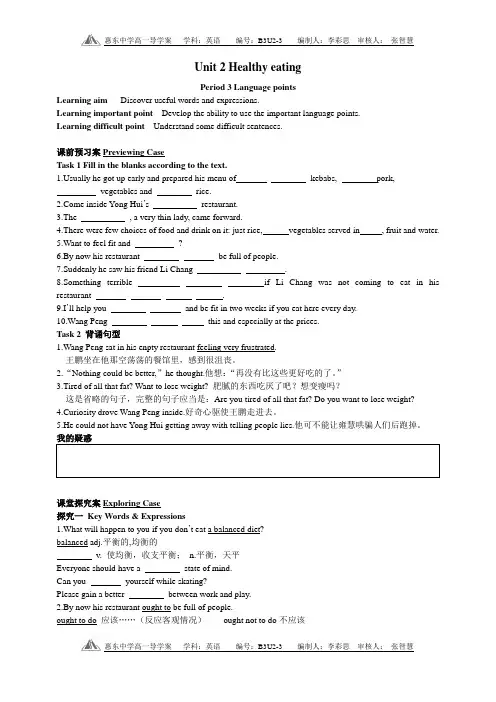
Unit 2 Healthy eating
Warming up, pre-reading and reading
Teaching aims
1.Get students to read the passage and learn the different reading skills.
2.Enable students to learn about the importance of healthy eating and know what it
healthy diet.
3.Develop students’ sense of cooperative learning.
Teaching importance
1.Let students read the passage and learn something about healthy eating. 2.Get students to learn different reading skills.
Teaching difficulties
1.Develop students’ reading ability.
2.Enable students to learn to talk about the food and our daily diet.
Teaching methods
1.Task-based teaching and learning 2.cooperative learning
3.Discussion
Teaching procedures
Step1 Warming up
1. Match the food with the festivals.
We have leant something about festivals in last unit. Do you know what do we usually
eat during each festival?
Moon cake
Zongzi
Dumplings
Yuanxiao Chocolate
Turkey
Pumpkin Lantern Festival
Spring Festival
Thanksgiving Day
Dragon Boat Festival Mid-autumn Festival
St Valentine’s Day
Halloween
2. Discussion 1. What do you usually eat every day?
2. What is your favourite food?
3. Do you think your diet is healthy?
Step 2 Pre-reading
Imagine you have a restaurant, what kinds of food will you provide to your
customers?
Step 3 Reading
Task 1 Fast reading
Scan the text and then choose the best answer according to the text.
1. Why did Wang Peng feel it had been a very strange morning?
A. what he had prepared was sold out.
B. Few people walked into his restaurant to eat. C. He couldn’t make his restaurant more beautiful. D. He didn’t know how to make delicious food.
2. Where did the customers go to eat instead of going to Wang Peng’ s restaurant?
A. They ate at home. B. They went to a new big restaurant to eat.
C. They ate in a new small restaurant.
D. They wanted to eat something rich in fat in another place.
3. What is Wang peng’ s impression on Yong Hui’ s restaurant? A. All the customers in it were very slim. B. It was too small and too
noisy.
C. The food in it was very nice and better than that in his
D. There was so limited food but the price was much higher. 4. What was the disadvantage of the food offered by Yong Hui’ s restaurant?
A. It had too much fat. B. It couldn’t make people lose weight really.
C. It could make people ill. D. It couldn’t offer people enough energy.
5. We can infer from the last sentence that ____
A. Wang Peng and would learn from Yong Hui.
B. Yong Hui would learn from Wang Peng. C, The competition had begun and would continue.
D. The two restaurants would give up the competition.
Task 2 Careful reading
The test can be divided into three parts. Listen to the tape of each part and find out the
main idea of each part. Then use about 30 words to sum up the main idea of this
passage.
Part 1 (para 1)
Part 2 (para 2-3)
Part 3 (para 4)
According to the passage, we know that Wang Peng’restaurant became _____
because a new one had taken his regular _____ away, and he wanted to _____ it to win his customers back.
Task 3 Summary
Wang Peng felt frustrated because his ______(custom) didn’t come to eat at his
restaurant ____ usual though he prepared a perfect menu. When his friend Li Chang
passed by his restaurant ________ coming into his restaurant to eat as he always did,
Wang Peng felt that something terrible must _______. So Wang Peng followed him to
a newly-opened small restaurant with a sign in the window. The sign said in this
restaurant people tired of fat could be served slimming foods only and would become
_____ (thin) soon. With ____ (curious), Wang Peng entered and was shown a menu
by a thin lady named Yong Hui. On the menu, there were only rice, raw vegetables, fruit and water. After _____ (leave) the restaurant, he decided to do some research.
Soon he found that Yong Hui’ s restaurant did not serve energy-giving foods and the
customers would become _______(tire) quickly. So he put up a new sign _____ said
his restaurant would serve foods providing all-day energy. The ________ between the
two restaurant was on.
Step 4 Homework
Find out the useful words, expressions and sentence structures in the
passage.