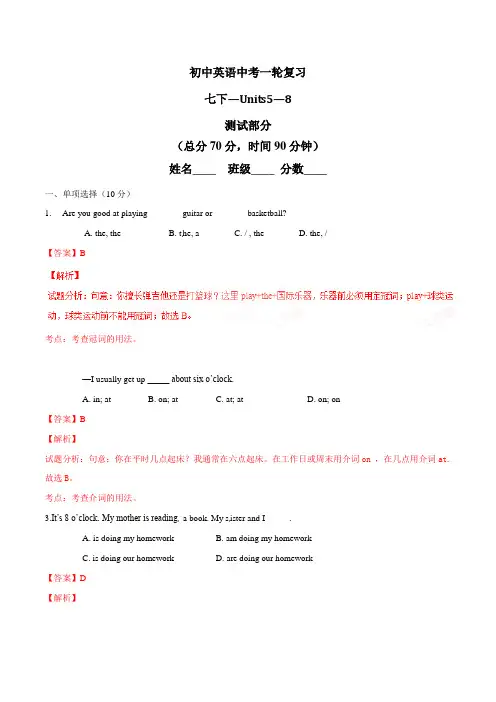
人教版英语中考一轮复习七年级下册5-8单元+考点汇总练习
- 格式:docx
- 大小:32.68 KB
- 文档页数:9
中考复习人教版七下5-8
一、词汇扩展
1. (v.& n.)睡觉→ (过去式/过去分词)→ (adj.)睡着的→
(adj.)困倦的
2. (v.& n.)下雨;雨水→ (adj.)多雨的
3. (n.)太阳→ (adj.)晴朗的
4. (n.)风→ (adj.)多风的
5. (n.)云→ (adj.)多云的
6. (n.)雪→ (adj.)有雪的
7. (adj.)温暖的→ (n.)温暖
8. (adj.& n.)南方的;南方→ (adj.)南方的
9. (n.)欧洲→ (adj.& n.)欧洲的;欧洲人
10. (adj.)糟糕的→ 更糟糕的(比较级)→ 最糟糕的(最高级)
11. (n.)危险→ (adj.)危险的
12. (n.)小孩→c (复数)→ (n.)童年
13. (adj.)美丽的→ (n.)美→ (adv.)漂亮地
14. (n.)男人;人→ (复数) 15. (n.)美国→ (adj.& n.)美洲的;美国人;美国人的
16. (adj.)免费的;自由的→ (n.)自由
答案
1.sleep(v.& n.)睡觉→slept(过去式/过去分词)→asleep(adj.)睡着的→sleepy(adj.)困倦的
2.rain(v.& n.)下雨;雨水→rainy(adj.)多雨的
3.sun(n.)太阳→sunny(adj.)晴朗的
4.wind(n.)风→windy(adj.)多风的
5.cloud(n.)云→cloudy(adj.)多云的
6.snow(n.)雪→snowy(adj.)有雪的
7.warm(adj.)温暖的→warmth(n.)温暖
8.south(adj.& n.)南方的;南方→southern(adj.)南方的
9.Europe(n.)欧洲→European(adj.& n.)欧洲的;欧洲人
10.bad(adj.)糟糕的→worse更糟糕的(比较级)→worst最糟糕的(最高级)
11.danger(n.)危险→dangerous(adj.)危险的
12.child(n.)小孩→children(复数)→ childhood(n.)童年 13.beautiful(adj.)美丽的→beauty(n.)美→ beautifully(adv.)漂亮地
14.man(n.)男人;人→men(复数)
15.America(n.)美国→American(adj.& n.)美洲的;美国人;美国人的
16.free(adj.)免费的;自由的→freedom(n.)自由
二、考点讲解
1.Could you...?的句型用法
2.No problem.的句型用法
3.tell sb. (not) to do sth.的固定短语
4.反意疑问句
5.one one’s left的固定搭配
6.enjoy的用法
7.because/because of
8.other/the other/others/the others
解析版
二、考点讲解
1.Could you...?的句型用法
“Could you...?”意为“你能……吗?”,用于委婉地提出请求
肯定回答常为“Sure./Certainly./Of course.(当然可以。)/With pleasure.(乐意效劳。)/No problem.(没问题。)/Sure, I’d love to.(当然可以,我很乐意。)”,否定回答常为“Sorry, I can’t. I...(对不起,我不能。我……)”。
2.No problem.的句型用法
常用于口语中,表示同意或愉快地回答请求,意为“没问题;小事一桩”。
3.tell sb. (not) to do sth.的固定短语
tell sb. (not) to do sth.意为“告诉某人(不要)做某事”。
4.反意疑问句
反意疑问句由两部分组成,前一部分为陈述形式,后一部分为附加问句。
如果前一部分为肯定形式,后一部分通常为否定形式,否定形式必须缩写,即“前肯后否”;如果前一部分为否定形式,后一部分通常用肯定形式,即“前否后肯”。
后一部分的主谓与前一部分的主谓在人称、时态和数上要保持一致,且后一部分的主语必须是人称代词(there be句型除外)。
5.one one’s left的固定搭配
on one’s left意为“在某人的左边 on one’s right在某人的右边
6.enjoy的用法
enjoy及物动词,意为“享受;喜爱”,后跟名词、代词或动词-ing形式作宾语。enjoy doing sth.意为“喜欢做某事”。
enjoy oneself意为“玩得愉快”,相当于have a good time 或 have fun。
7.because/because of
because 连词 后接句子,引导原因状语从句
because of 介词短语 其后多接名词、代词或动名词
8.other/the other/others/the others
other “另外的,其他的”,后常接复数名词
the other 两者中的另一个,意为“一个……,另一个……”
others 剩余的另一些(并非全部),some...others...意为“一些……,一些……”
the others 指一定范围内剩余的全部,some..., the others...意为“一些……,其余的……”
练习
一、单项选择 1.Julia ______ short but she _______ long hair.
A.is; is B.has; is C.is; has D.has; has
2.What will your life _______ in the future.
A.like B.be like C.likes D.looks like
3.There is ______ food in the fridge. Let’s buy some.
A.much B.enough C.few D.little
4.Thank you very much ______ helping me.
A.for B.at C.with D.to
5.I come here only ______ good-bye to you.
A.say B.to say C.saying D.says
6. My father thinks good eating habits are very important to our health, and he seldom
encourages us to ________.
A. hang out B. take out C. come out D. eat out
7. She grew flowers with earth, water and love, so her ________ garden was filled
with beautiful flowers.
A. old B. wide C. back D. round 8. Different people may see things in different ways, so people may ________ the
same person differently.
A. protect B. mean C. describe D. break
9. A person's whole life is ________ changed by something unexpected.
A. quickly B. easily C. hardly D. quietly
10. —Hurry up!
—One moment. I ________ my emails and then I’m ready to go.
A. read B. am reading C. was reading D. have read
二、用所给词的适当形式填空
1.Jenny’s mother ________(pick) some apples yesterday.
2.There are different kinds of ________(flower) in the park.
3.It’s ________(sun) today.
4.Don’t ________(worry). I’ll help you.
5.Did you get any ________(gift) on your birthday?
6.Many foreigners, including ________ (Australia), visited Expo 2019, Beijing(北京世博会).
7.Mom, I want to see koalas ________ (one). They are my favorite animals. 8.— Let’s ________ (take) the bus to school today.
— OK.
9.I ________ (do) like the cat, because it is kind of boring.
10.Mary has some ________ (animal) in her home. They are very cute.
三、根据汉语意思完成句子。
1.看!有一些女孩在树下跳舞。
Look! There ________ some girls ________ under tile tree.
2.玛丽现在正在读报纸吗?
________ Mary ________ the newspaper now?
3.—他正在做什么呢?—他正在家里看电视。
—________ ________ he ________? —He is ________ ________ at home.
4.我正在给孩子们读故事。
I'm ________ the story ________ the children.
5.你想加入我们的晚餐吗?
________ you ________ ________ join us ________ dinner?
四、句型转换。
1.Peter likes music. (改为否定句)