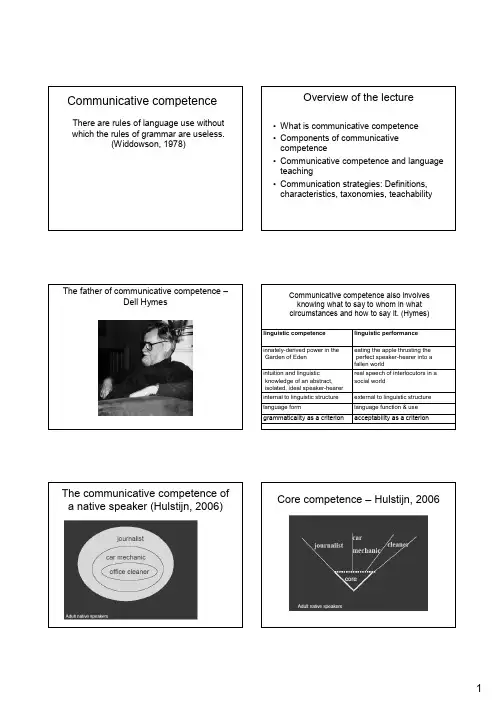
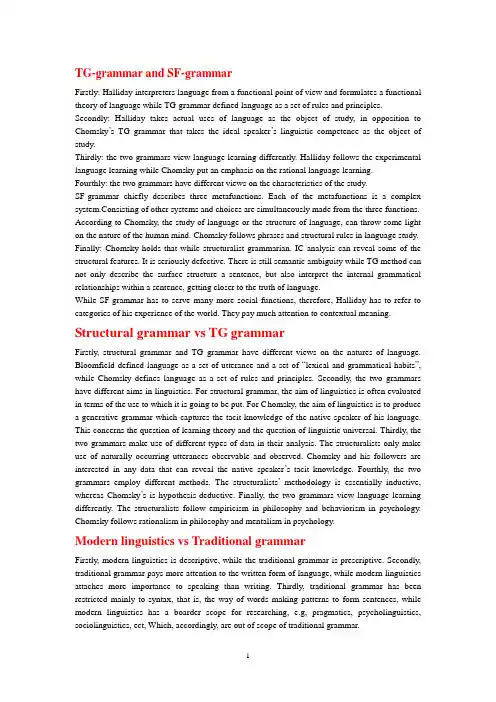
linguistic competence and performence
- 格式:doc
- 大小:73.00 KB
- 文档页数:5
Linguistic competence refers to the knowledge of a language system. The term
first emerged in the work of Noam Chomsky, where it referred specifically to
syntactic competence, and was specifically opposed to linguistic performance. The
term was used more broadly by Dell Hymes in formulating the concept of
communicative competence. Like communicative competence, language competence
is often divided into various subcompetences, such as syntactic competence and
lexical competence.
According to Chomsky, competence is the ideal speaker /hearer, i.e. an idealized
but not a real person who would have a complete knowledge of language. This means
a person’s ability to create and understand sentences, including sentences they have
never heard before.Performance is the actual use of the language by individuals in
speech and writing.
Speakers’ linguistic knowledge permits them to form longer and longer
sentences by joining sentences and phases together or adding modifiers to a noun.
whether you stop at three, five or eighteen adjectives, it is impossible to limit the
number you could add if desired. Very long sentences are theoretically possible, but
they are highly improbable.
Evidently, there is a difference between having the knowledge necessary to
produce sentences of a language, and applying this knowledge. It is a difference
between what you know, which is your linguistic competence, and how you use this
knowledge in actual speech production and comprehension, which is your linguistic
performance.
When we speak, we usually wish to convey some message. At some stage in the
act of producing speech, we must organize our thoughts into strings of words.
Sometimes the message is garbled. We may stammer, or pause, or produce slips of the
tongue. We may even sound like the baby, who illustrates the difference between
linguistic knowledge and the way we use that knowledge in performance.
Linguistic competence is the system of linguistic knowledge possessed
by native speakers of a language, it is in contrast to the concept of Linguistic
performance, the way the language system is used in communication. The concept
was first introduced by Noam Chomsky[1] as part of the foundations for his
Generative grammar, but it has since been adopted and developed by other linguists,
particularly those working in the generativist tradition. In the generativist tradition
competence is the only level of language that is studied, because this level gives
insights into the Universal Grammar, that generativists see as underlying all human
language systems. Functional theories of grammar tend to dismiss the sharp
distinction between competence and performance, and particularly the primacy given
to the study of competence.
According to Chomsky, competence is the 'ideal' language system that makes it possible for
speakers to produce and understand an infinite number [nb 1] of sentences in their language, and to
distinguish grammatical sentences from ungrammatical sentences. This is unaffected by
"grammatically irrelevant conditions" such as speech errors.[1] Competence versus performance
"Linguistic theory is concerned primarily with an ideal speaker-listener, in a
completely homogeneous speech-community, who knows its (the speech community's)
language perfectly and is unaffected by such grammatically irrelevant conditions as
memory limitations, distractions, shifts of attention and interest, and errors (random or
characteristic) in applying his knowledge of this language in actual performance."
~Chomsky,1965[1]
Chomsky differentiates competence, which is an idealized capacity, from
performance being the production of actual utterances. According to him, competence
is the ideal speaker-hearer's knowledge of his or her language and it is the 'mental
reality' which is responsible for all those aspects of language use which can be
characterized as 'linguistic'.[2] Chomsky argues that only under an idealized situation
whereby the speaker-hearer is unaffected by grammatically irrelevant conditions such
as memory limitations and distractions will performance be a direct reflection of
competence. A sample of natural speech consisting of numerous false starts and other
deviations will not provide such data. Therefore, he claims that a fundamental
distinction has to be made between the competence and performance.[1]
Chomsky dismissed criticisms of delimiting the study of performance in favor of
the study of underlying competence, as unwarranted and completely misdirected. He
claims that the descriptivist limitation-in-principle to classification and organization
of data, the "extracting patterns" from a corpus of observed speech and the describing
"speech habits" etc. are the core factors that precludes the development of a theory of
actual performance.