
Cost Cutting for Growth and Profitability
- 格式:ppt
- 大小:273.50 KB
- 文档页数:12

高三经济全球化英语阅读理解30题1<背景文章>Economic globalization refers to the increasing interdependence of world economies as a result of the growing scale of cross-border trade of commodities and services, flow of international capital and wide and rapid spread of technologies. It is a complex phenomenon that has been evolving over centuries.In ancient times, trade routes such as the Silk Road connected different regions and promoted the exchange of goods and cultures. This was an early form of economic globalization. During the Age of Exploration, European powers expanded their trade networks around the world, further accelerating the process.The Industrial Revolution brought significant changes. Advances in transportation and communication technologies made it possible to move goods and information more quickly and efficiently. This led to a massive increase in international trade and investment.One of the main characteristics of economic globalization is the integration of markets. Companies can now sell their products and services in markets all over the world. This has led to increased competition and has forced businesses to become more efficient and innovative. Anothercharacteristic is the mobility of labor. Skilled workers can move to different countries in search of better job opportunities.Globalization also has its challenges. It can lead to job losses in some industries as companies move production to countries with lower labor costs. It can also widen the gap between rich and poor countries. However, it also offers many opportunities. It can promote economic growth, improve living standards and facilitate the spread of knowledge and technology.In conclusion, economic globalization is a powerful force that is shaping the world economy. It has brought many benefits, but also poses challenges that need to be addressed.1. What is economic globalization mainly the result of?A. The growth of domestic trade.B. The increasing scale of cross-border trade, flow of international capital and spread of technologies.C. The decline of traditional industries.D. The isolation of world economies.答案:B。

收益管理英文名言Profit Management: The Art of Maximizing OpportunitiesIn the ever-evolving world of business, the concept of profit management has become a crucial aspect of success. Profit management is the strategic process of maximizing revenue, controlling expenses, and optimizing the overall financial performance of an organization. It requires a deep understanding of market dynamics, customer behavior, and efficient resource allocation to ensure long-term sustainability and growth.One of the key principles of profit management is the effective utilization of resources. This involves identifying and prioritizing the most profitable products or services, streamlining operations, and eliminating waste. By focusing on the most lucrative areas of the business, organizations can optimize their revenue streams and enhance their overall profitability.Another important aspect of profit management is cost control. Businesses must carefully analyze their expenses and find ways to reduce unnecessary spending without compromising the quality of their offerings. This may involve renegotiating supplier contracts,implementing cost-saving measures, or identifying areas where efficiency can be improved.Effective pricing strategies are also essential in profit management. Businesses must carefully analyze market trends, competitor pricing, and customer willingness to pay to determine the optimal prices for their products or services. This requires a deep understanding of the target market and the ability to adapt pricing strategies as market conditions change.In addition to these core principles, successful profit management also involves a strong focus on customer satisfaction. By understanding the needs and preferences of their target audience, businesses can develop products and services that meet or exceed customer expectations, leading to increased loyalty, repeat business, and positive word-of-mouth.To further illustrate the importance of profit management, let us consider the insightful words of renowned business leaders and thinkers:"Profit in business comes not from repeat sale, but from repeat customers." - Peter Drucker, management consultant and author.This quote emphasizes the significance of building long-termrelationships with customers, as it is the key to sustained profitability. By focusing on customer retention and loyalty, businesses can ensure a steady stream of revenue and minimize the cost of acquiring new customers."The goal of a successful business is to make money, make people happy, and make the world a better place." - Richard Branson, founder of the Virgin Group.This statement highlights the multifaceted nature of profit management, where the ultimate objective is not just to maximize profits, but to create value for all stakeholders, including customers, employees, and the broader community. By aligning business goals with social responsibility, organizations can enhance their reputation, attract and retain top talent, and contribute to the greater good."Profit is not the legitimate purpose of business. The legitimate purpose of business is to provide a product or service that people need and do it so well that it's profitable." - James Rouse, real estate developer and urban planner.This quote challenges the traditional notion of profit as the sole driver of business success. Instead, it suggests that the primary focus should be on delivering high-quality products or services that address genuine customer needs. By prioritizing customer value overshort-term profits, businesses can build a sustainable competitive advantage and achieve long-term profitability.In conclusion, profit management is a multifaceted discipline that requires a holistic approach to business strategy. By optimizing resource utilization, controlling costs, implementing effective pricing strategies, and maintaining a strong focus on customer satisfaction, organizations can enhance their profitability and ensure long-term success. The insights and wisdom shared by renowned business leaders serve as a guiding light for entrepreneurs and managers alike, inspiring them to pursue profit management as a means of creating value, driving growth, and making a positive impact on the world.。
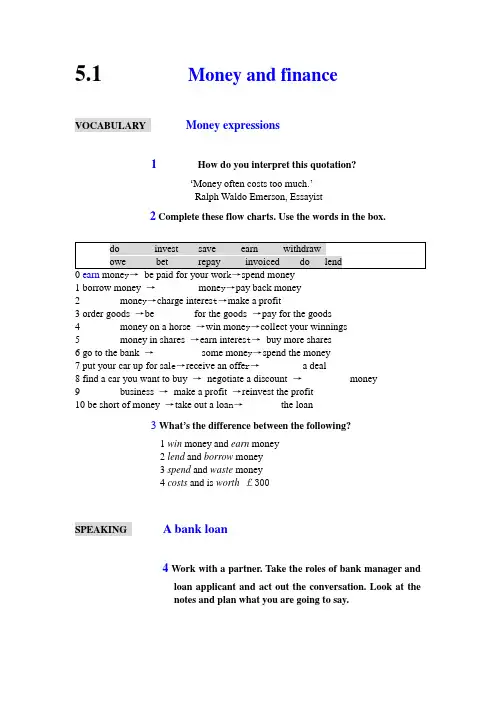
5.1Money and finance VOCABULARY Money expressions1How do you interpret this quotation?‘Money often costs too much.’Ralph Waldo Emerson, Essayist2Complete these flow charts. Use the words in the box.1 borrow money→________ mone y→pay back money2 _______ mone y→charge interes t→make a profit3 order goods→be _______ for the goods→pay for the goods4 _______ money on a horse→win mone y→collect your winnings5 _______ money in shares→earn interes t→buy more shares6 go to the bank→________ some mone y→spend the money7 put your car up for sal e→receive an offe r→_______ a deal8 find a car you want to buy→negotiate a discount→________ money9 _______ business→make a profit→reinvest the profit10 be short of money→take out a loa n→_______ the loan3What’s the difference between the following?1 win money and earn money2lend and borrow money3 spend and waste money4 costs and is worth£300SPEAKING A bank loan4Work with a partner. Take the roles of bank manager andloan applicant and act out the conversation. Look at thenotes and plan what you are going to say.LISTENING A culture of debt5Discuss these questions.1 Is it easy to get credit in your country, for example, tobuy a house, a car, a new TV?2 Is consumer confidence high at the moment? Why? /Why not?Exam Success 3 What is people’s general attitude to borrowing in yourcountry?Your answer will beexact word-for-word 6 You will hear part of a lecture given by an economist to phrases from the a group of bankers and economists. In it she describes listening text. They the impact of Alan Greenspan’s economic policy on must be spelt the US and global economies. A friend who can’t attend correctly has asked you to take some notes. Before listeningpredict the kind of words that will go in each space.7 Listen and complete the notes below. Use up to threewords in each space.Business MAGAZINE THE LEGACY OF ALAN GREENSPANThe background1 Alan Greenspan changed people’s attitudes to ________________.2 People have been against borrowing money since _____________.3 Now young people take out loans to pay their way through_________.4 For many homeowners it’s normal to have a second _________.The current lending market5 Credit is easy and interest rates are_________.6 Banks often lend money _________.7 In some states it’s possible to get a Mortgagee with no ________.Reasons for this policy8 As long as people are spending,_________.9 In Germany, in times of uncertainly people tend to _________.The future10 In 2005 American personal debt was_________________.11 Some people say we are sitting on _____________.12 Asset values will not continue to rise ______________.8Do you think a policy of borrow and spend helps the economy? Ordo you think sooner or later there will be a debt crisis?9 Explain the following financial terms from the text.1 to remortgage your home2 to make a down-payment3 asset values will crash4 to be in negative equity5 64 trillion dollarsGRAMMAR Expression of comparison1Underline the expressions of comparison and the adverbs /prepositions that go with them.0Warsaw is much cheaper than Oslo.1 I find the train more comfortable than the bus.2 Wal-mart is the biggest food retailer in the USA.3 It’s not as expensive as you think.4 The two articles present the same arguments as each other.5 Hungarian is a different language to German.6 Australian food is similar to New Zealand’s.7 It took me less time than I thought it world.8 The average American consumes twice as much energy as theaverage European.2What word(s) could you add to the statements in exercise 1 to show that the difference (or similarity) is big? Use these words to help you (sometimes there is more than one possibility)Warsaw is much cheaper than Oslo.3Make comparisons (differences and similarities) between the following.1 you and another member of your family (father, mother, brother, sister, etc)2 two cities you know well3 two employers or teachers you have had4 your own country and another country you have visited5 two companies you have worked for or colleges you have attend4Read this article about energy consumption in the USA. Write one word to fill each gap.SPEAKING Choosing an investment5In the city where you live (180,000 people), two independent cinemas have recently come up for sale. Both are in a popularsuburb of the city. The city has three other cinemas-a bigout-of-town mutiplex, a six-screen cinema in the centre oftown and a small independent in a different suburb.The details of the two cinema are given below. Study theinformation and decide which you think would be a betterinvestment.6Discuss your ideas with your partner, explaining your reasons.Use the language box to help you.VOCABULARY Company finance1What financial mistakes do you think small businesses mostcommonly make? Work with a partner and make a list.Not taking out insurance to cover the sudden loss of a senior /key employee.2Put these words into the right place to make pairs offinancial terms.fixed costs1 income ___________ 6 dividends ___________2 assets ____________ 7 creditor _____________3 gross _____________ 8 profitable ___________4 current _____________ 9 accounts payable ______3 Using the words in exercise 2 complete this passage from anonline guide for investors.Understanding financial statementsTo make good investment decisions, you need to understand the business you’re investing in. knowing when to buy and when to sell depends not only onunderstanding the market in general but also the financial health of the company. Your first port of call: the annual report.This contains the accounts-the balanceSheet, the income statement and the cashflow statement. We’ll deal with just the important. With all financial statements, you must compare the sets of figures from recent years to see how the company is developing.The balance sheet is a snapshot of a company’s financial position at a given moment. Imagine tomorrow you make a list of everything you own (including what in others owe to you)-house, car, money in the bank, etc. these are your (1)_______. Set against these everything that you owe-mortgage, credit card bill, etc. These are your (2) _______. The two columns are what make up the balance sheet.With a company balance sheet you also need to consider the shareholders’ equity (the shares owned in the company by others). The basic equation is assets=liabilities + shareholders’ equity.The (3)_________ assets of a company are its buildings and equipment. As an investor you should pay particular attention to two kinds of current asset-the stock and the accounts receivable (money owed to the company by customers). If the amount of stock is growing fast, then it could be that stock isn’t moving. If the accounts receivable figure is large, then the (4)________ aren’t paying their bills quickly enough. On the liability side look to see whether the debt, both short and long term, is increasing. Is the company borrowing more and if so, why? Read the notes to the accounts-maybe they will explain anything unusual. Look also at accounts (5) ______ to see if the company is paying its creditors on time.The income statement (sometimes also called the profit and (6) _________ account) shows the company’s income and (7)________ over a given period. It lists all the money generated by sales (the turnover) plus any other income, minus all the costs involved in running the business. This produces the gross profit that tells you if the business is healthy and operationally (8)_______ (9)_________ profit is the proverbial bottom line. It represents profit after tax and interest have been paid and is the amount that can be distributed to its shareholders in (10)_________ (though generally a part of this profit is retained for re-investment).As you study the income statements of recent years, get out your calculator and do some sums.Are sales growing? Are costs growing faster than sales or is the profit margin being maintained? What are the forecasts for future growth? Did any of the income come from the sales of assets?4 What do these words and phrases from the passage on page50 mean?1 your first port of call2 a snapshot3 over a given period4 the bottom line5 do some sumsREADING A financial summary5Study this financial summary of Tesco plc, Britain’s largestsupermarket chain. Find the following items.1 the turnover2 the profit made after tax3 the value of the company4 the cash still available after other investments。