
新教材牛津译林版高中英语必修第一册Unit1 Back to school 教学课件
- 格式:ppt
- 大小:2.51 MB
- 文档页数:260

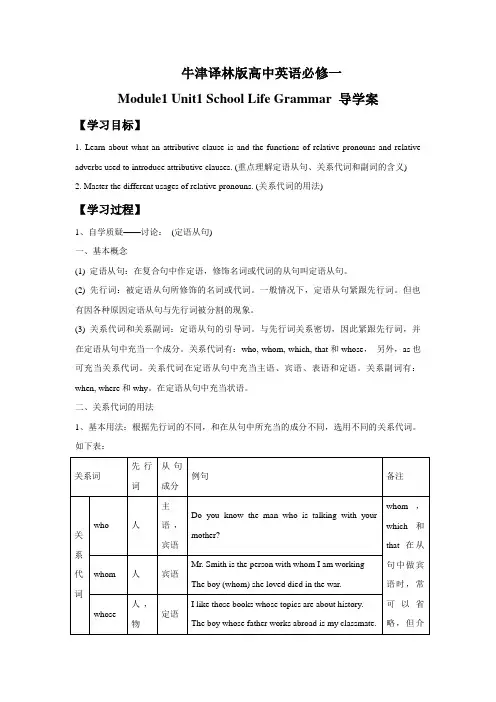
牛津译林版高中英语必修一
Module1 Unit1 School Life Grammar 导学案
【学习目标】
1. Learn about what an attributive clause is and the functions of relative pronouns and relative
adverbs used to introduce attributive clauses. (重点理解定语从句、关系代词和副词的含义)
2. Master the different usages of relative pronouns. (关系代词的用法)
【学习过程】
1、自学质疑——讨论: (定语从句)
一、基本概念
(1) 定语从句:在复合句中作定语,修饰名词或代词的从句叫定语从句。
(2) 先行词:被定语从句所修饰的名词或代词。一般情况下,定语从句紧跟先行词。但也有因各种原因定语从句与先行词被分割的现象。
(3) 关系代词和关系副词:定语从句的引导词。与先行词关系密切,因此紧跟先行词,并在定语从句中充当一个成分。关系代词有:who, whom, which, that和whose, 另外,as也可充当关系代词。关系代词在定语从句中充当主语、宾语、表语和定语。关系副词有:when, where和why。在定语从句中充当状语。
二、关系代词的用法
1、基本用法:根据先行词的不同,和在从句中所充当的成分不同,选用不同的关系代词。如下表:
关系词 先行词 从句成分 例句 备注
关系代词 who 人 主语,宾语 Do you know the man who is talking with your
mother? whom,
which和that在从句中做宾语时,常可以省略,但介whom 人 宾语 Mr. Smith is the person with whom I am working

1 牛津译林版高中英语必修三
Unit 3 Reading 教学设计
The article Lost civilizations is about a cultural expedition to sites of lost civilizations. The reading text is made up of several excerpts from the travel diary kept by a Canadian student about her travel experience in Pompeii in Italy and Loulan in China. Try to gain some information about ancient civilizations, to practice and reinforce your reading comprehension. The Reading strategy in this unit teaches you how to read diary entries. You are expected not only to master this strategy but apply it to your future study as well.
Step1: Lead—in
1. Hi, everybody. Please enjoy some pictures and try to say something about them. (From the pictures, we can see the tall buildings, castles, walls and so on are all in ruins now. Most of them are completely destroyed .Although they are in ruins, yet they were once magnificent and wonderful in history. From them we dare say they are lost civilizations. Lost civilizations means ancient buildings, cultures and countries that no longer exist.)

Unit1 Back to school
1.Welcome to the unit & Reading .................................................................................... - 1 -
2.Grammar usage & Integrated skills ............................................................................... - 6 -
3.Extended reading, Project, Assessment & Further study ............................................ - 12 -
1.Welcome to the unit & Reading
一、填空
1.She grasped every opportunity ____________(improve) her oral English in the
class.
2.Don't expect a junior high school student to rise ____________ the occasion like
that.
3.Most answers lie ____________ the data you collect from your customer
interactions.
4.Jonathan, as a young man with a warm heart, wants to be a man who can make
____________ difference to society.
5.They choose to work for themselves because they enjoy
1
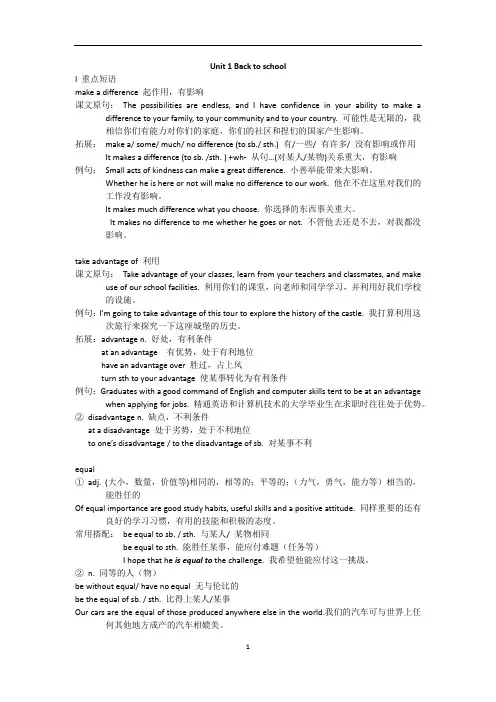
Unit 1 Back to school
I 重点短语
make a difference 起作用,有影响
课文原句: The possibilities are endless, and I have confidence in your ability to make a
difference to your family, to your community and to your country. 可能性是无限的,我相信你们有能力对你们的家庭,你们的社区和捏们的国家产生影响。
拓展: make a/ some/ much/ no difference (to sb./ sth.) 有/一些/ 有许多/ 没有影响或作用
It makes a difference (to sb. /sth. ) +wh- 从句…(对某人/某物)关系重大,有影响
例句: Small acts of kindness can make a great difference. 小善举能带来大影响。
Whether he is here or not will make no difference to our work. 他在不在这里对我们的工作没有影响。
It makes much difference what you choose. 你选择的东西事关重大。
It makes no difference to me whether he goes or not. 不管他去还是不去,对我都没影响。
take advantage of 利用
课文原句: Take advantage of your classes, learn from your teachers and classmates, and make
use of our school facilities. 利用你们的课堂,向老师和同学学习,并利用好我们学校的设施。