
中考英语总复习 第1部分 教材知识梳理篇 第28课时 九
- 格式:ppt
- 大小:2.16 MB
- 文档页数:13


1 专题课件
第二十一节 九年级(全)Units 11~12
一、单项选择
1. (2017武威)The whole family were ______agreement about what they should do
next.
A. about B. of
C. in D. on
2. (2017西宁)—Why was the young man so ______in himself?
—Because he had too many failures.
A. disappointed B. surprised
C. interested D. excited
3. With ______and determination(决心), she set out to achieve her childhood
dream to be a world famous actress.
A. wealth B. courage
C. truth D. choice
4. If you heat a pot of water, sooner or later, the water will______, do you
know where it's going?
A. disagree B. disappoint
C. discuss D. disappear
5. (2017河南说明与检测模拟试题三)Don't be hard ______your children and don't
be rude ______your parents. They are all your friends.
A. on; to B. with; with
C. with; to D. to; with
6. David promised that he would come to the party, but he didn't ______.
1 浙江省中考英语总复习第1部分教材知识梳理篇第25课时九下Modules12精讲试题外研版05111101
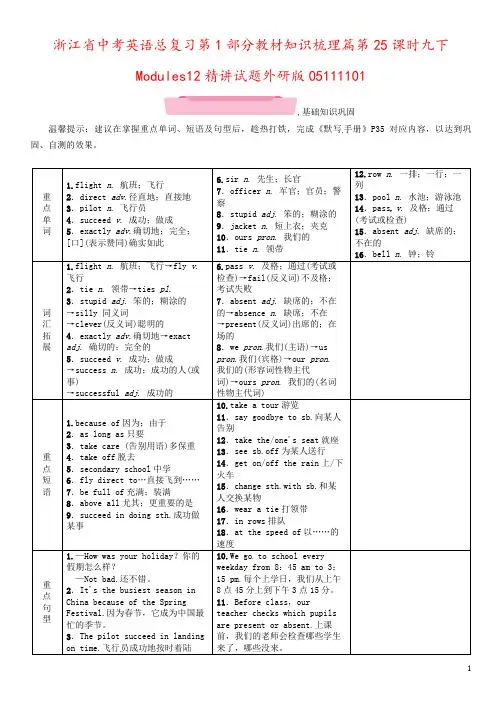
,基础知识巩固 温馨提示:建议在掌握重点单词、短语及句型后,趁热打铁,完成《默写手册》P35对应内容,以达到巩固、自测的效果。 重
点
单
词 1.flight n. 航班;飞行
2.direct adv.径直地;直接地
3.pilot n. 飞行员
4.succeed v. 成功;做成
5.exactly adv.确切地;完全;
[口](表示赞同)确实如此 6.sir n. 先生;长官
7.officer n. 军官;官员;警察
8.stupid adj. 笨的;糊涂的
9.jacket n. 短上衣;夹克
10.ours pron. 我们的
11.tie n. 领带 12.row n. 一排;一行;一列
13.pool n. 水池;游泳池
14.pass v. 及格;通过(考试或检查)
15.absent adj. 缺席的;不在的
16.bell n. 钟;铃
词
汇
拓
展 1.flight n. 航班;飞行→fly v.
飞行
2.tie n. 领带→ties pl.
3.stupid adj. 笨的;糊涂的→silly 同义词
→clever(反义词)聪明的
4.exactly adv.确切地→exact
adj. 确切的;完全的
5.succeed v. 成功;做成→success n. 成功;成功的人(或事)
→successful adj. 成功的 6.pass v. 及格;通过(考试或检查)→fail(反义词)不及格;考试失败
7.absent adj. 缺席的;不在的→absence n. 缺席;不在
→present(反义词)出席的;在场的
8.we pron.我们(主语)→us
pron.我们(宾格)→our pron.
我们的(形容词性物主代词)→ours pron. 我们的(名词性物主代词)
八年级(下册)
第8课时 Units1-2
知能优化训练
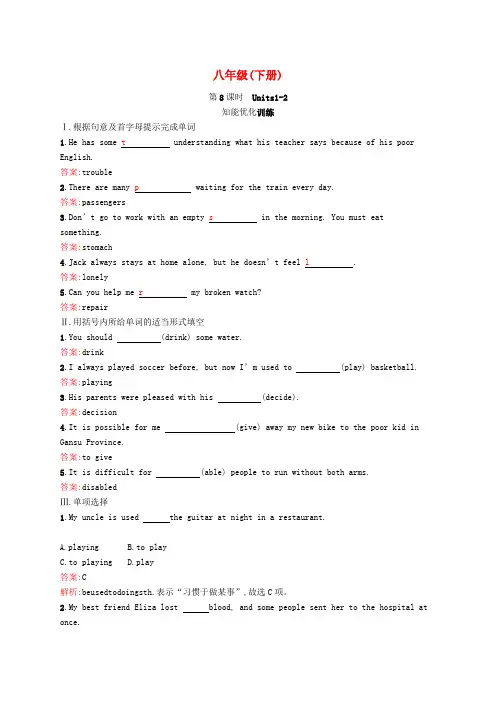
Ⅰ.根据句意及首字母提示完成单词
1.He has some t understanding what his teacher says because of his poor
English.
答案:trouble
2.There are many p waiting for the train every day.
答案:passengers
3.Don’t go to work with an empty s in the morning. You must eat
something.
答案:stomach
4.Jack always stays at home alone, but he doesn’t feel l .
答案:lonely
5.Can you help me r my broken watch?
答案:repair
Ⅱ.用括号内所给单词的适当形式填空
1.You should (drink) some water.
答案:drink
2.I always played soccer before, but now I’m used to (play) basketball.
答案:playing
3.His parents were pleased with his (decide).
答案:decision
4.It is possible for me (give) away my new bike to the poor kid in
Gansu Province.
答案:to give
5.It is difficult for (able) people to run without both arms.

八年级(上)Units 1-4
重难点精讲(懒人听讲解)
考点一They often go to the movies. 他们常常去看电影。(P2)
【用法归纳】常见频度副词的辨析
2012省卷24题、2012甘南61题、2011省卷23题考查
常见的频度副词有always, usually, often, sometimes, hardly, never。其频率大小如下图所示:
◆always意为“总是”,表示动作或状态中间没有间断。如:
The sun always rises in the east and sets in the west. 太阳总是东升西落。
◆usually 意为“通常”,即很少有例外。如:
He usually goes to bed at ten o’clock. 他通常10点钟睡觉。
◆often意为“常常”,不如usually那么频繁。如:
He is often late for school. 他上学经常迟到。
◆sometimes 意为“有时”,表示动作偶尔发生,可以位于句首,以示强调。如:
Sometimes he does it in this way and sometimes he does it in that way. 他有时这样做,有时那样做。
◆hardly 意为“几乎不,简直不”,常和ever 连用,意为“几乎不曾”hardly出现在反意疑问句中,附加词问句用肯定形式,表示强调。如:
I hardly ever go out these days. 这些天我几乎不出门。
◆never 意为“从来不,永不”。如:
My parents are never late for work.我父母上班从来不迟到。
考点二 —How often do you watch TV?你多久看一次电视?
—I watch TV every day.我每天都看电视。(P2)