
初中英语中考语法考点 专题一名词
- 格式:pptx
- 大小:137.45 KB
- 文档页数:25


第 1 页 共 10 页 定语从句
一、定语的概念:定语是用来修饰名词或代词的。比如:
(先试试用横线划出下面短语中的定语,然后在后面的括号里注明是什么在作定语)
a beautiful girl ( ) a shoe factory ( ) Jim’s
father ( )
our teacher ( ) the man in the car ( )
the man standing at the door ( ) the man who is talking with Sam
( )
二、定语从句的概念及主要特征:1.定语从句:2. 定语从句的主要特征:
在句中起定语作用,相当于形容词,修饰某一代词或名词或整个主句的从句。
1. 先行词 (Antecedent):定语从句所修饰的词。
2. 关系词 (Relatives) :连接主句与从句的词并在定语从句中充当某一句子成分。
3.定语从句所缺句子成分:主语、宾语、表语、状语。
The girl (先行词)who (关系词)stands under the tree is my sister.
三、定语从句的基本用法:
(一)关系代词引导的定语从句
1.who 指人,在定语从句中作主语,有时也作宾语。
The boys who are playing football are from Class One. 正在踢足球的男孩是一班的。
分析:先行词the boys 在从句中作主语。
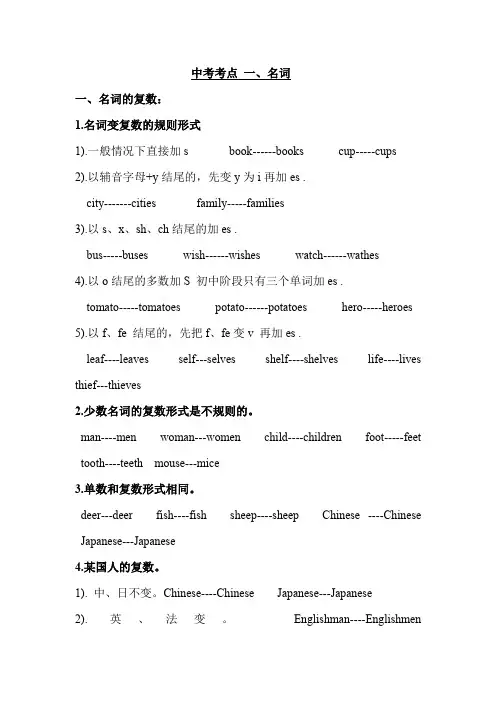
Those who want to go to the museum must be at the school gate at 7 tomorrow 定语从句的引导词关系代词关系副词指人指物who(主语、宾语),whom(宾语),that(主语、宾语), whose(定语)that(主语、宾语),which(主语、宾语)whose(定语)where (地点状语)when (时间状语)why (原因状语) 第 2 页 共 10 页 morning.
中考考点 一、名词
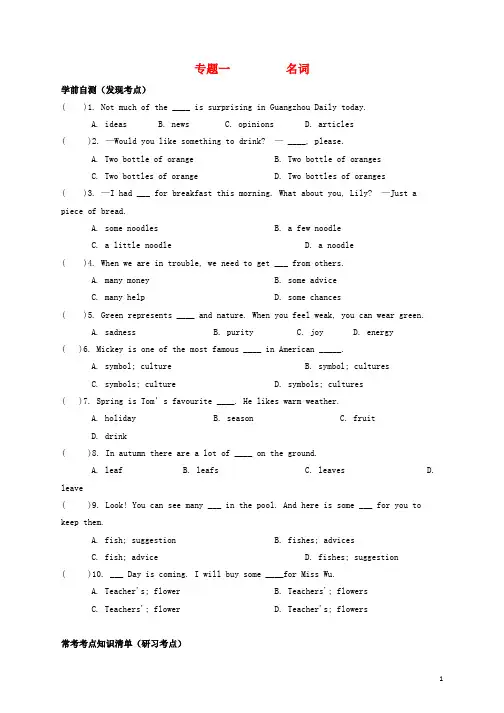
一、名词的复数:
1.名词变复数的规则形式
1).一般情况下直接加s book------books cup-----cups
2).以辅音字母+y结尾的,先变y为i再加es .
city-------cities family-----families
3).以s、x、sh、ch结尾的加es .
bus-----buses wish------wishes watch------wathes
4).以o结尾的多数加S 初中阶段只有三个单词加es .
tomato-----tomatoes potato------potatoes hero-----heroes
5).以f、fe 结尾的,先把f、fe变v 再加es .
leaf----leaves self---selves shelf----shelves life----lives
thief---thieves
2.少数名词的复数形式是不规则的。
man----men woman---women child----children foot-----feet
tooth----teeth mouse---mice
3.单数和复数形式相同。
deer---deer fish----fish sheep----sheep Chinese ----Chinese
Japanese---Japanese
4.某国人的复数。
1). 中、日不变。Chinese----Chinese Japanese---Japanese
2). 英、法变。 Englishman----Englishmen Frenchman----Frenchmen
3). 其余s加后面。 American -----Americans German----Germans
1 专题一 名词
学前自测(发现考点)
( )1. Not much of the ____ is surprising in Guangzhou Daily today.
A. ideas B. news C. opinions D. articles
( )2. —Would you like something to drink? — ____, please.
A. Two bottle of orange B. Two bottle of oranges
C. Two bottles of orange D. Two bottles of oranges
( )3. —I had ___ for breakfast this morning. What about you, Lily? —Just a
piece of bread.
A. some noodles B. a few noodle
C. a little noodle D. a noodle
( )4. When we are in trouble, we need to get ___ from others.
A. many money B. some advice
C. many help D. some chances
( )5. Green represents ____ and nature. When you feel weak, you can wear green.
A. sadness B. purity C. joy D. energy
( )6. Mickey is one of the most famous ____ in American _____.
专题01名词
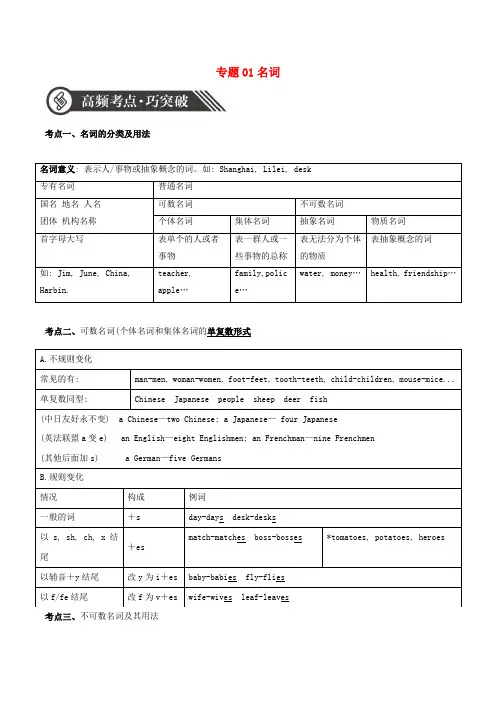
考点一、名词的分类及用法
名词意义:
表示人/事物或抽象概念的词。如: Shanghai, Lilei, desk
专有名词 普通名词
国名 地名 人名
团体 机构名称 可数名词 不可数名词
个体名词 集体名词 抽象名词 物质名词
首字母大写 表单个的人或者事物 表一群人或一些事物的总称 表无法分为个体的物质 表抽象概念的词
如: Jim, June, China,
Harbin. teacher,
apple… family,police… water, money… health, friendship…
考点二、可数名词(个体名词和集体名词的单复数形式
考点三、不可数名词及其用法 A.不规则变化
常见的有: man-men, woman-women, foot-feet, tooth-teeth, child-children, mouse-mice...
单复数同型: Chinese Japanese people sheep deer fish
(中日友好永不变) a Chinese—two Chinese; a Japanese— four Japanese
(英法联盟a变e) an English—eight Englishmen; an Frenchman—nine Frenchmen
(其他后面加s) a German—five Germans
B.规则变化
情况 构成 例词
一般的词 +s day-days desk-desks
以s, sh, ch, x结尾 +es match-matches boss-bosses *tomatoes, potatoes, heroes
以辅音+y结尾 改y为i+es baby-babies fly-flies
以f/fe结尾 改f为v+es wife-wives leaf-leaves (1)