概述英语中主语和谓语的一致
- 格式:pdf
- 大小:50.73 KB
- 文档页数:1
青春岁月
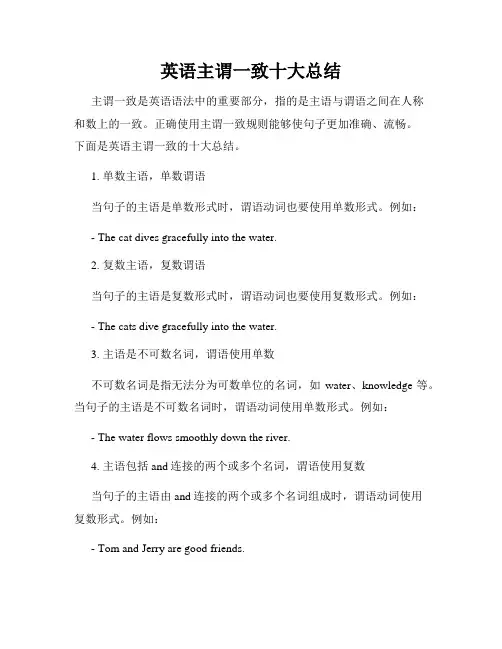
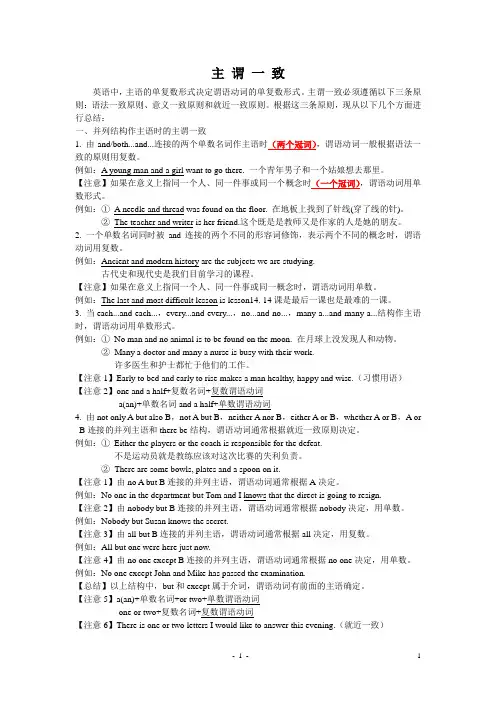
英语中,谓语动词在人称和数的方面必须和主语保持一致。
主谓一致,从总体上看包括三个方面:语法形式上的一致;意义上的一致;就近原则。
主谓一致的情况多而复杂,下面我将简要分述如下。
1、形式一致。
谓语动词的形式随主语的形式来确定,这是主谓一致的最基本的规律。
如:I am six teen,and he is fifteen.我十六,他十五。
2、形单义复。
某些集体名词如people,po lice,cro wd,cattle 等,在任何情况下都用作复数。
如:The police are searching fo r a thief.警察正在搜寻一个小偷。
(但po licem an 是个体名词,单数po licem an ,复数policemen )
3、整体为单,成员为复。
一些集体名词如family,class,g ro up,team,arm y 等作主语时,如果强调整体,谓语用单数;如果强调成员个体,则用复数。
如:M yfamily is a large one.我的家是个大家庭。
(整体)M y family are busy in gettingready for Spring Festival.我们一家人正忙着准备过年。
(成员)
4、单复同形。
fish,sheep,deer,Chinese,Japanese 等名词作主语时,谓语动词的变化应根据主语的意义而不是根据它的形式。
如:There is a deer in the zoo .动物园里有一头鹿。
There are deer in the zo o.动物园里有一些鹿。
5、形复义单。
News 和一些以-ics 结尾的学科名称如politics (政治),phy sics (物理),mathematics (数学)等,形式上是复数即词尾有s ,而意义上却是单数,它们作主语时,谓语用单数。
如:Phy sics is no t easy for u s.物理对我们来说不容易。
6、不定代词som eo ne,so mebo dy,so mething ,any one,an ybod y,any thing,everyo ne,every body ,ev ery thing,o n o ne,no body ,nothing 等作主语时,谓语动词用单数。
如:Someone wants to see yo u..有人要见你。
Every thing is ready.万事具备。
7、由两个对称的部分构成的一件物品如g lasses (眼镜),tro users(裤子),co mpasses (圆规),scisso rs (剪刀),cho psticks (筷子),clothes (衣服)等名词作主语时,谓语通常用复数。
如:Yo ur g lasses are o n the table.你的眼镜在桌上。
8、算式看做单数。
如:Fiv e plus fo ur is nine.五加四等于九。
9、表示时间、金钱、距离、重量的复数名词表示一个整体量用作主语时,谓语用单数。
如:One hundred years is not lon g.100年不算长。
T en dollars is enoug h for h im .10元钱就够他用的了。
10、the +形容词,表示具有某种特征的一类人,用作复数。
如:the o ld =the o ld people 老人the po or =the po or people 穷人
11、不定式、动名词、从句作主语,表示的是一个抽象的概念,谓语用单数。
如:Tosee is to believe.眼见为实。
Raising pig s is her job.喂猪是她的工作。
Ho w he g ot there is unknown.
12、定语从句的谓语要与先行词一致。
如:I do n ’t like the boo k that is p ut here.我不喜欢放在这儿的那本书。
I ’我不喜欢放在这儿的那些书。
13、“A +wit /as well as /tog ether w ith /along with /but /rather than /ex cept /besides …+B +谓语”结构,谓语取决于A 。
如:T he teacher with three students was doingan ex perim ent.那个老师和三个学生在做实验。
All but Li M ing hav e passed the test.除了李明,所有人都通过了考试。
14、就近原则。
以o r,either …o r,neither …no r,no t on ly …but also 等连接的名词或代词作主语时,谓语取决于和它最靠近的那个名词或代词。
如:Either y ou o r he is to g o.要么你去,要么他去。
Not only the child but alsothe parents are not allo wed to come in.那个孩子和他的父母都不准进来。
15、There 或here 引导的句子,主语不止一个时,谓语通常与邻近的名词或代词保持一致。
如:There is a desk,two chairs and three sofas in the roo m.Here are some env elops and a pen fo r y ou.
16、manya,m ore than on e 和后面的单数名词构成的短语当作单数,尽管它在意义上是“很多”。
如:Many a person has been there.很多人都去过那儿。
M ore than one perso n was invo lved in the case.很多人都牵涉进这个案件中。
17、“a number o f +复数名词”作主语看做复数,谓语用复数;“the number of +名词”看做单数,作主语时,谓语用单数。
如:A num ber o f students are ov er there.很多学生在那边。
T he number o f the students in our class is 70.我们班的学生数是70。
两者之所以不同,是因为短语中的中心词不同。
a num ber of students 的中心词是students ;the number of the students 的中心词是the num ber 。
【参考文献】
[1]王立善,戴宗显.中等职业教育课程改革国家规划新教材英语(下
册)[M].北京:语文出版社,2009:147-148.
概述英语中主语和谓语的一致
□张建红(新疆化学工业学校,新疆乌鲁木齐830021)
【摘要】英语中主语和谓语动词必须在人称和数的方面保持一致。
主谓一致的情况多而复杂,本文通过列举一些实例来简述主谓如何保持一致。
【关键词】主谓一致;单数形式;复数形式70
don t like those bo oks that are put here.。