
必修二演讲单元
- 格式:ppt
- 大小:517.50 KB
- 文档页数:16
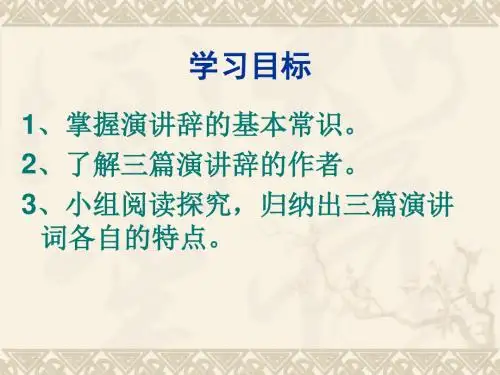

英语必修二演讲稿第四单元范文英文回答:My dear classmates, esteemed teachers,。
Today, I stand before you to express my thoughts on the topic of "The Power of Dreams." Dreams, as intangible as they may seem, hold an immense sway over our lives. They ignite our passions, fuel our aspirations, and shape the very fabric of our existence.Dreams are the sparks that ignite the flame of human aspiration. They propel us to transcend our limitations and strive for greatness. When we dream, we envision possibilities that extend beyond the confines of our current circumstances. It is through the power of dreams that individuals throughout history have achieved extraordinary feats, breaking down barriers and leaving an enduring legacy on the world.Dreams serve as a beacon of hope during times of adversity. They remind us that even in the face of setbacks and challenges, we have the capacity to overcome obstacles and create a better future. Dreams provide us with a sense of purpose and direction, guiding our actions and inspiring us to persevere even when the path ahead seems unclear.Moreover, dreams foster creativity and innovation. They spark ideas that might not otherwise have emerged and push us to explore new avenues of thought and action. Dreams allow us to break free from conventional thinking and embrace fresh perspectives, leading to groundbreaking discoveries and advancements.However, it is not enough to merely dream. To harness the transformative power of dreams, we must cultivate them, nurture them, and translate them into tangible actions. This requires perseverance, determination, and awillingness to take risks. It also entails surrounding ourselves with individuals who support our dreams and encourage us to pursue them relentlessly.In conclusion, dreams possess an undeniable power to shape our lives. They ignite our aspirations, provide hope during adversity, foster creativity, and ultimately lead to the realization of our full potential. By embracing the power of dreams, we unlock a world of possibilities and embark on a journey that is both fulfilling and transformative.中文回答:亲爱的同学们,尊敬的老师们,。
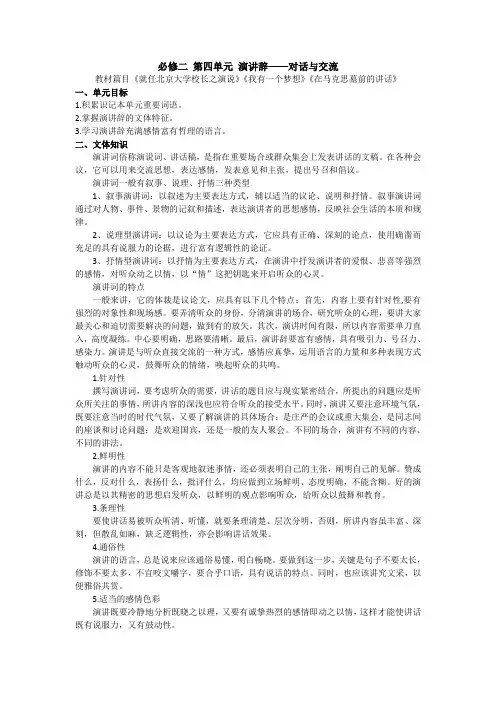
必修二第四单元演讲辞——对话与交流教材篇目《就任北京大学校长之演说》《我有一个梦想》《在马克思墓前的讲话》一、单元目标1.积累识记本单元重要词语。
2.掌握演讲辞的文体特征。
3.学习演讲辞充满感情富有哲理的语言。
二、文体知识演讲词俗称演说词、讲话稿,是指在重要场合或群众集会上发表讲话的文稿。
在各种会议,它可以用来交流思想,表达感情,发表意见和主张,提出号召和倡议。
演讲词一般有叙事、说理、抒情三种类型1、叙事演讲词:以叙述为主要表达方式,辅以适当的议论、说明和抒情。
叙事演讲词通过对人物、事件、景物的记叙和描述,表达演讲者的思想感情,反映社会生活的本质和规律。
2、说理型演讲词:以议论为主要表达方式,它应具有正确、深刻的论点,使用确凿而充足的具有说服力的论据,进行富有逻辑性的论证。
3、抒情型演讲词:以抒情为主要表达方式,在演讲中抒发演讲者的爱恨、悲喜等强烈的感情,对听众动之以情,以“情”这把钥匙来开启听众的心灵。
演讲词的特点一般来讲,它的体裁是议论文,应具有以下几个特点:首先,内容上要有针对性,要有强烈的对象性和现场感。
要弄清听众的身份,分清演讲的场合,研究听众的心理,要讲大家最关心和迫切需要解决的问题,做到有的放矢。
其次,演讲时间有限,所以内容需要单刀直入,高度凝练。
中心要明确,思路要清晰。
最后,演讲辞要富有感情,具有吸引力、号召力、感染力。
演讲是与听众直接交流的一种方式,感情应真挚,运用语言的力量和多种表现方式触动听众的心灵,鼓舞听众的情绪,唤起听众的共鸣。
1.针对性撰写演讲词,要考虑听众的需要,讲话的题目应与现实紧密结合,所提出的问题应是听众所关注的事情,所讲内容的深浅也应符合听众的接受水平。
同时,演讲又要注意环境气氛,既要注意当时的时代气氛,又要了解演讲的具体场合:是庄严的会议或重大集会,是同志间的座谈和讨论问题;是欢迎国宾,还是一般的友人聚会。
不同的场合,演讲有不同的内容、不同的讲法。
2.鲜明性演讲的内容不能只是客观地叙述事情,还必须表明自己的主张,阐明自己的见解。

英语高一必修二第五单元演讲稿范文Title: Embracing Change in Our Lives.Ladies and gentlemen,。
Good day! Today, I stand before you to delve into atopic that is as inevitable as it is significant Embracing Change in Our Lives. Change, a constant and pervasive force, shapes our world in ways both visible and invisible. It's the engine of progress, the catalyst for growth, and yet,it often brings a mix of excitement, fear, and uncertainty.In the words of Confucius, "Change is the only constant in life. One's ability to adapt to those changes will determine one's success in life." This quote resonates deeply with me, reminding us that our adaptability to change is a crucial skill that determines our success. Whether it's a new school, a shifting social circle, or the ever-evolving technological landscape, change is a part of our lives, and it's crucial to learn how to navigate itgracefully.Firstly, let's acknowledge that change is not always easy. It can be daunting to step into the unknown, to embrace new experiences, and to adapt to new routines. Change often brings about a sense of loss, whether it's the loss of familiar surroundings, the end of a chapter, or the fear of the unknown. It's natural to feel resistant to change, but resistance often leads to stagnation.Embracing change, on the other hand, opens us up to new possibilities and opportunities. It's a leap of faith into the unknown, but one that can lead to personal growth and new horizons. Embracing change means being open to new ideas,适应新环境,接纳新事物,and learning from each experience, whether it's a success or a failure.To embrace change effectively, we need to cultivate a mindset of positivity and flexibility. We need to believe that every change, whether big or small, holds thepotential for growth and learning. We need to view changes as stepping stones to better futures, not obstacles toovercome.Moreover, we need to cultivate resilience. Change often brings about challenges and difficulties, but it's our resilience that helps us navigate through them. Resilience is the ability to bounce back from adversity, to learn from our mistakes, and to keep moving forward. It's a skill that we can cultivate through practice and perseverance.Additionally, we should never forget to take time for self-reflection. Change can be overwhelming, and it's essential to pause, reflect, and understand how we are feeling about it. Self-reflection helps us gain clarity on our thoughts and emotions, allowing us to make informed decisions about how we want to approach the change.In conclusion, change is inevitable, and while it can be daunting, it also brings opportunities for growth and learning. By embracing change with an open mind and a positive attitude, we can turn each change into a new beginning, a chance to discover ourselves, and to create a better future. Let's not fear change but instead welcome itas a necessary and exciting part of our lives.Thank you for listening. I hope my words have inspired you to view change through a new lens and to embrace itwith open arms. Together, let's welcome change, adapt to it, and grow from it.This concludes my speech. Thank you once again for your attention.。
![[高中一年级语文]必修二演讲单元](https://imgs-1438308264.cos.ap-hongkong.myqcloud.com/03766a28e518964bcf847cfc.webp)