
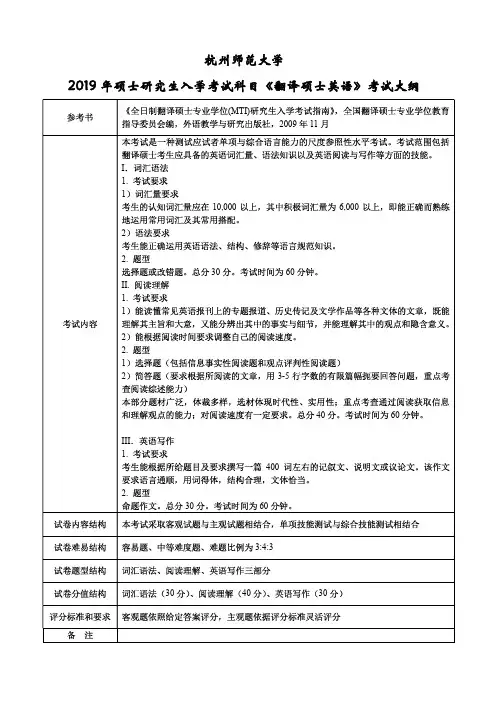
杭州师范大学2019年《211翻译硕士英语》考研专业课考试大纲
- 格式:pdf
- 大小:389.01 KB
- 文档页数:1
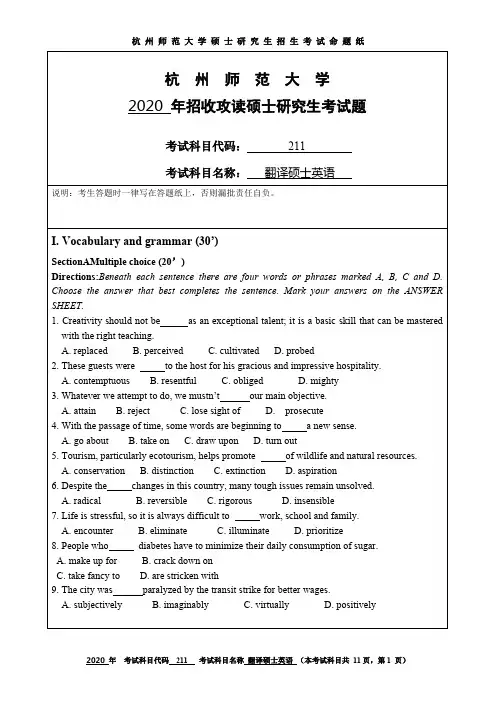
杭州师范大学2020年招收攻读硕士研究生考试题考试科目代码:211考试科目名称:翻译硕士英语说明:考生答题时一律写在答题纸上,否则漏批责任自负。
I. Vocabulary and grammar (30’)SectionAMultiple choice (20’)Directions:Beneath each sentence there are four words or phrases marked A, B, C and D. Choose the answer that best completes the sentence. Mark your answers on the ANSWER SHEET.1. Creativity should not be as an exceptional talent; it is a basic skill that can be mastered with the right teaching.A. replacedB. perceivedC. cultivatedD. probed2. These guests were to the host for his gracious and impressive hospitality.A. contemptuousB. resentfulC. obligedD. mighty3. Whatever we attempt to do, we mustn’t our main objective.A. attainB. rejectC. lose sight ofD. prosecute4. With the passage of time, some words are beginning to a new sense.A. go aboutB. take onC. draw uponD. turn out5. Tourism, particularly ecotourism, helps promote of wildlife and natural resources.A. conservationB. distinctionC. extinctionD. aspiration6. Despite the changes in this country, many tough issues remain unsolved.A. radicalB. reversibleC. rigorousD. insensible7. Life is stressful, so it is always difficult to work, school and family.A. encounterB. eliminateC. illuminateD. prioritize8. People who diabetes have to minimize their daily consumption of sugar.A. make up forB. crack down onC. take fancy toD. are stricken with9. The city was paralyzed by the transit strike for better wages.A. subjectivelyB. imaginablyC. virtuallyD. positively10. The changes brought about by digital technologies have impacted the whole world.A. novelB. adverseC. profoundD. prospective11. The camps are not usual tent-type camps. They are mostly long-established,structures, often with strange Islamic names.A. historicalB. monotonousC. permanentD.raw12. Among all the changes resulting from the ______ entry of women into the work force, the transformation that has occurred in the women themselves is not the least important.A. massiveB. quantitativeC. surplusD. formidable13. The manufacturing in China is expected to continue to expand in 2019 despite the slight decline of an index.A. versionB. sectorC. questD.factor14. Researchers say that cigarettes is necessary to dramatically reduce the chance of cardiovascular problems.A. carrying outB. breaking outC. cutting outD. putting out15. Economic recessions will weaken one’s confidence in the government and threaten social .A. cohesionB. erosionC. illusionD. evasion16. The Mexican settlers built cities and missions in what become California.A. used toB. would ratherC. was toD. had better17. Each of us is working hard to get happiness which brings substantial benefits for society .A. by mere chanceB. at great lengthC. all at onceD. as a whole18. Although the colonists ______ to some extent with the native Americans, the Indians’ influence on American culture and language was not extensive.A. migratedB. matchedC. mingledD. melted19. Most readers believe that this book is , thoughtful and informative.A. intriguingB. ambiguousC. compulsiveD. imperative20. Some of the recent actions of the government are their statement of policy.A. in the interest ofB. in conformity withC. in proportion toD. in the event ofSectionB Proofreading and error correction (10’)The passage contains TEN errors. Each indicated line contains a maximum of ONE error. In each case, only ONE word is involved. You should proofread the passage and correct it in the following way:For a wrong word underline the wrong word and write the correct one inthe blank provided at the end of the lineFor a missing wordmark the position of the missing word with a “Λ” signand write the word you believe to be missing in theblank provided at the end of the line.For an unnecessary word cross the unnecessary word with a slash “/”and put theword in the blank provided at the end of the line.EXAMPLEW h e nΛa r t m u s e u m w a n t s a n e w e x h i b i t,(1) anIt never buys things in finished form and hangs (2) neverthem on the wall. When a natural history museumwants an exhibition, it must often build it. (3) exhibitMany people are disturbed by the genetic diversify of (1)cancers--- an inevitable result of random evolution. (2)Cancer therapies used to be applied fairly random or (3)Carelessly, but nowadays many believe that effectivetherapies need to be specific and tailoring to genetic (4)faults in each individual’s cancer. Therefore, a personalized(5)treatment disregards the most fundamental reason (6)it is difficult to cure cancers once for all: cancer cellsadapt and evolve with response to treatment. Even drugs (7)that are initially effective often have a progressive (8)diminishing effect, as the biological systems blockedof the treatment spontaneously compensateof rerouting (9)the cancer cell’s internal wiring, in restoring the cancer’s (10)ability to spread. To use an analogy, in the absence ofshort cuts, evolution takes over: naturally arising mutantcancer cells that are resistant to the targeted drug rapidlyoutgrow their disabled siblings and cancer comes back.II. Reading comprehension(40’)Section A Multiple choice (20’)Directions:In this section there are two passages followed by multiple choice questions. Read the passages and then mark your answers on the answer sheet.Passage AThe language of rights now dominates political debate in the United States. Does the Government respect the moral and political rights of its citizens? Or does the Government’s war policy, or its race policy, fly in the face of these rights? Do the minorities whose rights have been violated have the right to violate the law in return? Or does the silent majority itself have rights, including the right that those who break the law be published? It is not surprising that these questions are now prominent. The concept of rights, and particularly the concept of rights against the Government, has its most natural use when a political society is divided, and appeals to co-operation or a common goal are pointless.The debate does not include the issue of whether citizens have some moral rights against their Government. It seems accepted on all sides that they do. Conventional lawyers and politicians take it as a point of pride that our legal system recognizes, for example, individual rights of free speech, equality, and due process. They base their claim that our law deserves respect, at least in part, on that fact, for they would not claim that totalitarian system deserve the same loyalty.Some philosophers, of cause, reject the idea that citizens have rights apart from what the law happens to give them. Bentham thought that the idea of moral rights was “nonsense on stilts”. But that view has never been part of our orthodox political theory, and politicians of both parties appeal to the rights of the people to justify a great part of what they want to do. I shall not be concerned, in this essay, to defend the thesis that citizens have moral rights against their governments; I want instead to explore the implications of that thesis for those, including the present United States Government, who profess to accept it.It is much in dispute, of cause, what particular rights citizens have. Does the acknowledged right to free speech, for example, include the right to participate in nuisance demonstrations? In practice, the Government will have the last word on what an individual’s rights are, because its police will do what the officials and courts say. But that does not mean that the Government’s view is necessarily the correct view, anyone who thinks it does must believe that men and women have such moral rights as Government chooses to grant, which means they have no moral rights at all.All this is sometimes obscured in the United States by the constitutional system. The American Constitution provides a set of individual legal rights in the First Amendment, and in due process, equal protection, and similar clauses. Under present legal practice the Supreme Court has the power to declare an act of Congress or of a state legislature void if the Court finds that the act offends these provisions. This practice has had some commentators to suppose that individual moral rights are fully protected by this system, but that is hardly so, nor could it be so.1. In the United States nowadays__________.A. politicians are discussing about the right language.B. politicians are debating about what is right and what is wrong.C. language is the most important theme in the political debate.D. we can hear lots of talks about rights.2. It is only natural that questions about citizens’ rights are now prominent because__________A. the minorities are violating the law.B. the political society in the USA is divided.C. the silent majority wants to punish those who have violated the law.D. people are looking for a common goal.3. Which of the following statements is not true?A. It is generally agreed that citizens should have some moral rights.B. It is a moral right of the citizens to respect the legal system.C. Citizens’ moral rights include free speech, equality and due process.D. The legal system deserves respect because it recognizes citizens’ moral rights.4. In this essay the author will not be concerned to defend the thesis that citizens have moralrights against their government because__________A. this thesis has never bee put into question in the mainstream political theory.B. he shares the view of those philosophers who think that citizens only have the rights that thelaw gives them.C. this thesis has appeal to politicians of both parties.D. the United States government professes to accept this thesis.5. The author believes that__________A. the United States Constitution protects citizens’ moral rights but the government does not.B. the Supreme Court has the power to protect citizens’ moral rights but it does not do that.C. Citizens’ moral rights could not be fully protected by the present legal practice.D. the United States Constitution does not have provisions that fully protect citizens’ moralrights.Passage BWhat do you do when everyone hates you? That is the problem faced by America’s pharmaceutical industry. Despite its successes in treating disease and extending longevity, soaring health-care costs and bumper profits mean that big drug firms are widely viewed as exploitative, and regarded almost as unfavorably as tobacco and oil firms (see chart). Last week, at a conference organized by The Economist in Philadelphia, the drug industry was offered some advice from an unlikely source: a tobacco firm. Steven Parrish of Altria, the conglomerate that includes Philip Morris, gave his perspective on how an industry can improve its tarnished public image.Comparing the tobacco and pharmaceutical industries might seem absurd, or even offensive. “Their products kill people. Our products save people's lives,” says Alan Holmer, the head of the Pharmaceutical Research and Manufacturers of America, an industry association. Yet the drug giants currently face an unprecedented onslaught of class-action lawsuits and public scrutiny; industry bosses are being grilled by lawmakers asking who knew what and when. It is all reminiscent of what happened to the tobacco industry in 1994.Mr. Parrish advised drug firms to abandon their bunker mentality and engage with their critics. Rather than arguing about the past, he said, it is better to move on, and give people something new to think about. (Philip Morris now acknowledges, for example, that cigarettes are addictive and deadly, and is trying to develop less harmful products.) Not everyone is open to persuasion, so focus on those who are, he said. But changing opinions takes time and demands deeds as well as words: “This is not about spin, this is about change.”The pharmaceutical industry is pursuing a range of initiatives to mollify its critics, Mr. Holmer noted in his own speech. But Mr. Parrish suggested that speaking with one voice through a trade association might be counter-productive, since it can give the impression that the industry is a monolithic cartel. And too much advertising, he said, can actually antagonize people further.The audience was generally receptive, claims Mr. Parrish. This is not the first time he has offered his thoughts on dealing with implacable critics. At a conference at the University of Michigan last year, he offered America’s State Department advice on improving America’s image in the Middle East. So does his prescription work? There has been a positive shift in attitudes towards tobacco firms, if only a small one. But at least, for once, a tobacco firm is peddling a cure, rather than a disease.1. Why is America’s pharmaceutical industry so unpopular?A. Because it, like tobacco and oil firms, does harm to people‘s health and environment.B. Because it fails to cure disease and make people live longer.C. Because the prices of its products are too high and its profit margin is too wide.D. Because it exploits its employees.2. Alan Holmer is quoted to illustrate that __________A. the comparison between tobacco and pharmaceutical industries might seem ridiculous, oreven insulting.B. the pharmaceutical industries agree that they are similar to tobacco industry.C. tobacco products do more harm to people than pharmaceutical products.D. pharmaceutical industries are currently facing lots of problems.3. According to the text, Mr. Parrish gives the following suggestions to drug firms except__________A. To acknowledge the problems and try to do something to improve their images.B. Not to react to the public in one voice through the drug association.C. Not to care about the past.D. To try to spend time and energy to persuade the majority of the audience who are open topersuasion.4. The word “mollify” (Line 1, Paragraph 4) might mean?A. placateB. enrageC. fightD. relieve5. What does the author imply by saying “This is not the first time he has offered histhoughts on dealing with implacable critics.”?A. Mr. Parrish has offered his advice to other on dealing with tough critics for several times.B. Mr. Parrish has dealt successfully with other critics himself.C. Mr. Parrish has given sound advice to drug firms.D. Mr. Parrish has been of help to others on critical moments.Section B Answering questions(20’)Directions:Read the following two passages and then answer IN COMPLETE SENTENCES the questions which follow each passage. Use only information from the passage you have just read and write your answers on the answer sheet.Questions 1-3New tools offer new opportunities, but what are the risks and who benefits?Human intervention for the improvement of crops, trees, livestock and fish is nothing new. For millennia, humans have bred, crossed and selected those varieties, ecotypes and breeds that were more productive, better adapted or particularly useful.Conventional breeding practices can now be complemented by a number of new and powerful techniques. Some of these allow, for example, the propagation of plant material in glass tubes to keep it free of diseases, and the production of more sensitive and specific reagents for diagnosing diseases in plants, livestock and fish through tissue and cell culture. Others, often referred to as molecular methods, enable scientists to see the layout of the entire genome of any organism and to select plants and animals with preferred characteristics by “reading” at the molecular level, saving precious time and resources.Modern biotechnology also includes an array of tools for introducing or deleting a particular gene or genes to produce plants, animals and micro-organisms with novel traits. This kind of genetic manipulation is called “genetic engineering” and the product is a genetically modifiedorganism, or GMO. Both traditional and modern biotechnologies result in plants, animals and micro-organisms with combinations of genes that would not have come about without human intervention. It has to be emphasized, however, that biotechnology includes a range of techniques and products, and GMOs are but one of them.“With the increasingly limited amount of new land available to agriculture, modern biotechnologies could complement and improve the efficiency of traditional selection and breeding techniques to enhance agricultural productivity,” says Mahmoud Solh, Director of FAO’s Division of Plant Production and Protection.A plant or an animal resistant to a particular disease can be produced through a “traditional” breeding programme, that is, through crosses with resistant relative, selection and backcrossing again, or by the introduction of a gene that confers the resistance through genetic engineering. While the products of both approaches will be disease resistant, only the second one is a GMO. What is new is the ability of scientists to unravel the genome to look at the genes of an organism, and then make use of that information to change the organism, and even transfer genes to another organism very distant in the evolutionary scale. And that is where the controversy comes in.“FAO recognizes that genetic engineering has the potential to help increase production and productivity in agriculture, forestry and fisheries,” says FAO’s Statement on Biotechnology. “It could lead to higher yields on marginal lands in countries that today cannot grow enough food to feed their people.” But, it adds, FAO “is also aware of the concern about the potential risks posed by certain aspects of biotechnology. These risks fall into two basic categories: the effects on human and animal health and the environmental consequences.”These new tools offer new opportunities for solving problems where traditional techniques have failed. Genetically modified products are usually developed and used for large-scale commercial interests, and with a few exceptions, small-scale farmers have so far not benefited from the technology.The articles in this focus are intended to provide background information on genetic engineering in agriculture for the non-specialist--what it is, how it is being used, how it might be used in the future and possible benefits and risks. If you are new to the subject, you might find it easiest to read the pages in the order shown in the column on the right. Those who would like to pursue the subject further may wish to visit.1. According to the passage, what is called “genetic engineering”?2. What are the potential benefits and risks of genetic engineering in agriculture?3. Why are small-scale farmers unlikely to benefit from biotechnology?Questions 4-5According to the latest figures, the majority of the world’s population is now bilingual or multilingual, having grown up speaking two or more languages. In the past, such children were considered to be at a disadvantage compared with their monolingual peers. Over the past fewdecades, however, technological advances have allowed researchers to look more deeply at how bilingualism interacts with and changes the cognitive and neurological systems, thereby identifying several clear benefits of being bilingual.Research shows that when a bilingual person uses one language, the other is active at the same time. When we hear a word, we don’t hear the entire word all at once: the sounds arrive in sequential order. Long before the word is finished, the brain’s language system begins to guess what that word might be. If you hear ‘can’, you will likely activate words like ‘candy’ and ‘candle’ as well, at least during the earlier stages of word recognition. For bilingual people, this activation is not limited to a single language; auditory input activates corresponding words regardless of the language to which they belong. Some of the most compelling evidence for this phenomenon, called ‘language co-activation’, comes from studying eye movements. A Russian-English bilingual asked to ‘pick up a marker’ from a set of objects would look more at a stamp than someone who doesn’t Know Russian, because the Russian word for ‘stamp’, marka, sounds like the English word he or she heard, ‘marker’. In cases like this, language co-activation occurs because what the listener hears could map onto words in either language.Having to deal with this persistent linguistic competition can result in difficulties, however. For instance, knowing more than one language can cause speakers to name picture more slowly, and can increase ‘tip-of-the-tongue states’, when you can almost, but not quite, bring a word to mind. As a result, the constant juggling of two language creates a need to control how much a person accesses a language at any given time. For this reason, bilingual people often perform better on tasks that require conflict management. In classic Stroop Task, people see a word and are asked to name the colour of the word’s font. When the colour and the word match (i.e., the word ‘red’ printed in red), people correctly name the colour more quickly than when the colour and the word don’t match (i.e., the word ‘red’ printed in blue). This occurs because the word itself (‘red’) and its font colour (blue) conflict. Bilingual people often excel at tasks such as this, which tap into the ability to ignore competing perceptual information and focus on the relevant aspects of the input. Bilinguals are also better at switching between two tasks; for example, when bilinguals have to switch from categorizing objects by colour (red or green) to categorizing them by shape (circle or triangle), they do so more quickly than monolingual people, reflecting better cognitive control when having to make rapid changes of strategy.It also seems that the neurological roots of the bilingual advantage extend to brain areas more traditionally associated with sensory processing. When monolingual and bilingual adolescents listen to simple speech sounds without any intervening background noise, they show highly similar brain stem responses. When researchers play the same sound to both groups in the presence of background noise, however, the bilingual listeners’ neural response is considerably larger, reflecting better encoding of the sound’s fundamental frequency, a feature of sound closely related to pitch perception.Such improvements in cognitive and sensory processing may help a bilingual person toprocess information in the environment, and help explain why bilingual adults acquire a third language better than monolingual adults master a second language. This advantage may be rooted in the skill of focusing on information about the new language while reducing interference from the languages they already know.Research also indicates that bilingual experience may help to keep the cognitive mechanisms sharp by recruiting alternate brain networks to compensate for those that become damaged during aging. Older bilinguals enjoy improved memory relative to monolingual people, which can lead to real-world health benefits. In a study of over 200 patients with Alzheimer’s disease, a degenerative brain disease, bilingual patients reported showing initial symptoms of the disease an average of five years later than monolingual patients. In a follow-up study, researchers compared the brains of bilingual and monolingual patients match on the severity of Alzheimer’s symptoms. Surprisingly, the bilinguals’ brains had more physical signs of disease than their monolingual counterparts, even though their outward behaviour and abilities were the same. If the brain is an engine, bilingualism may help it to go farther on the same amount of fuel.Furthermore, the benefits associated with bilingual experience seem to start very early. In one study, researchers taught seven-month-old babies growing up in monolingual or bilingual homes that when they heard a tinkling sound, a puppet appearing on the opposite side of the screen. In order to get a reward, the infants had to adjust the rule they’d learned; only the bilingual babies were able to successfully learn the new rule. This suggests that for very young children, as well as for older people, navigating a multilingual environment imparts advantages that transfer far beyond language.4. Why do bilingual people often perform better than monolingual people on tasks that requireconflict management?5. According to the passage, what are the results when monolingual and bilingual adolescentslisten to simple speech sounds with or without intervening background noise?III. Writing (30’)Directions:After Abhijit Banerjee, Esther Duflo and Michael Kremer were awarded the 2019 Nobel Memorial Prize in Economic Science for their outstanding contributions to “experimental research” into the “daunting issue” of global poverty, many have questioned the Nobel Committee’s choice, with some saying China’s poverty alleviation efforts have been the most effective in the world and are more worthy of study. But since the three winners are experts in development economics, this year’s Nobel Prize for economics is seen as highlighting the global need for eradicating poverty and achieving common economic growth.Write a composition of about 400 words on the ANSWER SHEET, in which you should:(1) express your opinion on why poverty alleviation core of development economics andwhat further steps to be taken.(2) give sound arguments to support your view.Marks will be awarded for content relevance, content sufficiency, organization, and language quality.Failure to follow the above instructions may result in a loss of marks.杭州师范大学2019年招收攻读硕士研究生考试题考试科目代码:211考试科目名称:翻译硕士英语说明:考生答题时一律写在答题纸上,否则漏批责任自负。
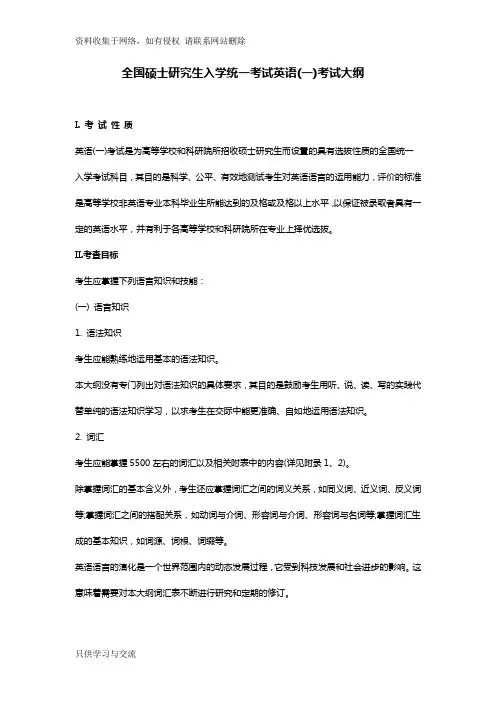
全国硕士研究生入学统一考试英语(一)考试大纲I. 考试性质英语(一)考试是为高等学校和科研院所招收硕士研究生而设置的具有选拔性质的全国统一入学考试科目,其目的是科学、公平、有效地测试考生对英语语言的运用能力,评价的标准是高等学校非英语专业本科毕业生所能达到的及格或及格以上水平,以保证被录取者具有一定的英语水平,并有利于各高等学校和科研院所在专业上择优选拔。
II.考查目标考生应掌握下列语言知识和技能:(一) 语言知识1. 语法知识考生应能熟练地运用基本的语法知识。
本大纲没有专门列出对语法知识的具体要求,其目的是鼓励考生用听、说、读、写的实践代替单纯的语法知识学习,以求考生在交际中能更准确、自如地运用语法知识。
2. 词汇考生应能掌握5500左右的词汇以及相关附表中的内容(详见附录1、2)。
除掌握词汇的基本含义外,考生还应掌握词汇之间的词义关系,如同义词、近义词、反义词等;掌握词汇之间的搭配关系,如动词与介词、形容词与介词、形容词与名词等;掌握词汇生成的基本知识,如词源、词根、词缀等。
英语语言的演化是一个世界范围内的动态发展过程,它受到科技发展和社会进步的影响。
这意味着需要对本大纲词汇表不断进行研究和定期的修订。
此外,全国硕士研究生入学英语统一考试是为非英语专业考生设置的。
考虑到交际的需要,考生还应自行掌握与本人工作或专业相关的词汇,以及涉及个人好恶、生活习惯和宗教信仰等方面的词汇。
(二) 语言技能1. 阅读考生应能读懂选自各类书籍和报刊的不同类型的文字材料(生词量不超过所读材料总词汇量的3%),还应能读懂与本人学习或工作有关的文献资料、技术说明和产品介绍等。
对所选材料,考生应能:1) 理解主旨要义;2) 理解文中的具体信息;3) 理解文中的概念性含义;4) 进行有关的判断、推理和引申;5) 根据上下文推测生词的词义;6) 理解文章的总体结构以及上下文之间的关系;7) 理解作者的意图、观点或态度;8) 区分论点和依据。

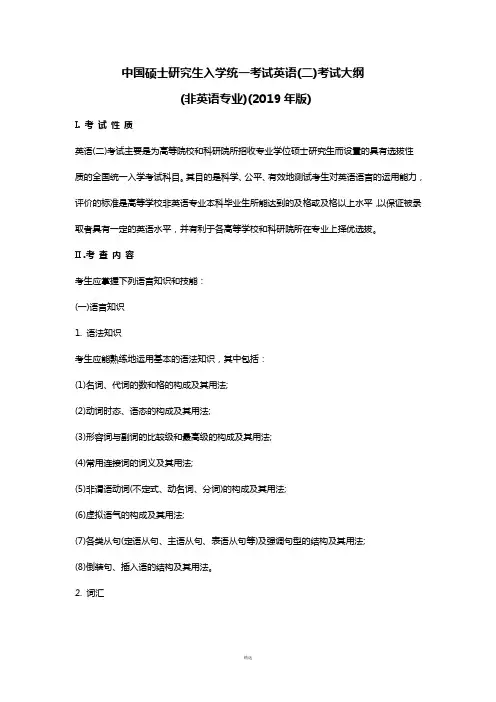
中国硕士研究生入学统一考试英语(二)考试大纲(非英语专业)(2019年版)I. 考试性质英语(二)考试主要是为高等院校和科研院所招收专业学位硕士研究生而设置的具有选拔性质的全国统一入学考试科目。
其目的是科学、公平、有效地测试考生对英语语言的运用能力,评价的标准是高等学校非英语专业本科毕业生所能达到的及格或及格以上水平,以保证被录取者具有一定的英语水平,并有利于各高等学校和科研院所在专业上择优选拔。
II .考查内容考生应掌握下列语言知识和技能:(一)语言知识1. 语法知识考生应能熟练地运用基本的语法知识,其中包括:(1)名词、代词的数和格的构成及其用法;(2)动词时态、语态的构成及其用法;(3)形容词与副词的比较级和最高级的构成及其用法;(4)常用连接词的词义及其用法;(5)非谓语动词(不定式、动名词、分词)的构成及其用法;(6)虚拟语气的构成及其用法;(7)各类从句(定语从句、主语从句、表语从句等)及强调句型的结构及其用法;(8)倒装句、插入语的结构及其用法。
2. 词汇考生应能较熟练地掌握5 500个左右常用英语词汇以及相关常用词组(详见附录相关部分)。
考生应能根据具体语境、句子结构或上下文理解一些非常用词的词义。
(二)语言技能1. 阅读考生应能读懂不同题材和体裁的文字材料。
题材包括经济、管理、社会、文化、科普等,体裁包括说明文、议论文和记叙文等。
根据阅读材料,考生应能:(1)理解主旨要义;(2)理解文中的具体信息;(3)理解语篇的结构和上下文的逻辑关系;(4)根据上下文推断重要生词或词组的含义;(5)进行一定的判断和推理;(6)理解作者的意图、观点或态度。
2. 写作考生应能根据所给的提纲、情景或要求完成相应的短文写作。
短文应中心思想明确、切中题意、结构清晰、条理清楚、用词恰当、无明显语言错误。
III. 考试形式、考试内容与试卷结构(一)考试形式考试形式为笔试。
考试时间为180分钟。
满分为100分。