
无机非金属材料工程专业英语 第2章
- 格式:ppt
- 大小:2.04 MB
- 文档页数:27
Unit 1 Materials Science and EngineeringMaterials science材料科学Stone age石器时代Naked eye肉眼Bronze age铜器时代Optical property光学性能Integrated circuit集成电路Mechanical strength机械强度Thermal conductivity导热“Materials science” involves investigating the relationships that exist between the structures and properties of materials. In contrast ,”materials engineering “is ,on the basis of there structure property correlations ,designing or engineering the structure of a material that produce a predetermined set of properties。
,材料工程是根据材料的结构和性质的关系来设计或操纵材料的结构以求制造出一系列可预定的性质。
从功能方面来说,材料科学家的作用是发展或合成新的材料Virtually all important properties of solid materials may be grouped into six different categories: mechanical, electrical, thermal, magnetic, optical ,and deteriorative。
固体材料的所有重要的性质可以分成六个不同的种类,机械性能、电性能、热性能、磁性能、光性能和内耗。
In addition to structure and properties , two other important components are involved in the sciences and engineering of materials , namely“processing”and“performance”.除了组织性能之外,另外两个重要的性质也包括在材料科学和工程之中,即“加工”和“特性”The more familiar an engineer or scientist is with the various characteristics and structure-property relationship,as well as processing techniques of material,the more proficient and confident he or she will be to make judicious materials choices based on these criteria。
Unit 2 Classification of MaterialsSolid materials have been conveniently grouped into three basic classifications: metals, ceramics, and polymers. This scheme is based primarily on chemical makeup and atomic structure, and most materials fall into one distinct grouping or another, although there are some intermediates. In addition, there are three other groups of important engineering materials —composites, semiconductors, and biomaterials.译文:译文:固体材料被便利的分为三个基本的类型:金属,陶瓷和聚合物。
固体材料被便利的分为三个基本的类型:金属,陶瓷和聚合物。
固体材料被便利的分为三个基本的类型:金属,陶瓷和聚合物。
这个分类是首先基于这个分类是首先基于化学组成和原子结构来分的,化学组成和原子结构来分的,大多数材料落在明显的一个类别里面,大多数材料落在明显的一个类别里面,大多数材料落在明显的一个类别里面,尽管有许多中间品。
尽管有许多中间品。
除此之外,此之外, 有三类其他重要的工程材料-复合材料,半导体材料和生物材料。
有三类其他重要的工程材料-复合材料,半导体材料和生物材料。
Composites consist of combinations of two or more different materials, whereas semiconductors are utilized because of their unusual electrical characteristics; biomaterials are implanted into the human body. A brief explanation of the material types and representative characteristics is offered next.译文:复合材料由两种或者两种以上不同的材料组成,然而半导体由于它们非同寻常的电学性质而得到使用;生物材料被移植进入人类的身体中。
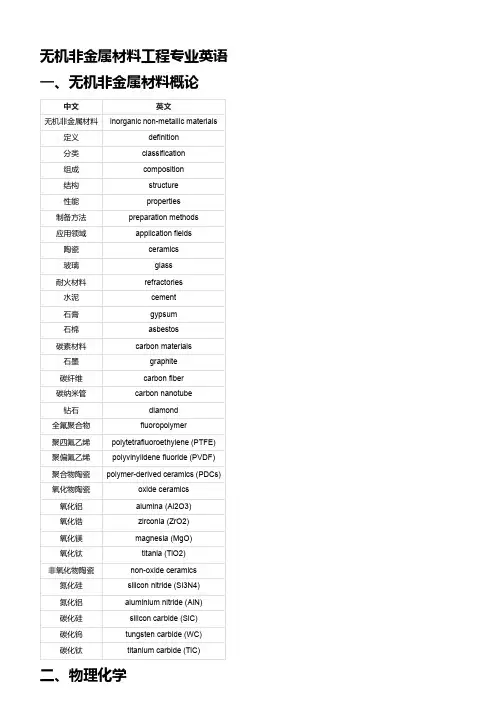
无机非金属材料工程专业英语一、无机非金属材料概论中文英文无机非金属材料inorganic non-metallic materials 定义definition分类classification组成composition结构structure性能properties制备方法preparation methods应用领域application fields陶瓷ceramics玻璃glass耐火材料refractories水泥cement石膏gypsum石棉asbestos碳素材料carbon materials石墨graphite碳纤维carbon fiber碳纳米管carbon nanotube钻石diamond全氟聚合物fluoropolymer聚四氟乙烯polytetrafluoroethylene (PTFE)聚偏氟乙烯polyvinylidene fluoride (PVDF)聚合物陶瓷polymer-derived ceramics (PDCs)氧化物陶瓷oxide ceramics氧化铝alumina (Al2O3)氧化锆zirconia (ZrO2)氧化镁magnesia (MgO)氧化钛titania (TiO2)非氧化物陶瓷non-oxide ceramics氮化硅silicon nitride (Si3N4)氮化铝aluminium nitride (AlN)碳化硅silicon carbide (SiC)碳化钨tungsten carbide (WC)碳化钛titanium carbide (TiC)二、物理化学中文英文物理化学physical chemistry物质matter结构structure组成composition性质properties变化规律laws of change分子运动论kinetic theory of molecules分子molecule原子atom离子ion气体gas液体liquid固体solid理想气体ideal gas真实气体real gas相平衡phase equilibrium相phase相图phase diagram相规则phase rule单元系unary system二元系binary system三元系ternary system溶液理论solution theory溶液solution溶剂solvent溶质solute浓度concentration摩尔分数mole fraction理想溶液ideal solution非理想溶液non-ideal solutionRaoult定律Raoult's lawHenry定律Henry's law三、无机材料科学基础中文英文无机材料科学基础fundamentals of inorganic materials science 无机材料inorganic materials结构structure性能properties结构-性能关系structure-property relationship晶体结构crystal structure晶体系统crystal system点阵类型lattice type空间群space group单胞参数lattice parameters基元胞primitive cell单位胞unit cell四、热工基础中文英文热工基础thermal engineering fundamentals热力学thermodynamics传热学heat transfer流体力学fluid mechanics热工学科thermal engineering disciplines 热力学第一定律first law of thermodynamics热力学第二定律second law of thermodynamics 热力系统thermodynamic system系统边界system boundary系统状态system state状态方程equation of state过程process循环cycle工作物质working substance理想气体ideal gas气体常数gas constant温度temperature压力pressure体积volume内能internal energy热容heat capacity比热容specific heat capacity焓enthalpy熵entropy自由能free energy吉布斯函数Gibbs function卡诺循环Carnot cycle热效率thermal efficiency 反向卡诺循环reversed Carnot cycle制冷系数coefficient of performance传导传热heat conduction傅里叶定律Fourier's law热导率thermal conductivity热阻thermal resistance稳态传热steady-state heat transfer非稳态传热transient heat transfer对流传热heat convection对流换热系数convection heat transfer coefficient 力对流forced convection自然对流natural convection努塞尔特数Nusselt number辐射传热heat radiation斯特藩-玻尔兹曼定律Stefan-Boltzmann law黑体blackbody发射率emissivity吸收率absorptivity反射率reflectivity透射率transmissivity灰体graybody视域因子view factor流体静力学fluid statics流体fluid密度density粘度viscosity表面张力surface tension液压hydrostatics帕斯卡定律Pascal's law流体运动方程equations of fluid motion质量守恒方程continuity equation动量守恒方程momentum equation能量守恒方程energy equation雷诺数Reynolds number理想流体ideal fluid实际流体real fluid层流laminar flow湍流turbulent flow边界层boundary layer阻力drag升力lift伯努利方程Bernoulli's equation皮托管Pitot tube五、无机非金属材料物理性能中文英文无机非金属材料物理性能physical properties of inorganic non-metallic materials 电学性能electrical properties磁学性能magnetic properties光学性能optical properties声学性能acoustic properties热学性能thermal properties电导率electrical conductivity电阻率electrical resistivity电容率electrical capacitance介电常数dielectric constant压电效应piezoelectric effect热电效应thermoelectric effect光电效应photoelectric effect半导体性质semiconductor properties铁电性质ferroelectric properties磁导率magnetic permeability磁化率magnetic susceptibility磁滞回线hysteresis loop铁磁性质ferromagnetic properties反铁磁性质antiferromagnetic properties顺磁性质paramagnetic properties抗磁性质diamagnetic properties光学常数optical constants折射率refractive index反射率reflectance吸收率absorbance透射率transmittance色散现象dispersion phenomenon双折射现象birefringence phenomenon声速sound velocity声阻抗acoustic impedance。
ferrous alloys铁合金More than 90% by weight of the metallic materials used by human beings are ferrous alloy. This represents an immense family of engineering materials with a wide range of microstructures and related properties. The majority of engineering designs that require structural load support or power transmission involve ferrous alloys. As a practical matter, those alloys fall into two broad categories based on the carbon in the alloy composition. Steel generally contains between wc=0.05% and wc=4.5%.超过90%的重量的金属材料使用的人类是铁合金。
这是一个巨大的工程材料的家庭与广泛的微观结构和相关的属性。
大部分的工程设计,需要结构性的负载支持或电力传输涉及铁合金。
作为一个实际问题,这些合金分为两大类基于碳在合金成分。
钢一般包含在wc = 0.05%和wc = 4.5%。
Within the steel category,we shall other than carbon is used.A compositon of 5% total noncarbon high alloy steels. Those alloy additions are chosen carefully becouse they invariably bring with them sharply increased material costs. They are justified only by essential improvements in improvements such as higher strength or improved corrosion resistance在钢的类别,我们将使用碳。
The Professional English for Inorganic Nonmetallic MaterialsA.Translation1.We define ceramics as the art and science of making and using solid articles which have as their essentialcomponent ,and are composed in large part of, inorganic nonmetallic materials.我们把陶瓷学定义为制造和应用由无机非金属材料作为基本组分组成的固体制品的技术和科学。
2.The origination of novel ceramic materials and new methods of manufacture requires us to take afundamental approach to the art and science and a broad view of the field.新颖的陶瓷材料和新的制造方法的出现,要求我们对这种技艺和科学进行基础性的探讨,并且要对相关领域有更广泛的认识。
3.Perhaps even more important than being useful or necessary of themselves are those situations inwhich the feasibility or effectiveness of a large system depends critically on its ceramic components.也许比陶瓷本身的实用性或必要性更为重要的是,一个大的系统是否切实可行或有效,在很大程度上取决于这一系统中所使用的陶瓷组件。
4.This leverage in the importance of ceramic materials has in many cases led to intensive research toward abetter understanding of properties, often out of all proportion to their dollar value.在很多情况下,陶瓷材料所具有的举足轻重的地位导致了对其进行深入的研究,以便更好地了解它的性能。
英语考得很简单,最后的翻译千万不要空着。
只要填上,老师就会给分,去年我们班有个孩子直接空着,老师都没办法通融。
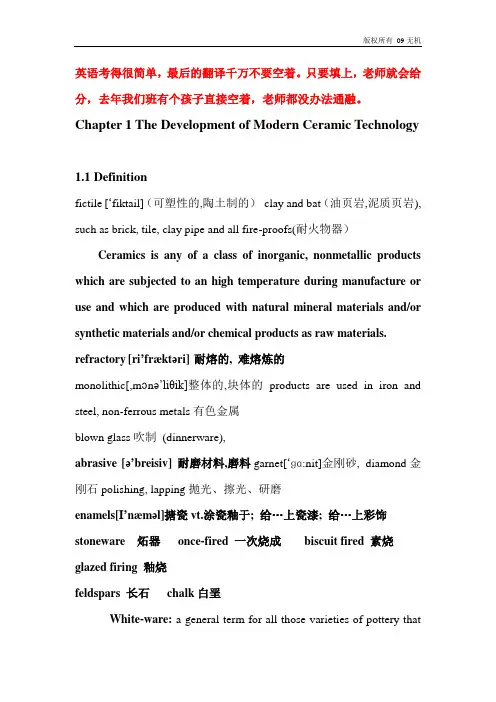
Chapter 1 The Development of Modern Ceramic Technology1.1 Definitionfictile[‘fiktail](可塑性的,陶土制的)clay and bat(油页岩,泥质页岩), such as brick, tile, clay pipe and all fire-proofs(耐火物器)Ceramics is any of a class of inorganic, nonmetallic products which are subjected to an high temperature during manufacture or use and which are produced with natural mineral materials and/or synthetic materials and/or chemical products as raw materials. refractory[ri’fræktəri]耐熔的, 难熔炼的monolithic[,mɔnə’liθik]整体的,块体的products are used in iron and steel, non-ferrous metals有色金属blown glass吹制(dinnerware),abrasive[ə’breisiv] 耐磨材料,磨料garnet[‘ɡɑ:nit]金刚砂, diamond金刚石polishing, lapping抛光、擦光、研磨enamels[I’næməl]搪瓷vt.涂瓷釉于; 给…上瓷漆; 给…上彩饰stoneware 炻器once-fired 一次烧成biscuit fired 素烧glazed firing 釉烧feldspars 长石chalk白垩White-ware: a general term for all those varieties of pottery thatusually have a white body, e.g, tableware, sanitary ware and wall tiles.Glaze: A thin glassy layer formed on the surface of a ceramic product by firing on applied coating, a glaze may be partially crystalline.Porcelain: thin shiny material of very fine quality, of which cups, dishes etc., may be made, and which is produced by baking a clay mixture.瓷器China: in USA, A STM-C242 defines the word as any glazed or unglazed vitreous ceramic white-ware used for non-technical purposes, e.g. dinnerware, sanitary-ware and art-ware, provided that they are vitreous. 精细瓷器China, a hard white substance made by baking fine clay at high temperature- compare porcelain.1.2 Classification of ceramicsAdvanced ceramics can be classified as Engineering Ceramics and Functional Ceramics by their propertiesTypical engineering ceramics now widely used are alumina [ə’lju:minə]n.氧化铝, zirconia[zə:’kəuniə]氧化锆, silicon carbide, and silicon nitride etcFunctional ceramics includes bioceramics,electronic ceramics, magnetic ceramics, optical ceramics,nuclear and environmental ceramics, super-conducting ceramics, electro-optic ceramics etc.1.3The history of Chinese ceramicsPorcelain derived from pottery. Scholars differ on 持不同意见exactly how and when pottery-making began.prehistory史前Porcelain was a great invention of ancient ChinaAfter 1,000 years, mature celadons [‘selədən]灰绿色,青瓷色were manufactured in Eastern Han. Eastern Han was in important milestone in Chinese ceramic history.For example, North Xin邢were white ceramics ‘‘silver-alike, snow-alike’’, Southern Yue were celadons ‘‘jade-alike, ice-alike’’, two series of wares "north white, South celadon ‘‘formed.The porcelain capital Jingdezhen grew up in Yuan Dynasty, and it was very famous for blue-and-white porcelain, underglazed[‘ʌndəɡleiz]釉下的red porcelain and egg white porcelain.People invented another new way to make ceramics which mixed porcelain stones and kaolin.bronze red 铜红delicate[‘delikit]精美的,雅致的elegant优美的the opium war 鸦片战争breaking out, China reduced to the status of semi-colonial[kə’ləunjəl], semi-feudal[‘fju:dl]封建的society with weak national power.Being the peak of Chinese ceramics history, the ceramics industry of Ming and Qing Dynasty had a great influence upon modern Chinese ceramics industry.sites of遗址the Neolithic age, commodities日用品, pottery figurine雕像. clay-strip building method (泥条筑成型方法)throw clay method(拉坯成型), side-fired kiln(侧烧窑)and shaft kiln (立窑)ground firing (园烧). firing temperature烧成温度Kiln[kiln]窑: A high temperature installation used for firing ceramic ware or for calcining or sintering.shaft kiln(立窑): vertical kiln charged at the top and discharged at the bottom.Celadon: An art ware glaze of a characteristic green colour, which is obtained by introducing a small percentage of iron oxide into the glaze match and firing under reducing conditions so that the iron is in ferrous state亚铁态.Aging(陈腐): A process, also known as souring, in which moistened clay, or prepared body, is stored for a period to permit the water to become more uniformly dispersed.filtration滤泥, washing, pugging mullering练泥, aging 陈腐were omitted. Body bareness (秃釉)and glaze flow(流釉)combination between body and glazeScaling(脱釉)seedtime(萌芽期)In this period, the society was turbulent(动荡), truceless(战乱). Buddhism[‘budizəm] 佛教all-time (有史以来)exquisite(优美的).The porcelain capital Jingdezhen grew up in Yuan Dynasty, and it was very famous for blue-and-white porcelain, underglazed red porcelain and egg white porcelain.jigger 辘轳车wheel jiggering 旋坯成型,又称压坯成型,或样板刀成型(template forming),是将可塑泥料置于旋坯机上旋转的石膏模具中,泥料受到样板刀剪切和挤压,在模子表面形成坯体的可塑成型方法。
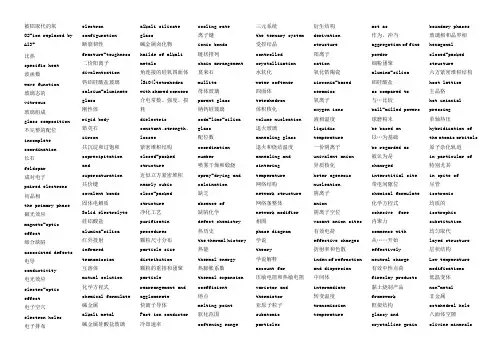
被铝取代的氧O2-ion replaced by Al3+比热specific heat波函数wave function玻璃态的vitreous玻璃组成glass composition 不完整的配位incomplete coordination长石feldspar成对电子paired electrons 初晶相the primary phase 磁光效应magneto-optic effect缔合缺陷associated defects 电导conductivity电光效应electro-optic effect电子空穴electron holes电子排布electronconfiguration断裂韧性fracture-toughness二价阳离子divalentcation钙铝硅酸盐玻璃calcium-aluminateglass刚性体rigid body锆英石zircon共沉淀和过饱和coprecipitationandsupersaturation共价键covalent bonds固体电解质Solid electrolyte硅铝酸盐alumina-silica红外投射infraredtransmission互溶体mutual solution化学方程式chemical formulate碱金属alkali metal碱金属硅酸盐玻璃alkali silicateglass碱金属卤化物hailde of alkalimetals角连接的硅氧四面体[SiO4]tetrahedrawith shared corners介电常数、强度、损耗dielectricconstant、strength、losses紧密堆积结构closed-packedstructure近似立方紧密堆积nearly cubicclose-packedstructure净化工艺purificatinprocedures颗粒尺寸分布particle sizedistribution颗粒的重排和团聚particlerearrangement andagglomerate快离子导体Fast ion conductor冷却速率cooling rate离子键ionic bonds链状排列chain arrangement莫来石mullite母体玻璃parent glass钠钙硅玻璃soda-lime-silicaglass配位数coordinationnumber喷雾干燥和煅烧spray-drying andcalcination缺乏absence of缺陷化学defect chemistry热历史the thermal history热能thermal energy热膨胀系数thermal expansioncoefficient熔点melting point软化范围softening range三元系统the ternary system受控结晶controlledcrystallization水软化water softener四面体tetrahedron体积核化volume nucleation退火玻璃annealing glass退火和烧结温度annealing andsinteringtemperature网络结构network structure网络条整体network modifier相图phase diagram学说theory学说解释account for压敏电阻和热敏电阻varistor andthermistor亚原子粒子subatomicparticles衍生结构derivationstructure阳离子cation氧化锆陶瓷zirconia-basedceramics氧离子oxygen ions液相温度liquidustemperature一价阴离子univalent anion异质核化heter ogeneousnucleation阴离子anion阴离子空位vacant anion sites有效电荷effective charges折射率和色散index of refractionand dispersion中间体intermediate转变温度transmissiontemperatureact as作为,冲当aggregation of finepowder细粉团聚alumina-silica铝硅酸盐as compared to与…比较ball-milled powers球磨粉末be based on以…为基础be regarded as被认为是chanrgedinterstitial site带电间隙位chemical formulate化学方程式cohesive fore内聚力commence with从……开始effectivelyneutral charge有效中性点荷fireclay products黏土烧制产品framework框架结构glassy andcrystalline grainboundary phases玻璃相和晶界相hexagonalclosed-packedstructure六方紧密堆积结构host lattice主晶格hot uniaxialpressing单轴热压hybridization ofthe atomic orbitals原子杂化轨道in particular of特别尤其in spite of尽管isotronic均质的isotrophicsubstitution均匀取代layed structure层状结构Low temperaturemodifications低温变体non-metal非金属octahedral hole八面体空隙olivine minerals橄榄石矿物on the basis of 以…为基础point defects点缺陷quantum mechanics 量子力学shrinkage and densification收缩和致密化solid solution固溶体tetrahedral coordinations四面体配位tetrahedral site 四面体位置Three dimensiona models三维结构模型transmission of light beams透过光束transparency、translucency、opacity透明、半透明、不透明universal acceptance普遍认可vacancy pair空位对Van der Waals forces范德华力vice versa反之亦然。
Composite materials复合材料Ferroconcrete钢筋混凝土Steel reinforcement钢筋Civil engineering土木工程Polymeric materials聚合物材料Structural properties结构性能Tailor structure performance调整结构Thermal expansion热膨胀Fatigue resistance耐疲劳Science efforts科研工作Comprehension综合理解Optimization最佳化Structural composite materials结构复合材料Component部件Economic经济上State of the art技术水平Satisfy specific requite满足特殊需求Thermoplastic based composite热塑性塑料基复合材料Composites based on Natural occurring materials天然存在材料为基体的复合材料Resin树脂Cost-efficient合算Biomedical生物医学Concurrent engineering methodology并存的工程方法论Natural tissues天然组织College of material science and engineering材料科学与工程学院Cross-disciplinary strategies交叉学科策略National institute for advanced interdisciplinary research国家先进跨学科研究院Combining element综合元素Tissue engineering组织工程Trend趋势Quality assurance质量保证Specific functional properties功能特性The principal requirement最主要的要求Filler size填料大小Surface chemical nature表面化学特性Magnetic-elastic磁致弹性Significantly enhance明显提高Elasto-dynamic response弹性动力学响应Atoms原子Electrons电子Mature manufacturing technology成熟加工技术Set at design level处于设计水平Expectation期望Sensor传感器Actuators调节器Organ器官Artificial prosthesis人造假肢Muscle肌肉Cartilage软骨Soft tissue软组织Composite structure复合结构Biohybrid technology生物杂化技术Culture cells培养细胞Delivery vehicle运载工具Polymeric biodegradable scaffold可降解的聚合物支架纳米材料Nanostructured materials纳米材料Categories种类Chemical composition化学组成The arrangement of the atoms原子排列Atomic structure原子结构Solid state physics固体物理Inert gas惰性气体Condensation冷凝Amorphous无固定形状的Precipitation沉降Crystalline结晶Devices器件装备Multilayer quantum多层量子Nanometer-sized纳米尺寸Bulk块状Ion implantation离子植入Laser beam激光束Supersaturated liquid饱和液体Atomic structure of solid surface固体表面的原子结构Hardness硬的Modify修改修饰Corrosion resistance抗腐蚀Wear resistance耐磨损Protective coating保护层Subgroup分枝Free surface自由表面Pattern模型Lithograph光蚀刻Local probes局部探测Near-field近场Focused聚焦的Beams电流能量Integrated circuit集成电路Single electron transistor单电子晶体管Building blocks构筑模型Gels胶体Supersaturated solid solutions过饱和固溶体Nano-length scale纳米尺度Implanted materials植入材料Quenching淬火Annealing退火Assembled装配Incoherent非共格Coherent interface共格晶面Heterogeneous非均质的Grain boundaries晶界Inherently天生的,固有的Synonymous同义的Exclusively专有的,表征Concept概念Industrial society工业社会Triggered引发Technological revolution科技发展Steam engine蒸汽机Initiated开创Industrial era工业时代Silicon technology硅技术Phase阶段Embryonic胚胎Intergration集成Illustrate说明Chemical systems化学物系Monomer单体Block模板Backbone主链Organism有机体Life science生命科学Macroscopic design宏观设计Molecular application of synthetic materials合成材料的结构应用Reshuffle重组Buzz Word术语Phenomena现象Scientific environment科学环境Microscopy显微技术Determine确定Characterize表征Architecture结构Fullerenes富勒烯Nanotube纳米管Dendritic枝状Hyperbranched超支化Promising希望Milestone里程碑Dendrimers枝状单体Multifunctional macromolecular多功能大分子Non-covalent非共价Covalent compound共价化合物Ionic compound离子化合物Organic compound有机化合物Supramolecular超分子Mimicking模拟Potential关键Sustainable民用Modify改变Concept of life生活观念Thorough彻底Chemical industry化学工业Merger合并Fusion融合Life cycle生命周期S-curve S曲线Cracker裂化装置Bulk polymer本体聚合物Synergy协同作用Solution provider决策者Principal原理Spin-off company派生公司Pronounced明确的Polymeric materials高分子材料Co-operation合作Venture capital风险投资Entrepreneurial spirit企业家精神Crucial至关重要Capacitor电容器Water purification systems水纯化装置Solid-solubility固熔度Electronegativity电负性Chemical formula化学式Stainless steels不锈钢Transition metal过渡金属Copolymer共聚物Homopolymer均聚物Cells in parallel并联Cells in series串联Inorganic nomatallic material无机非金属Wavelength波长Dielectric constant介电常数Adverse effect副作用Fatigue resistance抗疲劳性Defect缺陷Photovoltaic cell光生伏打灯Biomimetic仿生Uniform均一的Dispersion分散Short circuit短路Battery shot电池短路Open circuit开路Environmental friendly环境友好Interdisciplinary各学科间的Mechanical机械的、力学的Magnetic磁力的Optical视觉的Deteriorative变化的Van der waals bonds范德瓦耳斯力TEM电子透射显微镜。
无机非金属材料工程英语样本In the realm of engineering, particularly in the domain of inorganic non-metallic materials, there exists a vast expanse of linguistic intricacies and technical jargon that often bewilder even the most adept minds. The sheer complexity of this subject matter, coupled with its ever-evolving nature, renders it a perennial source ofperplexity and spontaneity for both novices and seasoned professionals alike.Navigating through the labyrinthine corridors of inorganic non-metallic materials engineering, one is immediately confronted with a plethora of terminologies, each more cryptic than the last. From the arcane depths of crystallography to the enigmatic realms of polymer science, the lexicon of this discipline is replete with terms that seem to dance on the precipice of comprehension, teasing the intellect with their elusive meanings.At the heart of this linguistic enigma lies the concept of material characterization, a process as intricate as it isindispensable. Through a delicate interplay ofspectroscopic analysis, electron microscopy, and mechanical testing, engineers endeavor to unravel the secretsconcealed within the molecular tapestry of inorganic non-metallic materials. Each sample, a testament to theingenuity of human endeavor, serves as a microcosm of the broader scientific inquiry into the properties andbehaviors of these enigmatic substances.In the realm of inorganic non-metallic materials, language serves not merely as a tool for communication, but as a conduit for understanding the very essence of matter itself. As engineers grapple with the complexities of composition and structure, they are compelled to forge new pathways of linguistic expression, crafting a lexicon that mirrors the intricacies of the materials they seek to comprehend.Yet, amidst the labyrinth of technical terminology, there exists a profound sense of wonder and discovery. With each sample meticulously examined and analyzed, engineers are granted a fleeting glimpse into the inner workings of the natural world, a glimpse that serves as both a humblingreminder of humanity's limitations and a testament to its boundless curiosity.In the realm of inorganic non-metallic materials engineering, spontaneity is not merely a byproduct of the creative process; it is a fundamental aspect of the journey towards enlightenment. As engineers grapple with the ever-shifting landscape of scientific discovery, they are constantly forced to adapt and innovate, drawing upon their ingenuity and resourcefulness to overcome the myriad challenges that lie in their path.In conclusion, the world of inorganic non-metallic materials engineering is a tapestry woven from the threads of curiosity, ingenuity, and perseverance. From the cryptic depths of crystallography to the boundless expanse of polymer science, it is a realm where language serves as both a barrier and a bridge, a testament to the indomitable spirit of human inquiry.。
Unit2 Silicate StructuresAtomic arrangement in hundreds of silicates having complex chemical compositions have in their basic structures a beautiful simplicity and order. At the same time the details of many of the silicate structures are complex and difficult to illustrate without three-dimensional models, and we will not attempt to give precise structure information.The radius ratio for Si-O is 0.29, corresponding to tetrahedral coordination, and four oxygen ions are almost invariably arrayed around a central silicon. With a bond strength of 1, oxygen ions may be coordinated with only two silicon atoms in silica; this low coordination number makes close-packed structures impossible for SiO2, and in general silicates have more open structures than those discussed previously. The SiO4tetrahedra can be linked in compounds such as corners are shared in several ways. There are four general types. In orthosilicates, [SiO4]4-, tetrahedra are independent of one another; in pyrosilicates ,[Si2O7]6- ions are composed of two tetrahedra with one corner shared; in metasilicates, SiO3(SiO3)n, two corners are shared to form a variety of ring or chain structures; in layer structures,(Si2O5)n, layers are made up of tetrahedra with three shares corners; in the various forms of silica, SiO2, four corners are shared.silica. Crystalline silica, SiO2, exists in several different polymorphic forms corresponding to different ways of combining tetrahedral groups with all corners shared. Three basic structures—quartz、tridymite、cristobalite—each exists in two or three modifications . The most stable forms are low quartz , below 573C ;high quartz ,573 to 867C;high tridymite,867 to 1470C;high cristobalite ,1470 to 1710C;and liquid ,above 1710C;and liquid , above 1710C .The low temperature modifications are distorted derivative structures of the basic high—temperature forms .(A derivative structure in the sense is one that can be derived from a basic structure of greater symmetry by distorting the structure in space rather than substituting different chemical species) We confine our attention to the basic high—temperature forms .High quartz has a structure which can be viewed as composed of connected chains of silica tetrahedra. Compared to the close packed structures discussed in the last section ,this is a relatively open structure; for example ,the density of quartz is 2.65g/cm3,compared with 3.59 for MgO and 3.96 for Al2O3 .However ,quartz has a greater density and closer packing than either of the high—temperature forms, tridymites(p=2.26)and cristobalite(p=2.32)Orthosilicates. This group includes the olivine minerals (forsterite,Mg2SiO4, and solid solutions with Fe2SiO4), the garnets, zircon, and the aluminosilicates-kyanite, silimanite, andalusite, and mullite. The structure of forsterite, Mg2SiO4, is similar to that found for chrysoberyl, Al2BeO4.The oxygen ions are nearly in a hexagonal close-packed structure with Mg2+ in octahedral and Si4+ in tetrahedral sites. (From a coordination point of view this assembly can also be considered an array of SiO4 tetrahedra with Mg2+ ions in the octahedral holes) .Each oxygen ion is coordinated with one Si4+ and three Mg2+ or with two Si4+.The structure of kyanite, Al2SiO5, consists of nearly cubic close-packed oxygen ions with Si4+ in tetrahedrl and Al3+ in octahedral sites. However, in the polmorphic forms andalusite and sillimanite have much more open structures, with SiO4tetrahedra coordinated with AlO6octahedral. Mullite, Al6Si2O13 , a common constituent of fired clay, has a structure similar to that of sillimanite (compare Al16Si8O40 and Al18Si6O39) .Pyrosilicate. Crystalline silicates containing Si2O76- ions are rare.Metasilicates. Silicates containing (SiO3)n2n-ions are of two types-cyclic or chain arrangements of the silica tetrahedra. Some of the discrete cyclic ions observed are the Si3O96- (such as in wollastonite, CaSiO3) and Si6O1812- (in bery1,BeAl2Si6O18) ions. Minerals with chain structures comprise a large group. Those with compositions corresponding to singlechain,(SiO3)n2n-, are the pyroxenes , and those with double chains,(Si4O11)n6n-,the amphiboles. The pyroxenes include enstatite, MgSiO3 ; dropsied ,MgCa(SiO3)2; spodumene,LiAl(SiO3)2; and jadeite .The amphiboles include tremolite ,(OH)2CaMg5(Si4O11)2, in which isomorhic substitution is widespread. The asbestos minerals are amphiboles. Framework Structures. Many important silicate structures are based on an infinite three dimensional silica framework. Among these are the feldspars and the zeolites. The feldspars are characterized by a framework formed with Al3+ replacing some of the Si4+ to make a framework with a net negative charge that is balanced by large ions in interstitial positions, that is,albite,NaAlSi3O8;anorthite,CaAl2Si2O8;orthoclase,KalSi3O8;celsian,BaAl2S i2O8; and the like .The network structures are similar in nature to the cristobalite structure ,with the alkali or alkaline earth ions fitting into interstices. Only the large positive ions are from feldspars; smaller ones that enjoy octahedral coordination are from chains or layer silicates.Much more open alumina-silica frameworks occur in the zeolites and ultramarines. In these compounds the framework is sufficiently open for there to be relatively large channels in the structure .The alkali and alkaline earth ions present can be exchanged in aqueous solutions, leading to there use as water softeners. In addition ,these channels can be used as molecularsieves for filtering mixtures on the basis of molecular size. The size of the channels in the network depends on the composition.硅酸盐结构单元原子排列在数以百计的硅酸盐有复杂的化学成分的基本结构一个美丽的简单性和秩序。
无机非金属专业英语1、Solid ceramic bodies are generally produced by using the process of powder compaction followed by firing at high temperature. 固体陶胚体通常都是利用粉末压实而后在高温烧结的工艺来生产。
A.Precipitation from solutionB.Uniaxial pressingC.Hot uniaxial pressingD.Solid-state sintering(a) Precipitation from solution 溶液的沉淀析出2、Alumina occurs as the mineral bauxite and is refined in the Bayer process whereby ore is initially dissolved under pressure in sodium hydroxide so that solid impurities (SiO2, TiO2, Fe203) separate from sodium aluminate solution.氧化铝是以矿物质铝矾土的形式出现的,并且在精炼矾土工艺中得以精制。
这个工艺借以矿石最初是在压力下溶解在氢氧化钠中的因此固体杂质如二氧化硅、二氧化钛、氧化铁等就可以从铝酸钠溶液中分离出来。
This solution is either seeded with gibbsite crystals (a-Al2O33H2O) or undergoes autoprecipitation to bayerite (β-Al2O33H2O) after its neutralisation with CO2 gas. Temperature,alumina supersaturation and amount of seed affect particle size during crystallisation. 这种溶液要么是结晶出水铝矿晶体,要么是和二氧化碳气体中和后沉淀出三水铝石。