
【最新】北师大版八年级英语下册Unit 4 Dealing with Problems Lesson 10 Problem Page 第二课时课件
- 格式:ppt
- 大小:2.70 MB
- 文档页数:9


课题名称:Unit 4 Lesson 10 Problem Page (1) 课型:Reading 教材版本:北师大版教师姓名:学校:授课年级:初二教学指导思想《英语课程标准2011版》明确指出义务教育阶段英语课程的总目标是:通过英语学习使学生形成初步的综合语言运用能力,促进心智发展,提高综合人文素养。
英语课程提倡采用既强调语言学习过程又有利于提高学生学习成效的语言教学途径和方法,尽可能多地为学生创造在真实语境中运用语言的机会。
综合语言运用能力的形成应根据初中生认知能力发展的特点和学业发展的需求,在进一步发展学生综合语言运用能力的基础上,着重提高学生用英语获取信息、处理信息、分析问题和解决问题的能力,形成健全的情感、态度、价值观。
在语言技能目标(五级)中对阅读技能的目标要求学生能理解理解段落中各句子之间的逻辑关系;能根据不同的阅读目的运用简单的阅读策略获取信息。
在情感态度目标(五级)中要求学生能在英语交流中注意并理解他人的情感以及积极与他人合作,相互帮助,共同完成学习任务。
教学内容分析本课是北师大版《初中英语》八年级下册教材第4单元的第10课,话题为“问题交流页”,属于课标话题7情感与情绪(feelings and moods)以及话题8人际交往(interpersonal communication)下的第27个子话题合作与交流(cooperation and communication)同时也是社会交往功能意念下的建议功能。
本课是本单元的第1课,本课将重点培养学生体会建议的合理性和实效性并提出自己个性化的建议同时培养学生运用批判性思维看待事物,渗透提建议的方式。
在本课结束时,学生就问题能够提出自己个性化的建议。
本课的教学设计分为两个课时。
第一课时以帮助同班同学解决问题为主线,侧重通过一系列的活动活跃学生思维。
首先通过提问学生你有什么问题使学生联系实际并激活其已知,在语境中体会表达感受的词汇。
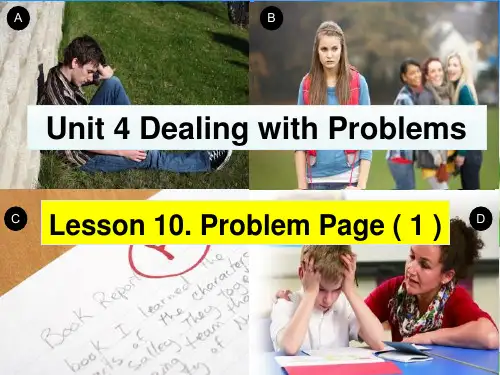

Unit 4 Dealing with ProblemsLesson 10 Problem Page本课是北师大版《初中英语》八年级下册教材第4单元的第10课,话题为“问题交流页”,属于课标话题7情感与情绪(feelingsand moods )以及话题8人际交往(interpersonal communication )下的第27个子话题合作与交流(cooperation and communication )同时也是社会交往功能意念下的建议功能。
本课是本单元的第1课,本课将重点培养学生体会建议的合理性和实效性并提出自己个性化的建议同时培养学生运用批判性思维看待事物,渗透提建议的方式。
在本课结束时,学生就问题能够提出自己个性化的建议。
【知识与能力目标】1. Key vocabulary2. Key structures【过程与方法目标】1.说出自己生活中经常遇到的问题并表达感受;2.通过阅读,找出学生们经常遇到的问题以及文中所给出的建议。
【情感态度价值观目标】增强面对困境倾诉问题并有针对性的解决问题的意识和能力。
【教学重点】1.通过阅读,找出学生们经常遇到的问题以及文中所给出的建议;2. 结合文本信息和自己的生活体验对这些问题提出合理有效的建议。
【教学难点】通过阅读,找出学生们经常遇到的问题以及文中所给出的建议Tape recorder, MultimediaStep 1. Warm-upSs answer the questions with the help of the pictures. Q1: What problems do they have?Show some pictures.Step 2. Pre-reading1. T introduces the task to the Ss and activates them.Q1: Would you like to take part in the activity?2. Ss understand why they need to solve problems.Q1: What problems have you got?Q2: How do you feel?3. Ss guess their common problems according to a survey.Q: Can you guess which ones are common for us?4. Ss look at the result of the survey.Q: Are the problems also common for other students?Step 3. Reading1 1st reading:Ss get the problems that others have.Read and underline them.Understand the problems by choosing the videos.Ss give their own replies in groups.Ss choose the problem that they want to solve.Ss work in groups to discuss and then write their reply down.Ss show their replies.2.2.nd reading:Ss read for the proper reply and find out the suggestions and structures by themselves.Ss read the reply part and choose the proper reply on the problem they chose,Ss work in groups to find out the suggestions and structure of the reply.Q1: How many suggestions does somebody else give?Q2: What are they?Q3:What are the relationships between sentences?Ss show their ideas on suggestions and relationships.Ss summarize how to give a reply.Step 4.Work in pairs1. Ss use critical thinking to think more.Ss compare their reply with the reply on the textbook to evaluate which one is reasonable and tell why.Q: Which reply do you think is reasonable, yours or the reply on the textbook?Ss think about whether the suggestions on the textbook are enough to solve the problems.Q: Do you think the suggestions on the textbook are enough to solve the problems?2. Ss work in groups to perfect their replies and then show them in class.T presents the task and shows the evaluation form to Ss.Ss work in groups to perfect their reply.Ss show their replies in class.One of the group members gives the class a presentation according to their reply.After listening, other Ss evaluate the reply and write down one most useful suggestion.T encourages Ss to help others. They are good helpers.Step 5 ExciseRead the problems (1-4) and match them with the suggestions (a-d).Check the answers.Step 6 Homework1. Read the text.2. Write down your suggestions.略。