
INTERIOR DESIGNER2003
- 格式:ppt
- 大小:2.72 MB
- 文档页数:8


Workbench 管道模块创建管线▼创建管线可以通过两个模块:工艺模块Design>Lines或管道模块▼两个模块创建管线的功能相同,但是在管道模块中可以建立管线参数列表,而工艺模块不能▼创建管线有两种方式:手动创建或从P&ID导入▼以在管道模块中创建管线为例进行讲解,在创建管道之前,应先完成与管道属性相关的数据集合的设置设置管道等级代码▼通过以下菜单–Setup> Pipe Spec. Codes进入V-9721窗口–输入等级代码并发布设置介质代码▼通过以下菜单–Setup> Fluid Codes进入V-9782窗口设置保温代码▼通过以下菜单–Setup> Insulation Codes进入V-1550窗口–输入等级代码并发布设置伴热代码▼通过以下菜单–Setup>Tracing Codes进入V-1540窗口–输入等级代码并发布设置涂层代码▼通过以下菜单–Setup>Paint Codes进入V-9782窗口设置试压介质▼通过以下菜单–Setup>Pressure Test Media进入V-9782窗口设置采购状态▼通过以下菜单–Setup>Line Status进入V-9782窗口设置法兰等级▼通过以下菜单–Setup>Flange Ratings进入V-9782窗口设置用户自定义项▼通过以下菜单–Setup> Project Defined 1进入V-9782窗口–Setup> Project Defined 2进入V-9782窗口–Setup> Project Defined 3进入V-9782窗口建立保温厚度列表▼根据管线尺寸和介质温度确定保温厚度▼建立管线尺寸和介质温度范围列表–Setup> Insulation Thickness进入V-1562窗口,建立列表保存,点击Create Tables Scream进入下一窗口点击建立保温厚度列表▼建立保温厚度列表–从列表中选择保温类型代码、管线尺寸集合、介质温度范围集合,保存,点击Create Tables,产生列表,在表格中键入保温厚度,完成保温厚度列表创建管线▼通过以上各步完成了管道参数列表▼创建管线通过以下菜单–Design> Lines进入V-1320窗口,完成管线详细设计数据的输入–在V-1320窗口点击Other Forms按钮,数据管理功能区改变到其他窗口显示区,点击Line Properties 可以查看包括保温厚度在内的所有管线属性点击点击为管线的项目自定义属性负值▼管线的自定义属性项通过以下菜单建立–Setup>Project>ProjectConfiguration>Line DataSetup,V-9723窗口–为管线的自定义属性负值,通过V-1320窗口,点击Other Forms>ProjectDefined Attribute。
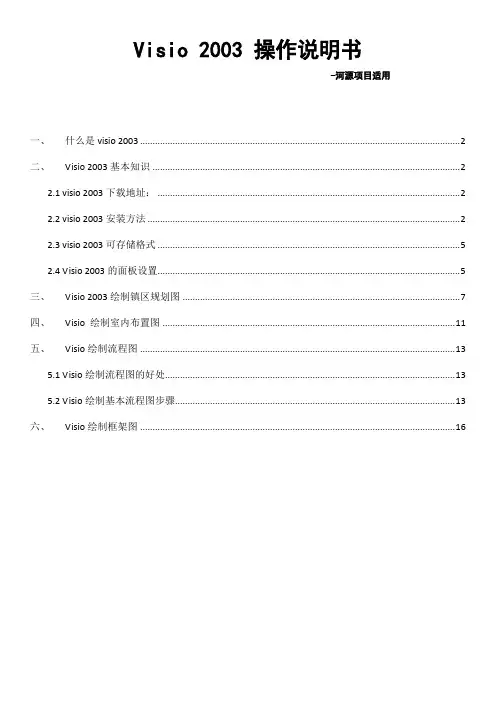
Visio 2003 操作说明书-河源项目适用一、什么是visio 2003 (2)二、Visio 2003基本知识 (2)2.1 visio 2003下载地址: (2)2.2 visio 2003安装方法 (2)2.3 visio 2003可存储格式 (5)2.4 Visio 2003的面板设置 (5)三、Visio 2003绘制镇区规划图 (7)四、Visio 绘制室内布置图 (11)五、Visio绘制流程图 (13)5.1 Visio绘制流程图的好处 (13)5.2 Visio绘制基本流程图步骤 (13)六、Visio绘制框架图 (16)一、什么是visio 2003Visio 2003是微软公司开发的一个办公软件。
它主要功能是专业制作各类图纸的软件,例如程序流程图、网络拓扑图、数据分布图、地图、室内布置图、规划图、线路图等图纸的软件,包含了非常多的组件。
我们公司常用Visio 2003绘制流程图、室内分布图、镇区规划图等。
一个形象的图片能更加衬托方案的整体性与设计性。
所以学好Visio 2003会对我们的工作起到较大的帮助。
二、V isio 2003基本知识2.1 visio 2003下载地址:我们下载较为常见的软件可以直接到狗狗网搜索,然后根据用户的评论来下载所需软件,因为网络资源中许多都存在病毒木马的危害,选择大家都说好的产品下载才是比较理性的。
下面是03版与07版visio 的下载地址。
Visio 2003下载地址:/down?cid=D39C5603F3EC360859736A91C418151E7C6C0CDA#com_anchorVisio 2007下载地址:/down?cid=DD5B41CDD91F29EC9729EC53588244D06B054F222.2 visio 2003安装方法(1)把下载到的visio 2003(2)在弹出的对话框中输入正确的序列号,然后单击“下一步”。


Interior DesignUndergraduate InformationThe Study of Interior DesignInterior design is an ideal academic homefor enthusiastic and inquisitive studentsseeking a meaningful, varied and creativeprofession. Designers enhance interiorspaces to maximize occupants’ quality oflife, increase their productivity, and protecttheir health, safety and welfare. Aestheticprinciples have long inspired and guidedinterior design, but it must be equallyattentive to laws of nature and science,lessons of liberal arts, and developmentsin technology. A designer must be broadlyeducated in art, architecture, literature,psychology, economics and management,while using the latest technology in com-puters, materials and building processes.Interior Design at Iowa State UniversityFrom its modest beginnings in 1901 as a course in Interior House Design, interior design at Iowa State University has evolved into one of the better-known professional programs in its field. Since 1978, it has been one of the creative disciplines in the College of Design, and since 1983, it has been accred-ited at the professional level by the Council for Interior Design Accreditation. DesignIntelligence consistently ranks the program in the top 15 in the country.The interior design program, part of the department of art and design, focuses on a process of sequential learning framed around a model of experimentation. This model is based on the belief that interior design is purposeful problem solving that emphasizes issues of human safety, operational (function-al) utility, and physical, psychological and contextual fit.The DegreeUndergraduates earn a bachelor of fine arts (BFA) in interior design. This four-year, FIDER-accredited professional degree prepares students to design the complex environments that make up building interiors. BFA students learn business prac-tices, industry trends, and design communication. They develop expertise in such areas as human factors, lighting, design history, structures, color, materials, and building and fire codes, as well as an understanding of people and the way environment affects their behavior, performance and satisfaction.The interior design program also offers a master of arts (MA) degree focused on general design practice, and a master of fine arts (MFA) degree that emphasizes the application of design research to the design studio.How can interior spaces affect and improve people’s lives and protect their health and safety?How do lighting and color affect health, establishmood, focus attention and create illusions?Process books, ArtID 265The CurriculumEvery first-year undergraduate student enrolls in the college’s Core Design Program, which includes courses in design, drawing, and cultural studies as well as general education requirements such as math, science, English composition, an introduction to the university library, and electives. At the end of the first year, students wishing to major in interior design are evaluated by the faculty on the basis of a portfolio review, essay, and academic achievement. Forty candidates annually are selected for entry to the BFA curriculum in interior design.The interior design curriculum is studio-based, supported by lecture courses in interior materials and systems, interior history, and professional practices. Expanding on the interdis-ciplinary approach of the freshman core, students often select supplementary courses from other areas within the college, including furniture design, architecture, and studio arts. Visualization and communication skills, include drawing, drafting and rendering, are taught using both manual and computer applications. Computer-aided design is integrated into design studios during the sophomore year. Students are strongly encouraged to own laptops and bring them to class for maximum productive use of their time. The College of Design provides assistance and advice on which computer and software are needed for each design discipline; if you are considering a major in interior design, please consult with the college’s laptop program coordinator prior to purchasing a machine. Model building, written and oral presentations, ac-tive listening and other communication skills are emphasized throughout the curriculum.The availability of elective courses offers a broad range of opportunities. Students may organize these courses to develop special interests such as business, environmental science, psychology or sociology that support specific areas of interior design.How can the design of interior spaces create a strong impression or make an impact on human feelings, behavior and impressions?How can we preserve the historic character of commercial and residential properties while responding to changing useand access needs?Junior class field trip to ChicagoRetail design project, ArtID 465If these are questions that interest you, consider a major in interior design.The Faculty Iowa State’s seven interior design faculty members have diverse educational, experiential, philosophical and ethnic back-grounds. Outside their teaching and advising responsibilities, they are all active, enthusiastic and productive contributors to the profession. Their work is widely recognized and respected both nationally and internationally. Their research and creative activity includes work on cross-cultural interiors and architec-ture; lighting design; institutional design; health, safety and welfare issues in design; product design; human-environment issues, and visual communication.Opportunities and ResourcesDesign-build and community outreach projects are included in studios, providing students with direct opportunities to work with clients and experience real design situations. Recent proj-ects have included campus and downtown revitalization proj-ects, full-scale furniture production, and the design of special exhibits. In addition to hands-on studio experiences and lecture courses, students are required to complete an eight-week intern-ship during the summer before their senior year. Internships are obtained in top-ranked design firms, small local firms, and allied organizations such as museums and product design companies.Students are encouraged to explore travel opportunities in the United States and internationally to broaden awareness of new design developments. Field trips are integral to interior design education. Day trips to design firms, manufacturers, historical sites and interesting design installations are common. Extended trips to Omaha or Minneapolis, Chicago and T oronto are a formal part of the study program. An optional trip to New York or another active design market focuses on studying design issues in context.Many students choose to spend fall semester of their senior year in the College of Design’s Rome Program. This optional academic program includes studios and lecture classes in interior design and art, architecture and design history. It also offers participants an opportunity to travel and experience first hand a range of significant classical and contemporary European interior design, furniture and art.Professional designers are invited to campus to review student portfolios and have informal discussions with students about ca-reer building. Many students participate in the Interior Design Student Association (IDSA), which sponsors additional field trips, career days and interior trade shows. IDSA members ben-efit from networking and professional exposure, and may also become student members of the American Society of InteriorDesigners or the International Interior Design Association.Jillissa Balcom, retail design project, ArtID 465Molly Benson, site model, ArtID 265“Learning to enhance human experience through thoughtful interior design”College of EngineeringMarston Hall Renovation Proposals ArtID 465 Interdisciplinary Studio with graphic designIda Risius, Rachel Warren, Amanda WiersonIda Risius, Rachel Warren, Amanda WiersonBrian Buckles, Kelly Kavelage, Massina BloemkeJessie James, process book, ArtID 265Interior rendering, ArtID 465© 2007 Iowa State UniversityPhotographs by Cigdem Akkurt, Robert Elbert, Dorothy Fowles, Michael Faas, Heather Sauer, Maruja TorresIowa State University does not discriminate on the basis of race, color, age, religion, national origin, sexual orientation, gender identity, sex, marital status, disability, or status as a US veteran. Inquiries may be directed to the Director of Equal Opportunity and Diversity, 3680 Beardshear Hall, Ames, IA 50011-2024, (515) 294-7612.Front cover student work by Stacy Kohorst, florist shop model, ArtID 465The FacilitiesThe College of Design, home to the interior design program, features five stories of studio classrooms and offices wrapped around a public atrium capped with a vaulted skylight. Out-side are expansive lawns, native prairie plantings, and several display areas for public art. Inside are galleries, Design Reading Room, Design Cafe, art supply store, printing center, a com-prehensive model-building shop, and spray rooms.Several computer graphics labs allow students to concentrate on image editing, three-dimensional modeling, and anima-tion, as well as geographic information systems (GIS), com-puter-aided design and desktop publishing.The material resource center allows interior design students to explore and utilize product information and samples of materials and furnishings in their studio work. The space also provides for experimentation with materials and lighting.Demand for GraduatesIowa State interior design graduates are employed by interior design and architectural firms, retail stores, and the design departments of corporations and institutions. Some are self-employed and own their own studios. Some are involved in areas of specialization, such as offices; restaurants, hotels and resorts; health-related facilities; retail and exhibition design; places of worship; schools; museums and theaters; government facilities, etc. Still others are involved in specialized aspects of the field such as lighting, color and materials specification, manufacturer’s representation, etc.Financial AssistanceThe university offers financial assistance in the form of grants, scholarships, loans and part-time employment. Scholarship recipients are selected on the basis of academic merit or other demonstrated talent as well as financial need. A comprehensive list of scholarships available to new and currently enrolled College of Design students may be found at /scholarships.php.High School PreparationMinimum high school requirements for admission to the department and the College of Design include four years of English, three years of math (including one year each of algebra, geometry and advanced algebra), three years of science (includ-ing one year each of two of the following: biology, chemistry and physics), and two years of social studies. Students planning to major in interior design may find courses in art, drafting, speech, wood technology, computer-aided design, and computer science and other courses that emphasize problem solving help-ful in preparing for their college coursework.Contact UsFor more information on how you can become involved in the study of interior design at Iowa State University, contact the department or the Office of Admissions.Iowa State UniversityDepartment of Art and Design Interior Design Program 158 College of Design Ames, IA 50011-3092(515) 294-6724/ID Iowa State University Office of Admissions Alumni HallAmes, IA 50011-2010(800) 262-3810admissions@Rome lectureStudents at work in Rome。