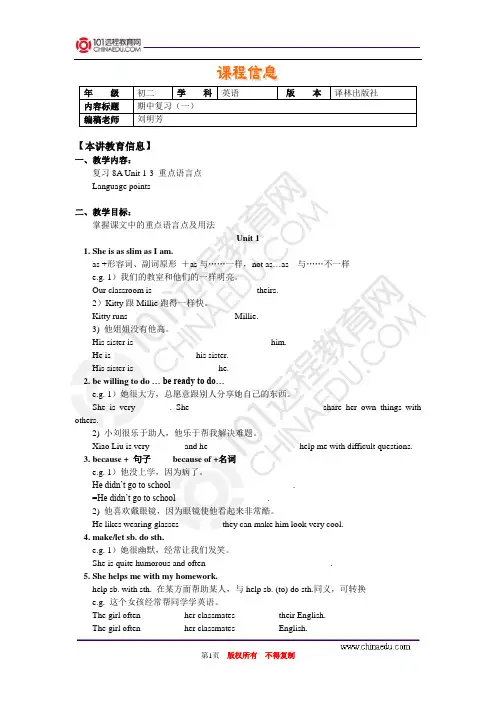
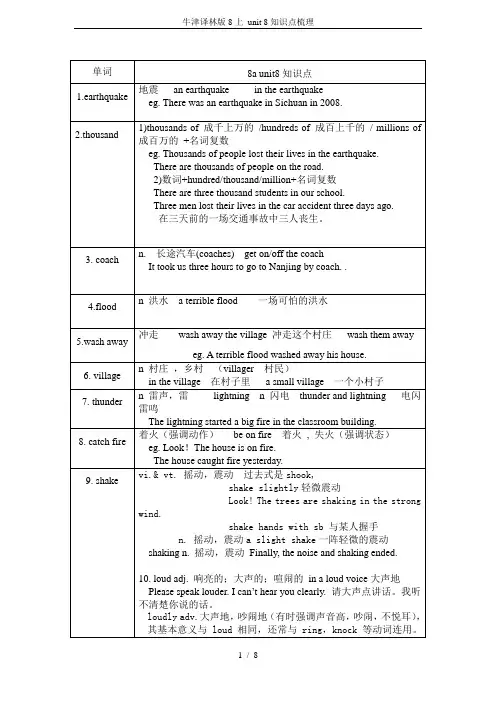
初中英语 牛津译林版8A Unit8重要知识点知识点
- 格式:docx
- 大小:37.96 KB
- 文档页数:6
初中英语 牛津译林版8A Unit8重要知识点知识点
e!
I was in the middle of sleeping when the rain started to fall。The phrase "when" introduces a time clause。and "was sleeping"
is in the past XXX is formed with "was/were + present participle (-ing)" and indicates an n that was in progress at a specific time in
the past.
XXX't you hear the rain。This is a negative XXX expresses
surprise。disbelief。disappointment。or reproach。In Chinese。it can be translated as "难道。不吗?" The negative interrogative
sentence XXX:
1) To express the XXX.
XXX。你还没有结束吗?
2) XXX。meaning "真是。" XXX in Chinese。Isn't it a fine
day today。今天的天气多么晴朗啊!
3) To express criticism。annoyance。or reproach. Can't you walk a little faster。难道你不能走快点吗?
4) To make polite requests or XXX.
Won't you come and have dinner with us。难道你不想和我们一起吃晚饭吗?
Mop up" means to clean completely with a mop (noun
follows verb)。Other examples of this usage include "eat up" (eat
all the food)。"use up" (use all of something)。"end up" (reach a
final result)。and "pay up" (pay in full).
When referring to specific numbers。"XXX" should be used
after the number。For example。"two hundred" or "XXX。"XXX
of。" should be used。For example。"hundreds of people" or "ns
of dollars."
Coach" can refer to a long-distance bus or a private XXX。As a verb。it means to train or guide.
Crash" is a verb that means "to collide or strike." "Crash into"
means to XXX.
Wash away" XXX).
Start" XXX。meaning "to cause something to begin," or an
intransitive verb。meaning "to begin something oneself."
To hear about/of" means to XXX or something。"To hear"
means to XXX。"To hear from" means to XXX.
Hit" is a verb that means "to strike or harm." XXX "hit-hitting-hit."
Catch a fire" means to ignite or be on fire。It can be
expressed as "something is on fire."
1.Break down can mean either a XXX。or a XXX.
2.Because of is used to indicate the cause of something and
can be followed by a noun。pronoun。or verb in the -ing form.
3.XXX is used to describe an n that was in progress at a
specific time or during a specific time d in the past。The structure
is was/were + verb-ing. Affirmative sentence: Subject + was/were + verb-ing + other
details.
Negative sentence: Subject + was/were + not + verb-ing +
other details.
Interrogative sentence: Was/Were + subject + verb-ing +
other details?
Wh- ns: Wh- word + was/were + subject + verb-ing + other
details?
XXX include specific time ds or points in the past。such as
"at this time yesterday (last night/Sunday/week。)"。"this
morning"。"the whole morning"。"all day yesterday"。"XXX。"。"when"。"while"。etc.
When used as a subordinating n。"when" introduces a time
clause that describes an n that was in progress at the same time as
the n in the main clause.
Some verbs cannot be used in the continuous form.
1."As soon as possible" means to do something as quickly as
one can。It is XXX to "as。as one can."
2."As soon as" is used to XXX after another n (usually in the
future)。It is often used with the future tense. XXX: I'll tell him to give you a call as soon as he gets home.
3."Learn from" means to gain knowledge or skills from
something or someone。"Learn of/about" means to e aware of or
find out about something.
4."Keep oneself safe" means to ensure one's own safety.
Please keep the window open.
Please keep XXX.
Don’t keep them working day and night.
If you see a fire。immediately call for help and stay away
from it.
To avoid accidents。XXX.
If you get burnt。XXX apply cold water to the affected area.
Grandson。XXX。XXX.
On weekdays。most people work。while on weekends。they
have time off.
I waited at the bus。for my XXX.
XXX next morning。I woke up early to start my day.
Clear the table after dinner to keep the room tidy.
The picture on the TV was clear and easy to see. Last year。due to heavy rain。my hometown was flooded。I
had to walk slowly and pull myself through the water。People
began to XXX It was a difficult time。but we all came together to
help each other。I think if everyone XXX measures。we can
minimize the damage caused by natural disasters.