
北师大版英语四下《Unit 9》
- 格式:ppt
- 大小:411.50 KB
- 文档页数:5

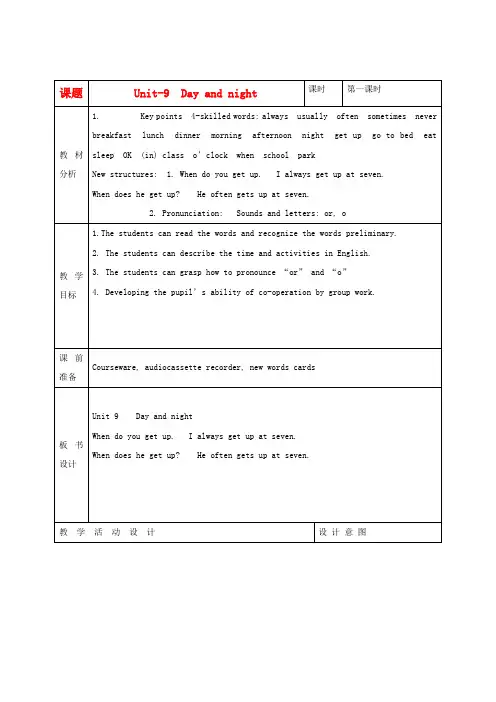
课题 Unit-9 Day and night 课时 第一课时
教材分析 1. Key points 4-skilled words: always usually often sometimes never
breakfast lunch dinner morning afternoon night get up go to bed eat
sleep OK (in) class o’clock when school park
New structures: 1. When do you get up. I always get up at seven.
When does he get up? He often gets up at seven.
2. Pronunciation: Sounds and letters: or, o
教学目标 1.The students can read the words and recognize the words preliminary.
2. The students can describe the time and activities in English.
3. The students can grasp how to pronounce “or” and “o”
4. Developing the pupil’s ability of co-operation by group work.
课前准备 Courseware, audiocassette recorder, new words cards
板书设计
Unit 9 Day and night
When do you get up. I always get up at seven.
版权所有:中华资源库
Unit 5 Rhythm
Lesson 2 Beijing Opera同步辅导与测试
word是一个十分常用的单词,其含义丰富,搭配能力强。为了便于同学们全面掌握其用法,现将其常见用法归纳如下。
一、word的基本含义
1.(指用声音或用书面形式表达的)词.作可数名词用。如:
The story is told in words and pictures. 讲这个故事的时候配有图片。
It's known that the words in the dictionary are arranged in alphabetical order. 众所周知,词典中的词是按字母顺序排列的。
2.(指人说出的)话;语言.作可数名词用。如:
He didn't say a word about his son's bad manners.他对他儿子无礼貌的行为一句话都没说。
I don't believe a word of his report. 他的报告我一句话都不相信。
You must show your support by deeds, not by words. 你必须用行动支持,不能空口说白话。
3.消息;信息.通常只能用单数,且不能用冠词修饰。如:
Please send me word that you arrive in Paris safely. 请把你平安到达巴黎的消息告诉我。
Word came that the bird flu had been controlled all over China. 有消息说,中国所有地区的禽流感都得到了控制。
二、word构成的习惯搭配
1. be as good as one's word 守信用。如:
基础训练
Ⅰ.用适当的介词或副词填空
1.Our school should be equipped ________ a bigger and better sports field.
2.He promised to come,but so far he has not turned ________.
3.I differ ________ my classmates on that issue.
4.The doctor said that he was ________ risk for AIDS.
5.He has run ________ of food and his children are hungry.
6.If the car should break ________ on the way,you would have to walk back.
7.Armed conflict is likely to break ________ between the two countries.
8.How can I get it ________ to you people how important it is?
9.Then he took the sunglasses ________,gave a big smile and said “That is cool”.
10.There is a limit ________ everything.
答案 1.with 2.up 3.with 4.at 5.out 6.down 7.out 8.across 9.off 10.to
Ⅱ.完成句子
11.The virus caused the computer to ________________.
病毒使得计算机出故障了。
12.I must admit I ________________ romantic movies.

Unit 8 Hot Soup
单元教学目标
技能目标
1.能询问别人是否有某物,说明自己有什么;
2.能表达自己对食物的喜好;
3.能说明食物或物品的特征;
4.能结合插图和录音理解故事内容;
5.能朗读故事。
知识目标
1.语音
能区别辅音字母f和v在单词中的发音。
2.词汇
话题词汇:能指认、说出:soup,water,milk,cola,tea,juice等饮料名称;能运用:hot,healthy,fresh,cold等形容词描述食物。
情景词汇:能够在语境中理解want,any, idea, favorite, try this, wait, I feel better,
tired, thirsty等词汇。
3.句型
能够运用“Do you have....?”询问别人是否有某物;能用“Bobby likes…/Bobby
doesn’t like… .”说明他人对食物的喜好;能用“What’s your favorite…? My
favorite…is….”询问别人、说明自己喜好的物品。
情感、策略、文化意识目标
1. 能通过故事中对饮料的讨论,培养健康饮食的意识。
2. 能通过故事中Mocky由于心急喝汤被烫到的情节,培养良好的进餐习惯。
第一课时
教学目标
1.能读懂故事主要内容,利用插图理清故事情节;
2.能模仿人物对话,正确朗读故事;
3.能借助图片正确指认饮料名称;
4.能在情境中询问或说明是否有某物;
5.培养健康饮食的意识。
教学重点
1.结合插图理解并正确朗读故事;
2.运用“Do you have....?”询问别人是否有某物。
教学难点
理解“Do you have....?I want some….”的意义。
教具准备
配套教学光盘,自制课件,教学卡片。
教学过程
Get Ready
(1)准备几张表示天气热的图片。逐一出示图片,询问学生“How does he/she