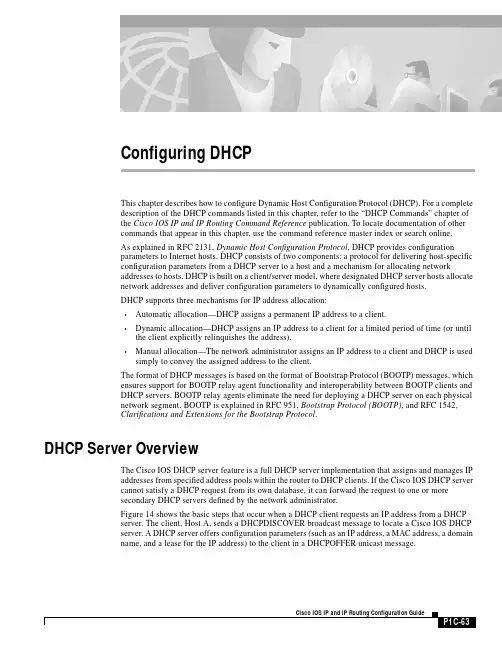
Configuring DHCPThis chapter describes how to configure Dynamic Host Configuration Protocol(DHCP).For a completedescription of the DHCP commands listed in this chapter, refer to the “DHCP Commands” chapter ofthe Cisco IOS IP and IP Routing Command Reference publication. To locate documentation of othercommands that appear in this chapter, use the command reference master index or search online.As explained in RFC2131,Dynamic Host Configuration Protocol, DHCP provides configurationparameters to Internet hosts.DHCP consists of two components:a protocol for delivering host-specificconfiguration parameters from a DHCP server to a host and a mechanism for allocating networkaddresses to hosts.DHCP is built on a client/server model,where designated DHCP server hosts allocatenetwork addresses and deliver configuration parameters to dynamically configured hosts.DHCP supports three mechanisms for IP address allocation:•Automatic allocation—DHCP assigns a permanent IP address to a client.•Dynamic allocation—DHCP assigns an IP address to a client for a limited period of time (or until the client explicitly relinquishes the address).•Manual allocation—The network administrator assigns an IP address to a client and DHCP is used simply to convey the assigned address to the client.The format of DHCP messages is based on the format of Bootstrap Protocol(BOOTP)messages,whichensures support for BOOTP relay agent functionality and interoperability between BOOTP clients andDHCP servers. BOOTP relay agents eliminate the need for deploying a DHCP server on each physicalnetwork segment. BOOTP is explained in RFC951,Bootstrap Protocol (BOOTP), and RFC1542,Clarifications and Extensions for the Bootstrap Protocol.DHCP Server OverviewThe Cisco IOS DHCP server feature is a full DHCP server implementation that assigns and manages IPaddresses from specified address pools within the router to DHCP clients.If the Cisco IOS DHCP servercannot satisfy a DHCP request from its own database, it can forward the request to one or moresecondary DHCP servers defined by the network administrator.Figure14 shows the basic steps that occur when a DHCP client requests an IP address from a DHCPserver. The client, Host A, sends a DHCPDISCOVER broadcast message to locate a Cisco IOS DHCPserver.A DHCP server offers configuration parameters(such as an IP address,a MAC address,a domainname, and a lease for the IP address) to the client in a DHCPOFFER unicast message.Configuring DHCPDHCP Server Overview Figure 14DHCP Request for an IP Address from a DHCP Server Note A DHCP client may receive offers from multiple DHCP servers and can accept any one ofthe offers; however, the client usually accepts the first offer it receives. Additionally, theoffer from the DHCP server is not a guarantee that the IP address will be allocated to theclient;however,the server usually reserves the address until the client has had a chance toformally request the address.The client returns a formal request for the offered IP address to the DHCP server in a DHCPREQUESTbroadcast message. The DHCP server confirms that the IP address has been allocated to the client byreturning a DHCPACK unicast message to the client.Note The formal request for the offered IP address (the DHCPREQUEST message) that is sentby the client is broadcast so that all other DHCP servers that received theDHCPDISCOVER broadcast message from the client can reclaim the IP addresses that theyoffered to the client.If the configuration parameters sent to the client in the DHCPOFFER unicast message bythe DHCP server are invalid (a misconfiguration error exists), the client returns aDHCPDECLINE broadcast message to the DHCP server.The DHCP server will send to the client a DHCPNAK denial broadcast message, whichmeans the offered configuration parameters have not been assigned,if an error has occurredduring the negotiation of the parameters or the client has been slow in responding to theDHCPOFFER message (the DHCP server assigned the parameters to another client)of theDHCP server.The Cisco IOS DHCP server feature offers the following benefits:•Reduced Internet access costsUsing automatic IP address assignment at each remote site substantially reduces Internet accesscosts. Static IP addresses are considerably more expensive to purchase than are automaticallyallocated IP addresses.•Reduced client configuration tasks and cost sBecause DHCP is easy to configure, it minimizes operational overhead and costs associated withdevice configuration tasks and eases deployment by nontechnical users.•Centralized managementBecause the DHCP server maintains configurations for several subnets,an administrator only needsto update a single, central server when configuration parameters change.Host A DHCP ACK (unicast)DHCPREQUEST (broadcast)DHCPOFFER (unicast)DHCPDISCOVER (broadcast)Cisco IOS DHCP server 32369Configuring DHCPDHCP Configuration Task ListBefore you configure the Cisco IOS DHCP server feature, complete the following tasks:•Identify an external File Transport Protocol(FTP),Trivial File Transfer Protocol(TFTP),or remote copy protocol (rcp) server that you will use to store the DHCP bindings database.•Identify the IP addresses that you will enable the DHCP server to assign,and the IP addresses that you will exclude.•Identify DHCP options for devices where necessary, including:–Default boot image name–Default router(s)–Domain Name System (DNS) server(s)–NetBIOS name server•Decide on a NetBIOS node type (b, p, m, or h).•Decide on a DNS domain name.DHCP Configuration Task ListThe DHCP server database is organized as a tree. The root of the tree is the address pool for naturalnetworks, branches are subnetwork address pools, and leaves are manual bindings to clients.Subnetworks inherit network parameters and clients inherit subnetwork parameters.Therefore,commonparameters,for example the domain name,should be configured at the highest(network or subnetwork)level of the tree.Note Inherited parameters can be overridden.For example,if a parameter is defined in both thenatural network and a subnetwork, the definition of the subnetwork is used.Address leases are not inherited.If a lease is not specified for an IP address,by default,theDHCP server assigns a one-day lease for the address.To configure the Cisco IOS DHCP server feature, first configure a database agent or disable conflictlogging, then configure IP addresses that the DHCP server should not assign (excluded addresses) andshould assign (a pool of available IP addresses) to requesting clients. These configuration tasks areexplained in the following sections. Each task in the following list is identified as required or optional.•Configuring a DHCP Database Agent or Disabling DHCP Conflict Logging (Required)•Excluding IP Addresses (Required)•Configuring a DHCP Address Pool (Required)•Configuring Manual Bindings (Optional)•Configuring a DHCP Server Boot File (Optional)•Configuring the Number of Ping Packets (Optional)•Configuring the Timeout Value for Ping Packets (Optional)•Enabling the Cisco IOS DHCP Server and Relay Agent Features (Optional)Configuring DHCPDHCP Configuration Task List Configuring a DHCP Database Agent or Disabling DHCP Conflict LoggingA DHCP database agent is any host, for example, an FTP, TFTP, or RCP server that stores the DHCPbindings database.You can configure multiple DHCP database agents and you can configure the intervalbetween database updates and transfers for each agent.To configure a database agent and database agentparameters, use the following command in global configuration mode:If you choose not to configure a DHCP database agent,disable the recording of DHCP address conflictson the DHCP server. To disable DHCP address conflict logging, use the following command in globalconfiguration mode:Excluding IP AddressesThe DHCP server assumes that all IP addresses in a DHCP address pool subnet are available forassigning to DHCP clients. You must specify the IP address that the DHCP server should not assign toclients. To do so, use the following command in global configuration mode:Configuring a DHCP Address PoolYou can configure a DHCP address pool with a name that is a symbolic string (such as “engineering”)or an integer (such as 0).Configuring a DHCP address pool also places you in DHCP pool configurationmode—identified by the (config-dhcp)# prompt—from which you can configure pool parameters (forexample,the IP subnet number and default router list).To configure a DHCP address pool,complete therequired tasks in the following sections.Configuring the DHCP Address Pool Name and Entering DHCP Pool Configuration ModeTo configure the DHCP address pool name and enter DHCP pool configuration mode,use the followingcommand in global configuration mode:CommandPurpose Router(config)#ip dhcp database url[timeout seconds | write-delay seconds ]Configures the database agent and the interval between database updates and database transfers.CommandPurpose Router(config)#no ip dhcp conflict logging Disables DHCP address conflict logging.CommandPurpose Router(config)#ip dhcp excluded-addresslow-address [high-address ]Specifies the IP addresses that the DHCP server should not assign to DHCP clients.CommandPurpose Router(config)# ip dhcp pool name Creates a name for the DHCP server address pool and places you in DHCPpool configuration mode (identified by the config-dhcp# prompt).Configuring DHCPDHCP Configuration Task List Configuring the DHCP Address Pool Subnet and MaskTo configure a subnet and mask for the newly created DHCP address pool,which contains the range of available IP addresses that the DHCP server may assign to clients,use the following command in DHCP pool configuration mode:Note You can not configure manual bindings within the same pool that is configured with thenetwork command.To configure manual bindings,see the “Configuring Manual Bindings”section.Configuring the Domain Name for the ClientThe domain name for a DHCP client places the client in the general grouping of networks that make up the domain.To configure a domain name string for the client,use the following command in DHCP pool configuration mode:Configuring the Domain Name System IP Servers for the ClientDHCP clients query DNS IP servers when they need to correlate host names to IP addresses. Toconfigure the DNS IP servers that are available to a DHCP client,use the following command in DHCP pool configuration mode:Configuring the NetBIOS Windows Internet Naming Service IP Servers for the ClientWindows Internet Naming Service (WINS)is a name resolution service that Microsoft DHCP clients use to correlate host names to IP addresses within a general grouping of networks.To configure the NetBIOS WINS servers that are available to a Microsoft DHCP client,use the following command in DHCP pool configuration mode:CommandPurpose Router(config-dhcp)#network network-number[mask |/prefix-length ]Specifies the subnet network number and mask of the DHCP address pool.The prefix length specifies the number of bits that comprise theaddress prefix. The prefix is an alternative way of specifying thenetwork mask of the client.The prefix length must be preceded bya forward slash (/).CommandPurpose Router(config-dhcp)#domain-name domain Specifies the domain name for the client.CommandPurpose Router(config-dhcp)#dns-server address[address2...address8]Specifies the IP address of a DNS server that is available to a DHCP client.One IP address is required; however, you can specify up to eight IPaddresses in one command line.Configuring DHCPDHCP Configuration Task List Configuring the NetBIOS Node Type for the ClientThe NetBIOS node type for Microsoft DHCP clients can be one of four settings:broadcast,peer-to-peer,mixed, or hybrid. To configure the NetBIOS node type for a Microsoft DHCP, use the followingcommand in DHCP pool configuration mode:Configuring the Default Router for the ClientAfter a DHCP client has booted, the client begins sending packets to its default router. The IP address of the default router should be on the same subnet as the client.To configure a default router for a DHCP client, use the following command in DHCP pool configuration mode:Configuring the Address Lease TimeBy default,each IP address assigned by a DHCP server comes with a one-day lease,which is the amount of time that the address is valid.To change the lease value for an IP address,use the following command in DHCP pool configuration mode:Configuring Manual BindingsAn address binding is a mapping between the IP address and MAC address of a client. The IP address of a client can be assigned manually by an administrator or assigned automatically from a pool by aDHCP server.Manual bindings are IP addresses that have been manually mapped to the MAC addresses of hosts that are found in the DHCP database.Manual bindings are stored in NVRAM on the DHCP server.Manual bindings are just special address pools.There is no limit on the number of manual bindings but you can only configure one manual binding per host pool.CommandPurpose Router(config-dhcp)#netbios-name-serveraddress [address2...address8]Specifies the NetBIOS WINS server that is available to a Microsoft DHCP client. One address is required; however, you can specify up toeight addresses in one command line.CommandPurpose Router(config-dhcp)#netbios-node-type type Specifies the NetBIOS node type for a Microsoft DHCP mandPurpose Router(config-dhcp)#default-routeraddress [address2... address8]Specifies the IP address of the default router for a DHCP client. One IP address is required,although you can specify up to eight addresses in onecommand line.CommandPurpose Router(config-dhcp)# lease {days[hours ][minutes ]| infinite }Specifies the duration of the lease. The default is a one-day lease.Configuring DHCPDHCP Configuration Task List Automatic bindings are IP addresses that have been automatically mapped to the MAC addresses of hoststhat are found in the DHCP database.Automatic bindings are stored on a remote host called a databaseagent. The bindings are saved as text records for easy maintenance.To configure a manual binding, first create a host pool, then specify the IP address of the client andhardware address or client identifier. The hardware address is the MAC address. The client identifier,which is required for Microsoft clients(instead of hardware addresses),is formed by concatenating themedia type and the MAC address of the client. Refer to the “Address Resolution Protocol Parameters”section of RFC1700,Assigned Numbers, for a list of media type codes.To configure manual bindings, use the following commands beginning in global configuration mode:Command PurposeStep1Router(config)# ip dhcp pool name Creates a name for the a DHCP server address pool and places youin DHCP pool configuration mode—identified by the(config-dhcp)# prompt.Step2Router(config-dhcp)#host address [mask| /prefix-length]Specifies the IP address and subnet mask of the client.The prefix length specifies the number of bits that comprise the address prefix. The prefix is an alternative way of specifying the network mask of the client.The prefix length must be preceded by a forward slash(/).Step3Router(config-dhcp)# hardware-address hardware-address typeorRouter(config-dhcp)#client-identifierunique-identifier Specifies a hardware address for the client.The type value:•Indicates the protocol of the hardware platform. Strings and values are acceptable. The string options are:–ethernet–ieee802•The value options are:– 1 10Mb Ethernet– 6 IEEE 802If no type is specified, the default protocol is Ethernet.orSpecifies the distinct identification of the client in dotted hexadecimal notation, for example, 01b7.0813.8811.66, where 01 represents the Ethernet media type.Step4Router(config-dhcp)# client-name name(Optional) Specifies the name of the client using any standardASCII character. The client name should not include the domainname. For example, the name mars should not be specified as.Configuring DHCP DHCP Configuration Task ListConfiguring a DHCP Server Boot FileThe boot file is used to store the boot image for the client. The boot image is generally the operatingsystem the client uses to load.To specify a boot file for the DHCP client,use the following command inDHCP pool configuration mode:Command PurposeRouter(config-dhcp)# bootfile filename Specifies the name of the file that is used as a boot image. Configuring the Number of Ping PacketsBy default, the DHCP server pings a pool address twice before assigning the address to a requestingclient.If the ping is unanswered,the DHCP server assumes(with a high probability)that the address isnot in use and assigns the address to the requesting client. To change the number of ping packets theDHCP server should send to the pool address before assigning the address,use the following commandin global configuration mode:Command PurposeRouter(config)#ip dhcp ping packets number Specifies the number of ping packets the DHCP server sends to a pooladdress before assigning the address to a requesting client.The defaultis two packets.Configuring the Timeout Value for Ping PacketsBy default, the DHCP server waits 500milliseconds before timing out a ping packet. To change theamount of time the server waits, use the following command in global configuration mode:Command PurposeRouter(config)# ip dhcp ping timeout milliseconds Specifies the amount of time the DHCP server must wait beforetiming out a ping packet. The default 500 milliseconds. Enabling the Cisco IOS DHCP Server and Relay Agent FeaturesBy default,the Cisco IOS DHCP server and relay agent features are enabled on your router.To reenablethese features if they are disabled, use the following command in global configuration mode:Command PurposeRouter(config)#service dhcp Enables the Cisco IOS DHCP server and relay features on your router.Use the no form of this command to disable the Cisco IOS DHCP server and relayfeatures.Configuring DHCPMonitoring and Maintaining the DHCP ServerMonitoring and Maintaining the DHCP ServerTo clear DHCP server variables, use the following commands in privileged EXEC mode, as needed:Command PurposeRouter#clear ip dhcp binding address |*Deletes an automatic address binding from the DHCP database.Specifying address clears the automatic binding for a specific(client)IPaddress, whereas specifying asterisk (*) clears all automatic bindings. Router#clear ip dhcp conflict address |*Clears an address conflict from the DHCP database.Specifying addressclears the conflict for a specific IP address whereas specifying an asterisk(*) clears conflicts for all addresses.Router#clear ip dhcp server statistics Resets all DHCP server counters to 0.To enable DHCP server debugging, use the following command in privileged EXEC mode:Command PurposeRouter# debug ip dhcp server{events | packets | linkage}Enables debugging on the DHCP server.To display DHCP server information, use the following commands in EXEC mode, as needed:Command PurposeRouter> show ip dhcp binding[address]Displays a list of all bindings created on a specific DHCP server. Router> show ip dhcp conflict[address]Displays a list of all address conflicts recorded by a specific DHCP server. Router#show ip dhcp database[url]Displays recent activity on the DHCP database.Note Use this command in privileged EXEC mode.Router> show ip dhcp server statistics Displays count information about server statistics and messages sent andreceived.Configuration ExamplesThis section provides the following configuration examples:•DHCP Database Agent Configuration Example•DHCP Address Pool Configuration Example•Manual Bindings Configuration ExampleConfiguring DHCPConfiguration Examples DHCP Database Agent Configuration ExampleThe following example stores bindings on host 172.16.4.253. The file transfer protocol is FTP. Theserver should wait 2 minutes (120 seconds) before writing database changes.ip dhcp database ftp://user:password@172.16.4.253/router-dhcp write-delay 120DHCP Address Pool Configuration ExampleIn the following example, three DHCP address pools are created: one in network 172.16.0.0, one insubnetwork 172.16.1.0,and one in subnetwork 172.16.2.0.Attributes from network 172.16.0.0,such as the domain name, DNS server, NetBIOS name server, and NetBIOS node type, are inherited insubnetworks 172.16.1.0and 172.16.2.0.In each pool,clients are granted 30-day leases and all addresses in each subnetwork, except the excluded addresses, are available to the DHCP server for assigning toclients. Table 5 lists the IP addresses for the devices in three DHCP address pools.ip dhcp database ftp://user:password@172.16.4.253/router-dhcp write-delay 120ip dhcp excluded-address 172.16.1.100 172.16.1.103ip dhcp excluded-address 172.16.2.100 172.16.2.103!ip dhcp pool 0network 172.16.0.0 /16domain-name dns-server 172.16.1.102 172.16.2.102netbios-name-server 172.16.1.103 172.16.2.103netbios-node-type h-node!ip dhcp pool 1network 172.16.1.0 /24default-router 172.16.1.100 172.16.1.101lease 30!ip dhcp pool 2network 172.16.2.0 /24default-router 172.16.2.100 172.16.2.101lease 30T able 5DHCP Address Pool DevicesPool 0 (Network 172.16.0.0)Pool 1 (Subnetwork 172.16.1.0)Pool 2 (Subnetwork 172.16.2.0)DeviceIP Address Device IP Address Device IP Address Default routers–Default routers 172.16.1.100172.16.1.101Default routers 172.16.2.100172.16.2.101DNS server 172.16.1.102—172.16.2.102————NetBIOS name server 172.16.1.103—172.16.2.103————NetBIOS node type h-node ————Configuring DHCPConfiguration ExamplesManual Bindings Configuration ExampleThe following example creates a manual binding for a client named .The MAC addressof the client is 02c7.f800.0422 and the IP address of the client is 172.16.2.254.ip dhcp pool Marshost 172.16.2.254hardware-address 02c7.f800.0422 ieee802client-name MarsBecause attributes are inherited, the previous configuration is equivalent to the following:ip dhcp pool Marshost 172.16.2.254 mask 255.255.255.0hardware-address 02c7.f800.0422 ieee802client-name Marsdefault-router 172.16.2.100 172.16.2.101domain-name dns-server 172.16.1.102 172.16.2.102netbios-name-server 172.16.1.103 172.16.2.103netbios-node-type h-nodeCisco IOS IP and IP Routing Configuration GuideP1C-73Configuring DHCP Configuration ExamplesCisco IOS IP and IP Routing Configuration GuideP1C-74。