
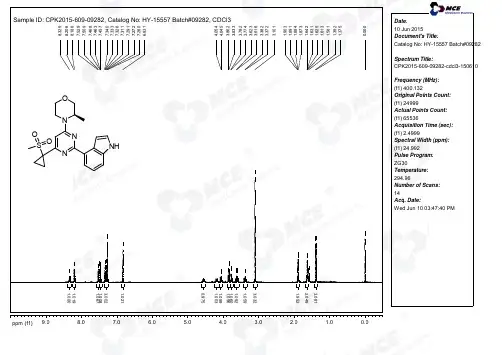
AZ20_HNMR_09282_MedChemExpress
- 格式:pdf
- 大小:372.30 KB
- 文档页数:1

Inhibitors, Agonists, Screening Libraries Data SheetBIOLOGICAL ACTIVITY:HSF1A is a cell–permeable activator of heat shock transcription factor 1 (HSF1).IC50 & Target: HSF1[1]In Vitro: HSF1A protects cells from stress–induced apoptosis, binds TRiC subunits and inhibits TRiC activity without perturbation of ATP hydrolysis. Genetic inactivation or depletion of the TRiC complex results in human HSF1 activation and HSF1A inhibits the direct interaction between purified TRiC and HSF1 in vitro. Moreover, fluorescence anisotropy experiments using FITC coupled to HSF1A demonstrates that HSF1A–FITC binds to a purified Tcp1 subunit of TRiC with an affinity of approximately 600 nM. This is validated qualitatively via titration of purified Tcp1 into binding reactions containing 500 nM Biotin or HSF1A–Biotin [1]. Quantification bycounting the number of cell containing aggregates as a function of the total number of cells reveals that at HSF1A concentrations as low as 2 μM, a reduced number of aggregate–containing cells are observed. The fraction of cells containing aggregates continued to decrease in a dose–dependent manner such that pretreatment with 12 μM HSF1A resulta in ~20% of the cells exhibiting aggregates visible by fluorescence microscopy [2].In Vivo: HSF1A enhances HSF1 activity, stabilizes HSF1 expression and minimizes Doxorubicin (DOX)–induced cardiac damage. WKY rats are challenged with DOX (accumulated dose: 30 mg/kgw), and DOX combined with HSF1A (100 mg/kgw/day). Supplementation with HSF1A significantly elevates cardiac functions back to the levels of the control group. HSF1A has been shown to stimulate human HSF1 nuclear translocation, elevate protein chaperone expression and ameliorate protein misfolding and cell death in aneurodegenerative disease model. The echocardiographic results show that HSF1A also alleviates DOX–induced failures in cardiac function [3].PROTOCOL (Extracted from published papers and Only for reference)Kinase Assay:[1]Protein extracts are generated from mammalian, yeast and E. coli cultures using biotin–binding buffer (20 mM HEPES,5 mM MgCl 2, 1 mM EDTA, 100 mM KCl, 0.03% NP–40) supplemented with 1% Trition–X100 and protease inhibitors. Approximately 0.5mg of protein extract is incubated with 100 μM HSF1A–Biotin for 4 h at 4°C and HSF1A–Biotin associated proteins captured by with NeutrAvidin Agarose Resin. After washing in biotin binding buffer proteins are eluted using 50 μL biotin elution buffer (100 mM Tris,150 mM NaCl, 0.1 mM EDTA, 2 mM D–biotin), resolved on a 4–20% SDS–PAGE, and immunoblotted. For purified TRiC and Hsp70analyses, 5 nM protein is incubated in biotin–binding buffer+0.5% Triton X–100 with 100 μM biotin or 100 μM HSF1A–Biotin for 4 h at 4°C and captured with NeutrAvidin Resin. For NiNTA purified yeast Tcp1, different concentrations of Tcp1 0.5 μM, 1 mM, 2 mM, 3 mM and 4 mM in 25 mM Hepes pH 7.5, 150 mM NaCl are incubated with 0.5 μM Biotin or HSF1A–Biotin for 4 h at 4°C and captured with NeutrAvidin Resin [1].Cell Assay:[2]PC12 cells seeded into a 96–well plate (5×10⁴ cells/well) are treated with increasing concentrations of HSF1A (2, 4, 8 andProduct Name:HSF1A Cat. No.:HY-103000CAS No.:1196723-93-9Molecular Formula:C21H19N3O2S2Molecular Weight:409.52Target:HSP Pathway:Cell Cycle/DNA Damage; Metabolic Enzyme/Protease Solubility:DMSO: ≥ 150 mg/mL12 μM) for 15 h, at which time httQ74–GFP expression is stimulated by incubation in the presence of 1 μg/mL Doxycycline for 5 d. Cell viability is assessed via the XTT viability assay[2].Animal Administration:[3]Rat[3]Ten–week–old Wistar Kyoto rats (WKY) are used. The rats are housed at a constant temperature (22°C) on a 12–h light/dark cycle with food and tap water. The animals are arranged into three groups: WKY rats (the control group), DOX rats and DOX rats treated with HSF1A. Each group contain five animals. The DOX group is injected with DOX (5 mg/kg) for 6 consecutive weeks intraperitoneal injection to achieve a cumulative dose of 30 mg/kg, which has been well documented to achieve cardiotoxicity. The small molecular HSF1 activator HSF1A (100 mg/kg/day) is injected intraperitoneally.References:[1]. Neef DW, et al. A direct regulatory interaction between chaperonin TRiC and stress–responsive transcription factor HSF1. Cell Rep. 2014 Nov 6;9(3):955–66.[2]. Neef DW, et al. Modulation of heat shock transcription factor 1 as a therapeutic target for small molecule intervention in neurodegenerative disease. PLoS Biol. 2010 Jan 19;8(1):e1000291.[3]. Huang CY, et al. Doxorubicin attenuates CHIP–guarded HSF1 nuclear translocation and protein stability to trigger IGF–IIR–dependent cardiomyocyte death. Cell Death Dis. 2016 Nov 3;7(11):e2455.Caution: Product has not been fully validated for medical applications. For research use only.Tel: 609-228-6898 Fax: 609-228-5909 E-mail: tech@Address: 1 Deer Park Dr, Suite Q, Monmouth Junction, NJ 08852, USA。

高效液相色谱法测定美沙拉嗪控释胶囊的有关物质作者:肖惠雅刘敏来源:《中国科技博览》2015年第16期[摘要]目的:采用高效液相色谱法来对米沙拉嗪孔氏控释胶囊中的有关物质进行测定。
方法:主要采用高效液相色谱法,其中流动相为磷酸盐缓冲液,其中包含甲醇、乙腈。
将柱温控制在30摄氏度的范围内,流速为1.2ml?min-1,在检测的过程中可检测波长为220nm。
结果:经过测定,发现在0.1994-1.994μg/ml的浓度范围内的3-氨基水杨酸可以和峰面积建立良好的线性关系,其中r=1.0000。
从整体上看,回收率达到96.38%,其中RSD为1.7%左右。
结论:采用高效液相色谱法来对美沙拉嗪控释胶囊的相关物质进行测定,具有一定的准确性和灵敏性,可以在以后的药物研究中进行大力推广。
[关键词]高效液相色谱法;美沙拉嗪;有关物质中图分类号:P650.3 文献标识码:A 文章编号:1009-914X(2015)16-0387-01在慢性疾病中,比较常见的就是溃疡性结肠炎,这种疾病的病变范围比较广,而且病情会呈现出反复发作的现象,而且很可能导致癌变,所以说,这种疾病的危害性极大,得到了医护人员的高度重视。
从现如今临床诊疗方面来看,美沙拉嗪药物疗效显著。
但是在药物应用的过程中还没有对其内部的相关标准进行规定,也就是说现如今,对于美沙拉嗪药物中的相关成分还没有进行完全的掌握,控制度不够。
虽然有些药物研究著作中对原料进行了检测,但是药品的质量问题以及相应的不良反应还没有落实到位。
所以,为了用药安全,有必要进行进一步的检测。
进而为以后的药物使用提供相应的参考。
1、仪器与试药在实验之前要对仪器和试药的准备好,其中高效液相色谱仪是必不可少的主要仪器。
其中含有检测仪,自动化的进样箱以及色谱工作站等等。
主要的试药就是美沙拉嗪控释胶囊,其生产批号和规格都符合国家药品监督总局的规定和要求,可以进行实验。
除此之外,还有甲醇溶液,乙腈容易以及辛烷磺酸钠等等,试验中所应用的水分为娃哈哈水。

银杏叶鼻用原位凝胶的制备及体外吸收研究崔海珍;刘福强;王艳萍;赵楠;李子严【摘要】目的制备银杏叶鼻用原位凝胶剂,并考察促渗剂对银杏叶透黏膜吸收作用.方法以卡波姆934、HPMC为凝胶基质制备pH敏感型鼻用原位凝胶剂,对粘度、粘附性及药物离体透黏膜吸收进行研究.结果 0.8% 卡波姆934和1.5% HPMC可制备原位凝胶.3种促渗剂黏膜渗透速率为:1%氮酮>1%吐温>0.5%冰片.随氮酮浓度的增大,药物黏膜吸收逐渐增加,吸收过程符合Weibull动力学方程.结论本银杏叶鼻用原位凝胶剂制备工艺可行,氮酮能有效地促进银杏叶的鼻腔吸收.【期刊名称】《药学实践杂志》【年(卷),期】2010(028)002【总页数】4页(P118-121)【关键词】银杏叶提取物;鼻用原位凝胶;吸收促进剂【作者】崔海珍;刘福强;王艳萍;赵楠;李子严【作者单位】延边大学药学院,吉林,延吉,133000;解放军第208医院,吉林,长春,130062;解放军第208医院,吉林,长春,130062;解放军第208医院,吉林,长春,130062;解放军第208医院,吉林,长春,130062【正文语种】中文【中图分类】R283银杏叶提取物(ginkgo biloba leaf extract,GBE),是从银杏科植物银杏叶中提取的有效成分,主要含有24%黄酮苷类和6%萜内酯类[1]。
其药理作用主要有抗氧化、抗自由基、改善心脑血管系统及外周循环、拮抗血小板活化因子和神经保护作用。
目前临床上主要用于治疗心、脑血管疾病、增加动脉血流量及对老年痴呆预防性治疗。
但由于血-脑屏障的存在,常规给药途径脑内药物浓度普遍较低,限制了脑部疾病的治疗。
而鼻腔给药后药物分子可滞留于嗅部黏膜而吸收进入脑部,因而绕过血-脑屏障,起到治疗作用[2]。
因此,根据鼻腔的生理特点,以卡波姆934、HPMC为凝胶基质,制备pH敏感型原位凝胶剂,并考察促进剂对银杏叶透黏膜吸收的影响。
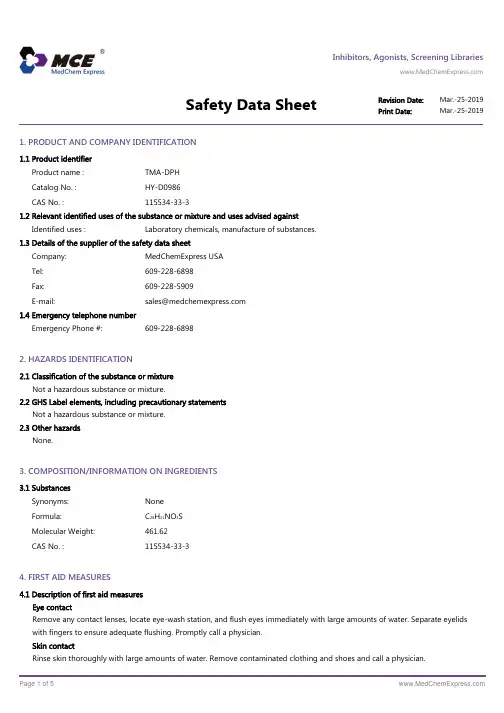
Inhibitors, Agonists, Screening LibrariesSafety Data Sheet Revision Date:Mar.-25-2019Print Date:Mar.-25-20191. PRODUCT AND COMPANY IDENTIFICATION1.1 Product identifierProduct name :TMA-DPHCatalog No. :HY-D0986CAS No. :115534-33-31.2 Relevant identified uses of the substance or mixture and uses advised againstIdentified uses :Laboratory chemicals, manufacture of substances.1.3 Details of the supplier of the safety data sheetCompany:MedChemExpress USATel:609-228-6898Fax:609-228-5909E-mail:sales@1.4 Emergency telephone numberEmergency Phone #:609-228-68982. HAZARDS IDENTIFICATION2.1 Classification of the substance or mixtureNot a hazardous substance or mixture.2.2 GHS Label elements, including precautionary statementsNot a hazardous substance or mixture.2.3 Other hazardsNone.3. COMPOSITION/INFORMATION ON INGREDIENTS3.1 SubstancesSynonyms:NoneFormula:C28H31NO3SMolecular Weight:461.62CAS No. :115534-33-34. FIRST AID MEASURES4.1 Description of first aid measuresEye contactRemove any contact lenses, locate eye-wash station, and flush eyes immediately with large amounts of water. Separate eyelids with fingers to ensure adequate flushing. Promptly call a physician.Skin contactRinse skin thoroughly with large amounts of water. Remove contaminated clothing and shoes and call a physician.InhalationImmediately relocate self or casualty to fresh air. If breathing is difficult, give cardiopulmonary resuscitation (CPR). Avoid mouth-to-mouth resuscitation.IngestionWash out mouth with water; Do NOT induce vomiting; call a physician.4.2 Most important symptoms and effects, both acute and delayedThe most important known symptoms and effects are described in the labelling (see section 2.2).4.3 Indication of any immediate medical attention and special treatment neededTreat symptomatically.5. FIRE FIGHTING MEASURES5.1 Extinguishing mediaSuitable extinguishing mediaUse water spray, dry chemical, foam, and carbon dioxide fire extinguisher.5.2 Special hazards arising from the substance or mixtureDuring combustion, may emit irritant fumes.5.3 Advice for firefightersWear self-contained breathing apparatus and protective clothing.6. ACCIDENTAL RELEASE MEASURES6.1 Personal precautions, protective equipment and emergency proceduresUse full personal protective equipment. Avoid breathing vapors, mist, dust or gas. Ensure adequate ventilation. Evacuate personnel to safe areas.Refer to protective measures listed in sections 8.6.2 Environmental precautionsTry to prevent further leakage or spillage. Keep the product away from drains or water courses.6.3 Methods and materials for containment and cleaning upAbsorb solutions with finely-powdered liquid-binding material (diatomite, universal binders); Decontaminate surfaces and equipment by scrubbing with alcohol; Dispose of contaminated material according to Section 13.7. HANDLING AND STORAGE7.1 Precautions for safe handlingAvoid inhalation, contact with eyes and skin. Avoid dust and aerosol formation. Use only in areas with appropriate exhaust ventilation.7.2 Conditions for safe storage, including any incompatibilitiesKeep container tightly sealed in cool, well-ventilated area. Keep away from direct sunlight and sources of ignition.Recommended storage temperature: -20°C, protect from lightShipping at room temperature if less than 2 weeks.7.3 Specific end use(s)No data available.8. EXPOSURE CONTROLS/PERSONAL PROTECTION8.1 Control parametersComponents with workplace control parametersThis product contains no substances with occupational exposure limit values.8.2 Exposure controlsEngineering controlsEnsure adequate ventilation. Provide accessible safety shower and eye wash station.Personal protective equipmentEye protection Safety goggles with side-shields.Hand protection Protective gloves.Skin and body protection Impervious clothing.Respiratory protection Suitable respirator.Environmental exposure controls Keep the product away from drains, water courses or the soil. Cleanspillages in a safe way as soon as possible.9. PHYSICAL AND CHEMICAL PROPERTIES9.1 Information on basic physical and chemical propertiesAppearance Light yellow to yellow (Solid)Odor No data availableOdor threshold No data availablepH No data availableMelting/freezing point No data availableBoiling point/range No data availableFlash point No data availableEvaporation rate No data availableFlammability (solid, gas)No data availableUpper/lower flammability or explosive limits No data availableVapor pressure No data availableVapor density No data availableRelative density No data availableWater Solubility No data availablePartition coefficient No data availableAuto-ignition temperature No data availableDecomposition temperature No data availableViscosity No data availableExplosive properties No data availableOxidizing properties No data available9.2 Other safety informationNo data available.10. STABILITY AND REACTIVITY10.1 ReactivityNo data available.10.2 Chemical stabilityStable under recommended storage conditions.10.3 Possibility of hazardous reactionsNo data available.10.4 Conditions to avoidNo data available.10.5 Incompatible materialsStrong acids/alkalis, strong oxidising/reducing agents.10.6 Hazardous decomposition productsUnder fire conditions, may decompose and emit toxic fumes.Other decomposition products - no data available.11.TOXICOLOGICAL INFORMATION11.1 Information on toxicological effectsAcute toxicityClassified based on available data. For more details, see section 2Skin corrosion/irritationClassified based on available data. For more details, see section 2Serious eye damage/irritationClassified based on available data. For more details, see section 2Respiratory or skin sensitizationClassified based on available data. For more details, see section 2Germ cell mutagenicityClassified based on available data. For more details, see section 2CarcinogenicityIARC: No component of this product present at a level equal to or greater than 0.1% is identified as probable, possible or confirmed human carcinogen by IARC.ACGIH: No component of this product present at a level equal to or greater than 0.1% is identified as a potential or confirmed carcinogen by ACGIH.NTP: No component of this product present at a level equal to or greater than 0.1% is identified as a anticipated or confirmed carcinogen by NTP.OSHA: No component of this product present at a level equal to or greater than 0.1% is identified as a potential or confirmed carcinogen by OSHA.Reproductive toxicityClassified based on available data. For more details, see section 2Specific target organ toxicity - single exposureClassified based on available data. For more details, see section 2Specific target organ toxicity - repeated exposureClassified based on available data. For more details, see section 2Aspiration hazardClassified based on available data. For more details, see section 212. ECOLOGICAL INFORMATION12.1 ToxicityNo data available.12.2 Persistence and degradabilityNo data available.12.3 Bioaccumlative potentialNo data available.12.4 Mobility in soilNo data available.12.5 Results of PBT and vPvB assessmentPBT/vPvB assessment unavailable as chemical safety assessment not required or not conducted.12.6 Other adverse effectsNo data available.13. DISPOSAL CONSIDERATIONS13.1 Waste treatment methodsProductDispose substance in accordance with prevailing country, federal, state and local regulations.Contaminated packagingConduct recycling or disposal in accordance with prevailing country, federal, state and local regulations.14. TRANSPORT INFORMATIONDOT (US)This substance is considered to be non-hazardous for transport.IMDGThis substance is considered to be non-hazardous for transport.IATAThis substance is considered to be non-hazardous for transport.15. REGULATORY INFORMATIONSARA 302 Components:No chemicals in this material are subject to the reporting requirements of SARA Title III, Section 302.SARA 313 Components:This material does not contain any chemical components with known CAS numbers that exceed the threshold (De Minimis) reporting levels established by SARA Title III, Section 313.SARA 311/312 Hazards:No SARA Hazards.Massachusetts Right To Know Components:No components are subject to the Massachusetts Right to Know Act.Pennsylvania Right To Know Components:No components are subject to the Pennsylvania Right to Know Act.New Jersey Right To Know Components:No components are subject to the New Jersey Right to Know Act.California Prop. 65 Components:This product does not contain any chemicals known to State of California to cause cancer, birth defects, or anyother reproductive harm.16. OTHER INFORMATIONCopyright 2019 MedChemExpress. The above information is correct to the best of our present knowledge but does not purport to be all inclusive and should be used only as a guide. The product is for research use only and for experienced personnel. It must only be handled by suitably qualified experienced scientists in appropriately equipped and authorized facilities. The burden of safe use of this material rests entirely with the user. MedChemExpress disclaims all liability for any damage resulting from handling or from contact with this product.Caution: Product has not been fully validated for medical applications. For research use only.Tel: 609-228-6898 Fax: 609-228-5909 E-mail: tech@Address: 1 Deer Park Dr, Suite Q, Monmouth Junction, NJ 08852, USA。