
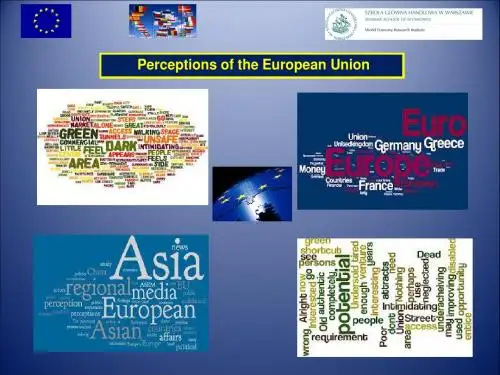
3.EU.Perceptions
- 格式:ppt
- 大小:2.65 MB
- 文档页数:19
研究生英语系列教程·多维教程·熟谙-英语课后答案Book IIUnit 1A.1.????assess2.????alliance3.????outcome4.????ethical5.????identity6.????ambiguous7.????tolerable8.????participates9.????pursuit10.????constructiveB.1.????at stake2.????were obliged3.????the climate of4.????feel well-equipped5.????beyond my grasp6.????cut back7.????other than8.????rise above9.????care about10.????is boundedC.1.????incompetent2.????indulgence3.????migrants4.????probes5.????complex6.????suspense; engaged7.????compassionate; committed8.????tolerant9.????tempted10.????interconnectedD.1.????A. Judging from2.????B. in which3.????C. and4.????D. believe5.????A. is one of/ is that of6.????B. must get7.????C. likely8.????D. unemployed9.????C. as well as/ and10.????B. simplerE.1.????what2.????graduation3.????intend4.????getting5.????eventually6.????survey7.????although8.????graduates9.????transfer10.????rise11.????attending12.????instead13.????cause14.????because15.????attending16.????below17.????failure18.????expectations19.????confidence20.????educationKey to the translation from English to Chinese:1.????德.汤说过,一切进步,一切发展均来自挑战及由此引起的反应。

CHAPTER 3 Cognitive Psychology1 . PerceptionA . Visual perceptual organizationa.Perception is the process of interpreting and organising the environmental information received by the senses.b.Visual perceptual organizationFor visual perception, this involves taking the constantly fluctuating patterns of light which arrive from all over the environment, upside-down, onto our two-dimensional retinas and detecting the shape of objects in the environment; Establishing location in three-dimensional space; Recognizing an object in terms of its shape, size, brightness and colour.c.Perceptual Organization: Gestalt(1)Visual Capture:tendency for vision to dominate the other senses.(2)Gestalt -- an organized whole tendency to integrate pieces of information into meaningful wholes.(3)Grouping: the perceptual tendency to organize stimuli into coherent groups.Grouping Principles:Proximity -- group nearby figures togetherSimilarity -- group figures that are similarContinuity -- perceive continuous patternsClosure -- fill in gapsConnectedness -- spots, lines, and areas are seen as unit when connectedd.Top-down theories of perception(1)Sometimes referred to as constructivist theories, these theories stress the factors in the construction of reality that go beyond the information received from the senses.(2)Gregory’s theory and perceptual set theory regard perception as a very active process, whereby the individual’s past knowledge, expectations and stereotypes seek out sensory data to ‘complete the picture’.(3)Perceptual Constancyperceiving objects as unchanging even as illumination and retinal image change.(color,shape ,size)(4) Illusions(5) Perceptual Set: Schemase.Bottom-up theories of percption(1)These theories emphasise the richness of the information entering theeye and the way that perception can occur from using all the information available.(2)Gibson believes perception occurs directly from sensation, feature detection theories examine the processes involved in assembling perception from sensations.f.The development of perceptionDepth Perception: ability to see objects in three dimensions; allows us to judge distance.Binocular cues:retinal disparity,images from the two eyes differ; closer the object, the larger the disparity.Convergence: neuromuscular cue; two eyes move inward for near objects. Monocular Cuesrelative size: smaller image is more distantInterposition: closer object blocks distant objectrelative clarity: hazy object seen as more distantTexture: coarse --> close; fine --> distantrelative motion: closer objects seem to move fasterlinear perspective: parallel lines converge with distancerelative brightness: closer objects appear brighter2 . AttentionA. Definition: The focusing and concentration of mental effort thatusually results in conscious awareness of certain aspects of external sensory stimuli or mental experiences(although most study has focused on the former).B. Some studies have looked at focused or selective attention – how certain stimuli are selected over others through allocating attention.Other studies have looked at divided attention – how, within a limited capacity, attention can be allocated to more than one task at a time(Research has shown that if tasks are practised enough, they become automatic, need less attention, and can be successfully performed with other tasks).3 . MemoryA.Memory:persistence of learning over time via the storage and retrieval of information.B.Flashbulb Memory:a clear memory of an emotionally significant moment or eventC.Memory as Information Processinga. Encoding:the processing of information into the memory system. i.e.,extracting meaning.b.Storage:the retention of encoded information over time.c.Retrieval:process of getting information out of memory.D.Sensory Memory:the immediate, initial recording of sensory information in the memory system.E.Working Memory:focuses more on the processing of briefly stored information.G.Short-Term Memory:activated memory that holds a few items briefly, look up a phone number, then quickly dial before the information is forgotten.H.Long-Term Memory:the relatively permanent and limitless storehouse of the memory systemI.A Simplified Memory ModelEncoding EncodingLong-termmemoryShort-termmemorySensorymemorySensorymemorySensory input attention to important Retrievingor novel informationa. Encoding:Automatic Processing and Effortful Processing(1)Automatic Processing:unconscious encoding of incidental information(Space, time, frequency);well-learned information(word meanings);we can learn automatic processing(reading backwards)(2)Effortful Processing:requires attention and conscious effort.(3)Rehearsal:conscious repetition of information.(to maintain it in consciousness ;to encode it for storage)(4)Ebbinghaus used nonsense syllables:the more times practiced on Day 1, the fewer repetitions to relearn on Day 2.(5)Spacing Effect:distributed practice yields better long- term retention than massed practice.b.What Do We Encode?(1) Semantic Encoding:encoding of meaning, including meaning of words.(2) Acoustic Encoding:encoding of sound, especially sound of words(3)Visual Encoding:encoding of picture images.(4)Imagery:mental pictures, a powerful aid to effortful processing, especially when combined with semantic encoding.(5)Mnemonics:memory aids ,especially those techniques that use vivid imagery and organizational devices .(6)Chunking:organizing items into familiar, manageable units,like horizontal organization--1776149218121941(often occurs automatically);use of acronyms;Organized information is more easily recalled;(7)Hierarchies:complex information broken down into broad concepts and further subdivided into categories and subcategories.Encoding(automaticor effortful)OrganizationMeaning(semanticEncoding)Imagery(visualEncoding)ChunksHierarchiesb. Storage: Retaining Information(1) Iconic Memory:a momentary sensory memory of visual stimuli;a photographic or picture image memory lasting no more that a few tenths of a second.(2)Echoic Memory:momentary sensory memory of auditory stimuli.(3)Short-Term Memory :limited in duration and capacity;“magical”number 7+/-2(4)Long-Term MemoryⅠ.Synaptic changes:increase in synapse’s firing potential after brief, rapid stimulation.Ⅱ.Strong emotions make for stronger memories:some stress hormones boost learning and retention.Ⅲ.Explicit Memory:memory of facts and experiences that one can consciously know and declare;also called declarative memory;hippocampus--neural center in limbic system that helps process explicit memories for storage.Ⅳ.Implicit Memory :retention independent of conscious recollection;also called procedural memory.c. Retrieval(1)retrievalⅠ.Recall:measure of memory in which the person must retrieve information learned earlier,as on a fill-in-the-blank test.Ⅱ.Recognition:Measure of memory in which the person has only to identify items previously learned ,as on a multiple-choice test.Ⅲ .Relearning:memory measure that assesses the amount of time saved when learning material a second time.Ⅳ. Priming:activation, often unconsciously, of particular associations in memory.(2) Retrieval CuesⅠ.Deja Vu (French)--already seen:cues from the current situation may subconsciously trigger retrieval of an earlier similar experience.Ⅱ.Mood-congruent Memory:tendency to recall experiences that are consistent with one’s current mood ;memory, emotions, or moods serve as retrieval cues.State-dependent Memory-----what is learned in one state (while one is high, drunk, or depressed) can more easily be remembered when in same stateⅢ .After learning to move a mobile by kicking, infants had their learning reactivated most strongly when retested in the same rather than a different context.d. Forgetting(1) Forgetting can occur at any memory stage.(2)As we process information, we filter, alter, or lose much of it.(3)Amnesia--the loss of memory(4)Forgetting as encoding failure:Information never enters the long-term memory. Ebbinghaus forgetting curve over 30 days-- initially rapid, then levels off with time.(5)Forgetting as retrival failure:Forgetting can result from failure to retrieve information from long-term memory.(6)Interference:Learning some items may disrupt retrieval of other information.Ⅰ.Proactive (forward acting) Interference:disruptive effect of prior learning on recall of new information.Ⅱ.Retroactive (backwards acting) Interference:disruptive effect of new learning on recall of old information.Ⅲ .Motivated Forgettingpeople unknowingly revise memoriesⅣ.Repressiondefense mechanism that banishes from consciousness anxiety - arousing thoughts, feelings, and memories.(7)Memory ConstructionⅠ.We filter information and fill in missing pieces.Misinformation Effect and Source AmnesiaⅡ.Eyewitnesses reconstruct memories when questionedJ . Improve Your Memory(1)Study repeatedly to boost recall.(2)Spend more time rehearsing or actively thinking about the material.(3)Make material personally meaningful.(4)Use mnemonic devices: associate with peg (标记性) words--something already stored;make up story;chunk--acronyms.(5)Activate retrieval cues--mentally recreate situation and mood(6)Recall events while they are fresh-- before you encounter misinformation(7)Minimize interference(8)Test your own knowledge:rehearse;determine what you do not yet know.CHAPTER 3 Developmental Psychology1 . Prenatal Development and the NewbornA . Rooting Reflextendency to open mouth, and search for nipple when touched on the cheek B. Preferencesa. human voices and facesb.smell and sound of motherC. Habituationdecreasing responsiveness with repeated stimulationD. Having habituated to the old stimulus, newborns preferred gazing at a new one.2. Infancy and Childhood:A. Physical Developmenta.Maturation(1)biological growth processes that enable orderly changes in behavior.(2)relatively uninfluenced by experience.b.Babies only 3 months old can learn that kicking moves a mobile--and can retain that learning for a monthB . Cognitive Developmenta. Schemaa concept or framework that organizes and interprets information.b. Assimilationinterpreting one’s new experience in terms of one’s existing schemas.c. Accommodationadapting one’s current understandings (schemas) to incorporate new information.d. CognitionAll the mental activities associated with thinking, knowing, remembering, and communicating.e.Piaget’s Stages of Cognitive DevelopmentTypical Age Range Description of Stage Developmental PhenomenaBirth to nearly 2 years SensorimotorExperiencing the world throughsenses and actions (looking,Object permanence Stranger anxietytouching, mouthing)About 2 to 6 years PreoperationalRepresenting thingswith words and imagesbut lacking logical reasoning Pretend play Egocentrism Language developmentAbout 7 to 11 years Concrete operationalThinking logically about concreteevents; grasping concrete analogiesand performing arithmeticaloperations Conservation Mathematical transformationsAbout 12 through adulthood Formal operationalAbstract reasoningAbstract logicPotential for moral reasoning(1)Object Permanencethe awareness that things continue to exist even when not perceived.(2)Baby MathematicsShown a numerically impossible outcome, infants stare longer(3)Conservationthe principle that properties such as mass, volume, and number remain the same despite changes in the forms of objects.(4)Egocentrismthe inability of the preoperational child to take another’s point of view. (5)Theory of Mindpeople’s ideas about their own and others’ mental states - about their feelings, perceptions, and thoughts and the behavior these might predict. (6) AutismMarked by deficient communication, social interaction and understanding of others’ states of mind.C . Social Developmenta. Stranger Anxiety(1)fear of strangers that infants commonly display.(2)beginning by about 8 months of age.b. Attachment(1)an emotional tie with another person.(2)shown in young children by their seeking closeness to the caregiver and displaying distress on separation.c. Harlow’s Surrogate Mother ExperimentsMonkeys preferred contact with the comfortable cloth mother, even whilefeeding from the nourishing wire mother.d. Critical Periodan optimal period shortly after birth when an organism’s exposure to certain stimuli or experiences produces proper development.e. Monkeys raised by artificial mothers were terror-stricken when placed in strange situations without their surrogate mothers.f. Imprintingthe process by which certain animals form attachments during a critical period very early in life.h. Basic Trust (Erik Erikson)(1)a sense that the world is predictable and trustworthy(2)said to be formed during infancy by appropriate experiences with responsive caregiversi. Self-Concepta sense of one’s identity and personal worthAddition: Child-Rearing Practices①Authoritarian: parents impose rules and expect obedience②Permissive:submit to children’s desires, make few demands, use little punishment③Authoritative:both demanding and responsive;set rules, but explain reasons and encourage open discussion3. AdolescenceTips: Adolescence-----the transition period from childhood to adulthood.extending from puberty(青春期)to independencePuberty-----the period of sexual maturation.when a person becomes capable of reproduction.Throughout childhood, boys and girls are similar in height. At puberty, girls surge ahead briefly, but then boys overtake them at about age 14. A. Kohlberg’s Moral LadderPostconventional level Morality of abstract principles: to affirm agreed-upon rightsand personal ethical principles.Conventional level Morality of law and social rules: to gain approval or avoiddisapproval.Preconventional level Morality of self-interest: to avoid punishment or gainconcrete rewards.B . Erikson’s Stages of Psychosocial DevelopmentApproximate age Stage Description of Task Infancy(1st year) Trust vs. mistrust If needs are dependably met, infantsdevelop a sense of basic trust.Toddler(2nd year)Autonomy vs. Shame anddoubt Toddlers learn to exercise will and do things for themselves, or they doubt their abilities.Preschooler(3-5 years)Initiative vs. guilt Preschoolers learn to initiate tasksand carry out plans, or they feel guiltyabout efforts to be independent.Elementary(6 years-puberty)Competencevs. inferiorityChildren learn the pleasure ofapplying themselves to tasks, or theyfeel inferior.Adolescence(teens into 20’s)Identity vs. RoleconfusionTeenagers work at refining a sense ofself by testing roles and thenintegrating them to form a singleidentity, or they become confusedabout who they are.Young Adult(20’s to early 40’s)Intimacyvs. isolationYoung adults struggle to form closerelation-ships and to gain the capacityfor intimate love, or they feel sociallyisolated.Middle Adult (40’s to 60’s)Generativityvs. stagnationThe middle-aged discover a sense ofcontri-buting to the world, usuallythrough family and work, or they mayfeel a lack of purpose.Late Adult (late 60’s and up)Integrity vs.despair When reflecting on his or her life, theolder adult may feel a sense ofsatisfaction or failure.C . Social Developmenta. Identity: one’s sense of self. the adolescent’s task is to solidify a sense of self by testing and integrating various roles.b .Intimacy: the ability to form close, loving relationships. a primary developmental task in late adolescence and early adulthood.c. The changing parent-child relationship: dwindle per years.4. AdulthoodA. Physical Developmenta. The Aging Senses: vision ,smell ,and identifying spoken words aredecreasing per years .b. Slowing reactions contribute to increased accident risks among those 75 and older.c. Incidence of Dementia by AgeRisk of dementia increases in later years .B. Cognitive Developmenta. Recalling new names introduced once, twice, or three times is easier foryounger adults than for older ones .b. the ability to recall new information declined during early and middle adulthood, but the ability to recognize new information did not.c. Cross-Sectional Study:a study in which people of different ages are compared with one anotherd. Longitudinal Study: a study in which the same people are restudied and retested over a long period.e. Verbal intelligence scores hold steady with age, while nonverbal intelligence scores decline .f. Crystallized Intelligence:one’s accumulated knowledge and verbal skills .Tends to increase with age .Fluid Intelligence: ones ability to reason speedily and abstractly .Tends to decrease during late adulthood .C. Social Developmenta. Social Clock: the culturally preferred timing of social events ,such asmarriage ,parenthood ,retirementb .Multinational surveys show that age differences in life satisfaction are trivial .。


Perception of Non-Verbal Emotional Listener FeedbackMarc Schr¨o derDFKI GmbH Saarbr¨u cken,Germany schroed@dfki.deDirk HeylenUniversity of TwenteThe Netherlandsheylen@ewi.utwente.nlIsabella PoggiUniversity of RomeItalypoggi@uniroma3.itAbstractThis paper reports on a listening test assessing the percep-tion of short non-verbal emotional vocalisations emitted by a listener as feedback to the speaker.We clarify the concepts of backchannel and feedback,and investigate the use of af-fect bursts as a means of giving emotional feedback via the backchannel.Experiments with German and Dutch subjects confirm that the recognition of emotion from affect bursts in a dialogical context is similar to their perception in isolation.We also investigate the acceptability of affect bursts when used as listener feedback.Acceptability appears to be linked to display rules for emotion expression.While many ratings were similar between Dutch and German listeners,a number of clear differ-ences was found,suggesting language-specific affect bursts.1.IntroductionHuman-machine interaction systems should become natural to use.They should show human-like interaction skills,including the behaviour spontaneously shown by humans when listening to their interaction partners.Listeners give feedback[1],sig-nalling whether they are engaged in the conversation,whether they understand and are interested in what the speaker is saying, whether they believe the speaker,agree,and which emotions or attitudes are elicited in them by the speaker’s utterance[10]. Listeners also use backchannel utterances[17]to confirm that the speaker should keep the turn.This complex,multi-layered communication channel by lis-teners appears to be little studied and,if at all,only rudimentar-ily implemented in state-of-the art interactive systems[9].Some research has focused on predicting the right places for giving backchannel feedback(e.g.,[6],[16]).The functions of backchannels and feedback are reasonably clear;we clarify these concepts in Section2below.However,little seems to be known about the form of lis-tener feedback utterances.Even though the often-mentioned “mm-hmm”backchannel may be ambiguous with respect to the meaning conveyed,it seems reasonable to assume that at least some of the many functions of backchannel feedback can be linked to certain surface forms of the corresponding feedback utterances.This paper addresses the specific issue of emotional listener feedback.As afirst step to understanding this phenomenon,we simulate listener feedback by embedding non-verbal emotional vocalisations into a speaker sentence.In a listening test,we assess the emotion expressed by the feedback and the appropri-ateness of the feedback in the given context.This research was funded by the EU Project HUMAINE(IST-507422).2.Listener behaviourWhen we talk to other people,we do not only want them to understand the content of what we are saying,but we also want to know how they react to it.We expect a feedback from them in order to understand the effect of our words on their mental state,their thoughts and feelings about what we are saying.The listener may provide feedback by officially taking the floor and expressing what s/he thinks or feels in a whole turn, or may provide feedback during the turn of the speaker.In conversation research,two notions have been proposed to deal with these aspects of communicative interaction,the notion of backchannel and the notion of feedback.Feedback[1]may be defined as the whole set of reactions to the speaker’s talk that are communicated by the addressee.From the semantic point of view,the concept of feedback encompasses both the information about whether the listener is hearing,following,understanding what the speaker is saying and information about his/her stance towards it,including eval-uations,emotions,and tendencies to act and to react.From the point of view of its occurrence,feedback can be provided both while the speaker is holding his/her turn,and by the(former)listener taking the turn(now becoming a speaker).Yngve[17]introduced the term“backchannel”in one of the classic texts dealing with expressive behaviours of listen-ers.His main concern was with turn-change signals in gen-eral.These do not only involve signals of speakers that have the intention to yield or keep the turn,but also signals by lis-teners indicating that they will or will not(yet)take the turn. These signals by listeners are part of the“backchannel”.In this conception,backchannel behaviours,or backchannels for short, mostly function as a way to set the common ground of conver-sation.They do not add much new information but mainly fulfil the“control goals”[4]of conversation–the permanent goals of a talking person to know if her discourse is being attended to, heard,and understood.Backchannels can take various forms.In some cases they use another modality,like gaze or facial expression,but short vocal expressions can also be used,such as interjections or af-fect bursts(see below)that do not interrupt the speaker’s speech flow.Thus,one could say that the notion of backchannel stereo-typically describes a subset of feedback behaviour–those reac-tions provided by the listener to the speaker that,on the seman-tic side,inform the speaker about the listener’s comprehension, and possibly agreement/disagreement,while on the occurrence side,are provided only during the speaker turn,without the lis-tener interrupting the speaker and without taking a turn on their own.However,the semantic and the occurrence level need not always go together,in that the“common ground–new infor-mation”opposition may not coincide with the“speaker turn–listener turn”opposition.In other words,it is not always the case that information which makes conversation“go on”neces-sarily takes a turn of its own.In some cases,a comment pro-viding a substantive reaction from the listener,concerning some of his emotions or evaluations about what the speaker is saying, may come during the turn of the speaker.In this case,some lis-tener reaction that from the occurrence point of view looks like a backchannel,is on the semantic side actually feedback in the more general sense.3.Expression of emotions3.1.Affect bursts:Non-verbal emotional vocalisations Affect bursts are“very brief,discrete,nonverbal expressions of affect in both face and voice as triggered by clearly iden-tifiable events”([12],p.170).Their vocal form ranges from non-phonemic vocalisations such as laughter or a rapid intake of breath,via phonemic vocalisations such as[a]or[m]where prosody and voice quality are crucial to conveying an emotion, to quasi-verbal interjections such as English“yuck”or“yippee”for which the segmental form transports the emotional meaning independently of the prosody.In a previous experimental study[13],we collected a range of affect bursts for each of10emotions,produced in isolation by German actors.On the basis of phonetic similarity,we grouped them into24“affect burst classes”,which were classified cor-rectly in a listening test81%of the time on average.We also ob-tained characterisations of each affect burst class in terms of the emotion dimensions arousal,valence,and power.The distinc-tion between quasi-verbal,language-specific“affect emblems”and universal“raw affect bursts”,proposed by[12],was opera-tionalised in terms of the stability of the segmental form across subjects,which we assessed in a transcription task.We thus proposed candidates for the status of“emblem”vs.“raw burst”.In this work we investigate the use of affect bursts as a way for the listener to give emotional feedback.3.2.The role of context in emotion perceptionCauldwell[5]demonstrated that short utterances can be per-ceived as anger in isolation and as emotionally neutral when perceived in the context in which they were uttered.Interest-ingly,the perception of anger from the utterance in isolation persisted even after having heard it in context.Similarly,Trouvain[14]showed that certain kinds of laugh-ter are perceived as sobs in isolation,but as laughs in context.In both cases,the difference in perception was the conse-quence of extracting a vocal expression from its original con-text.It is unclear whether a similar phenomenon should be ex-pected when a vocalisation which originally was produced in isolation by an actor is inserted into a new context.Embedding expressive vocalisations into a new context is not a straightforward thing to do,however.Inserting laughs into a speech synthesis context,we found[15]that most were perceived as inappropriate,with the exception of a very mild laugh.The details of the circumstances under which such an insertion was considered appropriate are not yet clear.In addition,a conversational context may change the func-tion of an emotional expressive display.In the case of facial ex-pressions,for instance,[2]showed how facial displays of emo-tion during conversations are not the result of the emotion felt at the time of speaking,that almost all of them are symbolic parts of messages that are integrated with other communica-tive signals such as words,intonation and gestures.A“sur-prise”expression may be used,for instance,to signal disbelief. Similarly,the interpretation of affect bursts introduced into the conversational backchannel may or may not be interpreted as a comment,a symbolic act rather than the mere expression of an emotion felt.This may influence both the judgements of what is being expressed by the affect burst and the judgements on the appropriateness of the affect burst in this context.4.Experiment4.1.Motivation and Research QuestionsThe present experiment addresses the question whether affect bursts can be used by a listener to give emotional feedback to the speaker.This question has two main aspects.1.Do affect bursts,used as listener feedback in the context of a short dialogue fragment with an emotionally inexpressive speaker utterance,convey the same emotions as in isolation?2.How acceptable is such feedback?One possible expectation is that affect bursts recorded in isolation are not at all acceptable for this use–that only feed-back produced in an interactive setting can be acceptable.Al-ternatively,it could be that the acceptability can be linked to a property of the affect burst,such as its arousal–possibly,only affect bursts with a similarly low arousal as the context utter-ance are acceptable.In addition to these core questions,we also tentatively in-vestigate the role of language background.3.To what extent do recognition and acceptability of affect bursts differ between German and Dutch listeners?We can expect tofind differences in recognition between physiology-based“raw”affect bursts and culture-specific affect emblems.4.2.MethodFor each of the ten emotion categories studied by[13],we se-lected two affect bursts as follows.From the24affect burst classes proposed by[13],we removed the four classes identi-fied as clear cases of quasi-verbal affect emblems.The remain-ing20classes can thus be expected to be reasonably language-independent.For each emotion,we selected the two affect bursts which were recognised best in isolation,if possible from two differ-ent affect burst classes.This was possible for all emotions ex-cept“threat”and“elation”,where both affect bursts had to be selected from the same class.Table1lists the original recogni-tion rates of the selected affect bursts along with their respective emotion and affect burst class.We created the stimuli by embedding each of the20se-lected affect bursts into a neutral speaker sentence.That sen-tence was deliberately semantically underspecified and spoken in an inexpressive,colloquial way.The sentence was:“Ja, dann hab’ich mir gesagt,probierste’s einfach mal<pause> und dann hab’ich das gemacht!”(German);“Ja,toen zei ik tegen mezelf,probeer het maar een keer<pause>en toen heb ik het gedaan!”(Dutch);“Yeah,then I told myself,why don’t you try it<pause>and then I did it!”(English translation).In both the German and the Dutch sentence,the pause was750ms long.The affect bursts were mixed into the sentence starting at 150ms into the pause,without modifying the pause duration.In other words,the feedback and the second part of the speaker ut-recognition(%)accepta-isol.in context bility emotion burstde nl de nl de nladmiration wow9510097897970 boah9523100117336threat hey1954170372623 hey2901955222638disgust bu¨a h1006997595337 ih959790825345elation ja1859090745152 ja2704480404968boredom yawn9510097965849 hmm858186857051relief sigh10010093744656 uff1008890784745startle int.breath100100100963334 ah907487482241worryoje1003487586245 oh-oh857197656545contempt pha958187823548 tse1007187775550anger growl1908180743723 growl2805870483222average927187654944Table1:Recognition results of20affect bursts.de=German listeners;nl=Dutch listeners.Ratings of affect bursts in isola-tion for German listeners taken from[13].Acceptability ratings ranged from0(very bad)to100(very good).terance overlapped for those affect bursts that were longer than 600ms.All affect bursts were normalised to the same aver-age power as the sentence into which they were embedded.In order to mask the different recording conditions between the speaker sentence and the feedback,a low-intensity white noise (at-60dB)was added to the resulting stimuli.The test was carried out in a web-enabled setup,using the open source tool RatingTest.The20stimuli were presented in an automatically randomised order.For each stimulus,subjects answered two questions.In a forced choice setup comparable to the one used by[13],they identified the emotion expressed by the listener from a list of ten categories.In addition,they rated on a continuous scale the question of how well the listener’s interjectionfits into the dialogue.In the German test,30subjects participated(15female; mean age:24.1years).11of these took the test in a controlled setting in a quite office room;the remaining subjects took part in the test via the web.In the Dutch test,27subjects participated via the web(5female;mean age:24.2years).A separate group of32Dutch listeners also rated the affect bursts in isolation,in order to provide Dutch data comparable to the results in[13].4.3.ResultsThefirst observation to make in Table1is that the recognition rates for affect bursts in isolation are lower for Dutch listeners than for German listeners.Differences are rather small for the vast majority of bursts;only four bursts that were highly recog-nised by German listeners are not recognised by Dutch listen-ers.The two threat bursts were badly recognised,confirming thefinding in[13]that the threat and anger categories cannot be fully distinguished.Also,Dutch listeners do not seem to make the clear distinction that Germans make between“boah”(expressing admiration)and“bu¨a h”(expressing disgust),lead-ing to a very low recognition for“boah”.Similarly low is the recognition of worry“oje”,suggesting that in both cases,the language-specific segmental form may be crucial to the emo-tional meaning.Regarding the recognition in context,it can be seen from Table1that overall recognition rates are slightly lower than for perception in isolation.However,the distribution of recognition rates across categories is very similar to the perception in isola-tion.We conclude that the role of context on emotion recogni-tion in this case appears to be very small.Acceptability ratings showed clear differences between the stimuli,but the pattern is not easy to interpret.We can observe (Table1)that ratings tend to be consistent within emotion cate-gories.Acceptability was rated very high for admiration(leav-ing aside the Dutch rating of the“boah”burst not recognised as admiration),moderately high for boredom,worry,elation,and relief,moderately low for disgust and contempt,and very low for threat,anger and startle.Interpretation is not made easier by the inherent ambiguity of the question of“goodfit”that we had asked the subjects to rate.It may have been interpreted by the subjects as a general appropriateness in the context,as we had intended;one might have found it a strange reaction as a reaction to the meaning of the carrier sentence;it may also have been used to indicate technical aspects such as a mismatch between the sound qual-ity of context and burst or the timing of the burst;or it may have been used to indicate social appropriateness in the given context,in the sense of Ekman’s display rules:social norms prescribed by one’s culture as to“who can show what emotion to whom,when.”[7]The fact that the standard deviation of ac-ceptability ratings is relatively high(29.5on average)indicates that the rating was not an easy task.We verified whether the observed pattern could be ex-plained by general properties of the emotional states expressed, using linear regression tests.A regression using the three emo-tion dimensions arousal,valence and power as predictors ac-counts for only12%of the variance.Clearly,the general prop-erties of emotional states as captured by emotion dimensions can not explain the acceptability ratings.Pursuing the issue of social appropriateness,we can attempt to account for the pattern found in terms of display rules.Our results can make sense if seen as a cue to display rules whose underlying logic classifies emotions both in terms of their being positive or negative and the type of goal they monitor[3,11].Thefirst display rule seems to point at a general bias against expressing negative emotions.More specifically,the most sanc-tioned emotions are those linked to goals of aggression(anger and threat),while a somewhat lower sanction holds over neg-ative emotions linked to goals of evaluation(disgust and con-tempt).Moving up to higher scores,wefind worry,relief and elation,emotions linked to the goal of well-being,and then, even higher,admiration,linked to the evaluation of others. Therefore,a positive bias toward the expression of emotions may hold,first,over emotions that show a positive evaluation of the other(admiration),then positive emotions like elation and relief,andfinally over negative emotions like worry.Ac-tually,there is a common feature to elation,relief and worrywhen expressed after another sentence:they may all be viewed as empathic reactions to the other’s narration.To sum up,these results might lead us to hypothesise the following display rules for affect bursts:•display emotions that are gratifying for the speaker(ad-miration);•display emotions that show empathy toward the speaker(elation,worry and relief);•do not display emotions that show a negative evaluationof things or persons(disgust and contempt);•do not display emotions linked to aggression(anger andthreat).Unfortunately,no clear interpretation arises for the results concerning startle and boredom.Startle could be ruled out in that it seems to be a reflex and not an emotion[8],more likely to be caused by a sudden noise than by reasoning on an inter-locutor’s sentence.The really puzzling result from our data is the high level of acceptability credited to boredom.This is a “cognitive”emotion,felt when the level of novel information acquired is below a minimal threshold,and does not respond to a subject’s interest.It signals the low relevance of incom-ing information,which may be quite offending for the speaker: a cognitive emotion having quite severe social effects!On the other hand the boredom may be attributed in part to the state of the listener,such as tiredness,which makes it less offensive.So, this result is not easy to interpret in the same way as the others, which quite consistently respond to display rules coherent with rules of politeness.5.Conclusions and Further Research This pilot experiment investigated the effects of embedding af-fect bursts in a conversational setting on the judgements of their fit within this context and the recognition of the emotion con-veyed by the burst compared to the recognition in isolation.We have shown that for some emotions,highly recognisable affect bursts were judged tofit well into the context.The results of this simple test lead us to the design of new experiments,following the question of what makes a context fitting for an affect burst.We assume that at least the following issues could have an influence on the perception of emotional feedback:a.the social acceptability of the expressed emotion,de-scribed in terms of display rules;b.the semantic and pragmatic interaction between the speaker’s utterance and the affect burst;c.the timing of the feedback with respect to the speaker’s utterance;d.more specifically,an interaction could be expected be-tween timing and emotion:e.g.,more aroused emotions might be expressed more quickly;e.the relation between speaker and listener and the formal-ity of the situation.The breadth of these aspects highlight the amount of re-search still needed in order to really understand emotional lis-tener feedback.6.References[1]J.Allwood,J.Nivre,and E.Ahls´e n.On the semantics andpragmatics of linguistic feedback.Semantics,9(1):1–26, 1992.[2]J.B.Bavelas and N.Chovil.Faces in dialogue.In J.Rus-sell and J.-M.Fernandez-Dols,Eds.,The Psychology of Facial Expression,pp.334–346.Cambridge UP,1997. [3] C.Castelfranchi.Affective appraisal versus cognitiveevaluation in social emotions and interactions.In A.Paiva, Ed.,Affective Interactions.Towards a New Generation of Computer Interfaces.Springer,Berlin,2000.[4] C.Castelfranchi and D.Parisi.Linguaggio Conoscenze escopi.Il Mulino,Bologna,1980.[5]R.Cauldwell.Where did the anger go?The role of contextin interpreting emotion in speech.In Proc.ISCA Work-shop on Speech and Emotion,pp.127–131,Northern Ire-land,2000.[6]J.Edlund,M.Heldner,and J.Gustafson.Utterance seg-mentation and turn-taking in spoken dialogue systems.InB.Fisseni et al.,Eds.,Sprachtechnologie,mobile Kommu-nikation und linguistische Ressourcen,pp.576–587.Peter Lang,Frankfurt,2005.[7]P.Ekman.Biological and cultural contributions to bodyand facial movement.In J.Blacking,Ed.,The anthro-pology of the body,pp.39–84.Academic Press,London, 1977.[8]P.Ekman,W.Friesen,and R.Simons.Is the startle reac-tion an emotion?J.Pers.Soc.Psychol.,49(5):1416–1426, 1985.[9]R.M.Maatman,J.Gratch,and S.Marsella.Natural be-havior of a listening agent.In5th Intl.Conf.on Interactive Virtual Agents.Kos,Greece,2005.[10] C.P´e lachaud et al.HUMAINE deliverable D6d:Proposalfor exemplars and work towards them:Emotion in Inter-action./deliverables,2005. [11]I.Poggi and M.Germani.Emotions at work.In Proc.8thIntl.Conf.on Human Aspects of Advanced Manufactur-ing:Agility and Hybrid Automation(HAAMAHA’03),pp.461–468,Rome,Italy,2003.[12]K.Scherer.Affect bursts.In S.van Goozen,N.van dePoll,and J.Sergeant,Eds.,Emotions:Essays on emotion theory,pp.161–wrence Erlbaum,Hillsdale,NJ, 1994.[13]M.Schr¨o der.Experimental study of affect bursts.SpeechCommunication,40(1-2):99–116,2003.[14]J.Trouvain.Non-verbal vocalisations–the case of laugh-ter.Paper presented at Evolution of Language:5th Intl.Conf.,Max Planck Institute for Evolutionary Anthropol-ogy,Leipzig,Germany,31March–3April2004. [15]J.Trouvain and M.Schr¨o der.How(not)to add laugh-ter to synthetic speech.In Proc.Workshop on Affective Dialogue Systems,pp.229–232,Kloster Irsee,Germany, 2004.[16]N.Ward and W.Tsukahara.Prosodic features which cueback-channel responses in english and japanese.Journal of Pragmatics,23:1177–1207,2000.[17]V.Yngve.On getting a word in edgewise.In Papers fromthe Sixth Regional Meeting of the Chicago Linguistic So-ciety,pp.567–577.1970.。