2013北京中考英语试题
- 格式:docx
- 大小:37.22 KB
- 文档页数:3
2013北京中考英语试题
Introduction
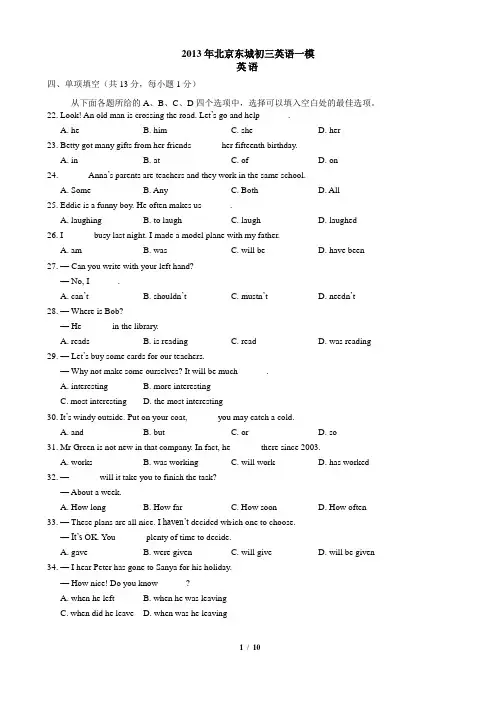
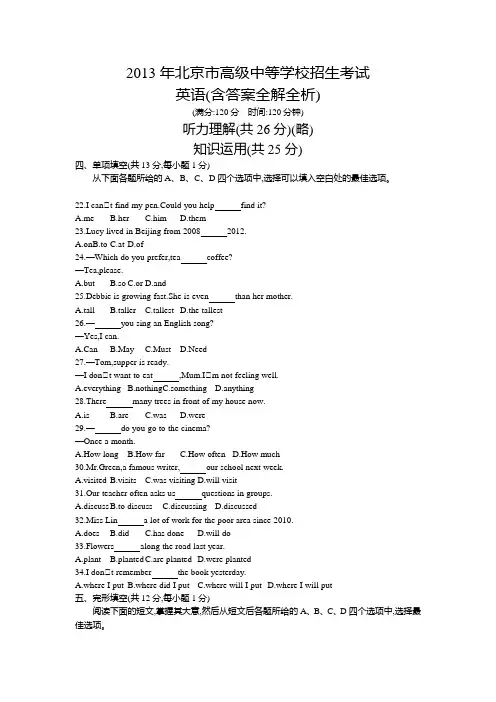
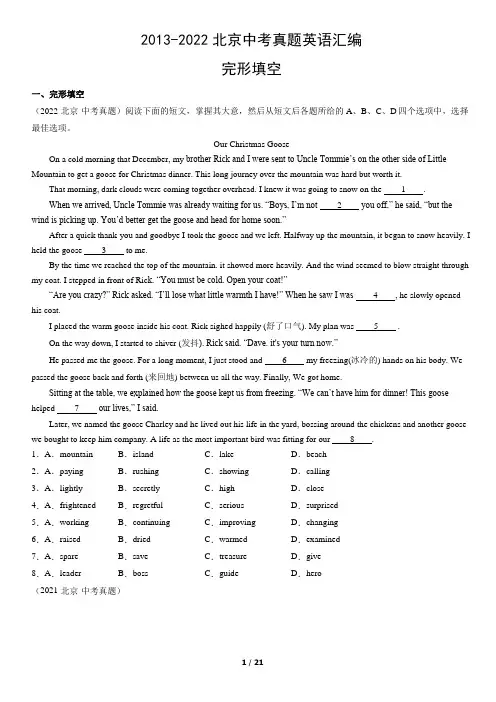
The 2013 Beijing Middle School Entrance Examination (中考) included
an English test section. This article provides an overview and analysis of the
exam questions, as well as some tips and strategies for future test-takers.
Part 1: Listening Comprehension (听力理解)
The listening comprehension section consisted of several short dialogues
and passages, followed by multiple-choice questions. This section tested
students' ability to understand spoken English in various real-life situations,
such as conversations between friends, interviews, and public
announcements. It aimed to assess students' listening skills and their ability
to grasp key information accurately. Test-takers were advised to listen
carefully to the audio recordings and read the questions before choosing the
correct answers.
Part 2: Reading Comprehension (阅读理解)
The reading comprehension section tested students' ability to understand
written English texts. It included a variety of reading materials, such as
advertisements, newspaper articles, and personal letters. Each passage was
followed by a set of questions, requiring students to identify main ideas,
infer meanings, and make logical deductions. To succeed in this section,
students needed to pay attention to details, use contextual clues, and apply
their knowledge of vocabulary and grammar.
Part 3: Vocabulary and Grammar (词汇与语法) The vocabulary and grammar section assessed students' knowledge of
English words, phrases, and grammatical structures. Test-takers were
required to choose the correct word or phrase to complete sentences or fill in
the blanks. This section aimed to evaluate students' understanding and
application of vocabulary and grammar rules in context. Students were
advised to study and review commonly used words, idioms, and grammar
patterns to enhance their performance in this section.
Part 4: Writing (写作)
The writing section tested students' ability to express their thoughts and
ideas in written English. Students were given a choice of topics and were
required to write an essay or a letter based on the given prompts. This
section aimed to assess students' creativity, coherence, and organization in
writing. Test-takers were advised to plan their writing, pay attention to
paragraph structure, and use appropriate vocabulary and grammar to
effectively convey their ideas.
Conclusion
The 2013 Beijing Middle School Entrance Examination English test
section was designed to assess students' listening, reading, vocabulary,
grammar, and writing skills. To excel in this exam, students needed to
develop their English communication abilities through regular practice and
study. In addition, test-takers could benefit from effective time management,
careful reading, and strategic approaches to problem-solving. With proper
preparation and a positive attitude, students could confidently approach the
English test and achieve successful results in the Beijing Middle School
Entrance Examination. (Note: This article does not include any specific content from the actual
2013 Beijing Middle School Entrance Examination English test, as it is
designed to provide a general overview and analysis of the exam.)