
牛津译林版八年级上册英语Unit 3 A day out ReadingI课件
- 格式:ppt
- 大小:1.52 MB
- 文档页数:17


Unit 3 A day out
Comic strip ﹠Welcome to the unit
Teaching aims:1. Introduce some well-known places in China and around the world.
2. To activate existing knowledge of the world and identify names of places and countries.
3. To express the feeling of love to our countries.
Teaching importance and difficulties :
1. To activate existing knowledge of the world and identify names of places and countries.
2. To express the feeling of love to our countries.
Procedure:
Step One:
Do you like listening to the song? But can you tell me what the man want to do in the song? Can he do
that? (No)Why? (Because when he has money, he doesn’t have time; When he has time, he doesn’t have
money.)
So what a pity!
Do you like traveling? (Yes) But do you have time/money now? (No)So we can’t go to Guilin, either.

牛津译林版八年级英语上册
总课题 8A Unit 3 A day out 总课时 第3课时
课题 Reading2 课型 New
Teaching aims To master the phrases:
invite sb to do sth, join the school trip to sp, at the beginning (of…), a
lot of traffic, on the highway, feel sick, be made of, the whole world, places
of interest, all over the world, look just like, teach oneself sth, some photos
of…
Teaching focus To master the sentences:
1. It was a great day but we did not enjoy it at the beginning.
2. The trip from Kitty’s school took about two hours by coach .
3. Kitty and I did not feel sick any more.
Difficult points To describe your ideas with what you’ve learned correctly
Step One 默写下列单词和短语
1. coach, traffic, model, interest, real, main, stomach
2. at the beginning, be made of metal, invite me to join their school trip,
get on a coach, arrive at the World Park, not… any more, enjoy oneself,
最新初中英语精品资料设计
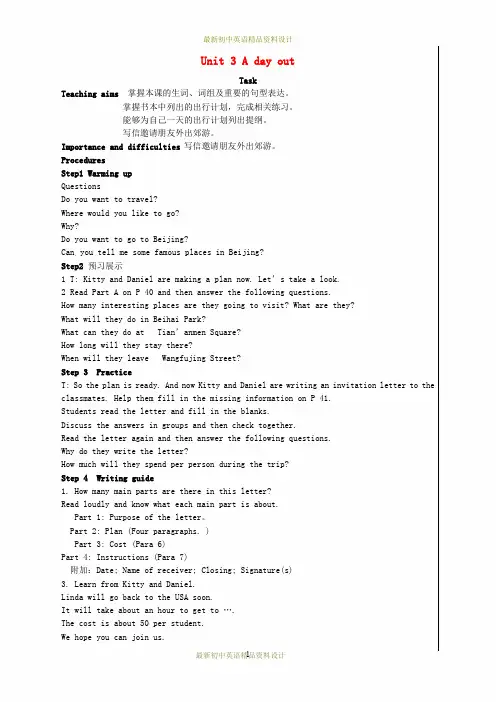
最新初中英语精品资料设计 1 Unit 3 A day out
Task
Teaching aims 掌握本课的生词、词组及重要的句型表达。
掌握书本中列出的出行计划,完成相关练习。
能够为自己一天的出行计划列出提纲。
写信邀请朋友外出郊游。
Importance and difficulties 写信邀请朋友外出郊游。
Procedures
Step1 Warming up
Questions
Do you want to travel?
Where would you like to go?
Why?
Do you want to go to Beijing?
Can you tell me some famous places in Beijing?
Step2 预习展示
1 T: Kitty and Daniel are making a plan now. Let’s take a look.
2 Read Part A on P 40 and then answer the following questions.
How many interesting places are they going to visit? What are they?
What will they do in Beihai Park?
What can they do at Tian’anmen Square?
How long will they stay there?
When will they leave Wangfujing Street?
Step 3 Practice
T: So the plan is ready. And now Kitty and Daniel are writing an invitation letter to the

8AU3Unit3Adayout
【welcome】1.begoingto(1)表示“意图”,即打算在(不久的)将来做某事。
(2)表示“预见”,即现在已有迹象表明将要发生或即将发生某种情况。►begoingto&will的区别(7B将来时态)
2.
eon①用来表示催促“来吧,赶快”
②用来表示请求,鼓励,劝说等“行啦;来吧”③表示责备或不耐烦“得了,行啦,够啦”④用于体育竞赛等场合鼓励队员“加油”
4.takeaboattrip乘船旅行takea.....triptospl.去...旅行(地点是副词时,不用to)
5.takecare保重;小心(=lookout/becareful)
6.by+时间“到...时”by+地点“在...旁”by+交通工具“乘...”by用于被动语态“被....,由...”bytheway顺便问一下byoneself(=onone’sown)独自willbegoingto
表示将来发生的事情时客观的情况,即客观上将要发生的事情.主观判断,及说话人主观上计划或安排将要去做的事情
说话人按照他的意图将要发生或进行的动作时没有经过事先计划或考虑,而是在说话的当时临时想到的意图或临时作出的决定经过事先考虑好的意图时间/条件从句中√
在正式的通知(如新闻媒体公布的官方消息,气象预报等)中用√
表示有迹象表明要发生某事√
exercise可数名词“习题”Mathsexercises
可数名词“一套动作,训练活动”doeyesexercises
不可数名词“锻炼;运动”take/doexercise
动词“锻炼”Ioftenexerciseaftersupper.by&beside&near
by“靠近;在...旁边”,强调在身边
beside“在...旁边”,指在左边或右边
near“在..附近”,指在不远处
7.topn.“顶部”onthetopof...在...的顶部adj.顶尖的,最好的topstudents尖子生