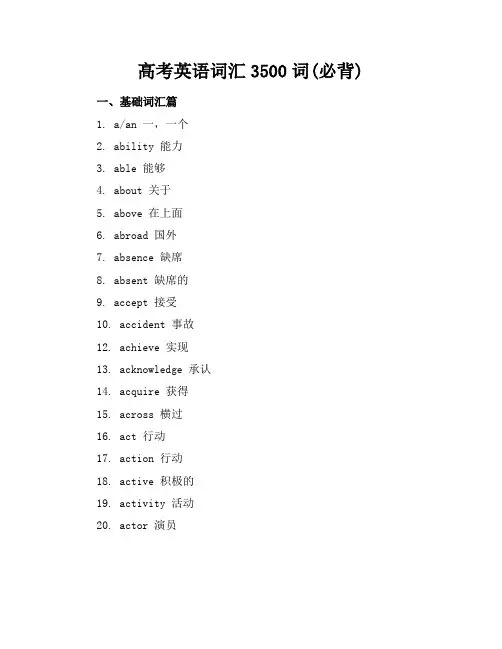
高考常用单词
- 格式:doc
- 大小:81.50 KB
- 文档页数:3
高考常用单词
一、名词(n.)
1. ability [əˈbɪləti]
- 意为“能力;才能”。例如:He has the ability to solve difficult
problems.(他有解决难题的能力。)
2. absence [ˈæbsəns]
- 表示“缺席;不在”。例如:His absence from the meeting surprised us.(他缺席会议让我们很惊讶。)
3. access [ˈækses]
- 有“通道;进入;机会”等意思。例如:The only access to the village is
by boat.(到那个村庄的唯一通道是乘船。)
4. accommodation [əˌkɒməˈdeɪʃn]
- 指“住处;膳宿”。例如:The hotel provides accommodation for up to
100 guests.(这家旅馆最多可为100位客人提供住宿。)
二、动词(v.)
1. accept [əkˈsept] - 意思是“接受;认可”。例如:I accepted his invitation.(我接受了他的邀请。)
2. achieve [əˈtʃiːv]
- 表示“达到;取得;实现”。例如:He achieved his goal through hard
work.(他通过努力工作实现了自己的目标。)
3. adapt [əˈdæpt]
- 有“使适应;改编”的含义。例如:We should adapt to the new
environment quickly.(我们应该快速适应新环境。)
4. add [æd]
- 意为“添加;增加;补充说”。例如:Add some salt to the soup.(往汤里加点盐。)
三、形容词(adj.)
1. able [ˈeɪbl]
- 表示“能够的;有能力的”。例如:He is an able man.(他是个能干的人。)
2. abundant [əˈbʌndənt]
- 意思是“丰富的;充裕的”。例如:Our country is abundant in natural
resources.(我们国家自然资源丰富。) 3. active [ˈæktɪv]
- 指“积极的;活跃的”。例如:He is an active member in the club.(他是俱乐部里的积极分子。)
4. actual [ˈæktʃuəl]
- 意为“实际的;真实的”。例如:What were his actual words?(他的原话是什么?)