
《动词时态和语态》课件
- 格式:pptx
- 大小:4.12 MB
- 文档页数:38


实用文档 动词的时态和语态
时 态
一般现在时
(1)可表示客观真理、科学事实。
The sun rises in the east and sets in the west.
太阳从东方升起,从西方落下。
(2)可用在由if,unless引导的条件状语从句,由even/if/though引导的让步状语从句,由when,before,until/till,as soon as,the moment引导的时间状语从句,由no
matter what/who/when/where/how或whatever,whoever等引导的让步状语从句中,这时主句往往表将来或主句是祈使句。
I’ll go with you as soon as I finish it.
我一做完,就与你一同去。
Whatever you say,I will not change my mind.
无论你说什么,我都不会改变主意。
一般过去时
表示“刚才,在过去”之意,暗示现在已“不再这样”。
—Your phone number again?I didn’t quite catch it.
——再重述一下你的电话号码好吗?我没记下来。
—It’s 9568686. 实用文档 ——是9568686。
一般将来时
(1)“will+动词原形”表示事物的固有属性与必然趋势。
Fish will die without water.离开水,鱼就会死。
(2)“be going to+动词原形”可表示根据迹象对未来进行推断。
Look at the dark clouds.It is going to rain.
看那乌云,要下雨了。
(3)“be about to+动词原形”表示立即的将来,很少与时间状语连用。
The train is about to start.火车就要开了。
(4)位移动词如come,go,arrive等,其一般现在时表按时间表将要发生的事,现在进行时可表计划、安排要做的事。
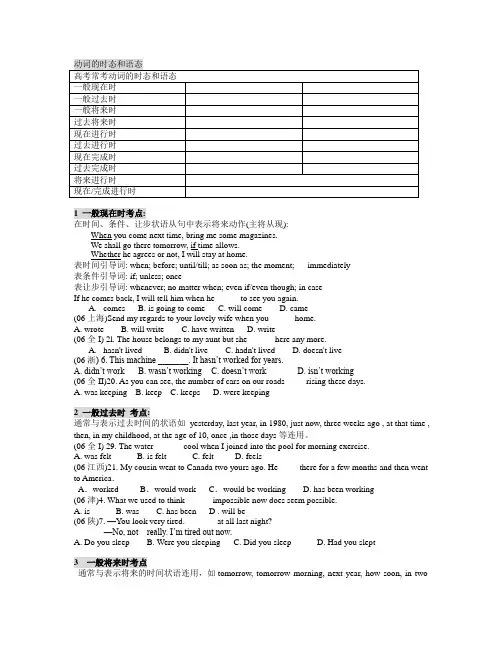
动词的时态和语态
高考常考动词的时态和语态
一般现在时
一般过去时
一般将来时
过去将来时
现在进行时
过去进行时
现在完成时
过去完成时
将来进行时
现在/完成进行时
1 一般现在时考点:
在时间、条件、让步状语从句中表示将来动作(主将从现):
When you come next time, bring me some magazines.
We shall go there tomorrow, if time allows.
Whether he agrees or not, I will stay at home.
表时间引导词: when; before; until/till; as soon as; the moment; immediately
表条件引导词: if; unless; once
表让步引导词: whenever; no matter when; even if/even though; in case
If he comes back, I will tell him when he _____ to see you again.
A. comes B. is going to come C. will come D. came
(06上海)Send my regards to your lovely wife when you _____ home.
A. wrote B. will write C. have written D. write
(06全I) 2l. The house belongs to my aunt but she______ here any more.
A. hasn't lived B. didn't live C. hadn't lived D. doesn't live

初中英语常用词组复习(3)
动词的时态和语态
(一)动词是谓语动所表示的动作或情况发生时间的各种形式。英语动词有
16种时态,但是常用的只有9种:一般现在时、一般过去时、一般将来时、现
在进行时、过去进行时、现在完成时、过去完成时、过去将来时、现在完成进
行时。下面分别介绍。
1、一般现在时的用法
1)表示经常性、习惯性的动作;表示现在的状态、特征和真理。句中常用
often,usually,everyday等时间状语。例如:
a.Hegoestoschooleveryday.
b.Heisveryhappy.
c.Theearthmovesaroundthesun.
2)在时间状语从句和条件状语从句中,用一般现在时表示将来。例如:
a.Ifyoucomethisafternoon,we’llhaveameeting.
b.WhenIgraduate,I’llgotocountryside.
3)有时这个时态表示按计划、规定要发生的动作(句中都带有时间状语),但
限于少数动词,如:begin,come,leave,go,arrive,start,stop,
return,open,close等。例如:
a.Themeetingbeginsatseven.
b.Therainstartsatnineinthemorning.
4)表示状态和感觉的动词(be,like,hate,think,remember,find,sound
等)常用一般现在进行时。
a.IlikeEnglishverymuch.
b.Thestorysoundveryinteresting.
5)书报的标题、小说等情节介绍常用一般现在时。
2.一般现在时的用法
1)表示过去某时间发生的事、存在的状态或过反复发生的动作。
a.HesawMr.Wangyesterday.
b.Heworkedinafactoryin1986.
2)表示过去经常发生的动作,也可用“usedto“和“would+动词原

第1页 版权所有 不得复制 1 初三英语通用版动词时态和语态课后练习
(答题时间:45分钟)
动词的时态
一、单项选择
*1. I like this silk dress, and it so soft and comfortable.
A. is feeling B. feels C. has felt D. is felt
2. —How was your weekend on the farm?
—Great! We with the farmers.
A. enjoy ourselves B. went fishing C. will work D. make friends
3. You to the meeting this afternoon if you have something important to do.
A.
needn’t to come B. don’t need come
C. don’t need coming D. needn’t come
4. The geography teacher told us yesterday that the earth
around the sun.
A. moves B. moved C. has moved D. was moving
*5. If he harder, he will catch up with us soon.
A. study B. studies C. will study
D. studied
6. —Shall we go shopping now?