2014年佛山市普通高中高三教学质量检测(2)
- 格式:docx
- 大小:121.65 KB
- 文档页数:9
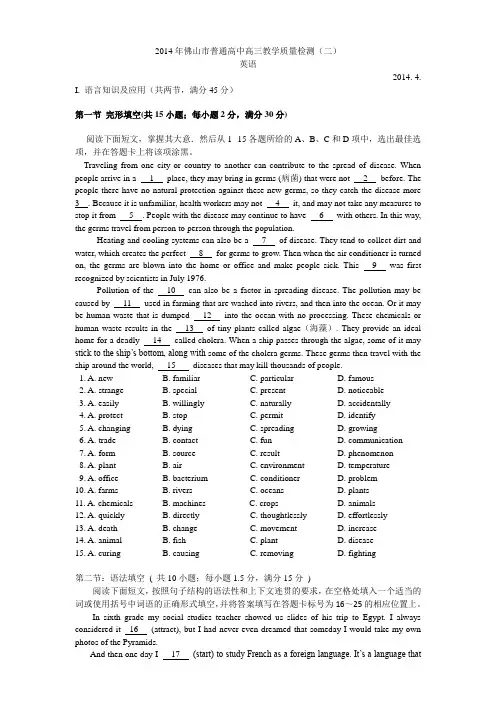
2014年佛山市普通高中高三教学质量检测(二)英语2014. 4.I. 语言知识及应用(共两节,满分45分)第一节完形填空(共15小题;每小题2分,满分30分)阅读下面短文,掌握其大意.然后从1-15各题所给的A、B、C和D项中,选出最佳选项,并在答题卡上将该项涂黑。
Traveling from one city or country to another can contribute to the spread of disease. When people arrive in a 1 place,they may bring in germs(病菌) that were not 2 before. The people there have no natural protection against these new germs, so they catch the disease more 3 . Because it is unfamiliar, health workers may not 4 it, and may not take any measures to stop it from 5 . People with the disease may continue to have 6 with others. In this way, the germs travel from person to person through the population.Heating and cooling systems can also be a 7 of disease. They tend to collect dirt and water, which creates the perfect 8 for germs to grow. Then when the air conditioner is turned on, the germs are blown into the home or office and make people sick. This 9 was first recognized by scientists in July 1976.Pollution of the 10 can also be a factor in spreading disease. The pollution may be caused by 11 used in farming that are washed into rivers, and then into the ocean. Or it may be human waste that is dumped 12 into the ocean with no processing. These chemicals or human waste results in the 13 of tiny plants called algae(海藻). They provide an ideal home for a deadly 14 called cholera. When a ship passes through the algae, some of it may stick to the ship's bottom, along with some of the cholera germs. These germs then travel with the ship around the world, 15 diseases that may kill thousands of people.1. A. new B. familiar C. particular D. famous2. A. strange B. special C. present D. noticeable3. A. easily B. willingly C. naturally D. accidentally4. A. protect B. stop C. permit D. identify5. A. changing B. dying C. spreading D. growing6. A. trade B. contact C. fun D. communication7. A. form B. source C. result D. phenomenon8. A. plant B. air C. environment D. temperature9. A. office B. bacterium C. conditioner D. problem10. A. farms B. rivers C. oceans D. plants11. A. chemicals B. machines C. crops D. animals12. A. quickly B. directly C. thoughtlessly D. effortlessly13. A. death B. change C. movement D. increase14. A. animal B. fish C. plant D. disease15. A. curing B. causing C. removing D. fighting第二节:语法填空( 共10小题;每小题1.5分,满分15分)阅读下面短文,按照句子结构的语法性和上下文连贯的要求,在空格处填入一个适当的词或使用括号中词语的正确形式填空,并将答案填写在答题卡标号为16~25的相应位置上。
In sixth grade my social studies teacher showed us slides of his trip to Egypt. I always considered it 16 (attract), but I had never even dreamed that someday I would take my own photos of the Pyramids.And then one day I 17 (start) to study French as a foreign language. It’s a language thatpushed me into the world 18 I learned that I could manage fine regardless of any language barriers. 19 my French still wasn’t great in university, it was obviously good enough that this girl named Lisa made the 20 (decide) that I should be her study partner. While French itself didn’t really change my life, 21 (meet) Lisa did. She came from a family that traveled, and she convinced me that I should see France 22 see the world.And so on January 26, 1993, 23 stood together in the immigration line waiting for those fateful passport stamps. Little did I know that we’d be standing in 24 same line in another dozen of countries that year and that later I’d still be standing in more than 100 countries all 25 the globe.Ⅱ. 阅读(共两节, 满分50分)第一节阅读理解(共20小题;每小题2分,满分40分)阅读下列短文,从每题所给的A、B、C和D项中,选出最佳选项,并在答题卡上将该项涂黑。
AOver the centuries the French have lost a number of famous battles with the British. However, they’ve always felt superior in the kitchen. France has for centuries had a reputation for cooking excellence, and Britain for some of the worst cooking in the world. But according to a recent survey, that reputation may no longer reflect reality.In the survey, 71% of the Britons said they cook at home every day, while only 59% of the French said they cook daily. British home cooks spend more time cooking each week and also produce a greater variety of dishes than French home cooks.The reaction in London was predictably enthusiastic. British food has greatly improved since the 1990s. Once upon a time, the menu for many family meals would have been roast beef, potatoes and over-cooked vegetables, but not now. Home cooks are experimenting with the huge range of ingredients now available in British supermarkets and are preparing all kinds of new dishes, using the cookbooks that sell millions of copies every year. As a result, there’s much more diversity in British food now, compared to French food, which tends to be very traditional.Some French people say that the survey did not show the whole picture. They agree that during the week French women don’t cook as much as they used to because most of them work and don’t have much time. They tend to buy ready-made or frozen dishes, but many of them make up for it on the weekend. There’s also a difference between Paris and the country-side. It’s true that people in Paris don’t cook much, but elsewhere, cooking is still at the heart of daily life.For many French people, opinions about British food have not changed. When Bernard Blier, the food editor at a magazine, was asked about British food, he replied: “I don’t go out of my way to try it. It is not very refined. You can say that I’m not a fan at all.”26. What does the underlined part in the first paragraph imply?A. French cooking is better than British cooking.B. The British defeated the French in many battles.C. British cooking is thought to be the worst.D. British cooking is now better than it was.27. According to the passage, nowadays British people_______ .A. cook less at home than the French every dayB. no longer eat roast beef and over-cooked vegetablesC. are more willing to try cooking all kinds of new foodsD. buy more cookbooks than French people do28. What can we infer from the fourth paragraph?A. French women cook less often now.B. The French prefer ready-made dishes.C. French women seldom cook on the weekend.D. Cooking is at the heart of people’s life in Paris.29. What is Bernard’s attitude towards British food?A. He would love to try it.B. He shows no interest in it.C. He considers it worse than before.D. He considers it better than before.30. What does the passage mainly talk about?A. The history of British food.B. The history of French food.C. The change in British food.D. The change in French food.BIn a number of societies around the world, there are established social rules on what makes up acceptable masculine(男性化的) and feminine(女性化的) behavior, especially during childhood and pre-adolescence. Most boys learn to play aggressive games which allow them to show off their physical strength. Most girls are encouraged to play with fashion dolls or other “girly girl” toys. When a girl chooses to reject the traditional feminine role and act more masculine, she is often referred to as a tomboy.A tomboy is a young girl who may prefer to climb a tree or wrestle instead of playing with dolls or wearing dresses. She may behave in a more aggressive or independent manner than her female friends or classmates. A tomboy often tends to choose a more masculine lifestyle as a form of pre-adolescent rebellion (叛逆) against the strict gender (性别) roles of her society.There are some who believe tomboys are largely the products of a male-dominated (主导) family. A girl trying to fit in with her male siblings and dominant father may find it easier to choose a more masculine lifestyle rather than risk being laughed at for having traditional feminine interests. A tomboy may also find it easier to fit in with male classmates, since female classmates can be more critical or jealous of other girls. A tomboy may have little or no romantic interest in boys during this time, but generally prefers their companionship over traditional "girly girls” who do not like to play more physical games.Many parents may become concerned over a daughter's tomboyish behavior, but child psychologists believe it should be considered more of a period than anything else. Some children resist adapting traditional gender and sexual roles until they become mature enough to handle the responsibilities which accompany them. A tomboy may simply be enjoying the last part of her childhood before taking on the more challenging role of an adolescent.31. Most boys learn to play aggressive games in order to___________.A. respect social rulesB. establish social rulesC. show off their physical strengthD. encourage girls to become tomboys32. What is TRUE about a tomboy?A. She's against the strict social gender roles.B. She never plays with dolls or wears dresses.C. She wishes to get as aggressive as a boy.D. She acts more aggressively than a boy.33. A tomboy chooses a more masculine style probably because .A. she's good at climbing treesB. she doesn't have any sistersC. she is quite jealous of other girlsD. she wants to be accepted by males34. What do psychologists think of a girl’s tomboyish behavior?A. It makes the girl more responsibleB. It will change as she grows older.C. It can help the girl become mature.D. It encourages a girl to change gender.35 In which section of a website would this passage probably appear?A. CareersB. Entertainment.C. Sports.D. Life.CMy son Advai t taught me a beautiful lesson today. He called out to me saying. “Papa, sit”. That usually means leaving everything and sitting down to play with him. As he will not stop calling out till I give in. He was playing with beads (珠子), an exercise to help build the motor skills.Anyway, so after he finished playing with the beads he began to put them in their box. He did that very slowly and carefully as if they were made of chocolate. And with over a hundred beads to go, I was getting tired “Why could he not pick up 10 in one go and pu t them in?” said my anxious mind. Damn! My morning was going to go for a toss today.And then it hit me like a brick. This boy was enjoying the whole process. For him the fun was in the game, in the preparation for the game and in the process of properly collecting and picking up. It was not just about his or the fun play. Every bit was as fun as the other. “What a great view to have,” I thought to myself. To live each moment as it is the perfect moment. To do each task as if it were the most awesome task to do. Nothing else matters.I thought of myself as a kid when we would go out to play cricket (扳球). If I was not playing, I was unhappy as I desperately waited for my toss to do so. Only the process of doing something I associated with happiness made me cheerful. The rest of the time I was waiting for my turn in the future or thinking of a great hit from the past. This is also how I have so often lived my life, waiting for something in the future or looking back on what it was like in the past.Now, Advait was showing me that life was about thoroughly living every moment with complete love and peace. I realized that the truest and happiest moments of my life have been the ones where I participated without thoughts of the past or the future.36. We can infer that the writer .A. liked playing beads when he was a childB. liked doing exercise to help build his skillsC. wasn't quite willing to play with his sonD. didn't allow his son to eat much chocolate37. The underlined phrase “go for a toss” probably means .A. be ruinedB. be forgottenC. become cheerfulD. become relaxing38. When the writer was a kid, he______.A. hated thinking of' the pastB. failed to enjoy every momentC. was crazy about doing sportsD. often associated cricket with happiness39. What would the writer probably do next?A. Go to play a cricket gameB. Go back to do his own workC. Enjoy watching his son finish his work.D. Help his son put away the heads quickly.40. What is the best title for the passage?A. How To Enjoy A GameB. My Childhood MemoriesC. Value Time With Your ChildD. Participate Fully In The MomentDYou may have heard of the “10,000hour rule”popularized in Malcolm Gladwel l’s book Outliers, which suggests that many people who have reached the top of their fields got there, in large part, due to practicing for 10,000 hours. The theory is most often credited to a 1993 study by K. Anders Ericsson (which has been mentioned more than 4.000 times, according to Google Scholar). But a new review of that study and other research in the field came to a different conclusion: Practice is not as vital as previously thought.In the new paper, published in Intelligence, the authors write that “we have evidence thatdeliberate practice, while important, is not as important as Ericsson has argued it is -- evidence that it does not largely account for individual differences in performance.”The authors of the new paper re-analyze scores of studies on outstanding chess players and musicians. They point out that there is significant variation in how long it took for people to get to the level of a chess master. One player in a 2007 study, for example, “took 26 years of serious involvement in chess to reach a master level, while another player took less than 2 years to reach this leve l,” they write. They conclude that practice can only explain one-third of the success in chess and music, and probably other fields as well.The evidence is “quite clear that some people do reach an outstanding level of performance without plentiful practice, while other people fail to do so although they do p lentiful practice,”they write. They suggest that other factors together explain the lion's share of success (at least in these two most-studied areas), such as intelligence, staffing age, personality and other factors.Despite their new analysis, the authors write that the debate is likely to continue “for many years to come,” which makes me think: Perhaps the “10,000 hour rule” should be defined (定义) as “the amount of time scholars spend arguing over what factors explain success.”41. What does the “10,000 hour rule” suggest?A. Your success is largely determined by your practice.B. Scholars need to practice less than people in other fields.C. You can’t succeed with less than 10,000 hou rs’ practice.D. 10,000 hours’ practice surely leads to the top of a field.42. The new paper in Intelligence finds that .A. more evidence is needed for the researchB. one should not practice deliberatelyC. Ericsson does not think practice is importantD. practice isn’t so important as people thought43. How did the new study get its conclusion?A. By studying dozens of chess players.B. By studying other people's research.C. Through 26 years of serious study.D. Through large amount of practice.44. What does the writer of this passage think of the “10,000 hour rule”?A. He is strongly for the rule.B. He doubts the truth of the rule.C He considers it the key to success. D. He prefers the rule to be proved wrong.45. What is the purpose of the passage?A. To persuade people to work harderB. To argue for the 10,000 hour rule.C. To introduce a new study on the 10,000 hour rule.D. To introduce different scholars’ great discoveries.第二节信息匹配(共5小题:每小题2分,满分10分)阅读下列应用文及相关信息,并按照要求匹配信息。