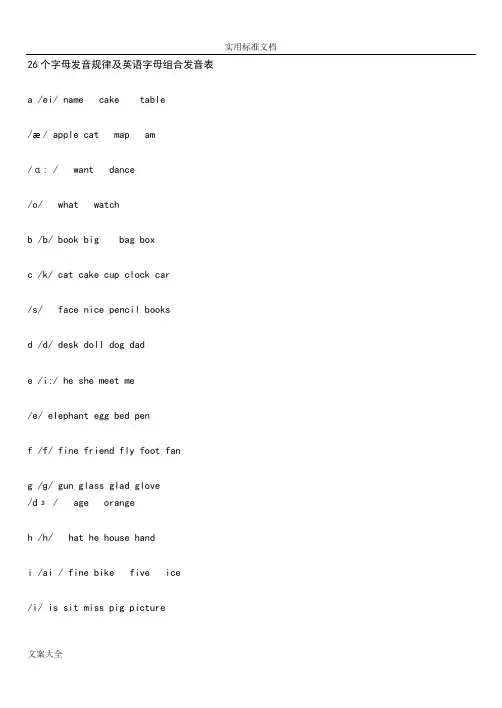
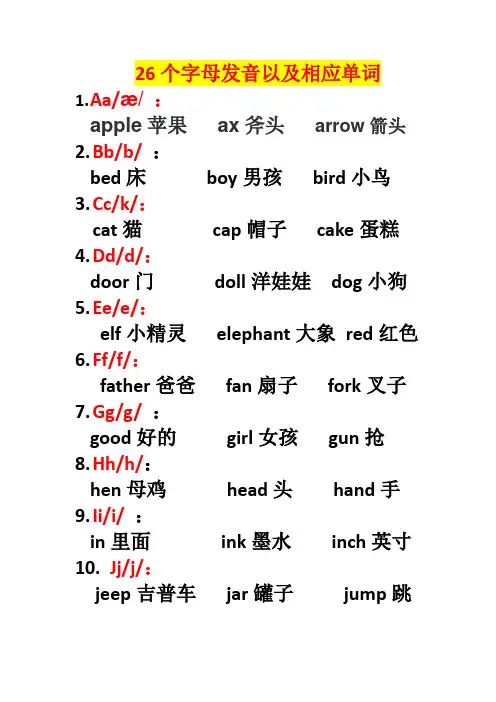
26个英语字母的发音表
- 格式:doc
- 大小:15.92 KB
- 文档页数:7
26个英语字母的发音表
Title: The Pronunciation Guide to the 26 English
Alphabet Letters.
The English alphabet, consisting of 26 letters, is the
foundation of the language. Each letter has a unique
pronunciation that plays a crucial role in word formation
and sentence structure. This guide aims to provide a
comprehensive pronunciation chart for all 26 English
alphabet letters, along with examples and tips to help you
master their sounds.
Vowels.
1. a /ə/ in "about"
2. e /iː/ in "eat"
3. i /aɪ/ in "ice"
4. o /əʊ/ in "go"
5. u /ʌ/ in "up"
Vowels are the sounds we make with our mouths open.
They are the foundation of syllable formation and are
essential for fluent speaking.
Consonants.
6. b /b/ in "bat"
7. c /k/ in "cat" (before vowels and consonants except
'g', 'h', 'n', 'r', 't', 'u', 'v', 'w', 'x', 'y', and 'z')。
8. d /d/ in "dog"
9. f /f/ in "fly"
10. g /g/ in "go" (before vowels and consonants except
'u')。
11. h /h/ in "hat"
12. j /dʒ/ in "jump"
13. k /k/ in "kit"
14. l /l/ in "let"
15. m /m/ in "mat"
16. n /n/ in "net"
17. p /p/ in "pat"
18. q /k/ in "queue" (always followed by 'u')。
19. r /r/ in "run"
20. s /s/ in "set" (except after 'sh', 'ch', 'x', 't' +
'i' or 'e', 'ss')。
21. t /t/ in "tip"
22. u /ʤ/ in "guess" (only when followed by another
consonant)。
23. v /v/ in "vet"
24. w /w/ in "wet"
25. x /ks/ in "box"
26. y /j/ in "yet" (as a consonant, only at the
beginning of a word or following a vowel)。
27. z /z/ in "zip"
Consonants are the sounds we make with our mouths
closed or partially closed. They are crucial for shaping
words and adding clarity to speech.
Diphthongs.
Certain combinations of vowels produce diphthongs, which are sounds that change during pronunciation. Here are
some common diphthongs in English:
1. ai /aɪ/ in "rain"
2. au /ɔː/ in "out"
3. aw /ɔː/ in "law"
4. ea /iː/ in "tea"
5. ee /iː/ in "see"
6. ie /aɪ/ in "tie"
7. oa /əʊ/ in "boat"
8. oe /əʊ/ in "toe"
9. ue /juː/ in "queue"
Diphthongs add complexity and richness to the English language, making it both challenging and rewarding to learn.
Tips for Better Pronunciation.
1. Listen and Mimic: The best way to improve
pronunciation is by listening to native speakers and
mimicking their sounds. Watch English movies, listen to
podcasts, and practice speaking with fluent friends.
2. Record Yourself: Use a recording device to capture
your pronunciation and compare it to native speakers. This
helps you identify areas where you need to improve.
3. Focus on Individual Sounds: Don't try to pronounce
an entire word at once. Focus on individual sounds and
blend them together smoothly.
4. Practice Regularly: Consistent practice is key to
improving pronunciation. Set aside time each day to work on
specific sounds or words that are challenging for you.
5. Be Patient: Perfect pronunciation takes time and practice. Don't be discouraged if you don't see immediate
results. Keep at it, and you'll eventually see progress.
By following these tips and practicing regularly,
you'll be well on your way to mastering the pronunciation
of the 26 English alphabet letters. Remember, consistent
practice and dedication are the keys to success in learning
a new language. Good luck!