
2014年6月大学英语四级考试真题(第3套)
- 格式:pdf
- 大小:2.97 MB
- 文档页数:5


2014年6月大学英语四级考试真题(第1套)Part I Writing (30 minutes)Directions: For this part, you are allowed 30 minutes to write a short essay on the following topic. You should write at least 120 words but no more than 180 words.Suppose a foreign friend of yours is coming to visit your hometown, what is the most interesting place you would like to take him/her to see and why?注意:此部分试题请在答题卡1上作答。
Part II Listening Comprehension (30 minutes)Section ADirections: In this section, you will hear 8 short conversations and 2 long conversations. At the end of each conversation, one or more questions will be asked about what was said. Both the conversation and the questions will be spoken only once. After each question there will be a pause. During the pause, you must read the four choices marked A), B), C) and D), and decide which is the best answer. Then mark the corresponding letter on Answer Sheet 1 with a single line through the centre.1. A) See a doctor about her strained shoulder.B) Use a ladder to help her reach the tea.C) Replace the cupboard with a new one.D) Place the tea on a lower shelf next time.2. A) At Mary Johnson’s. C) In an exhibition hall.B) At a painter’s studio. D) Outside an art gallery.3. A) The teacher evaluated lacks teaching experience.B) She does not quite agree with what the man said.C) The man had better talk with the students himself.D)New students usually cannot offer a fair evaluation.4. A) He helped Doris build up the furniture.B) Doris helped him arrange the furniture.C) Doris fixed up some of the bookshelves.D) He was good at assembling bookshelves.5. A) He doesn’t get on with the others. C) He has been taken for a fool.B) He doesn’t feel at ease in the firm. D) He has found a better position.6. A) They should finish the work as soon as possible.B) He will continue to work in the garden himself.C) He is tired of doing gardening on weekends.D) They can hire a gardener to do the work.7. A) The man has to get rid of the used furniture.B) The man’s apartment is ready for rent.C) The furniture is covered with lots of dust.D) The furniture the man bought is inexpensive.8. A) The man will give the mechanic a call.B) The woman is waiting for a call.C) The woman is doing some repairs.D) The man knows the mechanic very well.Questions 9 to 11 are based on the conversation you have just heard.9. A) She had a job interview to attend.B) She was busy finishing her project.C) She had to attend an important meeting.D) She was in the middle of writing an essay.10. A) Accompany her roommate to the classroom.B) Hand in her roommate’s application form.C) Submit her roommate’s assignment.D) Help her roommate with her report.11. A) W here Dr. Ellis’s office is located. C) Directions to the classroom building.B) When Dr. Ellis leaves his office. D) Dr. Ellis’s schedule for the afternoon. Questions 12 to 15 are based on the conversation you have just heard.12. A) He finds it rather stressful. C) He can handle it quite well.B) He is thinking of quitting it. D) He has to work extra hours.13. A) The 6:00 one. C) The 7:00 one.B) The 6:30 one. D) The 7:30 one.14. A) It is an awful waste of time.B) He finds it rather unbearable.C) The time on the train is enjoyable.D) It is something difficult to get used to.15. A) Reading newspapers. C) Listening to the daily news.B) Chatting with friends. D) Planning the day’s work.Section BDirections:In this section, you will hear 3 short passages. At the end of each passage, you will hear some questions. Both the passage and the questions will be spoken only once. After you hear a question, you must choose the best answer from the four choices marked A), B), C) and D). Then mark the corresponding letter on Answer Sheet 1 with a single line through the centre.注意:此部分试题请在答题卡1上作答。

2023年6月英语四级真题第3套Part I Writing (30 minutes)Directions:Suppose the student union of your university is organizing an online discussion on college students doing community service. You are to write an essay on its benefits and the service you can provide to the community. You will have 30 minutes for the task. You should write at least 120 words but no more than 180 words.Part II Listening Comprehension (25 minutes)温馨提示:2023年6月四级考试全国共考了2套听力,本套真题听力与前2套内容相同,只是顺序不同,故听力部分不再重复列出Part III Reading Comprehension (40 minutes)Section ADirection s: In this section, there is a passage with ten blanks. You are required to select one word for each blank from a list of choices given in a word bank following the passage. Read the passage through carefully before making your choices. Each choice in the bank is identified by a letter. Please mark the corresponding letter for each item on Answer Sheet 2 with a single line through the centre. You may not use any of the words in the bank more than once.Whether you're just having a down day or a down period, taking a walk can instantly lift your mood, especially when you go outdoors. Not only can walking make you less depressed, but according to a new study, depression sufferers who took a ___26___ walk showed just as much improvement in their ___27___ as people taking medicine. In fact, 60-70 percent of the participants in the study could no longer even be ___28___ as depressed.Bone density may not be one of the most exciting health benefits of walking, but it's an important one. People with stronger bones avoid osteoporosis (骨质疏松症) and all the problems that ___29___ with it, like breaks and other disabilities. And the best way to get strong, healthy bones is by doing weight-bearing exercises like running, dancing and walking, according to a large study. But as regards bones, it's ___30___ use it or lose it: To keep your bones strong you have to keep exercising. The researchers found that adults who walked regularly had better bone density throughout their lives than their ___31___ friends.Taking a walk can be great for ___32___ your head or blowing off some steam. It also provides a great opportunity to ___33___ with friends and family, far away from electronics and other ___34___ at home. Even better, you set a powerful example because when they see you ___35___ the benefits of walking, they'll be encouraged to walk more, too.A) accompany I) distractionsB) approved J) exclusivelyC) bond K) inactiveD) classified L) occurrencesE) clearing M) reapingF) come N) symptomsG) daily O) typicalH) definitelySection BDirections:In this section, you are going to read a passage with ten statements attached to it. Each statement contains information given in one of the paragraphs. Identify the paragraph from which the information is derived. You may choose a paragraph more than once. Each paragraph is marked with a letter. Answer the questions by making the corresponding letter on Answer Sheet 2.A Club Where Lions Dance and Traditions Take RootA) The first thing you notice in the staircase to the fourth-floor studio on Canal Street in Manhattan, NewYork, is the measured thumping (嘭嘭声) coming from behind a metal door. Just beyond the entrance, large lion masks were twisting and turning to the drum-beat. On a recent Friday evening, the teenagers made their way across the studio floor as they practiced Chinese lion dancing.B) "You want to play in a circle," Victor Fong, aged 24, told his students at the New York ChineseFreemasons Athletic Club. "Take it slow and do it again." The dance group, made up of 60 members, performs throughout the year but was now preparing for its biggest events, Chinese Lunar New Year celebrations, which will begin on Saturday and conclude on February 15. Teenagers comprise about half of the group, many of whom began lion dancing at the age of 14. About 100 current and past members of the dance group—which has been performing since 1956—will be among the 220 groups marching through Chinatown in Manhattan for the 18th Lunar New Year Parade on February 5.C) Mr. Fong has been involved in the organization since he was 15 and began teaching lion dancing threeyears ago. But the club also acts as a recreation center and safe haven (庇护所) for teenagers, with video games readily available. As many as 20 students show up after school. "The basic requirement for hanging out here is you have to learn how to lion dance," Mr. Fong said. While that is not a formal requirement for being a member, everyone finds a way to participate in the Lunar New Year Parade, whether it's by dancing, carrying a flag or beating a drum.D) Alvin Chau, aged 26, is an environmental consultant by day and a lion dancer on weekends. He has beena club member for 10 years and joined because of an interest in lion dance. "We're a big family," he said,shaking hands with other members as they walked through the door. "You know everyone."E) It is believed that the lion dance began in the third century. Stories vary about how lion dancing came tobe, but most of them include a monster named Nian who would terrorize a village. The villagers finally banded together and scared the beast away with firecrackers (爆竹) and drums. While lions are not native to China, some versions of the story include the villagers creating a monster of their own in the shape ofa lion to fight off the beast.F) Today, the dancers travel across Chinatown going from business to business to bring good luck for thecoming year. The new year-according to the Chinese lunar calendar-will begin on Saturday and marks the Year of the Rooster (鸡年), which is thought to be a symbol of positivity. "It's almost like the dark night is ending and the sun is coming up," said Ya Yung Teng, the digital collections coordinator for the Museum of Chinese in America. "It's hopeful that we're going to have a new day." Roosters and chickens are not particularly strong creatures, Ms. Teng said, but they are numerous. "In a way,” she said, the rooster "stands for "We the People.””G) The lion head and tail are operated by two people. As one person controls the head, a second followsunder a train of fabric representing the body. The dancers move in harmony as they imitate the animal's natural movements in the wild, including the aggressiveness of an attack. A lion head figure weighs under 10 pounds and sits squarely on the dancer's shoulders. Inside, the dancer manipulates strings that open and close the lion's eyes, shake its ears and open its mouth to reveal a fire-orange tongue.H) "A good lion dancer will imitate a living creature," said Karlin Chan, aged 59, who heads the athleticclub's community public relations. "I started lion dancing when I was a kid," he said. "Chinatown was much smaller then and it was a celebration with fireworks and firecrackers, which added a lot of flavor and meaning to it."I) Mr. Chan buys a new lion head each year when he travels to China. A head costs about $ 1,500. "If youwant the good stuff, the quality, you have to see it for yourself," he said. "I'll inspect the product before we put it in the container and ship it over." Mr. Chan, who has been involved with the club for nearly 50 years, said that passing the dance from one generation to the next was vital. "You need to pass on the traditions and the culture, and this is a part of our culture," he said. "It's a great way to promote cultural understanding and exchange; we welcome that.”J) For Sara Pore, aged 17, another club member, lion dance is more than just tradition, it provides a creative outlet. "Lion dancing started 2,000 years ago—that's incredible," she said. "But what makes you a competent lion dancer is that there's a sense of imagination involved. Lion dancing teaches competence in leadership because of this. You're constantly forced to push yourself past your limit."K) Back at rehearsal (排练), Justin Le, aged 18, tied a red ribbon around his waist to practice jumping. The dancers use the ribbons to pull themselves up over their partners' heads. The room's ceilings are too low to wear the lion heads for jumping practice, so once up on his partner's head, Mr. Le held out his arms as if in offering.L) Mr. Le comes by the dance as a legacy (传承). "I was born into it, " Mr. Le said, noting that his uncle and father were club members. "Growing up, I would always watch my family and see the lion dance, and I slowly grew interested in it." By the age of 14, he was fully enrolled in the athletic club's lion dance group. "I value my culture and tradition, being Chinese or Asian-American. I have a lot of pride in that,"he said. "I want to contribute and give back to the community."36. The lion dancers perform from door to door to bring New Year wishes to business people.37. The New York dance club also serves as a place for entertainment where youngsters can enjoythemselves safely.38. Lion dancers need to have a little imagination to perform well.39. There are a number of different versions about the origin of the lion dance.40. Some 50% of the members of a New York lion dance club are teenagers.41. One club member says he feels proud of his cultural tradition.42. Two dancers coordinate their movements, one manipulating the lion's head and the other its body.43. One lion dancer compares their New York dance club to a family.44. Lion dance should be handed down to future generations as part of Chinese culture.45. One lion dancer learned how to perform from his elders.Section CDirections: There are 2 passages in this section. Each passage is followed by some questions or unfinished statements. For each of them there are four choices marked A),B),C)and D).You should decide on the best choice and mark the corresponding letter on Answer Sheet 2 with a single line through the centre. Passage OneQuestions 46 to 50 are based on the following passage.Team-building exercises have become popular for managers trying to increase organisational and team harmony and productivity. Unfortunately many employees resent compulsory bonding and often regard these exercises as a nuisance.A paper published this week by University of Sydney researchers in Social Networks has reported participants' feelings about team-building interventions (干预), revealing ethical implications in forcing employees to take part."Many people see team-building activities as a waste of time, so we decided to look in more depth at what's behind this," said the paper's lead researcher, Dr Peter Matous."Teams are formed, combined and restructured. Staff are relocated and office spaces redesigned. All this is done with the aim of improving workplace efficiency, collaboration and cohesion. But does any of this work?" said Dr Matous.The study found that team-building exercises which focused on the sharing of and intervening into personal attitudes and relationships between team members were considered too heavy-handed and intrusive, although the researchers say some degree of openness and vulnerability is often necessary to make deep, effective connections with colleagues."Some participants were against team-building exercises because they were implicitly compulsory. They didn't welcome management's interest in their lives beyond their direct work performance," said Matous. "Many people don't want to be forced into having fun or making friends, especially not on top of their busy jobs. They feel management is being too nosy or trying to control their lives too much. "In this study the researchers recommended a self-disclosure (表露) approach where participants were guided through a series of questions that allowed them to increasingly disclose personal information and values. The method is well-tested and has been shown to increase interpersonal closeness. However, to be successful it must be voluntary.The researchers said there are numerous schools of thought that propose differing psychological methods for strengthening relationships. "With caution, many relational methods to improve teams and organisations can be borrowed from other fields. The question is how to apply them effectively to strengthen an entire collective, which is more than just the sum of individual relationships," said Dr Matous.46. Why are many employees opposed to team-building exercises?A) They consider such exercises annoying.B) They deem these exercises counter-productive.C) They see such exercises as harmful to harmony.。

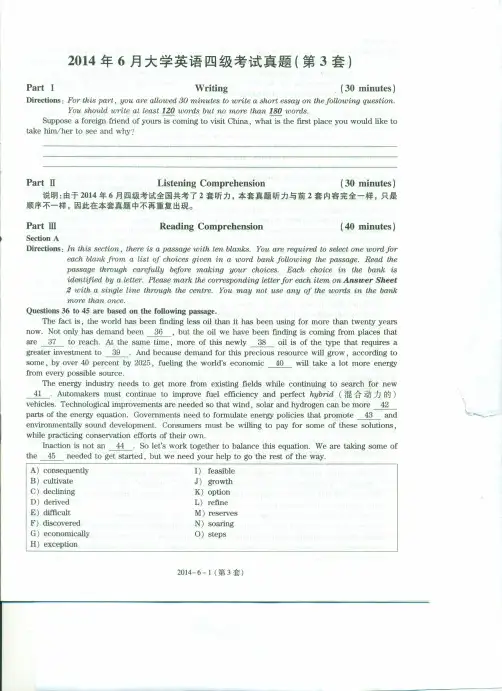
2014年6月大学英语四级考试真题(第3套)Part I Writing (30 minutes) Directions: For this part, you are allowed 30 minutes to write a short essay on the following topic.You should write at least 120 words but no more than 180 words.Suppose a foreign friend of yours is coming to visit China, what is the first place youwould like to take him/her to see and why?Part II Listening Comprehension (30 minutes) Section ADirections: In this section, you will hear 8 short conversations and 2 long conversations. At the end of each conversation, one or more questions will be asked about what was said.Both the conversation and the questions will be spoken only once. After each questionthere will be a pause. During the pause, you must read the four choices marked A), B),C) and D), and decide which is the best answer. Then mark the corresponding letter onAnswer Sheet 1 with a single line through the centre.1.A) He has proved to be a better reader than the woman.B) He has difficulty understanding the book.C)He cannot get access to the assigned book.D) He cannot finish his assignment before the deadline.2. A)She will drive the man to the supermarket.B)The man should buy a car of his own..C)The man needn’t go shopping every week.D) She can pick the man up at the grocery store.3. A) Get more food and drinks. C)Tidy up the place.B) Ask his friend to come over. D) Hold a party.4. A) The talks can be held any day except this Friday.B) He could change his schedule to meet John Smith.C) The first-round talks should start as soon as possible.D) The woman should contact John Smith first.5. A) He understands the woman’s feelings.B) He has gone through a similar experience.C)The woman should have gone on the field trip.D)The teacher is just following the regulations.6. A) She will meet the man halfway. B) She will ask David to talk less.C) She is sorry the man will not come. D) She has to invite David to the party.7. A) Few students understand Prof.Johnson’s lectures.B) Few students meet Prof.Johnson’s requirements.C)Many students find Prof.Johnson’s lectures boring.D)Many students have dropped Prof.Johnson’s class.8. A) Check their computer files. C)Study a computer program.B)Make some computations. D) Assemble a computer.Questions 9 to 12 are based on the conversation you have just heard.9. A) It allows him to make a lot of friends. C)It enables him to apply theory to practice.B) It requires him to work long hours. D)It helps him understand people better.10. A) It is intellectually challenging.B) It requires him to do washing-up all the time.C) It exposes him to oily smoke all day long.D) It demands physical endurance and patience.11. A) In a hospital. C)At a laundry.B)At a coffee shop. D) In a hotel.12. A) Getting along well with colleagues. C) Planning everything in advance.B) Paying attention to every detail. D) Knowing the needs of customers. Questions 13 to 15 are based on the conversation you have just heard.13. A) The pocket money British children get. C) The things British children spend money on.B) The annual inflation rate in Britain. D) The rising cost of raising a child in Britain.14. A) It enables children to live better. C)It often rises higher than inflation.B)It goes down during economic recession. D)It has gone up 25% in the past decade.15.A)Save up for their future education. C)Buy their own shoes and socks.B) Pay for small personal things. D) Make donations when necessary.Section BDirections: In this section, you will hear 3 short passages. At the end of each passage, you will hear some questions. Both the passage and the questions will be spoken only once.After you hear a question, you must choose the best answer from the four choicesmarked A), B), C) and D). Then mark the corresponding letter on Answer Sheet 1 witha single line through the centre.Passage OneQuestions 16 to 19 are based on the conversation you have just heard.16. A) District managers. C) Sales directors.B) Regular customers. D)Senior clerks.17. A) The support provided by the regular clients .B) The initiative shown by the sales representatives.C)The urgency of implementing the company’s plans.D)The important part played by district managers.18. A)Some of them were political-minded. C)One third of them were senior managers.B)Fifty percent of then were female. D)Most of them were rather conservative.19. A) He used too many quotations. C)He did not keep to the point.B) He was not gender sensitive. D)He spent too much time on details.. Passage TwoQuestions 20 to 22 are based on the conversation you have just heard.20.A)State your problem to the head waiter. C)Ask to see the manager politely but firmly.B)Demand a discount on the dishes ordered. D)Ask the name of the person waiting onyou.21.A)Your problem may not be understood correctly.B)You don’t know if you are complaining at the right time.C)Your complaint may not reach the person in charge.D)You can’t tell how the person on the line is reacting.22.A)Demand a prompt response. C)Send it by express mail.B)Provide all the details. D)Stick to the point.Passage ThreeQuestions 23 to 25 are based on the passage you have just heard.23.A)Fashion designer. C)City planner.B)Architect. D)Engineer.24.A)Do some volunteer work. C)Work flexible hours.B)Get a well-paid part-time job. D)Go back to her previous post.25. A)Few baby-sitters can be considered trustworthy.B)It will add to family’s financial burden.C)A baby-sitter is no replacement for a mother.D)The children won’t get along with a baby-sitter.Section CDirections: In this section, you will hear a passage three times. When the passage is read for the first time, you should listen carefully for its general ideal. When the passage is readfor the second time, you are required to fill the blanks with the exact words you havejust heard. Finally, when the passage is read for the third time, you should check whatyou have written.Almost every child, on the first day he sets foot in a school building, is smarter, more _26_, less afraid of what he doesn’t know, better at finding and _27_, more confident, resourceful(机敏的), persistent and _28_ than he will ever be again in his schooling—or, unless he is very unusual and very lucky, for the rest of his life. Already, by paying close attention to and _29_ the world and people around him, and without any school-type formal instruction, he has done a task far more difficult, complicated and _30_ than anything he will be asked to do in school, or than any of his teachers has done for years. He has solved the _31_ of language. He has discovered it—babies don’t even know that language exists—and he has found out how it works learnt to use it _32_. He has done it by exploring, by experimenting, by developing his own model of the grammar of language, by _33_ and seeing whether it works by gradually changing it and _34_ it until it work. And while he has been doing this, he has been learning other things as well, including many of the _35_ that the schools think only they can teach him, and many that are more complicated than the ones they do try to teach him.Part III Reading Comprehension (40 minutes) Section ADirections:In this section, there is a passage with ten blanks. You are required to select one word for each blank from a list of choices given in a word bank following the passage. Readthe passage through carefully before making your choices. Each choice in the bank isidentified by a letter. Please mark the corresponding letter for each item on AnswerSheet 2 with a single line through the centre. You may not use any of the words in thebank more than once.Questions 36 to 45 are based on the following passage.The fact is, the world has been finding less oil than it has been using for more than twenty years now. Not only has demand been _36_, but the oil we have been finding is coming from places that are _37_ to reach. At the same time, more of this newly _38_ oil is of the type that requires a greater investment to _39_. And because demand for this precious resource will grow, according to some, by over 40 percent by 2025, fueling the world’s economic _40_ will take a lot more energy from every possible source.The energy industry needs to get more from existing fields while continuing to search for new _41_. Automakers must continue to improve fuel efficiency and perfect hybrid(混合动力的)vehicles. Technological improvements are needed so that wind, solar and hydrogen can be more _42_ parts of the energy equation. Governments need to formulate energy policies that promote _43_ and environmentally sound development. Consumers must be willing to pay for some of these solutions, while practicing conservation efforts of their own.Inaction is not an _44_. S o let’s work together to balance this equation. We are taking someSection BDirections:In this section, you are going to read a passage with ten statements attached to it.Each statement contains information given in one of the paragraphs. Identify theparagraph from which the information is derived. You may choose a paragraph morethan once. Each paragraph is marked with a letter. Answer the questions by markingthe corresponding letter on Answer Sheet 2.I Cry, Therefore I AmA)In 2008, at a German zoo, a gorilla(大猩猩)named Gana gave birth to a male infant, whodied after three months. Photographs of Gana, looking stricken and inconsolable(伤心欲绝的), attracted crowds to the zoo. Sad as the scene was, the humans, not Gana, were the only ones crying. The notion that animals can weep has no scientific basis. Years of observations by the biologists Dian Fossey, who observed gorillas, and Jane Goodall, who worked with chimpanzees(黑猩猩), could not prove that animals cry tears from emotion.B)It’s true that many animals shed tears, especially in response to pain. Tears pro tect the eye bykeeping it moist, but crying as an expression of feeling is unique to humans and has played an essential role in human evolution and the development of human cultures.C)Within two days an infant can imitate sad and happy faces. If an infant does not cry out, it isunlikely to get the attention it needs to survive. Around 3-4 months, the relationshipbetween the human infant and its environment takes on a more organized communicative role, and tearful crying begins to serve interpersonal purposes; the search for comfort and pacification(抚慰). As we get older, crying becomes a tool of social interaction: grief and joy, shame and pride, fear and manipulation.D)Tears are as universal as laughter, and grief is more complex than joy. But although we all cry,we do so in different ways. Women cry more frequently and intensely than men, especially when exposed to emotional events. Like crying, depression is, around the world, more commonly seen in women than in men. One explanation might be that women, who despite decades of advances still suffer from economic inequality, discrimination(歧视)and even violence, might have more to cry about. Men not only cry for shorter periods than women, but they also are less inclined to explain their tears, usually shed them more quietly, and tend more frequently to apologize when they cry openly. Men, like women, report crying at the death of a loved one and in response to a moving religious experience. They are more likely than women to cry when their core identities—as providers and protectors, as fathers fighters —are questioned.E)People who score on personality tests as more sympathetic cry more than those who aremore rigid or have more self-control. Frequency of crying varies widely: some shed tears at any novel or movie, others only a handful of times in their lives. Crying in response to stress and conflict in the home, or after emotional trauma(创伤), lasts much longer than tears induced by everyday sadness—which in turn last longer than tears of delight and joy.F)Sadness is our primary association with crying, but the fact is that people report feelinghappier after crying. Surveys estimate that 85% of women and 73% of men report feeling better after shedding tears. Surprisingly, crying is more commonly associated with minor forms of depression than with major depression involving suicidal thoughts.G)People widely report that crying relieves tension, restores emotional balance and provides“catharsis,” a washing out of bad feelings. The term “catharsis” has religious implications of removing evil and sin; it’s no surprise that religious ceremonies ar e, around the world, one of the main settings for the release of tears.H)Crying is a nearly universal sign of grief, though some mourners report that, despite genuinesorrow, they cannot shed tears—sometimes even for years after their loved one has gone.Unlike today, when the privacy of grief is more respected, the public or ceremonial shedding of tears, at the graveside of a spouse or the funeral of a king or queen, was once considered socially or even politically essential.I)Crying has also served other social purposes. Rousseau wrote in his Confessions that while heconsidered tears the most powerful expression of love, he also just liked to cry over nothing. J)The association of tears with art has ancient roots. The classic Greek tragedies of the fifth century B.C. were primarily celebrations of gods. Tragedies, like poetry and music, were staged religious events. Even then it was recognized that crying in response to drama brought pleasure.K)I have argued that there are neurobiological(神经生物方面的)associations linking the arts and mood disorders. When I lecture on crying, I ask my audience to let me know, by a show of hands, which art forms most move them to tears. About 80% say music, followed closely by novels (74%), but then the figures fall sharply, to 43%, for poetry, and 10-22% for paintings, sculpture and architecture.L)The physical act of crying is mainly one of breathing in air, which is why we choke up when we weep. This suggests to language scientists that emotional crying evolved before language, perhaps explaining why tears communicate states of mind and feelings that are often so difficult to express in words. Of course, from an evolutionary perspective, recognition of emotion (usually through facial gesture) was essential for survival.M)The earliest humans arrived several million years ago, but only 150,000 to 200,000 years ago, did cultures, languages, religion, and the arts arise. Along the way, tears became more than a biological necessity to lubricate (润滑) the eye and developed into a sign of intense emotion and a signal of social bonding. The development of self-consciousness and the notion of individual identity, or ego; storytelling about the origins of the world, the creation of humanity and life after death; and the abil ity to feel others’ sadness—all were critical parts of the neurobiological changes that made us human.N)More recently, we’ve learned from neuroscience that certain brain circuits(回路)are activated(激活), rapidly and unconsciously, when we see another in emotional distress. In short, our brain evolved circuits to allow us to experience sympathy, which in turn made civilization, and an ethics based on sympathy, possible. So the next time you reach a tissue box, or sob on a friend’s shoulder, or shed tears at the movies, stop and reflect on why we cry and what it means to cry. Because ultimately, while we love to cry, we also cry to love.46. Nowadays people respect the privacy of grief more than in the past.47. Infants cry to attract attention for survival.48. There is no scientific evidence as yet that animal can shed tears from emotion.49. Tears can perform certain communicative function which words cannot.50. Our ability to experience sympathy is essential to the development of civilization.51. People are more inclined to cry when suffering minor forms of depression.52. Sometimes people cannot cry despite genuine grief.53. In humans’ long history,tears have developed an essential role in social relationships.54. Men are less likely to give reason for their tears.55. Crying has long been associated with art.Section CDirections: There are 2 passages in this section. Each passage is followed by some questions or unfinished statements. For each of them there are four choices marked A), B), C) andD). You should decide on the best choice and mark the corresponding letter onAnswer Sheet 2 with a single line through the centre.Passage OneQuestions 56 to 60 are based on the following passage.Hospitals, hoping to curb medical error, have invested heavily to put computers, smart phones and other devices into the hands of medical staff for instant access to patient data, drug information and case studies.But like many cures, this solution has come with an unintended side effect: doctors and nurses can be focused on the screen and not the patient, even during moments of critical care. A poll showed that half of medical technicians had admitted texting during a procedure.This phenomenon has set of an intensifying in discussion at hospitals and medical schoolsabout a problem perhaps best described as “distracted doctoring”. In response, some hospitals have begun limiting the use of electronic devices in critical settings, while schools have studied reminding medical students to focus on patients instead of devices.“You justify carrying the devices around the hospital to do medical records, but you can surf the Internet or do Facebook, and sometimes Facebook is more tempt ing,” said doctor Peter Papadakos at the university of Rochester Medical Center.“My gut feeling(本能的感觉)is lives are in danger,” said doctor Dr. Papadakos. “we’re not educating people about the problem, and it's getting worse.”A survey of 439 medical technicians found that 55 percent of the technicians who monitor bypass machines acknowledged that they had talked on cellphones during heart surgery. Half said they had texted while in surgery. The study concluded, “Such distractions have the potential to be disastrous”.Medical professionals have always faced interruptions from cellphones, and multitasking is simply a fact of life for many medical jobs. What has changed, say doctors, especially younger ones, is that they face increasing pressure to interrupt with their devices.The pressure stems from a mantra(信条)of modern medicine that patient care must be “data driven,” and informed by the latest, instantly accessible information. By many accounts, the technology has helped reduce medical error by providing instant access to patient data all prescription details.Dr. Peter Camel, president of the American Medical Association, said technology “offers great potential in health care,” but he added that doctor's first priority should be with the patient.56. Why do hospitals equip with their staff with computers, smart phones and other devices?A) To reduce medical error. C) To facilitate administration.B) To cope with emergencies. D) To simplify medical procedures.57. What does the author refer to by “distracted doctoring”?A) The disservice done by modern devices to doctors, nurses, as well as patients.B) The tendency of medical institutions encouraging the use of modern devices.C) The problem of devices preventing doctors from focusing on their working.D) The phenomenon of medical staff attending to personal affairs while working.58. What does Dr. Peter Papadakos worry about?A) Medical students are not adequately trained to use modern technology.B) Doctors’ interaction with their devices may endanger patients’ lives.C) Doctors are relying too heavily on modern electronic technology.D) Pressures on the medical profession may become overwhelming.59. Why do doctors feel increasing pressure to use modern devices?A) Patients trust doctors who use modern technology.B) Use of modern devices adds to hospitals’ revenues.C) Data is given too much importance in patient care.D) Patients’ data has to be revised from time to time.60. What is Peter Carmel’s advice to doctors?A) They follow closely the advances in medical science.B) They focus their attention on the patient’s condition.C) They observe hospital rules and regulations.D) They make the best use of modern devices.Passage TwoQuestions 61 to 65 are based on the following passage.I have closely watched my generation, known as The Millennials, for 29 years now. Joel Stein wrote an extensive piece on Millennials and he remains rather optimistic about our potential.I hesitate to share his optimism because of a paradox(矛盾的现象)we seem to exhibit, namely, that there are more avenues for us to entertain ourselves than ever before, yet we are more bored than ever before.Entertainment has never been more varied. We have more cable channels, television shows, and movies than ever before. Internet providers allow instant viewing of almost any movie or television program ever created. Social drinking and partying are also widely available for Millennials. Every generation develops these habits at a certain age, but Millennials seem to be extending this phase of life as they postpone marriage.Some of this is undoubtedly due to The Great Recession. Millennials are having a difficult time finding jobs; only 47 percent of 16-to-24-year-olds are employed, the smallest share since government started recording data in 1948.But do Millennials respond to these economic troubles by doing whatever it takes to make ends meet? Hardly. In fact, of the four generations Pew Research has data for, the Millennial generation does not cite work ethic(勤奋工作)as distinctive of itself. Millennials want to save the world, but they sit and wait for that world-changing opportunity to be handed to them. Instead of working 2-3 jobs, launching a business, or doing what it takes to succeed, they retreat. Millennials may be the first generation to have a lower standard of living than their parents, but with this response to adversity(逆境), perhaps deservingly so.Much ink has been spilled in management books discussing how to get the most out of these youths in the workplace. Largely, they come to the same conclusion: Millennials are entitled, over-confident, and expect too much too quickly. We should not be surprised. Today’s young adults were raised by parents who made sure to boost their self-esteem at every turn, telling them they could achieve whatever they set their minds to, and handing out prizes for sixth place.61. What does the author of the passage think of Millennials?A) They show little interest in entertainment.B) They are not confident about their ability.C) They enjoy an easy life due to high technology.D) They may not have bright prospects for success.62. How do Millennials feel about their life?A) They can hardly do anything about it. C) It is not as good as their paren ts’.B) There is little in it to get excited about. D) It is full of opportunities for success.63. In what way are Millennials different from previous generations according to the PewResearch?A) They spend less time socializing. C) They do not value hard work.B) They are indifferent to others. D) They are more independent.64. What should Millennials do according to the author?A) Remain optimistic in face of diversity. C) Make full use of new opportunities.B) Start a business as early as possible. D) Take action to change their situation.65. Why are Millennials over-confident about themselves?A) They have been spoiled by their parents. C) They are misguided by management books.B) They can always get whatever they expect. D) They think they are young and energetic.Part IV Translation (30 minutes) Directions: For this part, you are allowed 30 minutes to translate a passage from Chinese into English. You should write your answer on Answer Sheet 2.为了促进教育公平,中国已投入360亿元,用于改善农村地区教育设施和加强中西部地区农村义务教育(compulsory education)。