
2011届高考英语总复习《学案与测评》Module4 Music课件 外研版必修6
- 格式:ppt
- 大小:263.00 KB
- 文档页数:12


Module 4 Music(一)课前自主学习Ⅰ.阅读单词——————知其意1.poetry n.诗歌2.melody n. 旋律3.rhyme n. 押韵,韵4.pedestrian n. 行人,步行者5.semicircle n. 半圆6.interval n. 间隔,空隙7.billboard n. 告示牌,广告牌8.socket n. 插座9.organ n. 风琴,手摇风琴10.suite n. 组曲11.session n. 从事某项活动的集会(或一段时间) 12.signify v. 表示,表明13.critic n. (文艺)批评家14.tap v. 轻拍,轻敲,轻叩15.mop v. 擦,揩(脸、汗等)16.heritage n. 遗产17.tunnel n. 隧道,地道18.relay v. 转播,接转19.charm v. 吸引,使陶醉20.scene n. 活动领域Ⅱ.重点单词——————写其形1.characteristic n.[纵联1] 特征,特性,特质2.regarding prep. 关于3.passerby n.[纵联2] 过路人,行人4.shrink v. 变小,减少5.vacant adj. 空的,空缺的6.handle n. 柄,把手7.spotted adj. 有污迹的,有斑点的8.honour v. 尊敬,敬重9.present v. 赠送,颁发(礼物、奖品等)10.therefore adv. 因此,所以Ⅲ.拓展单词——————通其变1.relative n.亲戚,亲属→relation n.关系;联系→relate v.联系2.interpret v.诠释,解释;翻译→interpreter n.口译译员→interpretation n.解释,演绎3.combine v.结合,联合→combination n.联合 [纵联3]4.depress v.使沮丧,使意志消沉,使心灰意冷→depressed adj.沮丧的→depressing adj.令人沮丧的→depression n.沮丧,消沉 [纵联4]5.ambition n.志气,抱负,雄心→ambitious adj.有志气的,有野心的6.regulate v.规定,管理,整顿→regulation n.规章,制度→regular adj.有规律的;平常的→irregular adj.不正常的,不合乎常规的7.voluntary adj.自愿的→volunteer n.志愿者v.自愿8.liveliness n.活泼,快乐,生动→lively adj.活泼的,生动的9.relief n.(痛苦、忧虑等的)解除,减轻,调剂→relieve v.解除;减轻,缓和(不快或痛苦)10.relax v.使放松,使轻松→relaxed adj.轻松的,无拘无束的→relaxing adj.使人放松的→relaxation n.放松,消遣,娱乐活动11.collection n.收藏;收藏品→collect v.收藏 [纵联5]12.symbolic adj.象征的,作为象征的→symbol n.象征纵联1.ic结尾名词精选①characteristic特征②classic名著③clinic诊所④plastic塑料纵联2.变复数时主体名词加s的高频词一览①passerby→passersby 过路人,行人②fatherinlaw→fathersinlaw 岳父,公公③lookeron→lookerson 旁观者④editorinchief→editorsinchief 总编纵联3.由combine想到的①connect v.连接;联合②relate v.联系③associate v.联想;联系④unite v.联合;团结纵联4.de开头动词集汇①depress使沮丧②decline下降,减少③delight使高兴④debate辩论,争论⑤decrease减少,减小⑥determine决心⑦declare宣布,宣告⑧defend保卫,防御纵联5.后缀tion名词万花筒①collection收藏;收藏品②relation关系;联系③instruction说明;指导④competition比赛,竞赛⑤situation情况;状况⑥regulation规章,法规⑦introduction引进;介绍⑧communication交流单元话题——音乐子话题1 音乐相关人员①composer n.作曲家②conductor n.乐队指挥③band n.乐队④choir n.合唱团⑤chorus n.合唱曲,歌咏队⑥musician n.音乐家子话题2 音乐类型①symphony n.交响乐②pop music流行音乐③rock music摇滚音乐④classical music古曲音乐⑤country music乡村音乐⑥jazz n.爵士音乐子话题3 乐器①instrument n.乐器②drum n.鼓③guitar n.吉他④piano n.钢琴⑤violin n.小提琴⑥saxophone n.萨克斯管子话题4 其他①album n.唱片,专辑②release vt.发行③performance n.演出④compose a song创作歌曲⑤make/produce records制作唱片[学考对接·活学活用]高考采撷(一) 阅读中的词汇应用1.(2013·四川高考阅读E)Tests on healthy volunteers❶ found that they were more likely to feel a sense of fear at the moment when their hearts are contracting (收缩) and pumping blood around their bodies, compared with the point when the heartbeat is __❷__ (relax).①写出volunteers在本单元的同根形容词:voluntary②用relax的正确形式填空:relaxed2. (2011·重庆高考阅读E)A critical (批判的)❶ eye is valuable, and the media should present❷ information in such a way that could allow people to make informed decisions.Unfortunately, that is often inaccessible as blocked by the desire to be shocking or t o defend some special interests.People might become halfblind before a world partially exhibited by the media.That's a shame, because matters concerning ❸ the health of the planet are far too important to be treated lightly.①写出critical在本单元的同根名词:critic②选出present在句中的含义:__C__A.赠送 B.颁发C.呈现D.提交③用本单元的词汇替代concerning:regarding高考采撷(二) 写作中的词汇应用(根据汉语及提示词翻译句子)1.(2013·江苏高考书面表达)我们应该严格自愿地遵守交通规则,见到红灯要停下而不是抱怨交通堵塞。
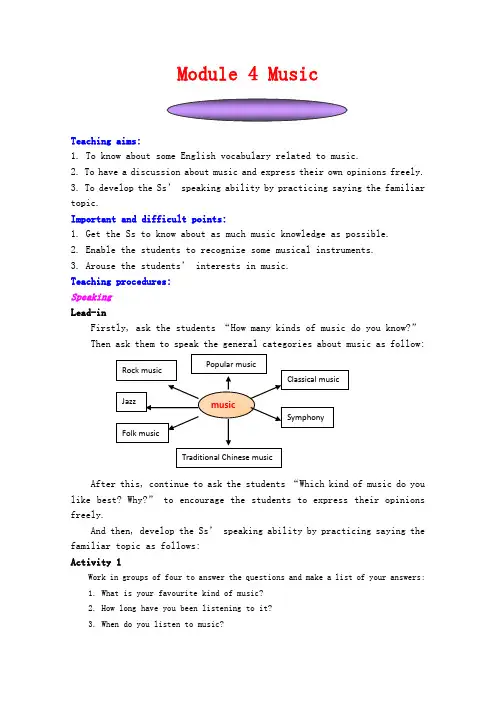
Module 4 MusicTeaching aims:1. To know about some English vocabulary related to music.2. To have a discussion about music and express their own opinions freely.3. To develop the Ss’ spe aking ability by practicing saying the familiar topic.Important and difficult points:1. Get the Ss to know about as much music knowledge as possible.2. Enable the students to recognize some musical instruments.3. Arouse the students’ interests in music.Teaching procedures:SpeakingLead-inFirstly, ask the studen ts “How many kinds of music do you know?”Then ask them to speak the general categories about music as follow:After this, continue to ask the students “Which kind of music do you like best? Why?” to encourage the students to express their opinions freely.And then, develop the Ss’ spe aking ability by practicing saying the familiar topic as follows:Activity 1Work in groups of four to answer the questions and make a list of your answers:1. What is your favourite kind of music?2. How long have you been listening to it?3. When do you listen to music?4. How do you listen to music?5. Why do you listen to music?Activity 2Write a short report about the music interests and habits of your group. Use these expressions:My favourite kind of music is …but Yang’s favorite music is…My favorite artist is…I’ve been listening to music…for/since…I like listening to music when I’m…IntroductionStep 1. Leading-inFirstly, lead in by playing a piece of music Liang zhu(梁祝)played by violin or Guzheng for the students to listen. Then ask them “What kind of musical instrument is the piece of music played by?”Next, brainstorm musical instruments: “How many kinds of musical instruments do you know?” At the same time, in order to make the students know about some English vocabulary related to music, show the students some pictures and ask them to recognize the musical instruments as follows:brain-storming:Are you familiar with these instruments?piano drumMusical instrumentsviolin erhuAfter this, say to the students, “Most of you are familiar with these musical instruments. Today we’ll know more Chinese and western musical instruments. Now let’s know more musical instruments.”flute guitar saxophoneStep 2.Activity 1Continue telling the Ss that the following photos are almost the same with those of their book on page 31. And ask them to look at the photos of Chinese and western musical instruments and answer the following questions.1. Which instruments have strings?2. Which Chinese and western instruments look similar.3. Which of the instruments does the musician hold when he / she is playing?Step 3.Activity 2Ask the students to look at the pictures and read the information about Chinese and Western musical instruments.The konghou is an instrument with strings. It came to China from theWest during the Han Dynasty about 2,000 years ago.The guzheng has been used for more than 2,300 years.It looks like a table harp.The pipa is a lute with four strings and is a relative of the Europeanlute. It came to China from Central Asia in the fourth century.The yueqin is a round instrument like a mandolin. It wascalled qinpipa during the Han Dansty.Step 4. DiscussionGet the students to discuss the following questions with other students.1. How many of the above Chinese instruments have you heard?2. Do you know any artists who play them?Teaching aims and demands:⒈ To learn about some vocabulary and knowledge rel ated to music.⒉ To catch the general idea of the whole passage.⒊ To understand the affection of the author.⒋ To be good at grasping the key words and recognizing the new wordsaccording to the context.⒌To develop their love and interests in music by knowing more about somemusicians.Teaching key points:To make the students grasp the usage of some vocabulary and phrases. Teaching difficulty:To develop their reading abilities and the awareness of the appreciation. Teaching aid:Multi-mediaTeaching procedures:Step 1. Fast readingActivity 1Ask the students to read through the text quickly and find out the information about Liu FangActivity 2Ask the students to find out the answers to the following questions, while listening and reading the text:1. How many the musical instruments she plays? 2. What has an influence on her in her music career? 3.What’s her ambition regarding Chinese music?Answers:①The pipa, the guzheng, the yueqin.②The main influence is traditional singing. ③she wish to introduce classical Chinese pipa and guzheng music to every corner of the world.Step 2. Intensive readingActivity 1Ask the students to match the words with their meanings:1. a musician who performs alone________2. a way of doing something, for example, playing an instrument________3. another word for melody or in the air________4. an event where musicians play________5. all the pieces of music that a musician can play________6. a school where musicians study ________Answers: 1.soloist 2. technique 3. tune 4. concert 5. repertoire 6. conservatoryActivity 2Ask the students to complete the following sentences with the correct form of the words in the box.1. She likes to __________musical styles from east and west.2. What is the _____of the piece she played?3. I like listening to___________Chinese folk songs.4. It’s a great __________to play an instrument like the pipa.5. Sometimes there is a long ________in the middle of the piece.6.I like the way she ___________classical pieces.Answers:1. combine 2. title 3. traditional 4. challenge 5. silence 6. interpretsActivity 3Ask the Ss to read part 1 of the passage and explain the following references.1)...during her visit to China. Who visited China?2)...each onehas its special way of interpreting the classical pieces. Each what?3)The same is true of my second instrument. What is true about the second instrument?1. (The Queen of England) 2. (Pipa school) 3. (To respect traditional but add her own style when playing)Activity 4Ask the Ss to read part 2 of the passage and choose the correct answers.1. When people listen to her playing,________.(a) they also hear her singing(b) they think they can hear her singing2. Liu Fang thinks that _________.(a) Chinese music is like the Chinese language(b) Chinese music and language use the same tones3. Chinese classical pieces often have poetic titles,______.(a) which is understandable(b) which is very surprising4. Empty spaces in Chinese paintings_______.(a) are like the silent parts of Chinese music(b) mean the pictures have no lifeAnswers: 1. b 2. a 3. a 4. aActivity 5Ask the Ss to read part 3 of the passage and answer the following questions.1. What does Liu Fang enjoy about performance?2. What makes her feel depressed or lonely?3. What does she want to do with other musicians?Answers:1.The atmosphere in a concert hall. 2.When she has no concert for along time3.Work with them.Activity 6Ask the Ss to complete the passage use the correct words in the text. Liu Fang, who was _____ in 1974, is an __________ music star. Since the age of six, she has played ____, and since the age of eleven she has given concerts including the performance for ___________________. She studied _______________ during her university. When she was five years old, her mother, who was ______________, taught her to play the ________. In 1996, she and her husband moved to ________.For her ,the biggest challenges of playing the pipa and guzhengare________________________________________. The main influence on LiuFang is ________________. When she is playing, listeners say that they can _____________ in her music.Chinese music ___________ the Chinese language. Chinese classical pieces have poetic titles, which is ________________. ____________ in Chinese paintings are like the silent parts of Chinese music.Answers: 1. born 2. international 3. pipa 4. the Queen of England 5. guzheng and pipa 6. a Dianju actress7. yue qin 8. Canada 9. to respect the traditions but add her own style 10. traditional singing 11. hear singing 12. is similar to 13. understandable 14. Empty spacesStep 3.Homework:Work in pairs and have a discussion on the following questions.1. What about Liu Fang impressed you most?2. Do you think Liu Fang is successful as an artist? Give possible reasons if you think so.Teaching objectives and demands:1. To learn new words and expressions and learn how to use them.2. To understand some a little long but complex sentences.Teaching keys and difficulties:The usage of: give concerts; graduate from; be true of/for; tune; experience(v./n.); share sth. with sb.; make contact with; wish. Teaching procedures:Step 1.Revision1. Check what they learn in the previous class.2. Get students to.Step 2.Important words, phrases, & sentences.1. She’s given concerts since she was eleven, including a performance for the Queen of England during her visit to China.(Part1. para.1)11岁起她就举办演奏会,包括英国女王访华期间为女王做的一场演出。