
M6 Unit 2-1
- 格式:ppt
- 大小:10.35 MB
- 文档页数:44
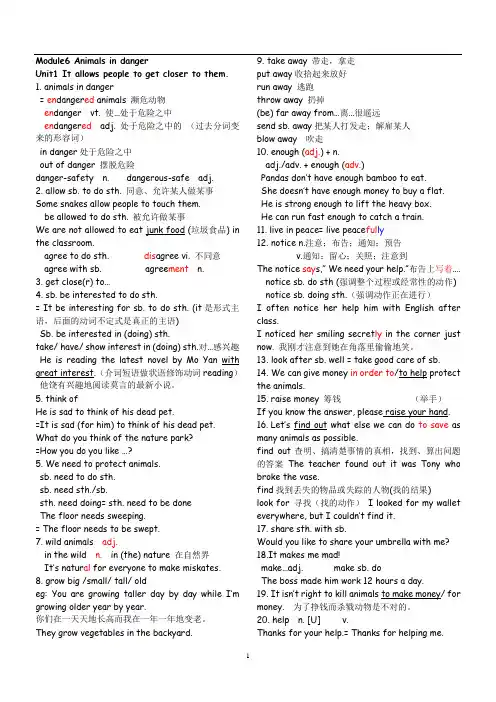
Module6 Animals in dangerUnit1 It allows people to get closer to them.1. animals in danger= en danger ed animals 濒危动物en danger vt. 使…处于危险之中en danger ed adj. 处于危险之中的(过去分词变来的形容词)in danger处于危险之中out of danger 摆脱危险danger-safety n. dangerous-safe adj.2. allow sb. to do sth. 同意、允许某人做某事Some snakes allow people to touch them.be allowed to do sth. 被允许做某事We are not allowed to eat junk food (垃圾食品) in the classroom.agree to do sth. dis agree vi. 不同意agree with sb. agree ment n.3. get close(r) to…4. sb. be interested to do sth.= It be interesting for sb. to do sth. (it是形式主语,后面的动词不定式是真正的主语)Sb. be interested in (doing) sth.take/ have/ show interest in (doing) sth.对…感兴趣He is reading the latest novel by Mo Yan with great interest.(介词短语做状语修饰动词reading)他饶有兴趣地阅读莫言的最新小说。
5. think ofHe is sad to think of his dead pet.=It is sad (for him) to think of his dead pet. What do you think of the nature park?=How you do you like …?5.We need to protect animals.sb. need to do sth.sb. need sth./sb.sth. need doing= sth. need to be doneThe floor needs sweeping.= The floor needs to be swept.7.wild animals adj.in the wild n. in (the) nature 在自然界It’s natur al for everyone to make miskates. 8.grow big /small/ tall/ oldeg: You are growing taller day by day while I’m growing older year by year.你们在一天天地长高而我在一年一年地变老。

学英语教学评课时备课S: Yes, I can./No, I can’t.T: Oh, you can …./Oh, you can’t….通过理解课文内容,掌握文中句子的语音语调,巩固一般过去时的一般疑问句句型。
1.Part 1:(1)Listen and repeat.(2)Read in roles.2.Part 2:T: Look, listen and say.Watch the video and readafter it.3.Listen, read and actout.4.Watch the video andask the students somequestions, let themanswer the questions.Watch the video againand tell them theemphasis.5.Read after the tapeand the teacher.6.Try to act out the1.Part 1:(1)Listen and repeat.(2)Read in roles: boys andgirls.2.Part 2:Watch the video and readafter it.3.Listen, read and actout.4.Answer the questions.①Can Lingling run fast?②Is Lingling good atbasketball?③Who is a goodgoalkeeper?5.Read after the tape andthe teacher.6.Try to act out the text.学生熟练准确读出新句型,正确理解新句型的使用语境。
个别发音不准确及不能熟练运用句型进行回答的学生,课后进行听读练习及讲解。
text.7.读单词。
7.齐读单词,对子互读单词,老师抽查。

四年级下册英语m6u2课文Unit 2: Growing UpLesson 1: Where Shall I Go?- IntroductionIn this lesson, students will learn about different careers and places where people work. They will also practice asking and answering questions about future plans and choices.- Vocabulary1. Nurse: a person who helps sick people and people who are hurt.2. Farmer: a person who grows plants and takes care of animals.3. Soldier: a person who protects their country.4. Chef: a person who cooks food professionally.5. Artist: a person who creates art.6. Pilot: a person who flies an airplane.7. Scientist: a person who studies the natural world and conducts experiments.- Reading and WritingRead the following passage and answer the questions:"Growing up, I always wanted to be a nurse. I enjoy helping people and making them feel better. Now that I am older, I am studying hard to achieve my dream job. I hope to work in a hospital and help those in need."1. What does the person want to be when they grow up?2. Why does the person want to be a nurse?3. Where does the person hope to work in the future?Now, write a short paragraph about what you want to be when you grow up. Use the vocabulary words in your response.- Speaking and ListeningIn pairs, take turns asking and answering the following questions:1. What do you want to be when you grow up?2. Why do you want to be a [chosen career]?3. Where do you hope to work in the future?Practice using the vocabulary words in your responses.- HomeworkFor homework, write a short paragraph about a career you are interested in pursuing in the future. Be sure to include why you are interested in that career and where you hope to work.。

六年级上册英语m6课文Unit 1 You've got a letter from New York.Daming: Look! I've got an email from Lingling. It's about English food. She had eggs and sausages.Fanfan: What did she have for lunch?Daming: She had sandwiches. And she had fish and chips for dinner.Fanfan: Fish and chips?Daming: Yes. It's a traditional English dinner. Do you like English food?Fanfan: Yes, I do. It's delicious.Unit 2 There's Chinese dancing.Simon: There's a Chinatown in New York. There are lots of Chinese shops and restaurants there.Daming: Really?Simon: Yes, and there's Chinese dancing. Let's go to Chinatown now.Daming: We can't go now. It's nine o'clock. We can go tomorrow.Simon: Ah! But I want to go now. All right, we can go tomorrow. Are there any Chinatowns in China?Daming: Oh, no! There are Chinatowns all over the world. There's one in San Francisco too. The Chinatown in New York is very famous. There are lots of Chinese people living there. They love the food from China. They oftengo to the Chinese restaurants. There are also Chinese supermarkets and shops. You can buy many things made in China there.Simon: Sounds great! I want to go to the Chinatown in New York very much. Let's go tomorrow!Daming: OK!。