闽教版小学英语四年级上册知识点
- 格式:docx
- 大小:39.66 KB
- 文档页数:12
闽教版小学英语四年级上册知识点
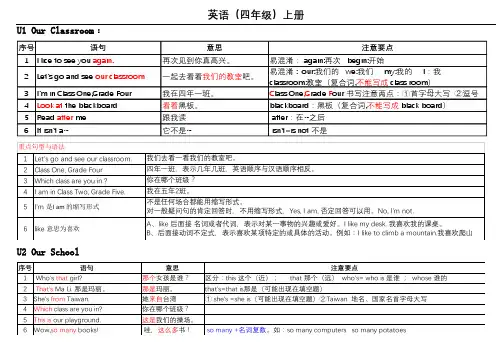
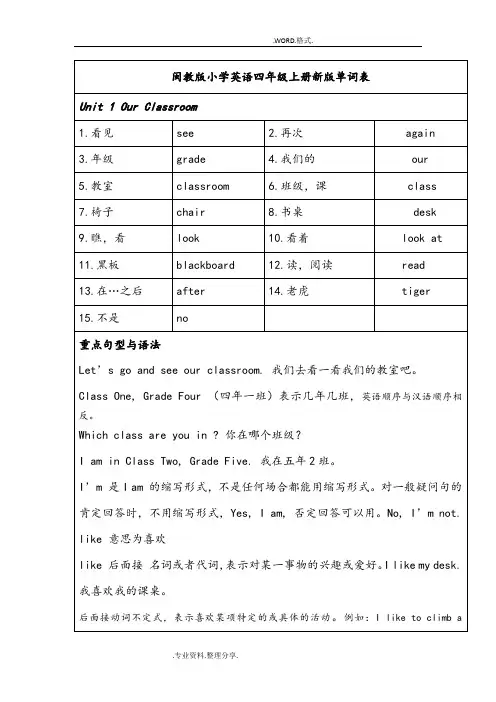
Unit 1:
Key words and phrases:
See: to perceive with the eyes
Again: once more。another time
Grade: a level of study in school
Our: XXX
Classroom: a room in a school where lessons take place
Class: a group of students who are XXX
Chair: a piece of XXX
Desk: a piece of furniture with a flat surface for writing on
Look: to direct one'XXX
Look at: to direct one's gaze towards someone or something
Blackboard: a large board for writing on with chalk
Read: to look at and XXX
After: following in time。place。or order
Tiger: a XXX
No: used to give a negative response
XXX and grammar:
Let's go and see our classroom: XXX.
Class One。Grade Four: The first class in fourth grade.
Which class are you in。What class are you in?
I am in Class Two。Grade Five: I am in the second class in
fifth grade.
I'm: XXX "I am".
Yes。I am: affirmative XXX.
No。I'm not: negative response to a n.
Like: to have a XXX.
I like my XXX: I have a XXX.
I like to climb a mountain: I have a XXX.
Unit 2:
Key words and phrases:
That: used to XXX
Cousin: a child of one's XXX From: indicating the place of origin or starting point of a
person or thing
School: an XXX
Playground: an outdoor area for children to play in
Big: of XXX
Computer: an electronic device for storing and processing
data
Room: a space or area XXX
Library: a place where books are kept for reading or
borrowing
XXX and grammar:
Who's that girl。Who is that girl?
That's Ma Li: That is Ma Li.
This is our playground: This is the XXX.
This is our computer room: This is the computer room that
belongs to us.
This is our library: This is the library that belongs to us.
She's from XXX: XXX.
Be from: to come from a particular place. So many computers!: There are a lot of computers!
So many + XXX
So much + XXX
Unit 3:
Key words and phrases:
Have: to possess or own
Farm: an area of land used for growing XXX raising animals
Dear: XXX cherished
XXX: the number equivalent to the sum of ten and three
Cow: a XXX
Fourteen: the number equivalent to the sum of ten and four
Horse: a XXX
Fifteen: the number equivalent to the sum of ten and five
XXX: XXX
XXX: the number equivalent to the sum of ten and six
How much: used to ask about the price or XXX something
Note: XXX. Unit 3
In English。the suffix -teen means 'ten'。and is used to form
numbers from 13 to 19.For example。if someone asks "How many
sheep do they have?"。the answer might be "They have fifteen
sheep"。Similarly。if someone asks "How many pigs do they
have?"。the answer might be "They have XXX using words like
"plus"。"and"。or "add"。For example。2+3 can be expressed as
"How much is two and three?" and the answer would be "Two and
three is five".
It's important to note the difference een the suffix -teen in
numbers like thirteen。fourteen。and fifteen。and the suffix -ty
in numbers like thirty。forty。XXX (XXX) with a single digit
number (like one or two)。and are pronounced with a hyphen een
the two parts。For example。21 can be expressed as "twenty-one"。and 32 can be expressed as "o".
When asking for the time in English。you might say "What's
the time?" and the response could be "It's five o'clock" for 5:00.For other times。you can simply read out the digits。like "nine o five"
for 9:05."nine fifteen" for 9:15."nine thirty" for 9:30.and "nine
forty-five" for 9:45.
Unit 4
Unit 4 XXX related to time and numbers。It's important to
note that numbers like thirty。forty。and fifty have the suffix -ty。while numbers like thirteen。fourteen。and fifteen have the suffix
-teen。This is important for n。as -ty numbers are XXX.
When asking for the time in English。you might say "What's
the time?" and the response could be "It's five o'clock" for 5:00.For
other times。you can simply read out the digits。like "nine o five"
for 9:05."nine fifteen" for 9:15."nine thirty" for 9:30.and "nine
forty-five" for 9:45.
Unit 5
Unit 5 XXX。For example。you might take a bus to school
or get into a car to go somewhere。It's important to note that "full"
can be used to XXX food。For example。"The bus is full" means
that there are no more seats available。while "I am full" means
that you have XXX.
Daily routines are also covered in this unit。such as getting
up in the morning。having breakfast。going to school。having
lunch。and going to bed at night。When describing the time of
day。you might use "at" for a specific time。like "I wake up at
7:00"。or "to" to indicate the n of time。like "It's ten to six" for
5:50.
Please get in the car。This phrase is used when getting into a
small car or taxi。On the other hand。we use "get on" when
getting on a bus or train.
What time do you usually wake up。Or simply。when do
you wake up。We use "XXX.