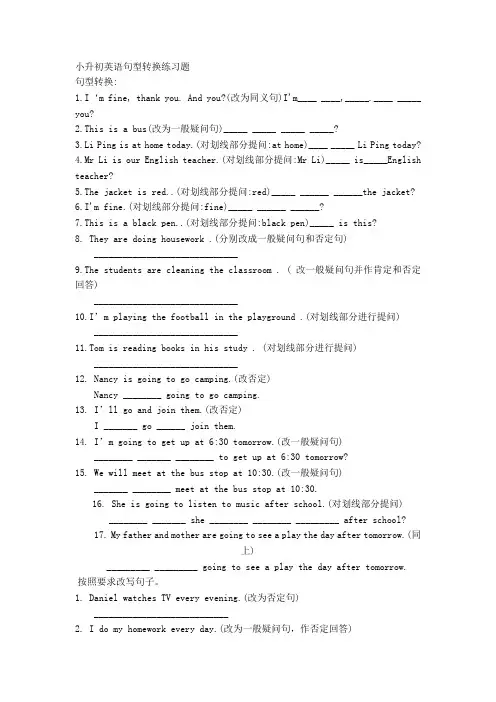
小升初英语句型转换专项练习试题
- 格式:doc
- 大小:31.08 KB
- 文档页数:6
.. . . ..
学习参考 【课堂演练】
句子类型主要有简单句和复合句。小学阶段主要学简单句。简单句的句型有:陈述句(肯定句和否定句)、疑问句(一般疑问句、特殊疑问句、选择疑问句、反意疑问句)、祈使句。句型转换是小升初常考题,下面看看做这些题有何技巧。
一、陈述句(肯定句 & 否定句):
否定句:改写时我们遵循“有情态动词和be动词时,在情态动词和be动词后直接加not,没有情态动词和be动词时,加入相应助动词的否定态并将谓语动词还原”的规则。
1.肯:I can swim. 否 I can not swim.
2.肯:I am a student. 否:I am not a student.
★当没有情态动词(__________________________________________)和be动词时,我们用相应的助动词帮助我们完成句子的否定含义。我们接触到的助动词有do, does, did,也就是说我们要用他们的否定形式即don’t, doesn’t, didn’t, 来帮助我们完成否定句。不要忘了要将don’t, doesn’t, didn’t后的谓语动词还原。
1. 肯:I like swimming. 否:I don’t like swimming.
2. 肯:She loves pets. 否:She doesn’t love pets.
3. 肯:I did my homework late yesterday. 否:I didn’t do my homework late yesterday.
★特别注意:如果肯定句中有some,and等这种只能用于肯定句的词汇时,在改否定句时,要把它们变为可以用在否定句中的any和or等。
1. 肯:I will go and join them. 否:I will not go or join them.
2. 肯:I like some bread. 否:I don’t like any bread.
二、疑问句:
(一)一般疑问句:
一般疑问句问句的改写遵循“有情态动词和be动词时,将情态动词和be动词提前,没有情态动词和be动词时,句首加入相应助动词并将谓语动词还原”的规则。但是当主语是I时,要将其改为you。
1. 肯:I can swim. 否:
2. 肯:I am a student. 否:
在回答一般疑问句时,我们一般用yes和no来回答,并遵循“用什么提问用什么回答”的原则,所以关键就在于问句的第一个词,但是有的情态动词引出的一般疑问句根据其表达意思可以用不同的情态动词回答。
1. They had a good time in the park last Sunday.(一般疑问句)__________________________________
2. You can pick them up for me.(一般疑问句)_____________________________________________
3. Ben and Jim often go home together after school.(一般疑问句)_______________________________
4. Jim lives near Ben.(一般疑问句)______________________________________________________
5. My father often watches TV after supper.(一般疑问句)______________________________________
6. We often visit our friends at the weekends.(否定句)
________________________________________ .. . . ..
学习参考 (二)特殊疑问句:
who询问主格(人);what询问物或干什么;whose询问所有格“谁的”;which哪一个人或物;
where询问地点;when询问时间;what time询问较为具体的时间;why询问原因;how询问用……方法,如何……;
how还可以后接相应的形容词或副词询问其程度:
how old询问年龄;how many询问可数名词的量;how much询问价格和不可数名词的量;how often询问频率;how soon询问还要多久才;how long询问时间多久或某物体多长;how far询问距离;how about询问对于某个行为动作的意见;what about询问对于某件事情或者物体的意见。
牛刀小试:
(一)按要求改写下列句子:
1. It’s Helen’s dress.(划线提问)
________________________________________________________
2. Those pots are Mr. Li’s. (划线提问)
_________________________________________________
3. They live in the town with their parents.(划线提问)
_________________________________________
4. My birthday is on the first of June.(划线提问)____________________________________________
5. It means “No littering”.(划线提问)_____________________________________________________
(二)选择:
1. Excuse me, can you tell me is the way to the shopping hall?
A. where B. which C. why D. who
2. ----- _________ got the 100th gold medal in the Olympics for China?
----- Zhang Yining.
A. Who B. What C. When D. Where
3. ----- __________ are you talking about?
----- We are talking about the Asia Games in Guangzhou.
A. What B. Where C. Why D. How
(三)选择疑问句:
选择疑问句提出两个或两个以上可能的答案供对方选择,选项之间用or连接。在形式上它很像一般疑问句,但是回答时我们要用肯定句而非yes, no。例如:
----- Do you like sandwich or hamburger? ----- I’d like a sandwich.
(四)反义疑问句:
反义疑问句要注意前肯后否,前否后肯的核心准则。如:
He has a new bike. (改为反义疑问句)→He has a new bike, doesn’t he ?
三、祈使句:
祈使句表示请求、命令、建议等等,其中谓语动词一律用原形而且句子中通常不用主语。
(一)肯定的祈使句:
(1)动词原形开头,例如:Stand up. 起立。 Be quiet, please. 请安静。
(2)Let引出的祈使句,例如:Let’s play ball. 我们玩球吧。 Let me help you. 让我来帮你。
如果要加人称,人称要用“,”隔开,例如:Li Ming, come here. 李明,过来。
(二)否定的祈使句: .. . . ..
学习参考 Don’t + 动词原形,例如:Don’t swim in the river. 别在河里游泳。 Don’t be late.
别迟到。
练一练:
1. Put the shoes next to the cupboard.(否定句)_________________________________________
2. Bill, come and chat with me.(否定句)_________________________________________________
改为同义句:
1. What date is it today? → __________________the date today?
2. It’s time for breakfast. → It’s time ___________ ______________
breakfast.
3. What’s the time? → _______________ time is _________?
4. I would like a toy bike as my birthday present. → I ___________ _______ have
a toy bike as my birthday present.
5. I was born on the fifth of December. → ________ ________________ _______
on the fifth of Dec.
四、其他改写要求:
(一)单数改复数句型:
单数改复数的句型,要求将句子里所有的单数词改为复数词,包括主语、谓语和宾语所含的词。如:She is a girl. → They are girls.
(二)改为同义句:
要求改为同义的句型,要注意用填写部分换掉题目划线部分,要求能完整表达原意。如: