
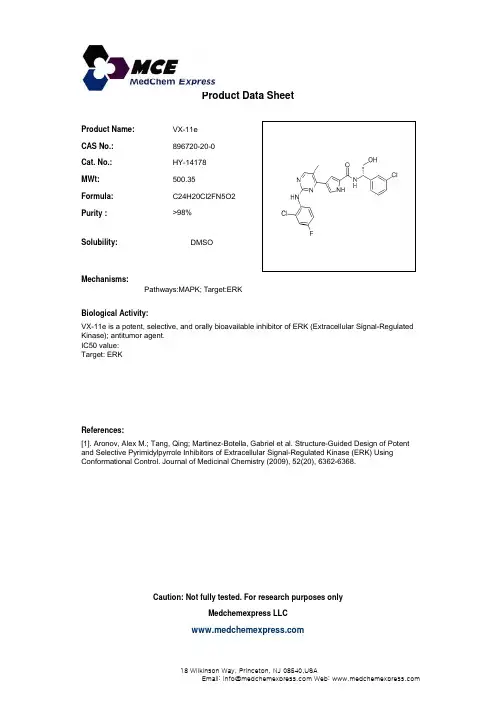
VX-11e_896720-20-0_DataSheet_MedChemExpress
- 格式:pdf
- 大小:63.48 KB
- 文档页数:1

Endotoxin Removal Solution Catalog Number E4274Product DescriptionEndotoxins are lipopolysaccharides (LPS), a major component of the Gram-negative bacterial cell wall, and are commonly found as contaminants in plasmid DNA preparations from E. coli. Endotoxins are large, negatively charged molecules that co-purify with DNA on ion exchange and size exclusion columns and in CsCl banding. Endotoxins are extremely potent stimulators of the mammalian immune system and are toxic to primary cells and to animals. The endotoxin toxicity is an obstacle to in vitro and in vivo transfection experiments.Non-ionic detergents, traditionally used for separation of integral membrane proteins,1 can be utilized for removal of endotoxins from DNA solutions by phase separation.2The solubility behavior of a detergent in a dilute, aqueous solution at physiological salt and pH conditions is strongly dependent upon the temperature of the solution. At low temperatures, the detergent forms a clear, micellar solution, but above the cloud point temperature, the micelles form larger, turbid aggregates and ultimately fuse to form a separate phase. The lower phase is detergent-enriched and the detergent-depleted upper phase contains detergent at a concentration slightly above the critical micellar concentration (CMC). Amphiphilic and hydrophobic molecules associated with the micelles of the detergent will aggregate within the detergent-enriched phase, while the soluble, hydrophilic molecules will remain in the detergent-depleted upper phase.Extraction of endotoxin contaminated DNA solutions with the appropriate non-ionic detergent will separate the hydrophilic DNA from the amphiphilic endotoxin. The amphiphilic endotoxin will associate with the lower phase, while the DNA will remain in the upper, detergent-depleted phase.2Reagents and equipment required, but not provided • Water, Molecular Biology Reagent, Catalog Number W4502• E-TOXATE® Water, Catalog Number 2107, or Tris-EDTA (TE) buffer 100×, Catalog NumberT9285• DNA solution (0.5 ml), ~ 1 mg/ml in E-TOXATE®Water or TE buffer• 3 M sodium acetate solution, pH 7.5.• 2-Propanol, Catalog Number I9516, or Ethanol, 190 proof, Catalog Number E7148; 200 proof, CatalogNumber E7023• 70% Ethanol• E-TOXATE®reagents Kits, Catalog Numbers 210A1, 210B1 or 210C1• Ice bucket• Heat block or incubator at 37 °C• Microcentrifuge at room temperature• 1.5 or 2 ml sterile microcentrifuge tubes• Endotoxin-free pipet tips (40-200 µl, 200-1000 µl) Precautions and DisclaimerThis product is for R&D use only, not for drug, household, or other uses. Please consult the Material Safety Data Sheet for information regarding hazards and safe handling practices.StorageStore at room temperature.Note: Removal of endotoxins from DNA preparations can be performed either during the final stage of DNApreparation, or during an earlier stage.Procedures for Endotoxin RemovalDuring the final stage of DNA preparationNote: The procedure described below was performed on plasmid DNA produced in E. coli DH5α cells.• Losses of up to 50% of the DNA are expected. • Use of a DNA concentration above therecommended 1 mg/ml reduces the efficiency ofthe procedure.1. Pipette 500 µl of the DNA solution into a sterilemicrocentrifuge tube.2. Add 50 µl of the 3 M sodium acetate solution to theDNA sample.3. Incubate on ice for 5 minutes.4. Add 100 µl of cold Endotoxin Removal Solution.5. Mix thoroughly and incubate on ice for 10 minutes.The solution should be light blue and clear.6. Incubate the tube at 37 °C for 20 to 30 minutes oruntil the phases separate.7. Spin for 5 minutes at 3000 x g in themicrocentrifuge. The upper phase is colorless and clear, while the lower phase is blue.8. Carefully transfer the upper phase containing theDNA to a clean microcentrifuge tube.9. Repeat steps 4 through 8 twice.10. Add 0.6× volume of 2-propanol. Mix by inversion atroom temperature and centrifuge at 15,000 x g for30 minutes at 4 °C. Alternatively, add2.5× volumes of ethanol. Incubate overnight at –20°C or 20 minutes at –70 °C and centrifuge at15,000 x g for 30 minutes at 4 °C.11. Carefully remove the supernatant12. Wash the DNA pellet twice with cold 70% ethanol.Remove the supernatant.13. Air-dry the pellet.14. Suspend the DNA in 100 µl of endotoxin free wateror TE buffer.15. Determine DNA concentration and endotoxin levelsusing endotoxin assay reagents and compare tothe starting material. During an earlier stage of DNA preparationThis procedure is based on the alkaline lysis of E. coli DH5α cells.3 The endotoxins are removed immediately after alkaline cell lysis, neutralization, and a clarification step. The resulting high salt solution is suitable for the endotoxin removal step. It is performed under “endotoxin free” conditions. The plasticware used is either sterile and disposable, or NaOH-treated. The buffers are prepared with endotoxin free water.1. Add the Endotoxin Removal Solution (0.2× volume)to the cold, crude DNA solution.2. Incubate on ice and mix occasionally by inversionto obtain a homogenous, clear blue solution3. Incubate at 37 °C for 20 to 30 minutes until thephase separation is obvious.4. Spin for 5 minutes at low speed (3000 x g) at roomtemperature.5. Transfer the upper aqueous phase to an endotoxinfree container.6. Proceed with the DNA purification by any method.Use endotoxin-free buffers and containers. References1. Bordier, C., J. Biol. Chem., 256, 1604-1607, (1981).2. Cotten, M. et al., Gene Therapy, 1, 239-246,(1994).3. Sambrook et al., Molecular Cloning, a LaboratoryManual, 2nd Ed. p. 1.38RK,PHC 09/05-1Sigma brand products are sold through Sigma-Aldrich, Inc.Sigma-Aldrich, Inc. warrants that its products conform to the information contained in this and other Sigma-Aldrich publications. Purchaser must determine the suitability of the product(s) for their particular use. Additional terms and conditions may apply. Please see reverse side ofthe invoice or packing slip.。

BX-301M ID R ANGE M EMBRANEI NSTRUCTIONSMet One Instruments, Inc.1600 NW Washington Blvd.Grants Pass, Oregon 97526Telephone 541-471-7111Facsimile 541-471-71161 About the BX-301 Mid-Range MembraneThe BX-301 is a special purpose mid-range membrane foil assembly which may be used to verify the linearity of the BAM-1020 mass calculation system. The mass calculation of the BAM-1020 is inherently linear in nature, and therefore it is unnecessary to audit a mid range point in the vast majority of applications. The BX-301 is provided only as a convenience to certain customers who may be required to perform the check by local regulations.The BAM-1020 unit performs a span membrane check automatically every hour using it’s built-in membrane with a mass of approximately 0.800 mg/cm2. The BX-301 allows the user to periodically perform an additional span check at about 0.500 mg/cm2.The BX-301 membrane is a fragile assembly, and must be handled very carefully. Any puncture or damage to the foil surface will render the part useless. Any dirt or contamination on the foil surface will be measured as mass, and will also invalidate the measurement. This assembly must be protected and stored in a safe location away from heat and direct sunlight.2 Mid Range Span Check ProcedureNote: The BAM-1020 unit must be powered on and warmed up for at least one hour before performing the test. The pump does not need to be running during warm-up.1. Remove the ten case cover screws and washers from the BAM-1020. You will needto access the inside of the unit later to complete the test.2. Verify the factory determined ABS value of the BAM-1020 unit. This can be found inthe SETUP > CALIBRATE menu or on the calibration certificate for the unit. This is the expected mass of the span membrane foil in the unit, and will be about 0.800mg/cm2.3. Enter the TEST > CALIBRATE menu on the user interface. This is the screen thatwill be used for the membrane tests. See Section 7.13 of the BAM-1020 manual.The CALIBRATE Test Screen4. Press the START soft key to start a membrane measurement with the existing foil.The test will take about eight minutes to complete. The unit will then display themeasured value of the span membrane foil as the CAL MASS M value. Comparethis value with the ABS (expected) value and record the results. These shouldtypically match within a few micrograms. Note: If these values disagree by 5% ormore, then there is something wrong with the unit such as a dirty membrane or an incorrect ABS value. Do not proceed with the test if the BAM-1020 is not reading its own membrane correctly.5. Remove the BAM case cover. Locate the membrane assembly on the inside of theunit, and the brass raceway in which the membrane assembly slides forwards and backwards. Remove the small dust cover (two small screws and washers). Set the parts aside.MembraneMotorDust CoverMembraneAssemblyMembraneControl ArmThe Membrane Assembly Inside the BAM-10206. Carefully remove the existing membrane from the unit: Pull back the control armagainst it’s spring pressure until you can slide the membrane from the back of the assembly. There should be an expected mass value printed on the back of the mid-range membrane. Record this value. Insert the mid-range membrane foil exactly as the other membrane was installed. Note: Make sure the pin of the membrane is in the slot of the control arm, or the test will not work. Swapping membranes is a very simple matter once you know what you are doing.7. Press the START soft-key to start the test with the mid-range membrane in place.When the unit has calculated and displayed the new CAL MASS M value, record it and start the test over. Perform the test two more times and take an average of the three measured values. This average must be within 5% of the expected valueprinted on the membrane, and will typically be within a few micrograms. Record the results.8. Remove the mid-range membrane and replace the original part. Reinstall the smalldust cover and the main case cover of the BAM-1020.BAM-1020 Membrane Foil Mid-Range Linearity CheckTest Results Record:Test Performed By:Test Date:BAM-1020 Serial Number:Expected ABS Value:mg/cm2Measured Mass of Existing Foil:mg/cm2Difference:mg/cm2Difference %:%Expected Mass of Mid-Range Foil:mg/cm2Measured Mid-Range Mass, Test 1:mg/cm2Measured Mid-Range Mass, Test 2:mg/cm2Measured Mid-Range Mass, Test 3:mg/cm2Average Mid-Range Mass:mg/cm2Difference from Expected Value:mg/cm2Difference %:%。

STNEMURTSNILACIDEM9180 电解质分析仪操作手册 第一版October 1997Copyright, 1997, AVL Scientific Corporation. 保留所有权力,除非另行通知.未经AVL Scientific Corporation同意,不得出版、传播、销售本书任何部分,或翻译成任何语言版本.欲知详情,请联系:AVL Scientific Corporation AVL MEDICAL INSTRUMENTS AG AVL LIST GmbH50 Mansell Court Stettemerstrasse 28Kleiststrasse 48P.O. Box 337CH-8207 Schaffhausen A-8020 GrazRoswell, Georgia USA 30077Switzerland Austria1-800-526-227241-848-800-88543-316-987-0翻译者:侯志强 2001.08.28二稿原版本PD5011 REV Aiiiii 操 作 安 全 信 息● 这个仪器属于安全标准I. 这个仪器属于B型仪器.本仪器符合FCC规则15。
操作必须符合以下二个条件:1。
该仪器不能引起有害的冲突,和 2。
必须能够兼容任何导致的冲突,包括非期望操作的冲突。
不赞成改变或修改本部分,其责任会降低用户操作仪器的权威性.本仪器测试是按照B级数字设备的阈值标准,依照FCC规则15部分.这些阈值参数设计是针对居室安装产生的干扰,提供合理的保护.如果没有按照规范程度安装使用可能产生的,以及仪器开机使用产生的音频辐射能量,会对音频通讯引起干扰.也不能绝对保证正常安装时不会产生干扰.通常开关仪器时会对音频或视频有干扰,为了避免之,用户可以试着采取以下一种或几种措施减少干扰:1.重新调整或部署天线.2.仪器和接收器间距离增大.3.将仪器的差分点连接到接收器的对应点.4.与销售商或有经验的相关技师联系.警告: * 该仪器时常规设计(非防水型). * 不要在爆炸性或附近有氧和硝石混合物的环境中操作. * 该仪器适合连续性使用. * 该仪器必须使用带地线的插头,使用外部电源时必须确定大小合适及地线良好. * 任何仪器内部或外部的对地泄漏,或未与地接触,会给操作仪器造成危险的结果. 任何潜在的接地不良都是不允许的.* 若替换保险丝必须确定是同样型号和大小.决不要用旧的或短路的保险丝.操 作 安 全 信 息iv方法正确使用9180电解质分析仪器是用来从样本中检测钠离子,钾离子,氯离子,离子钙和锂离子的仪器.样本可以是全血,血清, 血浆,尿液, 透析液,和水化液.临床意义钠钠是细胞外液中最主要的阳离子. 其对人体的主要功能是通过化学作用维护渗透压和酸碱平衡以及传递神经冲动. 钠离子的功能是调节细胞膜内外的电位差以维护神经元兴奋传导.钠还作为因子参与一些酶催化反应.人体一直维持基本平衡,即便病理情况下一些细微的变化也会察觉.钠值低即低钠症,通常反映了体液相对体内总钠量过剩.钠水平的减少与以下相关:低钠流入;由于呕吐或腹泻造成钠流失,并补充充足的水分和不充足的盐,每日使用不当,或缺盐型肾病;渗透多尿,代谢性酸毒症;肾上腺皮质不足; 先天性肾上腺增生; 因水肿,心功能不全,肝功能不全,甲状腺机能减退引起的稀释.高钠值是水分的流失超过盐分的流失,例如大量得出汗,呼吸过度,剧烈的呕吐或腹泻,糖尿病或糖尿病性酸毒症; 醛固酮症,CUSHING综合引起的肾脏钠存量增加;因昏迷或中枢疾病 造成水摄入不足; 脱水;或过度的碱治疗.获得钠值通常用来诊断或检测以下:所有的水平衡紊乱,临床注射,呕吐,腹泻,烧伤,心功能抯和肝功能不全,中枢或肾原来性糖尿病, 内分泌紊乱和原发性或继发性肾上腺皮质不足,或其它涉及电解质平衡的疾病.1 Tietz, Norbert W., Ed., Clinical Guide to Laboratory Tests, 2nd Ed., (Philadelphia: W.B.Saunders, Co., 1990) p.98-99, 118-119, 456-459, 510-511, 720-721.2 Burtis C, Ashwood E (Eds.), Tietz Textbook of Clinical Chemistry, 2nd Ed., (Philadelphia: W.B.Saunders, Co., 1994) pp.1354-1370.v钾钾是细胞内液最主要的阳离子,在细胞间起最初的缓冲作用.90%的钾离子在细胞内,损坏的细胞会释放钾离子到血液中.钾在神经传导,肌肉功能,保持酸碱平衡和渗透压方面起着重要的作用.高钾值会出现在少尿症,贫血,排尿障碍,肾炎或休克引起的肾功能不全,代谢性或呼吸性算毒症,带H离子和K离子交换的肾管酸毒症,以及溶血症.低钾症往往是钾的过度流失,常见于:腹泻或呕吐,钾摄入不足, 吸收不良,严重的烧伤和醛固酮分泌的增加.钾值的高低会引起肌肉应激性变化,呼吸作用变化,以及心肌功能的变化.获得钾值常常用来在诊断和治疗以下情况时监测电解质的平衡,如临床注射,休克,心脏或循环功能不全,酸碱平衡,每日疗法,各种肾脏疾病,腹泻,肾上腺皮质功能过剩和不足,以及其它涉及电解质平衡的疾病.氯氯是存在于细胞外的最主要的阴离子.通过它影响了细胞的渗透压.在监测酸碱平衡和水平衡中也起重要作用.在代谢性酸毒症中,当碳酸氢盐浓度下降时氯离子浓度会反向上升.氯降低发生在严重的呕吐,严重的腹泻,溃疡性结肠炎,幽门阻塞,严重烧伤,中暑,糖尿病酸毒症.Addison氏病,发烧, 象肺炎那样的急性感染,等.氯上升发生在脱水,Cushing综合症,换气过度,惊厥,贫血,心功能不全,等.离子钙血液中钙作为自由钙离子(50%)在蛋白质,大部分清蛋白(40%)和10%局限于如碳酸化,磷酸盐 化和乳酸盐化阴离子.但是,仅离子钙能被在身体使用,如肌肉收缩,心脏的功能,传送神经冲动和血凝这样的重要过程.AVL 9180分析仪测量总钙的离子部分.诊断例如胰腺炎和甲状旁腺功能亢进,与总钙相比,离子钙是一更好的指标.vi高血钙可以有各种各样的不良表现,钙值测量可以被生化学家作标记用.通常,在检测恶性肿瘤时,离子钙或总钙都有同样的作用,离子钙可能更敏感一些.高钙血症常常发生在酸碱调节和蛋白\白蛋白流失异常的危急病人中,通过检测离子钙可以很清晰有效地监视钙的状况.患肾脏血管球疾病的肾病患者通常会引起钙, 磷酸盐, 白蛋白,镁离子和PH的浓度异常.因为这些情况会改变总钙中离子钙的独立性,因此监测离子钙成为精确监护肾病患者钙状态的首选方法.(见附注3)离子钙对以下的诊断或监护有着重要意义:高血压控制,甲状旁腺,肾脏疾病,钙摄入不足,维生素监护,透析病人,癌症, 胰腺疾病,利尿剂作用,营养失调,肾结石,多发粘液瘤病,糖尿病等.锂锂是一种人体稀有的单价的碱金属.通常用来治疗狂躁抑郁精神疾病.除了临床上的一些重要并发症外,已被证明是一种非常有效的专用药物.锂存在于血浆蛋白中不到10%,半衰期是7-35小时,主要通过尿液排出体外(95%).锂的治疗范围非常窄,起始剂量约0.80-1.20mmol/L,且长期维持在0.60 to 0.80 mmol/L.治疗期间血清中的锂浓度必须仔细监测,因为只要稍微高于治疗范围的剂量,就会危及生命.尿液电解质电解质存在于人体,也从每日的食物中摄取,通过肾脏系统排泄到尿液中,这是一自然循环.从排泄物尿液中检测电解质,可以了解肾脏的状况和其它的病理状况等重要信息.检测可以从任意尿液样本中,也可从24小时收集的尿液样本作定量检测. 每天排泄的电解质量可以通过检测一天尿液中排泄浓度的增加量(mmol/L)来获得.3 Burritt MF, Pierides AM, Offord KP: Comparative studies of total and ionized serum calcium values in normal subjects and in patients with renal disorders. Mayo Clinic Proc. 55:606, 1980.vii透析电解质在透析器中,动脉血和透析液在透析膜的两边进行透析.透析膜会防止蛋白质和红细胞的扩散.因为血液和透析液的成分不同,膜两边会产生压力梯度,小分子就可以通过膜进行弥漫.这种方法可以有效的滤除那些因肾功能低下而不能排泄的尿素,尿酸等物质.当血液和透析液中的电解质浓度有显著差异时,电解质就会从浓度高处理向低的弥散,(如从血液向透析液扩散,或相反.)透析中电解质的透析对临床医生有着非常重要的意义,例如:* 为了维持透析前,透析时,透析后的电解质平衡,及时识别偏差,也可以及早纠正.* 控制透析液中电解质的浓度.一般混合定量的蒸馏水和适当浓度的物质来用.工作原理AVL9180是采用离子选择电极测量法来实现精确检测的.AVL 9180电解质分析仪上有六种电极:钠,钾,氯,离子钙,锂和参比电极.每个电极都有一离子选择膜,会与被测样本中相应的离子产生反应,膜是一离子交换器,与离子电荷发生反应而改变了膜电势,就可检测液,样本和膜间的电势.膜两边被检测的两个电势差值会产生电流,样本,参考电极,参考电极液构成"回路"一边,膜,内部电极液,内部电极为另一边.内部电极液和样本间的离子浓度差会在工作电极的膜两边产生电化学电压,电压通过高传导性的内部电极引到到放大器,参考电极同样引到放大器的地点.通过检测一个精确的已知离子浓度的标准溶液获得定标曲线,从而检测样本中的离子浓度.viii样本的收集和处理安全性采集样本时必须遵守基本的防范规则.所有的血液样本都有潜在的传染性,可能包含人类免疫缺陷病毒(HIV),肝炎B病毒(HBV)或其它的可怕的病原.为减少实验室可能的危险,必须掌握正确的血液采集技术.处理血液和其它体液时戴手套是必不可少的,要获得处理样本安全方面的进一步信息,请参阅NCCLS论文,M29-T2,"通过血液,体液和组织传染疾病的实验室保护措施-第二版"样本要求有关样本的采集存储和处理的详细信息,请参阅NCCLS论文,H11-A2,实验室分析用动脉血的收集-第二版,出版于1992年5月.分析用血样必须要适当地注意采集的仔细性,包括样本装置,位置选择,样本处理和书面记录.特殊的过程参见NCCLS指导.抗凝和样本收集装置AVL9180分析仪器可直接从注射器,采集管,样本杯(需用适配器),毛细管或AVL微量采样器中吸入样本.对于全血和血浆,加入推荐使用的抗凝剂-平衡肝素不会影响电解质值.钠肝素也可接受,但是约束了离子钙,会引起测量值范围的下降.其它的抗凝剂如EDTA, 柠檬酸盐,草酸盐, 氟化物对血液电解质有重要影响,不可以使用.对血清样本,容器不需添加剂.ix样本的处理和存储由于离子钙值,所有的样本都要无氧条件.接触周围的空气会引起样本中CO2丢失,从而使PH上升,造成离子钙的减少.全血全血样本必须采集在肝素化的注射器,AVL微量采样器,毛细管中,并尽快分析.样本容器尽可能采满些,以减少空气驻留的空间.如果需要存储,不要急速将样本降温,否则红细胞会破裂,释放出细胞内的钾离子,影响钾离子测量值的精确性.血浆血浆样本是通过快速离心肝素化的全血,从红细胞中分离出获得的,封在样本试管中.如果需要存储,必须密封且冷藏在4到8摄氏度.冷藏的样本在使用前必须恢复到室温(15-30摄氏度).如果存储超过一小时,血浆样本必须再离心以除去纤维蛋白凝结.血清血清样本收集在一个血液收集杯中,30分钟就会凝结,需要离心了.离心后除去血清中的凝快,密封试管.如果需要存储,样本必须盖紧且冷藏在4-8度,分析前必须恢复到室温(15-30摄氏度).每个实验室应该有自己的血液收集注射器,毛细管,试管和血浆血清的分离产品.x试剂ISE SnapPakTM (BP5186) 包含以下试剂:Standard A用途: 钠,钾,氯,离子钙,锂定标Contents: 350 mLActive Ingredients:Na+150mmol/LK+ 5.0mmol/LCl-115mmol/LCa++0.9mmol/LLi+0.3mmol/L添加物: 杀菌剂Storage:Temperature: 5 - 30 °C (41 - 86 °F)有效期: 见每个包底标签上的出厂日期和序列号码.Standard B用途: 钠,钾,氯,离子钙,锂定标Contents:85 mLActive Ingredients:Na+100mmol/LK+ 1.8mmol/LCl-72mmol/LCa++ 1.5mmol/LLi+0.3mmol/L 添加物: 杀菌剂Storage:Temperature: 5 - 30 °C (41 - 86 °F) 有效期: 见每个包底标签上的出厂日期和序列号码.xiStandard C 用途: 钠,钾,氯,离子钙,锂定标Contents:85 mLActive Ingredients:Na+150mmol/LK+ 5.0mmol/LCl-115mmol/LCa++0.9mmol/LLi+ 1.4mmol/L 添加物: 杀菌剂Storage:Temperature: 5 - 30 °C (41 - 86 °F)有效期: 见每个包底标签上的出厂日期和序列号码.Reference Solution用途: 定标和测量用的盐桥.Contents:85 mLActive Ingredients:Potassium chloride 1.2mol/L添加物: 杀菌剂Storage:Temperature: 5 - 30 °C (41 - 86 °F) 有效期: 见每个包底标签上的出厂日期和序列号码.Separately Packaged Reagents:Cleaning Solution A (BP1025)用途: 清洁测量系统.Contents:Each dispensing bottle contains 100 mL of solution Active Ingredients:Neodisher MA (detergent) 3.5 g/L添加剂: 无Storage:Temperature: 5 - 30 °C (41 - 86 °F)有效期: 见每个包底标签上的出厂日期和序列号码.xii调整液 (BP0380)用途: 钠电极和样本传感器每天的调整,Contents:Each dispensing bottle contains 100 mL of solution (U.S. market)Active Ingredients:Ammonium bifluoride 100 mmol/L添加剂: 无Storage:Temperature: 5 - 30 °C (41 - 86 °F)有效期: 见每个包底标签上的出厂日期和序列号码.尿稀释剂 (BP0344)用途: 用尿液样本时稀释用.Contents:Each bottle contains 500 mL of solutionActive Ingredients:Sodium chloride 120 mmol/L添加物: 杀菌剂Storage:Temperature: 5 - 30 °C (41 - 86 °F)有效期: 见每个包底标签上的出厂日期和序列号码.警告:使用非AVL生产的定标液或电极,不负责保质.试剂包内带废液罐,回收各种可能接触到的,可能会传染的体液.FOR IN-VITRO DIAGNOSTIC USE.Procedure需要的物件产品名称 定购编号ISE SnapPaK试剂包 BP5186清洁液 A BP1025调整液 BP0380尿稀释剂 BP0344打印纸 (5 卷) HP5025xiiiAVL9180电解质分析仪允许操作者采用一种下列操作方法:全血,血清,尿液,质控物,醋酸盐,重碳酸盐.操作者设定后,仪器自动处理样本并打印和显示出结果.在全血,血清,和质控物模式中,钠,钾的报告结果已被换算成相当于火焰测定法值.氯,离子钙,锂的报告结果是电解质直接光测定值.尿液模式允许测量预稀释尿液的钠钾氯. 醋酸盐,重碳酸盐和标准模式中,允许测量水溶液并作为直接光测定值报告.详细的操作请参阅操作手册.测试条件样本量: 95微升样本类型: 全血,血清,血浆,尿液,醋酸盐,重碳酸盐,透析液.样本容器: 毛细管,AVL微量采血器,注射器,试管,样本杯周围温度: +15 -- +32 C ( 60 -- 90 F)周围湿度: 5% -- 85% (未浓缩)测量类型: 直接光测定法测量参数参数 测量范围 显示分辨率全血,血清,血浆,透析液和水溶液:钠 40-205 mmol/L 1 or 0.1 mmol/L钾 1.5-15 mmol/L 0.1 or 0.01 mmol/L(0.8 - 1 5mmol/L 透析液)氯 50-200 mmol/L 1 or 0.1 mmol/L离子钙 0.2-5.0 mmol/L 0.01 or 0.001 mmol/L锂 0.1-6.0 mmol/L 0.01 or 0.001 mmol/L(透析液样本中不能测锂)尿液钠 1 - 300 mmol/L 1 mmol/L钾 4.5 - 120 mmol/L 0.1 mmol/L(60-120 with additional dilution)氯 1 - 300 mmol/L 1 mmol/L(钙和锂在尿液样本中不能测量)xiv定标分析仪器的软件包括六个参数中的任一种配置:Na+/K+/Ca++,Na+/K+/Cl-,Na+/K+/Li+,Na+/K+, Na+/Li+, Li+.这些配置中的每一种都用同样的定标液.在"准备"状态下,每4小时自动进行一次2点定标,每次测量自动进行一次1点定标.开机或复位时也进行自动定标.当没有样本测量时,定标过程也可以随时中断.质控AVL建议每天一次或定期质控,已知Na+,K+,Cl-,Ca++和Li+ 数据的质控液至少作二个水平(中值和低值或高值),要做进一步的了解,参阅操作手册的质控章节.质控结果与已知数据对照是否在允许极限内,如果偏出允许的极限,参阅操作手册的故障一节.参考值样本 参考范围N a + K+ Ca++ Cl - (mmol/l)(mmol/L)(mmol/L)(mmol/L)(mmol/L)血清血浆全血136-1451 3.5-5.11 1.12-1.321 97-1114 0.6-1.201尿液(mmol/24hrs)40-220125-1251N/A110-2501N/A以上仅供参考,各实验室应该建立自己的参考范围(针对AVL9180) 4 Henry, R.J., Clinical Chemistry - Principles and Technics, (New York: Harper and Row, 1974)xv局限性许多因素会引起全血,血清,血浆分析浓度的病理改变,讨论这些影响全血血清血浆浓度的广泛的因素不明确,也不在本文范围内.溴化物,铵,碘化物对血清和尿液没有重要影响已被证明.结合临床反应,用户应适当的考虑可能影响结果的因素,因为药物的使用或内在物质有不确定的冲突影响.实验室和临床医生必须根据病人的临床表现对结果进行估算.使用止血带会导致钾水平升高10-20%,建议采血时不要用止血带,或者在针扎入且过二分钟,拔出针前释放止血.因为红细胞内钾浓度远高于细胞外的,所以必须避免溶血,采集后尽可能从细胞中分离出.锂电极响应与样本中实际的钠浓度有关,AVL 9180分析仪的锂范围为105-180mmol/L Na+.参考高水平的水杨酸盐会影响氯电极,导致氯测量值正向偏离.采用水杨酸盐治疗的,对氯会产生重大的临床影响.锂电极对样本中的离子钙不灵敏,会使锂结果发生负向偏离.正常生理状态的离子钙浓度有重要的临床意义. 5 Kost b.Med., Vol.117, Sep.1993, p.890-95xvi离子钙和总钙的关系健康人群中离子钙占总钙约0.50 或者50% 1,5.当血液中使用了柠檬酸盐,或酸碱代谢紊乱时,其比例会改变.特殊性能指标重复性典型的隔次间的精度(Swr),隔天间的精度(Sdd),总精度(ST)来源于二台AVL9180,分别三种配置,每天二次间的重复性,共20天.钠钾的值是相当于6台仪器的平均值,氯,离子钙,锂的值是二次测量的每次重复性,所有的值单位都是mmol/L.Material: ISE-trol Protein Based Aqueous Control Material - Level 1Parameter mean S wr(CV%)S dd(CV%)S T(CV%) Sodium114.60.480.42%0.760.66%0.890.78%Potassium 2.820.0250.87%0.035 1.24%0.041 1.44%Chloride76.70.290.38%0.520.67%0.720.94% ionized Calcium 2.070.0150.72%0.024 1.18%0.034 1.66% Lithium0.400.010 2.40%0.018 4.57%0.026 6.41% Material: ISE-trol Protein Based Aqueous Control Material - Level 2Parameter mean S wr(CV%)S dd(CV%)S T(CV%) Sodium141.20.400.28%0.300.21%0.460.33%Potassium 4.350.0240.55%0.0230.53%0.0360.82%Chloride102.40.180.18%0.200.20%0.320.31% ionized Calcium 1.350.016 1.21%0.021 1.55%0.042 3.10% Lithium 1.040.012 1.19%0.035 3.36%0.045 4.31%xviiMaterial: ISE-trol Protein Based Aqueous Control Material - Level 3Parameter mean S wr(CV%)S dd(CV%)S T(CV%) Sodium158.80.510.32%0.760.48%0.900.56%Potassium 5.740.0270.48%0.0260.45%0.0360.62%Chloride123.20.360.29%0.890.72% 1.170.95% ionized Calcium0.630.010 1.52%0.007 1.07%0.014 2.29% Lithium 2.590.0250.97%0.063 2.44%0.082 3.18% Material: RNA EQUIL Reduced Bovine Hemoglobin Solution - Level 2Parameter mean S wr(CV%)S dd(CV%)S T(CV%) Sodium134.80.530.40%0.450.33%0.630.47%Potassium 4.890.0390.79%0.0210.42%0.0430.88%Chloride100.40.430.43%0.420.41%0.580.57% ionized Calcium 1.100.0080.75%0.0040.40%0.0110.95% Lithium N/AMaterial: Aqueous Standard Solution - Level 1Parameter mean S wr(CV%)S dd(CV%)S T(CV%) Sodium150.00.550.37%0.340.23%0.570.38%Potassium 4.970.0220.44%0.0180.36%0.0290.57%Chloride115.00.110.09%0.080.07%0.160.14% ionized Calcium0.960.0040.41%0.0040.39%0.0070.76% Lithium0.300.004 1.27%0.005 1.60%0.008 2.48% Material: Aqueous Standard Solution - Level 2Parameter mean S wr(CV%)S dd(CV%)S T(CV%) Sodium113.20.510.45%0.960.85% 1.070.95%Potassium 1.820.033 1.88%0.043 2.36%0.053 2.92%Chloride82.90.270.33%0.670.80%0.87 1.05% ionized Calcium 2.430.0140.56%0.032 1.33%0.043 1.76% Lithium 5.420.0430.78%0.155 2.86%0.196 3.62% xviiiMaterial: Pooled Human SerumParameter mean S wr(CV%)S dd(CV%)S T(CV%) Sodium138.80.300.22%0.360.28%0.470.34%Potassium 4.490.0340.75%0.0410.92%0.051 1.13%Chloride106.80.180.17% 1.000.93% 1.24 1.16% ionized Calcium 1.190.0070.55%0.031 2.64%0.039 3.29% Lithium0.170.011 6.19%0.0158.40%0.02313.28% Material: Acetate Dialysate SolutionParameter mean S wr(CV%)S dd(CV%)S T(CV%) Sodium86.10.850.98% 1.81 2.10% 1.78 2.07%Potassium 2.090.029 1.41%0.041 1.94%0.049 2.32%Chloride107.80.250.24%0.230.21%0.400.37% ionized Calcium 1.770.020 1.13%0.092 5.20%0.115 6.50% Lithium N/AMaterial: Bicarbonate Dialysate SolutionParameter mean S wr(CV%)S dd(CV%)S T(CV%) Sodium135.20.450.33%0.590.44%0.720.54%Potassium 1.580.023 1.46%0.031 1.95%0.037 2.37%Chloride107.30.370.35%0.630.59%0.860.80% ionized Calcium 1.680.0120.72%0.0160.96%0.027 1.63% Lithium N/AMaterial: UrineParameter mean S wr(CV%)S dd(CV%)S T(CV%) Sodium51.5 1.98 3.84% 3.06 5.94% 3.657.08%Potassium48.40.65 1.34%0.97 2.00% 1.11 2.29%Chloride85.90.530.62%0.660.76%0.99 1.16% ionized Calcium N/ALithium N/Axix标准水溶液的线性水液线性标准是公制的加N.I.S.T.可追踪盐并测量于6台9180的每台,每台二次:Na/K/Cl, Na/K/iCa and Na/K/Li.CorrelationParameter Slope Intercept Coefficient Sy*x Range n Sodium0.999930.01280.999950.66651-196300Potassium0.998380.01190.999190.194 2.0-12.6300Chloride0.97556-0.17750.999940.67456-194100 ionized Calcium 1.01552-0.00780.999800.0370.4-3.3100 Lithium0.998500.00870.999850.0380.3-5.3100血清的线性度血清线性是用未临床测试的二个样本分析比较:商业上精制的血清钠/钾/氯线性标准和一组少量的病人血清样本.所有的样本在二台AVL9180的任一台上分析,而每一种配置:Na/K/Cl, Na/K/iCa 和Na/K/Li.下列不同方法仪器的各个比较:直接ISE,与火焰不相关 AVL 983 Na/K/Cl Analyzer(listed as 98X) AVL 984 Na/K/iCa Analyzer AVL 985 Na/K/Li Analyzer直接ISE,与火焰相关 AVL 9130 Na/K/Cl Analyzer(listed as 91XX) AVL 9140 Na/K/iCa Analyzer火焰吸收光谱学 IL 943 Flame Photometer氯计 Labconco Digital Chloridometerxx火焰的相关性IL 943 Flame PhotometerCorrelationParameter Slope Intercept Coefficient Sy*x Range n Sodium0.9617 5.830.9908 2.04104-17850normalized to Na = 1400.47Potassium 1.02490.0150.99910.075 1.8-11.550normalized to K = 4.00.11Lithium0.98030.0110.98220.0280.11-0.71150.97200.0160.99570.0190.23-1.1315直接ISE(与火焰不相关)的相关性AVL 98X Electrolyte AnalyzersCorrelationParameter Slope Intercept Coefficient Sy*x Range n Sodium0.9895-6.350.99920.61110-18650normalized to Na = 140-7.83Potassium 1.0223-0.250.99960.05 2.0-11.650normalized to K = 4.0-0.164Chloride0.9631-1.010.99950.5170-15250normalized to Cl = 105-4.88ionized Calcium0.88980.1070.99600.0210.67-1.6650 normalized to iCa = 1.1-0.014Lithium0.99230.0080.99850.0100.11-0.7115xxi直接ISE(与火焰相关)的相关性AVL 91XX Electrolyte AnalyzersCorrelationParameter Slope Intercept Coefficient Sy*x Range n Sodium0.9856-2.020.9856 1.21104-17950 normalized to Na = 1400.006Potassium0.99920.020.99940.05 1.9-11.850normalized to K = 4.00.02Chloride 1.0026-5.310.99890.7370-15250normalized to Cl = 105-5.04ionized Calcium 1.00230.0400.99540.0220.62-1.5450 normalized to iCa = 1.10.042氯计的相关性Labconco Digital ChloridometerCorrelationParameter Slope Intercept Coefficient Sy*x Range nChloride 1.0222 2.750.9923 2.0366-14550 normalized to Cl = 1050.00xxii 参考书目Bishop ML, Duben-Engelkirk JL, Fody EP. Clinical Chemistry Principles Procedures Correlations, 2nd Ed., (Philadelphia: J.B.Lippincott Co.),1992,p.281.Burritt MF, Pierides AM, Offord KP: Comparative studies of total and ionized serum calcium values in normal subjects and in patients with renal disorders. Mayo Clinic Proc. 55:606, 1980.Burtis C, Ashwood E (Eds.), Tietz Textbook of Clinical Chemistry, 2nd Ed., (Philadelphia: W.B. Saunders, Co.,1994) pp.1354-1360,2180-2206.Calbreath, Donald F., Clinical Chemistry A Fundamental Textbook, (Philadelphia: W.B. Saunders Co., 1992) pp.371, 376, 390-395.Henry, R.J., Clinical Chemistry - Principles and Technics, (New York, Harper and Row, 1974)Kost b.Med., Vol.117, Sep.1993, p.890-95National Committee for Clinical Laboratory Standards. Protection of Laboratory Workers from Infectious Disease Transmitted by Blood, Body Fluids and Tissue, Second Edition; Tentative Guideline. NCCLS Document M29-T2, (1992).National Committee for Clinical Laboratory Standards. Additives for Blood Collection Devices: Heparin; Tentative Standard; NCCLS Document H24-T, (1988).National Committee for Clinical Laboratory Standards. Evaluation of Precision Performance of Clinical Chemistry Devices, Second Edition; Tentative Guideline. NCCLS Document EP5-T2, (1992).Rose, Burton David, Clinical Physiology of Acid-Base and Electrolyte Disorders, 4th Ed., (New York: McGraw-Hill, Inc., 1993) pp. 346-348, 432, 797-798.Schoeff, Larry E & Williams, Robert H. (Eds.) Principles of Laboratory Instruments, (St. Louis: Mosby Year Book Inc., 1993) pp. 150-157, 161-164.Snyder John R., Senhauser Donald A, (Eds.), Administration and Supervision in Laboratory Medicine, 2nd Ed, (Philadelphia: J.B.Lippincott Co., 1989) pp.262-284.Tietz, Norbert W.,Ed.,Clinical Guide to Laboratory Tests, 2nd Ed., (Philadelphia: W.B. Saunders Co., 1990), pp.98-99, 118-119, 456-459, 510-511, 720-721Tietz, Norbert W.,Ed., Textbook of Clinical Chemistry, 2nd Ed., (Philadelphia: W.B. Saunders, Co.,1986), pp.1816, 1837, 1840-1842, 1845.Toffaletti J, Gitelman JH, Savory J: Separation and quantification of serum constituents associated with calcium by gel filtration. Clin Chem 22: 1968-72, 1976.xxiii绪言WelcomeAVL 电解质分析仪可以快速,精确,高效地进行电解质测量,是你的实验室强有力的助手.该手册会教你如何设置仪器,如何开始样本分析.熟悉操作后,你可以手工设置程序,维护仪器,并且排除一些故障.如何使用手册如果仪器还未安装,可按第一和第二章开始,按第三和第四章质控,操作和保养在第五和第六章,详细的维修和操作原则在第七/八章.xxiv内容Chapter 1: AVL电解质仪器 概况 ............................... 1Chapter 2: 安装 ............................... 8Chapter 3: 程序 ............................... 20Chapter 4: 质控 ............................... 32Chapter 5: 操作 ................................ 36Chapter 6: 保养和日常管理. ..................... 42Chapter 7: 故障及其排除......................... 60Chapter 8: 操作原理 ........................... 78Chapter 9: 备件维修及保质....................... 90附录 A: 技术指标 ................................. 93附录 B: 程序流程图 ............................... 95附录 C: 保养日志 ................................. 96附录 D: 相关因数................................... 97xxvChapter 1概况 重要的安全指标在安装AVL电解质仪器之前必须仔细阅读这章.必须防范的是操作者和仪器运行的安全性.● 必须远离如水池等液体.● 不要用含氨的或含酒精的东西清洁.●● 一定要小心处理血液样本和容器.● 一定要带手套以防接触到样本.● 清洁吸样针时间需要无菌操作以防污染.● 一定要按照当地的规定处理试剂包.121-1. 9180 电解质分析仪主要部分(外观) 吸样针部分 控制面板键 控制面板显示 试剂包 前盖3分析仪构件AVL 电解质分析仪是微电脑芯片控制的,全自动的医疗仪器,其测量: Na +:Sodium K +:Potassium 再加下列一个Cl ¯:Chloride Ca ++:Calcium Li +:Lithium分析仪是由几大部分组成的,以后你会对各部分会了解并熟悉的.参见图1-1.通过键盘上的YES和NO键进行人机对话,这些键完成所有功能:样本测量,数据输入菜单选择和质控.参见图1-2.显示屏幕有二行,每行可显16个字符,分别显示仪器状态,菜单和样本结果.参见图1-3.1-2. 控制面板键1-3. 控制面板显示41-4. 9181电解质分析仪主要部分(内部) 吸样针机构液体控制阀 蠕动泵 打印机 测量室5打开主前盖可看到其它一些内部部件参见图1-4和1-5.测量室中有:左边的可活动的锁装置,用来固定电极;右边的样本传感器,电极安放位置有标示.电极标示:Ref :Reference Na +:Sodium K +:Potassium Cl ¯:Chloride Ca ++:Calcium Li +:Lithium 参见图1-6.蠕动泵用来在仪器内传送各种液体.参见图1-7.1-5. 打开主前盖1-6. 测量室1-7. 蠕动泵6吸样针机构位于小门的后面.参见图1-9.试剂包内有废液罐,避免废液的散出.参见图1-10.1-8. 液体控制阀1-10. 试剂包1-9. 吸样针机构7热敏打印机是用16阵列输出打在热敏纸上.可打印的值有:测量值,定标值,电极电压,试剂包中试剂剩余量.更换纸很方便.参见图1-11.型号和序列号铭牌位于吸样机构上方.参见图1-12.后面板上有一铭牌,标有电源开关,保险丝更换以及RS232接口.参见图1-13.祝贺你已了解了仪器的基本构成,你可以准备安装了.1-11. 热敏打印机1-12. 型号和序列号1-13. 后面板82-1. 仪器周围的空间要求Chapter 2安装选择安装位置位置对以后的正常操作很重要,位置的选择要方便于样本的需要以及以下条件: ●接地良好的电源座. ●避免太阳的直接照射. ●室温控制在15 C-32 C(60F-90F) ●最大湿度85% ●仪器周围应有一定的自由空间. 参见图2-1. ●远离强电磁辐射,如马达,X射线设备等 ●远离爆炸性气体等.13"13 3/8"13 3/4"现在仔细打开AVL仪器包装,不要丢弃包装泡沫.装机前仔细检查仪器各种附件,没有缺损.检查:电源线电极打印纸试剂包清洁液电极调质控液还需要在仪器旁准备软绒布和随意用的样本杯.设置在正式运行前仔细阅读该章并理解是很必要的.910将仪器放在桌子上,桌子上应有足够的操作空间,并方便与电源连接.打开仪器前盖,从阀上轻轻移去五个红色的阀垫保留这些阀垫以备以后长期关机,运输等需要.参见图2-2.装上蠕动泵管架,确定没有过分拉伸.参见图2-3.电极和测量室下面可以安装电极到测量室中.将电极从保护合中取出,放在柔软清洁的桌面上,检查每个电极左面都应有一个O形密封圈.参见图2-4.2-2. 移去阀垫2-3. 安装泵管架2-4. 电极上的O形密封圈11从参比电极上移去红色的传输套,并检查电极上的密封圈是否完整,保留传输套,以备将来关机或维修之需.参见图2-5.仔细将参比电极旋进参比电极套.参见图2-6.朝前轻轻的尽量拉出测量室,放松左边的固定机构.参见图2-7和2-8.2-5. 移去传送套2-6. 安装参比电极2-7. 朝前拉出测量室2-8. 放松左边的固定机构红色传输套参比电极参比电极套12插上样本传感器电缆插头.检查O形密封圈,电极架.参见图2-9.现在安装电极到测量室上,从右往左依次装(参比电极最后装).注意:迄今为止,最右边电极一般是下列之一:氯,离子钙,锂,或假电极.如果选择了钠和锂,钾电极将被假电极替代.检查确定安装无误,且所有的电极安装平整.(斜看电极边缘为一直线,与测量室空隙均衡.)参见图2-10.锁紧电极左边的电极固定旋钮,从前向后即锁紧.察看电极放的是否合适.参见图2-11.2-9. 样本传感器电缆和密封圈2-10. 安装电极2-11. 锁紧电极固定旋钮。
美国贝克曼库尔特流式细胞分析仪(Beckman coulter cell)产品型号:Cell Lab Quanta SC当前价格:0.00元产品数量:0新旧程度:全新有效期至:0000-00-00所在地:产品简介:仪器简介:T细胞亚群检测的CD45/CD4/CD8/CD3、CD45/CD56/CD19/CD3;阵发性血红蛋白尿(PNH)检测的CD55、CD59;血小板无力症(GT)检测的CD41、CD61等等详细信息仪器简介:T细胞亚群检测的CD45/CD4/CD8/CD3、CD45/CD56/CD19/CD3;阵发性血红蛋白尿(PNH)检测的CD55、CD59;血小板无力症(GT)检测的CD41、CD61等等。
但对于白血病/淋巴瘤免疫分型,国际上迄今为止也没有统一的抗体组合。
在2000年国际细胞分析学会(ISAC)大会上,临床血细胞计数协会组织了一次国际专家会议,以期对检测血液淋巴系统肿瘤所需最少、最有效的单抗数达成共识。
75%与会者一致认为,对于慢性淋巴系统增殖性疾病(CLD)有9种单抗:CD5,CD19,κ,λ,CD3,CD20,CD23,CD10,CD45对初诊来说是最基本的。
淋巴瘤和CLD相似,需要至少12-16种单抗。
对于急性白血病(AL),75%的与会者认为大约13-15种单抗是最基本的:CD10,CD19,CD79a,CD13,CD33,CD34,CD45,CD2,MPO,CD7,CD14,CD3,HLA-DR等,对初步鉴别白血病系列是必需的。
其他一些(CD16,CD56,CDw65,TdT,cyCD3)可能对某些病例有用。
几乎所有的投票者都认为,要对急性白血病完善分类所需单抗的恰当数量平均为20-24种。
但这些抗体之间组合也是一大难题,目前也无统一规定(如表二)。
大会多数发言者(11/13)指出,对已确诊病人的监护和分期来说,仅需较少单抗。
抗体的质量控制是实验的关键环节。
抗体的质量包括其特异性、灵敏度、精密度。