
英语五大句子基本结构课件
- 格式:pptx
- 大小:2.85 MB
- 文档页数:19


精品文档 英语五大基本句型结构
基本句型一:
SV(主+谓)
Subject(主语)+Verb(谓语)
这种句型中的动词大多是不及物动词 (英语中按动词后可否直接跟宾语, 可把动词分成不及
物动词与和及物动词。不及物动词:字典里词后标有 vi. 的就是不及物动词。不及物动词后
不能直接跟有动作的对象 (即宾语)。若要跟宾语, 必须先在其后添加上某个介词, 如 to,of,at
后方可跟上宾语。具体每个动词后究竟加什么介词就得联系动词短语了,如 listen to,look
at ⋯ .),不及物动词常见的有: appear,apologize,arrive,come,die,disappear,exist,fall,happen,rise
(好像还有所有的感官动词(如以上的 listen— — Eragon 注)等等。如:
The students work very hard. 学生们学习很努力。
She apologized to me again. 她再次向我道歉。
The accident happened yesterday evening.事故是昨天晚上发生的。 (happen 是不及物动词,但
表示 “某地 (某时)发生了什么事 ”,常用 “sth.+ happen +地点 /时间”这一结构来表达,此时主语
应是事情;表示 “某人出了某事 (常指不好的事 ) ”,要用 “sth.+happen+to sb. ”这一结构来表达
— — Eragon 注)
基本句型二 :
SVP(主谓表 )(好像有的叫 SVC(主系表) — — Eragon 注)
Subject(主语)+Link.V( 系动词)+ redicate(表语)(表语是用来说明主语的身份、性质、品性、
特征和状态的,表语常由名词、形容词、副词、介词短语、不定式、动词的 -ing、从句来充
当,它常位于系动词( be, become, appear, seem, look, sound, feel, get, smell 等词)之后。

英语句子成分和英语句子结构讲解及练习
1. 主语(subject):句子说明的人或事物。
The sun rises in the east (名词) He likes dancing. (代词)
Twenty years is a short time in history. (数词) Seeing is believing.
(动名词)
To see is to believe.(不定式) What he needs is a book.(主语从句)
It is very clear that the elephant is round and tall like a tree.
(It形式主语,主语从句是真正主语)
(一)指出下列句中主语的中心词
① The teacher with two of his students is walking into the classroom.
② There is an old man coming here.
③ The useful dictionary was given by my mother last year.
④ To do today's homework without the teacher's help is very difficult.
2. 谓语(predicate):是对主语加以陈述,表示主语的行为或状态,常用动词或者动词词组担任,放在主语的后面。
We study English. He is asleep.
(二). 选出句中谓语的中心词
① I don't like the picture on the wall. A. don't B. like C. picture
D. wall
② The days get longer and longer when summer comes. A. get B. longer C.
英语五大基本句型结构
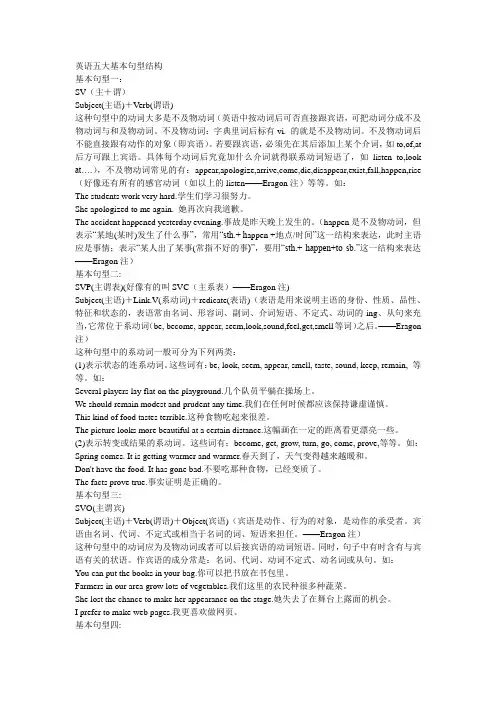
基本句型一:
SV(主+谓)
Subject(主语)+Verb(谓语)
这种句型中的动词大多是不及物动词(英语中按动词后可否直接跟宾语,可把动词分成不及物动词与和及物动词。不及物动词:字典里词后标有vi. 的就是不及物动词。不及物动词后不能直接跟有动作的对象(即宾语)。若要跟宾语,必须先在其后添加上某个介词,如to,of,at后方可跟上宾语。具体每个动词后究竟加什么介词就得联系动词短语了,如listen to,look
at….),不及物动词常见的有:appear,apologize,arrive,come,die,disappear,exist,fall,happen,rise(好像还有所有的感官动词(如以上的listen——Eragon注)等等。如:
The students work very hard.学生们学习很努力。
She apologized to me again. 她再次向我道歉。
The accident happened yesterday evening.事故是昨天晚上发生的。(happen是不及物动词,但表示“某地(某时)发生了什么事”,常用“sth.+ happen +地点/时间”这一结构来表达,此时主语应是事情;表示“某人出了某事(常指不好的事)”,要用“sth.+ happen+to sb.”这一结构来表达——Eragon注)
基本句型二:
SVP(主谓表)(好像有的叫SVC(主系表)——Eragon注)
Subject(主语)+Link.V(系动词)+redicate(表语)(表语是用来说明主语的身份、性质、品性、特征和状态的,表语常由名词、形容词、副词、介词短语、不定式、动词的-ing、从句来充当,它常位于系动词(be, become, appear, seem,look,sound,feel,get,smell等词)之后。——Eragon注)
英语句子成分和英语句子结构讲解及练习1
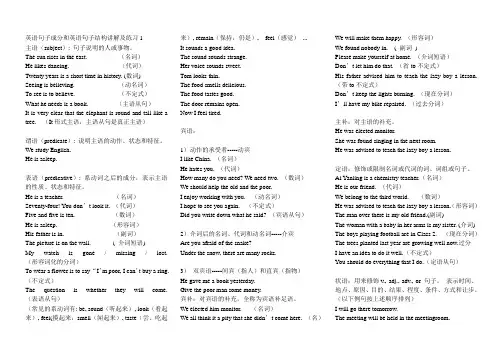
主语(subject): 句子说明的人或事物。
The sun rises in the east. (名词)
He likes dancing. (代词)
Twenty years is a short time in history. (数词)
Seeing is believing. (动名词)
To see is to believe. (不定式)
What he needs is a book. (主语从句)
It is very clear that the elephant is round and tall like a
tree. (It形式主语,主语从句是真正主语)
谓语(predicate): 说明主语的动作、状态和特征。
We study English.
He is asleep.
表语(predicative): 系动词之后的成分,表示主语的性质、状态和特征。
He is a teacher. (名词)
Seventy-four! You don’t look it. (代词)
Five and five is ten. (数词)
He is asleep. (形容词)
His father is in. (副词)
The picture is on the wall. ( 介词短语)
My watch is gone / missing / lost.
(形容词化的分词)
To wear a flower is to say “I’m poor, I can’t buy a ring.