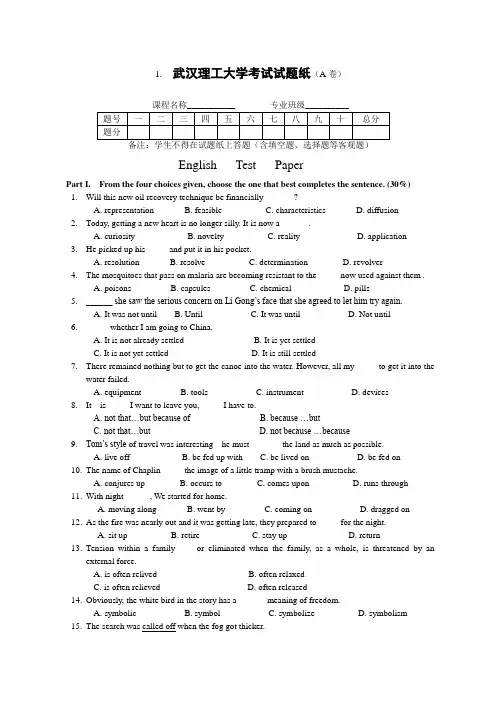
1.武汉理工大学考试试题纸(A卷)课程名称___________ 专业班级__________备注:学生不得在试题纸上答题(含填空题、选择题等客观题)English Test PaperPart I. From the four choices given, choose the one that best completes the sentence. (30%)1.Will this new oil recovery technique be financially ______ ?A. representationB. feasibleC. characteristicsD. diffusion2.Today, getting a new heart is no longer silly. It is now a ______.A. curiosityB. noveltyC. realityD. application3.He picked up his_____ and put it in his pocket.A. resolutionB. resolveC. determinationD. revolver4.The mosquitoes that pass on malaria are becoming resistant to the_____ now used against them .A. poisonsB. capsulesC. chemicalD. pills5.______ she saw the serious concern on Li Gong’s face that she agreed to let him try again.A. It was not untilB. UntilC. It was untilD. Not until6._____ whether I am going to China.A. It is not already settledB. It is yet settledC. It is not yet settledD. It is still settled7.There remained nothing but to get the canoe into the water. However, all my_____ to get it into thewater failed.A. equipmentB. toolsC. instrumentD. devices8.It is _____I want to leave you,_____ I have to.A. not that…but because ofB. because …butC. not that…butD. not because …because9.Tom’s style of travel was interesting---he must _______the land as much as possible.A. live offB. be fed up withC. be lived onD. be fed on10.The name of Chaplin_____ the image of a little tramp with a brush mustache.A. conjures upB. occurs toC. comes uponD. runs through11.With night _____ , We started for home.A. moving alongB. went byC. coming onD. dragged on12.As the fire was nearly out and it was getting late, they prepared to_____ for the night.A. sit upB. retireC. stay upD. return13.Tension within a family____ or eliminated when the family, as a whole, is threatened by anexternal force.A. is often relivedB. often relaxedC. is often relievedD. often released14.Obviously, the white bird in the story has a ______ meaning of freedom.A. symbolicB. symbolC. symbolizeD. symbolism15.The search was called off when the fog got thicker.A. startedB. canceledC. postponedD. continued16.Let’s ____our resources and get the job done quickly.A. use upB. put togetherC. conserveD. store up17.Mrs. Jones______ the suspect by the scar on his face.A. identifiedB. found outC. discoveredD. coincided18.The landlady could not ___--because all her rooms were bookedA. adapt usB. put up with usC. put us upD. help us19.The economic crisis has seriously____ French exports.A. stimulatedB. simulatedC. reducedD. increased20.What it ______ is simply that he is not willing to give us his support.A. amounts toB. mattersC. teachesD. signals21.The train will_____ from Platform 2 at 3:45 on Tuesday morning.A. arriveB. stopC. departD. derail22.The young girl took the cheese and ______ to eat.A. commencedB. commendedC. renouncedD. commented23.A judge must be disinterested when weighing evidence.A. interestedB. detachedC. separatedD. disconnected24.These courses, if properly conducted, will _____ the minds of the students.A. refreshB. renewC. stimulateD. encourage25.That way of speaking is _____ people in this part of the country.A. strange toB. odd toC. peculiar toD. particular about26.He______ as though he had never in his life seen me before.A. went pass meB. avoided meC. ignored meD. went away from me27.He had been _forced_ to give up much of his time to housework.A. orderedB. compelledC. persuadedD. frightened28.He ___ that he could create live fish out of chemicals.A. assertedB. demandedC. arguedD. announced29.The best students are_____ special scholarships.A. rewardedB. awardedC. compensatedD. refused30. Living on an isolated farm, they do not see anybody for weeks_____.A. in the endB. on endC. off and onD. endlesslyPart II. Reading Comprehension (40%)Passage OneIf you are like most people, your intelligence varies from season to season. Your are probably a lot sharper in the spring than you are at any other time of year. A noted scientist, Ellsworth Huntington, concluded from other men’s work and his own among peoples in different climates and temperature have a definite effect on our mental abilities.He found that cool weather is much more favorable for creative thinking than is summer heat. This does not mean that all people are less intelligent in summer than they are during the rest of the year. It does mean, however, that the mental abilities of large numbers of people tend to be lowest in summer.Spring appears to be the beat period of the year for thinking. One reason may be that in the spring man’s mental abilities are affected by the same factors that bring about great changes in all nature.Fall is the next-best season, then winter. As for summer, it seems to be a good time to take a long vacation from thinking31.According to the passage, man’s intelligence_________-A Varies from day to dayB. Stays the same throughout the yearC. Changes with the seasonsD.Changes from year to year32.Ellsworth Huntington decided that climate and temperature have________A.some effect on a few people’s intelligenceB. a great effect on everyone’s intelligenceC.some effect on most people’s intelligenceD.no effect on most people’s in telligence33.Ellsworth Huntington’s conclusion was based on____-A.variations of his own mental abilities from season to seasonB.the results of research done by him and other scientists among peoples in differentclimatesC.detailed records of temperature changes in different placesD.detailed records of different ways of thinking among peoples on different climates34.Why does the author say summer is a good time to take a long vacation from thinking? ____A.Because a long vacation in summer helps to improve people’s me ntal power.B.Because people tend to be less creative during summer.C.Because summer is a good time for outdoor activitiesD.Because mental exertion in the summer heat taxes too much of people’s energy.35.The central idea of this passage is______A.man’s mental abi lities change from season to seasonB.man’s intelligence varies from place to placeC.man should take a long vacation in summerD.if you want to do creative thinking, go to a cool placePassage TwoOn November 19,1863, Abraham Lincoln went to Gettysburg in Pennsylvania to speak at the National Soldiers Cemetery The Civil War was still going on. There was much criticism of President Lincoln at the time He was not at all popular. He had been invited to speak at Gettysburg only out of courtesy. The principal speaker was to be Edward Everett, a famous statesman and speaker of the day. Everett was a handsome man and very popular everywhere.It is said that Lincoln prepared his speech on the train while going to Gettysburg. Late that night, alone in his hotel room and tire out, he again worked briefly on the speech. The next day Everett spoke first. He spoke for an hour and 57 minutes. His speech was a perfect example of the rich oratory of the day. Then Lincoln rose. The crowd of 15,000 people at first paid little attention to him. He spoke for only nine minutes. At the end there was little applause. Lincoln turned to a friend and remarked, “I have failed again.” On the train back to Washington he commented sadly, “That speech was a flat failure, and the people are disappointed.Some newspapers at first criticized the speech. But little by little, as people read the speech, they began to understand better. They began to appreciate its simplicity and its deep meaning. It was a speech which only Abraham Lincoln could have made.Today , every American school child learns Lincoln’s Gettysburg Address by heart. Now everyone thinks of it as one of the greatest orations ever given in American history.36.In 1863, Abraham Lincoln was______-A. very popularB. unpopularC. very criticalD. very courteous37.Lincoln was invited to speak at the National Soldiers Cemetery Because he was______-A. very handsomeB. a famous oratorC. President of the United States at the timeD. a popular statesman38.It can be inferred from the text that_____A.Lincoln prepared his speech very carefully before he went to GettysburgB.Lincoln was very busy at the time and didn’t have much time to prepare his speechC.Lincoln’s speech was full of rich oratoryD.Lincoln’s sp eech was very long39.Lincoln’s speech was_____A.An immediate successB.Warmly applaudedC. A total failureD.Not well-received at first40.Which of the following statements is NOT true?A.Lincoln’s Gettysburg Address has deep meaning.B.Lincoln’s Gettysburg Address is simp le in styleC.Lincoln’s Gettysburg Address is memorized by every American school child.D.Lincoln’s Gettysburg Address is the greatest speech ever delivered in the United States.Passage ThreeThe word horsepower was first used two hundred years ago. James Watt had made the world’s first widely used steam engine. He had no way of telling people exactly how powerful it was, for at that time there were no units for measuring power.Watt decided to find out how much work one strong horse could do in one minute. He called that unit one horsepower. With this unit he could measure the work his steam engine could do.He discovered that a horse could lift a 3300-pound weight 10 feet into the air in one minute. His engine could lift a 3300-pound weight 100 feet in one minute. Because his engine did ten times as much work as the horse, Watt called it a ten horsepower engine.41. The selection says that Watt made the firstA. engineB. steam engineC. widely used steam engineD. useful engine42. watt wanted to find a way toA.measure the work his engine could doB.tell people how powerful his engine wasC.lift a 3300-pound weightD.both A & B43. He made up a unit of measurement based on the strength ofA. a manB. ten horsesC. his engineD. a horse44. One horsepower would equal theA.work a horse could do in a minuteB.weight a horse could liftC.work a horse could do in ten minutesD.weight of one horse45. The best title for this selection isA.Watt’s EngineB.The Origin of the Term HorsepowerC.Units of MeasurementD.It Happened 200 Years AgoPassage FourWhen I was about six years old, my mother came home one day and found that I had collected half a dozen babies of the neighborhood -------all of them too young to walk------and had them sitting before me on the floor while I was teaching them to wave their arms. When she asked the explanation of this, I informed her that it was my school of dance. She was amused, and placing herself at the piano, she began to play for me. This school continued and became very popular. Later on, little girls of the neighborhood came and their parents paid me a small sum to teach them. This was the beginning of what afterwards proved a very lucrative occupation.My mother took me to a famous ballet teacher, but his lessons did not please me. When the teacher told me to stand on my toes I asked him why, and when he replied “Because it is beautiful,” I said that it was ugly and against nature and after the third lesson I left his class, never to return. This stiff and commonplace gymnastics which he called dancing only disturbed my dream. I dreamed of a different dance. I did not know just what it would be, but I was feeling out towards an invisible world into which I guessed I might enter if I found the key.My art was already in me when I was a little girl, and it was owing to the heroic and adventurous spirit of my mother that it was not stifled. I believe that whatever the child is going to do in life should be begun when it is very young. I wonder how many parents realize that by the so-called education they are giving their children, they are only driving them into the commonplace, and depriving them of any chance of doing anything beautiful or original.46. When her mother came home one day, the narrator of the story_________.A. was teaching half a dozen babies to danceB. was teaching half a dozen babies to walkC.. was collecting babies of the neighborhoodD. .was making babies of the neighborhood sit before her on the floor47. The attitude of the narrator’s mother toward her school of dance was one of __________.A. despiseB. contemptC. supportD. indifference48. The narrator thought that ballet was ________.A. the most graceful danceB. stiff, ugly and unnaturalC. a dance that she had dreamed ofD. an invisible world into which she gussed she might enter49. According to the narrator, she owed her success in art to___________.A. the good education her parent gave herB. the support of her understanding and adventurous motherC. her inborn talentD. her ballet teacher50. The ce3ntral idea of the passage is that__________.A. parents should try to discover the natural gift in their children and help to develop it while theyare youngB. the so-called good education parents give their children only drives them into the commonplaceand deprives them of any chance of doing anything originalC. mothers should be heroic and adventurousD. ballet is no good as a form of dancePart III. Cloze (10%)Directions:There are 10 blanks in the following passage. For each blank there are four choices marked A, B, C and D. You should choose the ONE that best fits into the passage.After years of study, I have determined there are only two types of people in this world: those who get to the airport early and those who stroll in as the plane is about to take ___1___. If there were any justice in this world, the early-airport people would be rewarded ___2___ doing the right thing. And the late-airport people would be punished. But there is no ___3___. The early-airport people get stomach troubles, heart attacks and bite their fingernails to the bone. The late-airport people barely are aware they are flying.You know who really gets his luggage first? The late-airport person, who gets into the airport three minutes ___4___ the plane takes off. The pilot is practically in the air when these people are still paying off the taxi. Then they ___5___ a big fuss at the gate in order to get their luggage on board(登机). Not only will that late ___6___ be the first off the plane, ___7___ it is probably sitting on ___8___ of our luggage, crushing our shirts.After a lifetime of arguing over ___9___ I really have to pack 24 hours ahead of time and set the alarm clock four hours ___10___, I have learned one other fact about early-airport people and late-airport people: they always marry each other.1. A. on B. from C. off D. above2. A. for B. with C. to D. beyond3. A. reason B. justice C. significance D. result.4. A. after B. before C. as soon as D. when5. A. take B. see C. make D. produce6. A. people B. passengers C. bags D. luggage7. A. but B. nevertheless C. however D. yet8. A. tip B. top C. bottom D. button9. A. what B. when C. if D. how10. A. in advance B. ahead time C. before D. in frontPart IV. Translation: (20%)1.据说这一地区早在两千年前农业就很先进。