
高中英语语法--直接引语与间接引语转换看图写句子
- 格式:pdf
- 大小:489.70 KB
- 文档页数:2


高中英语语法直接引语和间接引语含练习题直接引语与间接引语一.基本概念1、直接引语:一字不改地引述别人的话He said,“I am a student.”(带引号)2.间接引语:用说话人自己的话转述别人的话 He said he was a student.二.直接引语变间接引语(一)(人称变换规则同下)1.如果直接引语所在的句中的谓语动词是现在时或将来时态,改为间接引语时,时态不变.Eg.He says “I didn’t go to school today.”He says that he didn’t go to school that day .2.如果直接引语讲述的是客观真理现象,改为间接引语时,其一般现在时不变. Eg.The teacher said ,“The earth is round .”The teacher said that the earth is round .三.直接引语变间接引语(二)1.如果说话时间与引述时间不同,即引述某人过去说过的话,则动词时态要作相应的变化即动词时态一律向过去推移一步.(主句为过去式时)2.变换规则(指的是间接引语中的从句部分)(1)人称的变化 ------ 一随主,二随宾,三不变(2)指示代词、时间状语、地点状语和动词的变化1〉指示代词的变化this---- that these----those2〉时间状语的变化now---- then,ago---- before,today----that day,yesterday----the daybefore,tomorrow----the next day,the day before yesterday----two daysbefore,the day after tomorrow----two days later,nextweek/month,etc.---- the next week/month,/doc/2a17542514.html,stweek/month,etc.---- the week/month before3〉地点状语的变化here----there4〉动词的变化come----go(3)时态的变化1〉一般现在时-------一般过去时2〉现在进行时-------过去进行时3〉现在完成时-------过去完成时4〉一般过去时-------过去完成时5〉过去完成时-------过去完成时6〉一般将来时-------过去将来时四.变换类型1.直接引语为陈述句直接引语为陈述句,用that引导(口语中可以省略).e.g.直接引语:The teacher told the students,“I will give you a surprise.”间接引语:The teacher told the students that she would give them asurprise.2.直接引语为疑问句(1)直接引语为一般疑问句时,由whether或if引导,用陈述句的语序e.g.直接引语:He said to us,“Are you going away today?”间接引语:He asked us whether/if we were going away that day.直接引语为疑问句(2)直接引语为特殊疑问句时,其关联词用相应的疑问代词或疑问副词,其后用陈述语序e.g.直接引语:She asked,“Who will help me finish the job?”间接引语:She asked who would help her finish the job.e.g.直接引语:He asked,“What have you done?”间接引语:He asked what I had done.直接引语为疑问句(3)直接引语为选择疑问句,变为间接引语时应用whether…or…e.g.直接引语:“Do you like tea or coffee?” she asked me.间接引语:She asked me whether I liked tea or coffee.3.直接引语为祈使句直接引语为祈使句,变为间接引语时将祈使句的动词原形变为带to 的不定式.它的否定是在to前加not.它没有时态的变化.其他的变化和直接引语是陈述句的情况相同.e.g.直接引语:I said to her,“Please give me a glass of wa ter.”间接引语:I asked her to give me a glass of water.直接引语:He said,“Don’t make so much noise,boys.”间接引语:He told the boys not to make so much noise.4.直接引语为感叹句直接引语若是感叹句,变为间接引语时多采用宾语从句结构,即可用what或how 引导,也可用that引导e.g.直接引语:“What a clever boy you are!”,my teacher said to him.间接引语:My teacher told him what a clever boy he was.My teacher told him that he was a very clever boy.英语小题集练——直接引语和间接引语1、— Could you tell me ______?—Yes. It’s next to the supermarket.A.where the post office isB.where was the post officeC.where is the post officeD.where the post office was2、My brother said, “I’m watching TV now.”My brother said watching TV .A.he, was, now B.I, was, thenC.I, am, that day D.he, was, then3、—Do you know____________?—It’s about ten minutes’ walk.A.how many minutes do you walk to the nearest hospital B.which is the way to the nearest hospitalC.how long did you reach the nearest hospitalD.how far it is to the nearest hospital from here4、-- Do you know ________ the new computer yesterday? -- Sorry, I have no idea.A.how much did she pay for B.how much will she pay for C.how much she paid for D.how much she will pay for5、Jenny is on holiday now. I wonder ________.A.when she will come back B.when she came backC.when will she come back D.when did she come back6、Would you please tell me ______ this book?A.where you bought B.where did you buyC.where you buy D.where do you buy7、— Could you tell me_____ ?— About half an hour.A.how long it takes to walk to the Science and Technology Museum from schoolB.how long it took to walk to the Science and Technology Museum from schoolC.how far was it to walk to the Science and TechnologyMuseum from schoolD.how far it was to walk to the Science and Technology Museum from school.8、I ______ that he’s a hardw orking teacherA.never doubt B.always doubt C.seldom ask D.often wonder答案1、2、3、4、5、6、7、8、直接引语和间接引语专项练习一、把下列的句子变成间接引语:1. “I’m leaving for London next week.” My sister said to me.2. John said, “Mr. Smith has come here.”3. She said, “Do you want me to help you?”4. “Does the man in the shop find his wallet at last?” She said.5. Mum said to the newcomer, “Can you speak English?”6. “How many people are there in your family?” He asked the boy.7. He said to me, “I have left my book in your room.”8. Kitty said “I’ll call again after supper this evening.”9. S he said, “I will come here again tonight.”10. He said, “I arrived yesterday morning.”11. She said , “My sister will be back tomorrow morning.”12. “Who lives next door?” she asked.13. He said , “I have lost my umbrella.”14. Paul said, “I’m trying to get a taxi.”15. “Frank, I came to return you the book,” Henry said.16. He asked me, “Are you a teacher or a student?”二、把下列句子变成直接引语:23. Father asked me who had broken the window.24. She asked me which one I liked the best.25. He asked whether I had watched TV the night before.26. Jim asked me if I was busy that day.27. Pick said that he would take Mary there the next time.三、扩展练习:宾语从句。
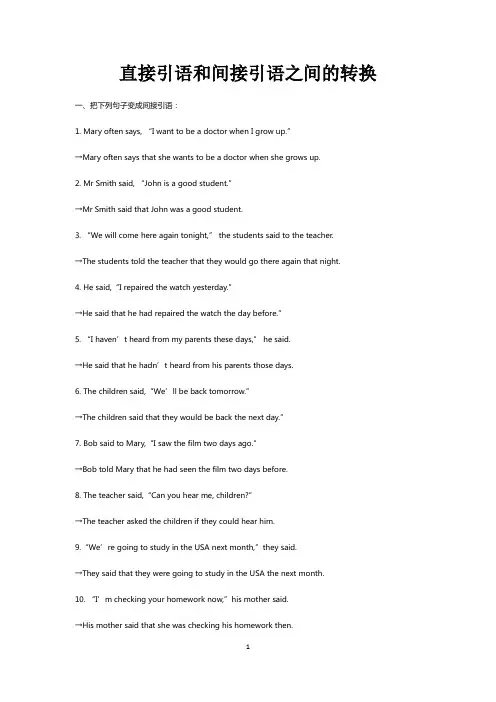
直接引语和间接引语之间的转换一、把下列句子变成间接引语:1. Mary often says, “I want to be a doctor when I grow up.”→Mary often says that she wants to be a doctor when she grows up.2. Mr Smith said, “John is a good student.”→Mr Smith said that John was a good student.3. “We will come here again tonight,” the students said to the teacher.→The students told the teacher that they would go there again that night.4. He said,“I repaired the watch yesterday.”→He said that he had repaired the watch the day before.”5. “I haven’t heard from my parents these days,” he said.→He said that he hadn’t heard from his parents those days.6. The children said,“We’ll be back tomorrow.”→The children said that they would be back the next day.”7. Bob said to Mary,“I saw the film two days ago.”→Bob told Mary that he had seen the film two days before.8. The teacher said,“Can you hear me, children?”→The teacher asked the children if they could hear him.9.“We’re going to study in the USA next month,”they said.→They said that they were going to study in the USA the next month.10. “I’m checking your homework now,”his mother said.→His mother said that she was checking his homework then.11. “The earth goes around the sun,” the teacher said.→The teacher said (that) the earth goes around the sun.12.“I can finish it in half an hour,” the worker said to me.→The worker told me he could finish it in half an hour.13.“Will you go to the station with me to meet a friend of mine this afternoon?” he asked me.→He asked me if I would go to the station with him to meet a friend of his that afternoon.14.“Do you remember what your uncle told you last night?” Li Ping’s father asked him.→Li Ping’s father asked him if he remembered what his uncle told him the night before.15.“Why did she refuse to go there?” the teacher asked.→The teacher asked why she had refused to go there.16.“Please wait for me at the gate of the Summer Palace at two tomorrow afternoon,” Kate said to her friend.→Kate asked her friend to wait for her at the gate of the Summer Palace at two the next afternoon.17.“Are you feeling better today?” the doctor asked my sister.→The doctor asked my sister if she was feeling better that day.18. He said to me,“Where did you go last week?”→He asked me where had I had gone the week before.19. He said,“I joined the English Club in 2007.”→He said that he joined the English Club in 2007.20. John said to me,“Where will you go this Sunday?”→John asked me where I would go that Sunday.21.She said,“I will come this evening.”→She said that she would go that evening.22.“Had you finished your homework before you watched TV?” Kate’s mother asked her.→Kate’s mother asked her if she had finished her homework before she watched TV.二、把下列句子变成直接引语:1. He said he knew nothing about Tom.→He said,“I know nothing about Tom.”2. Tom asked Mary if she would watch his CD-ROMs that day.→Tom said to Mary,“Will you watch my CD-ROMs today?”3. Tom’s mother asked him why he has made so many mistakes in his homework that time.→Tom’s mother said to him,“Why have you made so many mistakes in your homework this time?”→Tom’s mother asked,“T om, Why have you made so many mistakes in your homework this time?”4. They said they had studied English for three years.→They said,“We have studied English for three years.”5. He told me there would be a basketball match that afternoon.→He said to me,“There will be a basketball match this afternoon.”6. Uncle Wang asked me where my father had been and what he had been doing all those days. →Uncle Wang asked me,“Where has your father been and what has he been doing all these days?”7. He said he had seen the film that day.→He said,“I saw the film yesterday.”8. He said he had finished the work that day.→He said,“I have finished the work today.”9. He told his little son to go inside and not come out until the rain had stopped.→He told his little son,“Go inside and don’t come out until the rain has stopped.”10. The conductor asked Zhang Hong where she was going to get off.→The conductor said to Zhang Hong,“Where are you going to get off ?”11. He asked whether they would go with him.→He asked,“Will you go with me?”12. Mr White asked me to give his wife a message when she returned from the library.→Mr White said to me,“Please give my wife a message when she returns from the library.”13. A asked the teacher whether Gauss was born in 1777.→A asked the teacher,“Was Gauss born in 1777?”14. The old worker told us not to forget the past.→The old worker sad to us,“Don’t forget the past.”15. He asked me Why Eidson’s teacher said that he wasn’t bright and wasn’t worth teaching. →He asked me,“Why did Eidson’s teacher said that he wasn’t bright and wasn’t worth teaching?”16. He asked me what else I wanted him to do.→He asked me,“what else do you want me to do?”17. She asked Xiao Wang if that kind of telephone was made in Guangzhou.→She asked Xiao Wang,“Is this kind telephone made in Guangzhou? ”18. He asked me how many times I had been to my home town since 2000.→He asked me,“How many times have you been to your home town since 2000?”19. I asked one of the boys if there were any mistakes in his homework.→I asked one of the boys,“Are there any mistakes in your homework?”20. She told me she had seen a letter on my desk the day before.→“I saw a letter on your desk yesterday,”she said to me. 21. The guard said that he would not let him in if he had no pass. →The guard said,“I will not let you in if you have no pass.”。

2019 年高中英语语法知识点:直接引语和间接引语范文引述某人的话一般采用两种形式:一种是直接引语(DirectSpeech),即原封不动地引用原话,把它放在引号内;另一种是间接引语(IndirectSpeech),即用自己的话加以转述,被转述的内容不放在引号内。
一、直接引语变间接引语A.陈述句的间接引语直接引语是陈述句,变为间接引语时,在多数情况下都构成一个that 引导的宾语从句,引述动词通常是say,tell 等。
与此同时,间接引语中的人称、时态和其他方面也要相应有所变化。
Theforeigneraidtome,IlikeBeijingverymuch.那老外告诉我:我很喜欢北京。
→TheforeignertoldmethatheshelikedBeijingverymuch.那老外告诉我说他(她)很喜欢北京。
Shesaid,Weareveryfondofsports.她说:我们都喜欢体育运动。
→Shesaidthattheywereveryfondofsports.她说他(她)们都喜欢体运动。
I'llgooverthegrammarlessononceagain,hesaid.他说:我将把语法课再复习一遍。
→Hesaidhewouldgooverthegrammarlessononceagain.他说他将要把语法课再复习一遍。
(that 可省略)B.疑问句的间接引语1.一般疑问句和反意疑问句一般疑问句改为间接引语时,要用陈述语序,并要加连词 if 或whether,其主句动词常用ask,wonder,wanttoknow,didn'tknow 等。
句末不用问号。
Myteacheraskedme,DoyoulikeAmericancountrymusic 我老师问我:你喜欢美国乡村音乐吗?→MyteacheraskedmeifwhetherIlikedAmericancountrymusic.我老师问我是否喜欢美国乡村音乐。

Section ⅢGrammar——直接引语变间接引语一、直接引语变间接引语时人称的变化直接引语改为间接引语人称要相应地变化。
口诀如下:一随主,二随宾,第三人称不更新。
“一随主”即把直接引语中的第一人称(如:I,me,my,mine,we,us,our,ours)变为与主句的主语相一致的人称。
“二随宾”即把直接引语中的第二人称(you,your,yours)变为和主句的间接宾语(即听话人,如无听话人,可根据上下文确定一个人称)相一致的人称。
“第三人称不更新”即直接引语中的第三人称(he,him,his,she,hers,it,its,they,their,theirs,them)变为间接引语时,人称不变。
一随主:He said,“I like it very much.”→He said that he liked it very much.(I改为he,it不变)二随宾:He said,“You told me this story.”→He said that I had told him that story.(You改为I,me改为him,told改为had told)第三人称不更新:He said to me,“She's left her book in your room.”→He told me that she had left her book in my room.(She's改为she had,her不变,your改为my)[即时演练1]句型转换①The workers said,“The leaders often make the workers work extra hours.”→The workers said that the leaders often made the workers work extra hours.②Mary said,“I want to have a computer of my own.”→Mary said that she wanted to have a computer of her own.③Her colleague said to her,“Who did you ask for a leave?”→Her colleague asked her who she had asked for a leave.二、直接引语变间接引语时时态的变化1.主句的谓语动词是一般过去时。