2011年GCT考试英语真题
- 格式:doc
- 大小:83.00 KB
- 文档页数:8
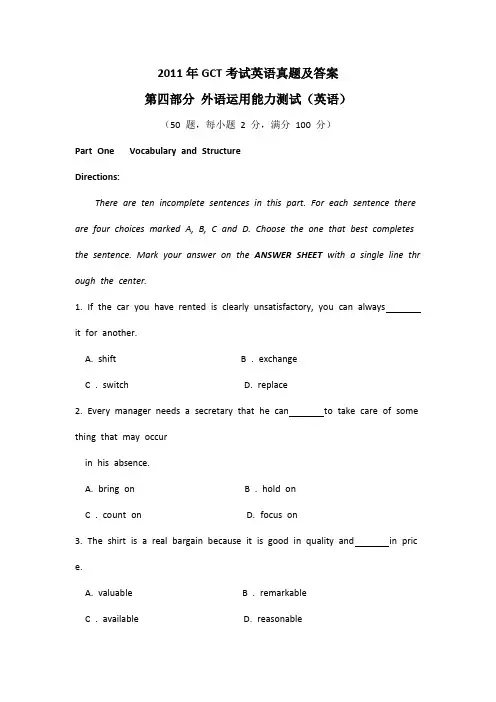
2011年GCT考试英语真题
第四部分 外语运用能力测试(英语)A卷
(50题,每小题2分,满分100分)
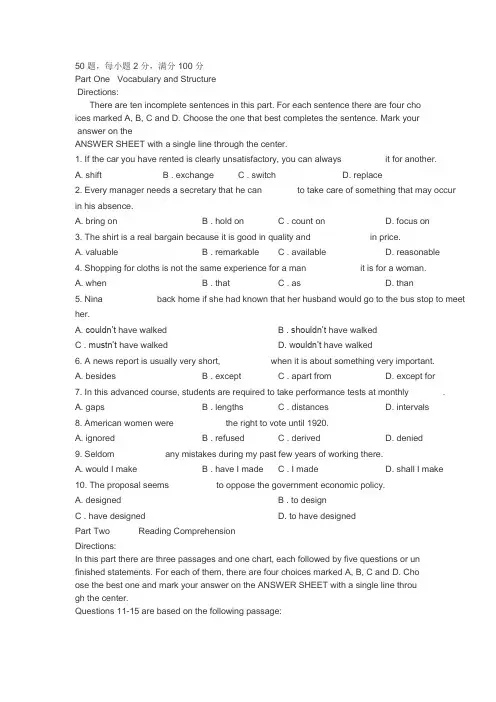
Part One Vocabulary and Structure
Directions:
There are ten incomplete sentences in this part. For each sentence there are four choices
marked A, B, C and D. Choose the one that best completes the sentence. Mark your answer on the
ANSWER SHEET with a single line through the center.
1. If the car you have rented is clearly unsatisfactory, you can always it for another.
A. shift B. exchange C. switch D. replace
2. Every manager needs a secretary that he can to take care of something that may occur
in his absence.
A. bring on B. hold on C. count on D. focus on
3. The shirt is a real bargain because it is good in quality and in price.
A. valuable B. remarkable C. available D. reasonable
4. Shopping for cloths is not the same experience for a man it is for a woman.
A. when B. that C. as D. than
5. Nina back home if she had known that her husband would go to the bus stop to meet
her.
A. couldn’t have walked B. shouldn’t have walked
C. mustn’t have walked D. wouldn’t have walked
6. A news report is usually very short, when it is about something very important.
A. besides B. except C. apart from D. except for
7. In this advanced course, students are required to take performance tests at monthly .
A. gaps B. lengths C. distances D. intervals
8. American women were the right to vote until 1920.
A. ignored B. refused C. derived D. denied
9. Seldom any mistakes during my past few years of working there.
A. would I make B. have I made C. I made D. shall I make
10. The proposal seems to oppose the government economic policy.
A. designed B. to design
C. have designed D. to have designed
Part Two Reading Comprehension
Directions:
In this part there are three passages and one chart, each followed by five questions or
unfinished statements. For each of them, there are four choices marked A, B, C and D. Choose the
best one and mark your answer on the ANSWER SHEET with a single line through the center.
Questions 11-15 are based on the following passage:
Happiness is becoming a huge area in psychological research and even in government policy,
with the UK government exploring a “happiness index”. It is tough, though, to define exactly what
happiness is, and what makes us happy.
There are two broad ways of looking at happiness: short-term happiness (a great cookie, a
bottle of wine) and long-happiness (financial security, achieving your goals). Both types of
happiness are valid, and important. The problem is, they’re often in competition.
Let’s say you’ve got a goal of losing 50 pounds this year. You know you’d be happier and
healthier if you weren’t carrying that extra weight. To achieve long-term happiness, you need to
go on a diet. In the short-term, though, it’s not that easy. A chocolate cake, or a large glass of wine,
might just the thing to cheer you up at the end of a long day - or to celebrate with friends. It’s the
same with lots of other goals.
If you’ve got a tendency to prioritize long-term happiness at the expense of day-to-day
pleasures, you should start looking for some small ways to bring a little joy back into your life. I
am not suggesting that you go out and get drunk every night, or that you stuff yourself with cake.
There are a plenty of other ways to enjoy yourself. Don’t pin all your hopes of happiness on some
far-off future, though. There’s no point working a 60-hour week and making yourself thoroughly
miserable in the belief that things will be perfect as soon as possible you’re making a six-figure
salary.
11. A proper title for the passage is
A. Happy Thereafter. B. Beyond Happiness.
C. Happiness in. Happiness Out. D. Happy now or in the Future?
12. Paragraph is mainly about .
A. what makes us happy B. how to understand happiness
C. how can we be happier D. what happiness can bring us
13. The example in paragraph 3 is meant to emphasize that .
A. both short-term happiness and long-term happiness is important
B. we tend to seek short-term happiness instead of long-term happiness
C. people prefer long-term happiness to short-term happiness
D. short-term happiness may contradict long-term happiness
14. The word “prioritize” (last paragraph) probably means “ ”.
A. treat something as more important than others
B. improve something 's value or quality
C. put extra emphasis on something