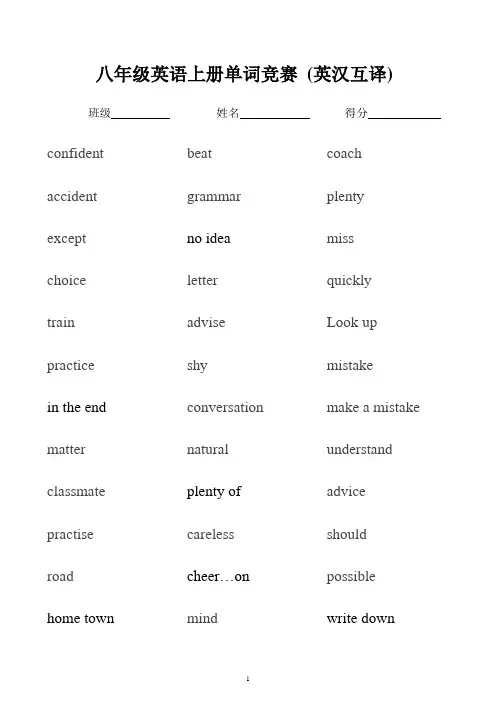
外研版八年级上册英语重点单词
- 格式:docx
- 大小:15.50 KB
- 文档页数:4
外研版八年级上册英语重点单词
1. abandon (v.): to leave behind or give up completely; to stop doing
something before it is finished
Example: The team had to abandon the game due to bad weather.
2. absorb (v.): to take in or soak up
Example: The sponge absorbed all of the water from the spilled glass.
3. accurate (adj.): correct and precise; without mistakes
Example: The scientist made an accurate calculation of the experiment's
results.
4. adapt (v.): to adjust or change to fit new conditions or circumstances
Example: It took some time for the international student to adapt to the new
culture.
5. adequate (adj.): enough or sufficient in quantity or quality
Example: The company provided an adequate amount of training for the new
employees.
6. adjacent (adj.): next to or adjoining something else
Example: Our hotel room is adjacent to the swimming pool.
7. adjust (v.): to change or alter in order to fit or be more suitable
Example: He adjusted the volume on the television so it wasn't too loud.
8. administrate (v.): to manage or control the affairs of a business or
organization
Example: She was hired to administrate the company's finances.
9. adolescent (n.): a young person who is in the transition period between
childhood and adulthood
Example: Adolescents often face many challenges as they navigate through their
teenage years.
10. advantage (n.): a benefit or advantage gained from something
Example: One advantage of living in the city is the easy access to public
transportation.
11. adverse (adj.): harmful or unfavorable; working against one's interests Example: The project faced several adverse conditions that delayed its
completion.
12. affection (n.): a feeling of liking or love towards someone or something
Example: She showed her affection by giving him a hug.
13. agency (n.): a business or organization that provides a particular service
Example: I contacted a travel agency to help me book my vacation.
14. agriculture (n.): the practice of farming and cultivating crops or animals
for food
Example: The country's economy heavily relies on agriculture.
15. aid (v.): to provide assistance or support to someone in need
Example: The Red Cross sent volunteers to aid in the disaster-stricken area.
16. aim (v.): to have a specific goal or purpose in mind; to direct one's
efforts towards achieving something
Example: She aimed to become a doctor and help people in need.
17. alarm (n.): a warning sound or signal that alerts people of danger or an
emergency
Example: The smoke alarm alerted us to the fire in the building.
18. alert (adj.): paying attention and ready to respond to any situation
Example: The security guard remained alert throughout the night shift.
19. alien (n.): a foreigner or someone who is not a citizen of a particular
country
Example: The country had strict immigration policies and made it difficult for
aliens to obtain citizenship.
20. alternative (adj.): offering a choice or different option from what is
usual or expected
Example: We explored alternative routes to avoid the heavy traffic.
21. amplify (v.): to make something louder or more noticeable; to increase the
strength or volume of
Example: The speaker amplify his voice so everyone could hear him.
22. analysis (n.): the process of examining something in detail to understand
its components or meaning Example: The analysis of the data revealed some interesting trends.
23. ancestor (n.): a person from whom one is descended; a predecessor from
past generations
Example: Many people traced their ancestors back to immigrants who arrived
centuries ago.
24. anonymous (adj.): without any name or identity; not known or named
Example: The anonymous donor contributed a large sum of money to the charity.
25. anticipate (v.): to expect or predict that something will happen; to look
forward to something
Example: The fans anticipated the release of their favorite band's new album.
26. apparent (adj.): clearly visible or understood; obvious
Example: It was apparent that the team had worked hard to prepare for the
competition.
27. appreciate (v.): to recognize the value or quality of something; to be
grateful for
Example: She appreciated the kind words and support from her friends.
28. architecture (n.): the art and science of designing buildings and
structures
Example: The city is known for its impressive architecture and historic
buildings.
29. aspect (n.): a particular part or feature of something; a specific way of
looking at something
Example: The teacher discussed various aspects of the topic to provide a
comprehensive understanding.
30. assist (v.): to help or support someone with a task or problem