
倒装句
- 格式:ppt
- 大小:511.50 KB
- 文档页数:17


中文名:倒装句
作用:强调、突出等
原理:颠倒原有语序的句式
感叹句疑问句:谓语将它放到句首
类型:否定句中代词充当宾语
应用:英语、文言等
文言
主谓倒装
也叫谓语前置或主语后置。古汉语中。谓语的位置也和现代汉语中一样,一般放在主语之后,但有时为了强调和突出谓语的意义,在一些疑问句或感叹句中,就把谓语提前到主语前面。例:甚矣,汝之不惠。全句是‚汝之不惠甚矣‛。谓语前置,表强调的意味,可译为‚你太不聪明 了‛
宾语前置
否定句中代词充当宾语、疑问代词充当动词或介词的宾语以及用‚之‛字或‚是‛字作为提宾标志时,宾语通常都要前置。
文言文中,动词或介词的宾语,一般放置于动词或介词之后,如下几种情况除外:
①、疑问句中,疑问代词做宾语,宾语前置。这类的句子,介词的宾语也是前置的。
a 介宾倒装 例:‚孔文子何以谓之‘文’也?‛ ‚何以‛是‚以何‛的倒装,可译为‚为什么‛ 微斯人,吾谁与归 ?‚吾谁与归‛是‚吾与谁归‛的倒装,可译为‚我和谁同道呢?‛
b谓宾倒装 例:何有于我哉?‚何有‛是‚有何‛的倒装。古汉语中,疑问代词做宾语时,一般放在谓语的前面。可译为‚有哪一样‛。孔子云:‚何陋之有?‛ ‚何陋之有‛即‚有何陋‛的倒装。可译为‚有什么简陋呢?‛‚何‛,疑问代词,‚之‛,助词,无实在意义,在这里是宾语前置的标志。
②、 文言否定句中,代词做宾语,宾语前置。例:僵卧孤村不自哀 ‚不自哀‛是‚不哀自‛的倒装,可译为‚不为自己感到悲哀‛。‚自‛,代词,在否定句中,代词做宾语要前置。另如‚忌不自信‛,‚自信‛即‚信自‛,意相信自己。
③、 用‚之‛或‚是‛把宾语提于动词前,以突出强调宾语。这时的‚之‛只是宾语前置的标志,没有什么实在意义。例:"莲之爱,同予者何人?"——‚莲之爱‛即‚爱莲‛的倒装,可译为‚对于莲花的喜爱‛。" 孔子云:‚何陋之有?‛ ——‚何陋之有‛即‚有何陋‛的倒装。可译为‚有什么简陋呢‛。这里的‚之‛,助词,无实在意义,在这里是宾语前置的标志。
倒装句
一、全部倒装
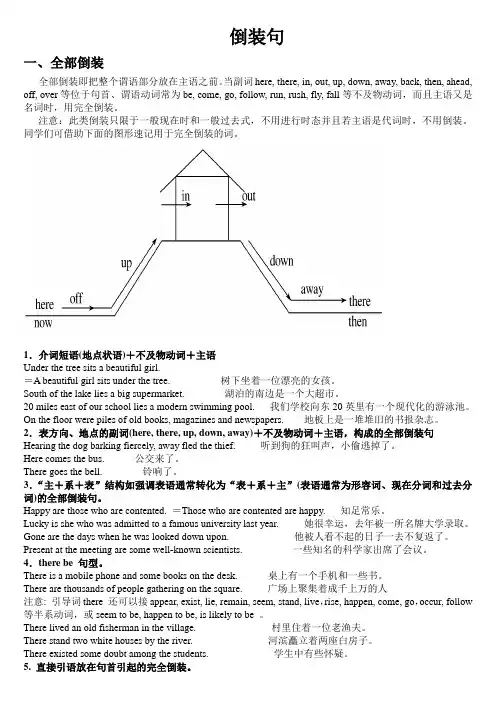
全部倒装即把整个谓语部分放在主语之前。当副词here, there, in, out, up, down, away, back, then, ahead,
off, over等位于句首、谓语动词常为be, come, go, follow, run, rush, fly, fall等不及物动词,而且主语又是名词时,用完全倒装。
注意:此类倒装只限于一般现在时和一般过去式,不用进行时态并且若主语是代词时,不用倒装。同学们可借助下面的图形速记用于完全倒装的词。
1.介词短语(地点状语)+不及物动词+主语
Under the tree sits a beautiful girl.
=A beautiful girl sits under the tree. 树下坐着一位漂亮的女孩。
South of the lake lies a big supermarket. 湖泊的南边是一个大超市。
20 miles east of our school lies a modern swimming pool. 我们学校向东20英里有一个现代化的游泳池。
On the floor were piles of old books, magazines and newspapers. 地板上是一堆堆旧的书报杂志。
2.表方向、地点的副词(here, there, up, down, away)+不及物动词+主语,构成的全部倒装句
Hearing the dog barking fiercely, away fled the thief. 听到狗的狂叫声,小偷逃掉了。
Here comes the bus. 公交来了。
There goes the bell. 铃响了。
3.“主+系+表”结构如强调表语通常转化为“表+系+主”(表语通常为形容词、现在分词和过去分词)的全部倒装句。

As 倒装句
倒装语序的as从句,既可以表让步,也可表原因。表让步时倒装是强制性的,可用though替换。表原因这种用法的倒装句不是强制性的。
原因:
Tired as they were, they went to bed as soon as they came back.
她们由于很累,一回到家就上床睡觉了。
Experienced as he is in constrast to his colleagues, he can deal with any difficult
situation. 由于他跟同事们相比很有经验,所以他能对付任何困难的局面。
Unaccustomed as I am to public speaking, I beg your indulgence for my new few
inelegant words. 由于我不习惯于发表演说,有些话讲的不大得体,敬请原谅。
让步:
Tired as / though they were= Though they were tired, Jurfis and Ona sat up late.
尽管朱尔金和奥纳很疲惫,但是他们很晚才睡。
Poor as / though he was, he was honest. 虽然他很穷,但是很诚实。
Genius though she was, she was quite unassuming.
虽然她是个天才,但是他很谦逊。
Fail though I did, I would not abandon my goal.
虽然我失败了,但是我不会放弃我的目标。
Modest though his needs were, he found it hard to get by on his income.
虽然他的需求并不高,但是他发现靠他的收入还是难以度日。
Much though I admire her, I can not excuse her faults.

1. 常考的几种倒装结 构
1) 当表示否定或基本否定的词或词组位于句首作状语时用倒装。这类词或词组常用的有:never, nowhere, seldom, rarely, little, hardly, scarcely, barely, not until, not
only, by no means, in no time, under no circumstances, under no condition, in
no way, in no case, at no time, on no account等。
Never have I heard it before.
Nowhere can I find my lost watch.
Under no circumstance should a student cheat in the exam.
Not only was Churchill a statesman, but also a poet.
Note: 当 “no sooner … than”和“hardly/scarcely … when/before”位于句首时用倒装。该结构表示“一…就…”,在时态上主句一般用过去完成时,when或than引导的从句用一般过去时。
Hardly/Scarcely had I got home when/before the bell rang.
No sooner had the performance begun than the lights went out.
2) 当here, there, then, thus, only, hence, little等副词位于句首,句中主、谓用倒装。
Here is the book for you.