河南省郑州市2017-2018学年高一下学期期末考试英语试题含答案
- 格式:doc
- 大小:45.39 KB
- 文档页数:15
第一部分 听力(共两节,满分30分)
做题时,先将答案标在试卷上。录音内容结束后,你将有两分钟的时间将试卷上的答案转涂到答题卡上。
第一节(共5小题;每小题1.5分,满分7.5分)
听下面5段对话。每段对话后有一个小题,从题中所给的A、B、C三个选项中选出最佳选项,并标在试卷的相应位置。听完每段对话后,你都有10秒钟的 时间回答有关小题和阅读下一小题。每段对话仅读一遍。
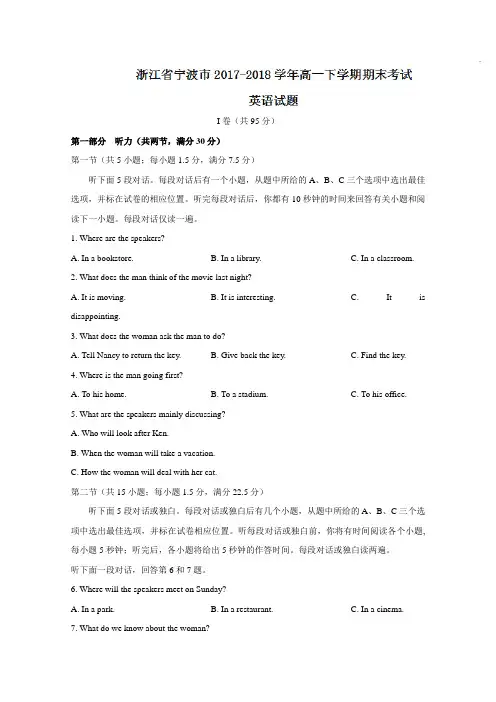
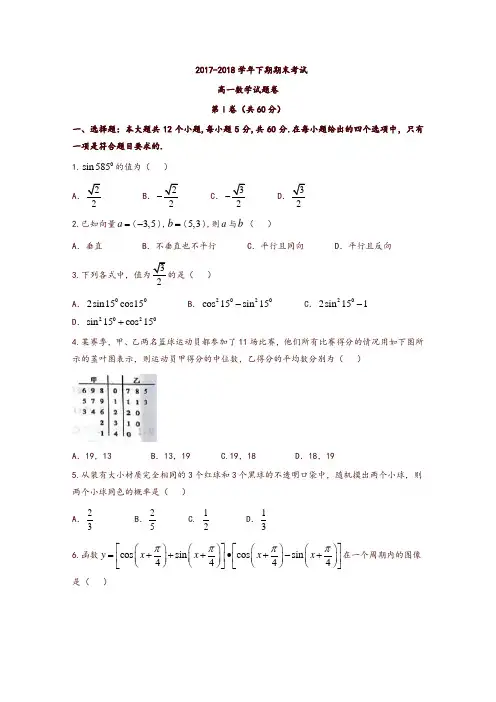
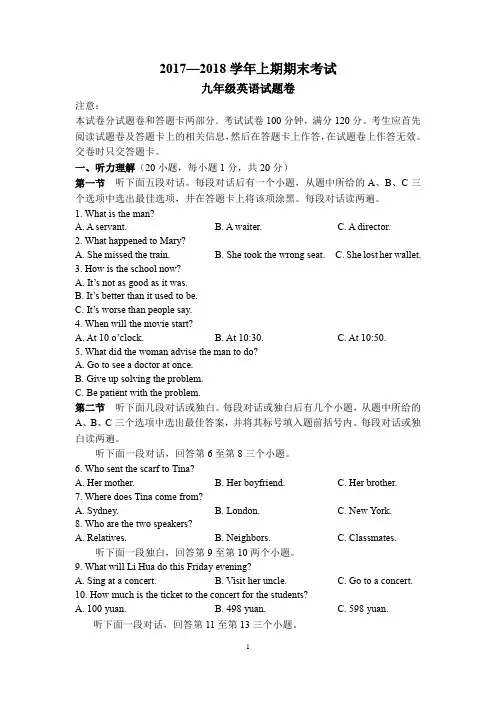
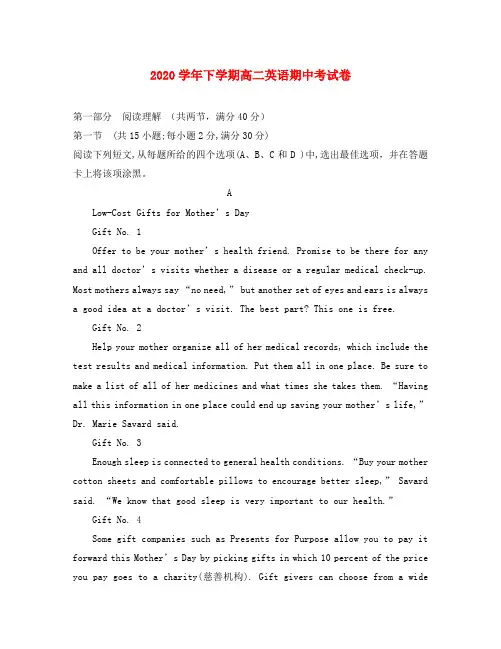
1. What is Mr. White?
A. A salesman. B. A professor. C. A
repairman.
2. What does the woman advise the man to do?
A. Tae Bus 105.
B. As another person.
C. Wal to the railway station.
3. What is the man’s attitude towards the plan?
A. He is against it.
B. He doesn’t care.
C. He thins it is reasonable.
4. What is the man’s problem?
A. He can’t see the sign clearly.
B. He has no ticet for the movie.
C. He’s pared in the wrong place.
5. In which year is the man in college now?
A. The first year. B. The second year. C. The third year.
第二节(共15小题;每小题1.5分,满分22.5分)
听下面5段对话或独白。每段对话或独白后有几个小题,从题中所给的A、B、C三个选项中选出最佳选项,并标在试卷的相应位置。听每段对话或独白前,你将有时间阅读各个小题,每小题5秒钟;听完后,各小题将给出5秒钟的作 答时间。每段对话或独白读两遍。
听第6段材料,回答第6、7题。
6. Where does the woman want to go?
A. The post office. B. The cinema. C. A par.
7. Who can help the woman?
A. The man with a bird.
B. The man with a beard.
C. The man with a bottle of beer.
听第7段材料,回答第8至10题。
8. Why is Jessie still at home?
A. She taes the day off.
B. She has enough time to go to wor.
C. She is waiting for the man to go out together.
9. What does Jessie thin of taing the subway?
A. Convenient and cheap.
B. Crowded and epensive.
C. Convenient but epensive.
10. What do we now about Jessie?
A. She used to have breafast in her office.
B. Her office is far away from the subway station.
C. She doesn’t have to wait for buses and tais in bad weather.
听第8段材料,回答第11至13题。
11. What are the two speaers mainly taling about?
A. A plan for the party.
B. A visit to their relatives.
C. A call to their colse friends.
12. Why is the woman thining of calling on Ann?
A. Ann has just got a new house.
B. Ann has just come out of hospital.
C. She wants to invite Ann to the party. 13. Why can’t they have a little party at Ric’s?
A. He is still in hospital.
B. He still doesn’t feel well.
C. He doesn’t lie noisy parties.
听第9段材料,回答第14至16题。
14. Who are the two speaers?
A. A man and his wife.
B. A man and his sister.
C. A man and his girlfriend.
15. What does the man usually do at weeends?
A. He has tea with his friends.
B. He goes shopping with his friends.
C. He watches football games on TV.
16. On which point of the picnic is the man different from the woman?
A. Who should get the car ready.
B. How many friends they should invite.
C. What food and drin they should prepare.
听第10段材料,回答第17至20题。
17. How do students enter the library?
A. With a password.
B. With a student card.
C. With a library account.
18. How many boos can students borrow at most once?
A. Nine. B. Eleven. C. Twelve.
19. What ind of boo has to be returned within one wee?
A. Boos published recently.
B. Boos lied by a lot of people.
C. Boos borrowed by local residents.
20. What will the speaer do net?
A. Tae the students on a campus tour. B. Show the students around the library.
C. Tell the students where to get bottled water.
第二部分 阅读理解(共两节,满分40分)
第一节(共15小题;每小题2分,满分30分)
阅读下列短文,从每题所给的A、B、C和D四个选项中,选出最佳选项,并在答题卡上将该项涂黑。
A
Slang (俚语) is very informal language which is often used by young people. It’s hard to eep up
to date with it as new words and phrases appear and develop. Living in a multicultural society has an
effect on language, especially on the young, whose friends are often from a mi of bacgrounds. TV
and music also have a big influence. A complete list of slang is difficult to mae. By the time it is
finished, the list will be out of date. However, here are a few eamples
“Safe”, “ sorted”, “ sound” or “cool” all means “That’s good” or “I understand”.
Instead of using different tag questions (附加疑问句) lie “… isn’t it?”, “… can’t you?”
or “…don’t they?”, people use “innit”. For eample, “He can dance really well, innit?” (=He
can dance really well, can’t he?) or “They always say that, innit?” (=They always say that, don’t they?)
Instead of saying “very”, “really” or “completely”, people use “well”. For eample,
“I’m well tired.” or “You got it well wrong!”
“Whatever” means “I don’t care”. For eample, A: “But the teacher says we can’t leave
until we’ve finished.” B “Whatever. I’m going.”
“He’s fine” or “He’s fit” both means “He’s good-looing”. “Fine” and “fit”
can describe a boy or a girl.
Not everybody uses slang and not everybody lies it. A school in the north of England recently
told its pupils to stop using slang words such as “hiya” (hello), cheers” and “ta” (both mean
“than you”) if they want to get a place at university or a good job.
When British people use language lie this, it’s no surprise that some say they can’t understand