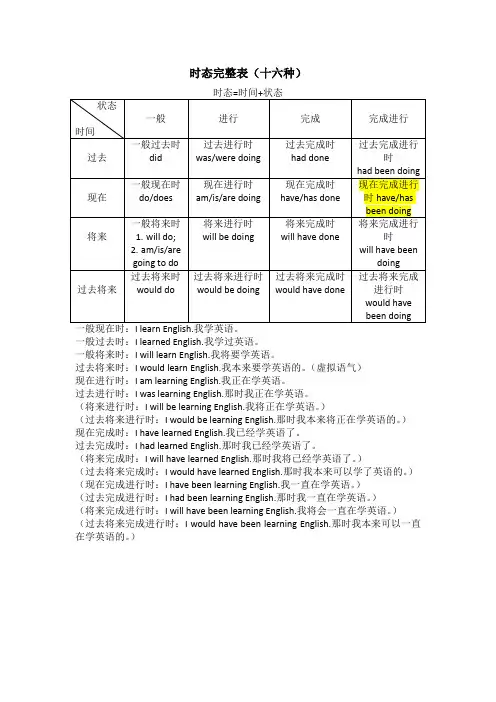
英语十六种时态表格总结
- 格式:doc
- 大小:100.50 KB
- 文档页数:19
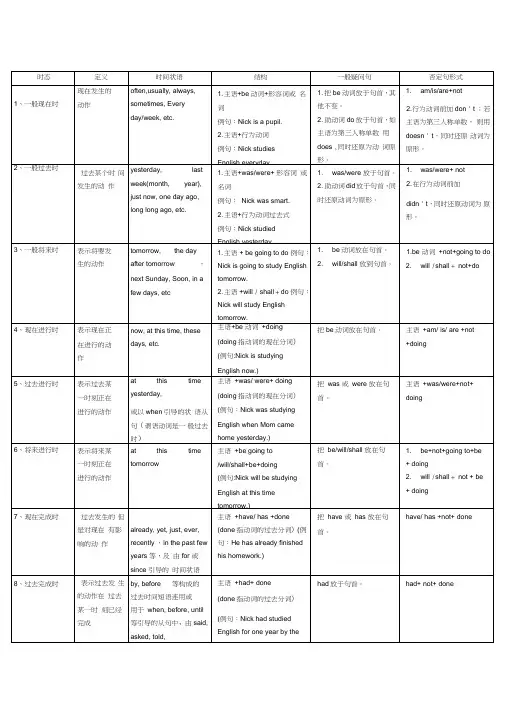
下面用表格的形式给大家罗列出来,便于大家记忆
页脚内容
一般现在时、一般过去时
时态
名称 结构 常连用的词 主要用法 例句
一般现在时 1 be动词用am/is/are表示,之后接名词,形容词或介词。
often;
usually;
every…;
sometimes;
always;
never;
once/twice/… a
week/month/year;
on
Sundays/Mondays/….; 一般现在时表示没有时限的持久存在的习惯性的动作或状态,或现阶段反复发生的动作或状态,或一般真理 陈述句:I am an office worker.
He is so lazy. They are at home now.
否定句: I am not Tim.
She is not very beautiful.
They are not in the office.
一般疑问句:Are you an officeassistant? Is she
beautiful?
2行为动词用V原形或V-s/es,引导疑问句和否定句,用do或don’t;第三人称时用does或doesn’t,有does出现动词用原形;第三人称陈述句V后加s或es. 陈述句:I work in Shanghai.
He works at home.
Davy never watches TV at home.
否定句: I don’t like the food in KFC.
Davy doesn’t like the food in KFC either.
一般疑问句:
Do you want a cup of coffee? Does she live near
thesubway station?
一般过去时。 1.be动词用过去式was或
were表示。 yesterday;
the day before
yesterday;
last 在过去时间里所发生的动作或存在的状态。 陈述句:I was a big boss.He was beautiful.
We were in Beijing last year.
否定句: I was not at home at that moment. 下面用表格的形式给大家罗列出来,便于大家记忆
页脚内容 week/month/year/….;
… ago;
a moment ago;
just now;
on/in+过去的时间; We were not at work yesterday.
一般疑问句: Were you a teacher?
Was she in the office last week?
2行为动词用V-ed,陈述句,疑问句和否定句借助于did,有did出现动词用原形。 陈述句:I worked in Sunmoon.
We studied English there. He lived inHongKong.
否定句: I didn’t work here.
They didn’t see me. She liked English a lot.
一般疑问句: Did you go to America?
Did he work in Sunmoon?
一般将来时、过去将来时
时态
名称 结构 常连用的词 主要用法 例句
一般将来时
1 任何人称+will+V原形.
tomorrow,
the day after
tomorrow;
soon;
next
week/month/year/...;
the
week/month/year/...
after next;
on/in +将来的时间;
in+一段时间;. 即将发生动作或状态。 陈述句:I will fly to Hong Kong tomorrow.
He will go with us.
We will arrive in Shanghai next week.
否定句:I will never believe you again.
He will not come tonight.
We will not buy a car next year.
一般疑问句:Will you go there by train?
Will he come tomorrow?
Will they live a five-star hotel?
2 is/am/are+going
to+V原形,表示计划陈述句:I’m going to go to Hong Kong by air.
否定句:We are not going to buy a house here. 下面用表格的形式给大家罗列出来,便于大家记忆
页脚内容 打算做什么事情。 一般疑问句:Are they going to change their jobs?
特殊疑问句:How are you going to tell him?
过去将来时
was/were going to +V原形 多用在宾语从句中 在过去将会发生的动作。 陈述句:I was going to buy a computer.
They told me that they were not going to go abroad.(间接引语)
否定句:I was not going to buy a computer.
任何人称+would +V原形 He said he would come in Shanghai.
I said I would buy you a car one day.
现在进行时、过去进行时
时态
名称 结构 常连用的词 主要用法 例句
现在进行时 is/am/are+V-ing now;
at present;
at the moment;
Look!(放在句首); 表示现在( 指说话人说话时) 正在发生的事情。 陈述句:I’m waiting for my boy friend.
He is doing the housework at home now.
We are enjoying ourselves.
否定句:He is not playing toys.
一般疑问句:Are you having dinner at home? 下面用表格的形式给大家罗列出来,便于大家记忆
页脚内容 Listen! (放在句首); Is Tim cooking in the kitchen?
特殊疑问句:What are you doing now?
Where are they having a meal?
过去进行时 was/were+V-ing at that time;
at this time
yesterday;
at+时间点+yesterday/last
night;
at that moment; 过去一段时间正在发生的事情。 陈述句:I was doing my homework at that time.
We were having a party while he was sleeping.
否定句:He was not sleeping at 11 o’clock last night.
一般疑问句: Were you watching TV at that time?
特殊疑问句: What were you doing at that moment?
现在完成时、过去完成时
时态
名称 结构 常连用的词 主要用法 例句
现在 already;just;before; 用来表示之陈述句:I have already told Davy. Davy has known 下面用表格的形式给大家罗列出来,便于大家记忆
页脚内容 完成时
have/has+ p.p(过去分词) yet(否定句中);ever;never;once/twice/…
for+一段时间;
since +时间点;
since+一段时间+ago;
by+现在时间;
so far; up to now; till now;
until now;
recently/lately;
during/over/in the
past/last…. 前已发生或完成的动作或状态,其结果的确和现在有联系。动作或状态发生在过去但它的影响现在还存在;也可表示持续到现在的动作或状态。 this matter.
He has lived here for nearly 10 years.
否定句:I haven’t finished my homework..
Tim hasn’t come yet.
We haven’t heard any news about him
一般疑问句: Has he worked here since he came here?
特殊疑问句: How long have you worked in this
company?
特别注意: 1.have/has always been+名词/形容词/介词:总是或一直是什么样子。。。
He has always been a good father.
I have always been busy.
They have always been in America.
2.have/has gone to:去了某地(未归)
He has gone to Beijing.
They have gone to the cinema. 3. have/has been to:表示去过或到过某地
I have been to Canada. Have you been to Hong Kong?
Where have you been? I have never been here.
过去完成时 had +过去分词 过去的过去:
by+过去的时间
(在XX之前,不迟于);
表“过去某动作或时间以前”的时间状语。 动作发生在过去的过去。 陈述句:He said he had told Davy.(间接引语)
He left the office after he had called Davy.
By the end of the day we had sold over 2000 tickets.
否定句:She hadn’t had dinner before she went out.
一般疑问句:Had she learnt English before she moved
here?
特殊疑问句:how many English words had he learnt by
the end of last year?