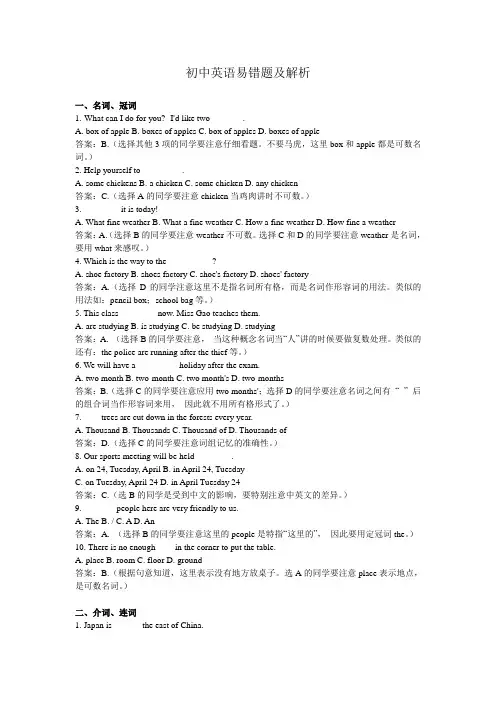
初中英语易错题知识点总结
- 格式:docx
- 大小:25.36 KB
- 文档页数:3
初中英语易错题知识点总结
一、名词单复数
名词的单数变复数大部分情况下在词尾加-s构成,如:apple—apples;pencil—pencils;book—books等。但也有一些特殊情况,需要掌握规则。如:
1. 以s, sh, ch, x, o结尾的词,在词尾加-es变复数,如:bus—buses;watch—watches;box—boxes;hero—heroes;
2. 以辅音字母+y结尾的名词变复数时,先把y变i再加-es,如:baby—babies;city—cities;
3. 以f或fe结尾的名词变复数时,通常将f或fe变成v再加-es,如:leaf—leaves;knife—knives;life—lives。
二、形容词的比较级和最高级
形容词比较级的构成规则是:在形容词的词尾加-er,如:big—bigger;small—smaller。但也有一些特殊情况,需要掌握规则。如:
1. 以e结尾的形容词,在后面直接加-r,如:nice—nicer;fine—finer;
2. 以辅音字母+y结尾的词,先变y为i再加-er,如:happy—happier;easy—easier;
3. 以一个辅音字母加一个元音字母再加一个辅音字母结尾的词,要双写辅音字母再加-er,如:big—bigger;hot—hotter;thin—thinner;
4. 在比较级的意义上衍生而来的比较级,有些用more或most构成,如:beautiful—more beautiful,interesting—more interesting;
三、动词的时态
1. 一般现在时:表示经常性、习惯性或真理性的动作或状态。其构成规则是:主语+动词原形+其他。如:She often goes to the park on weekends.
2. 一般过去时:表示过去某个时间内发生的动作或状态。其构成规则是:主语+动词的过去式+其他。如:He watched TV last night.
3. 现在进行时:表示现在正在进行的动作。其构成规则是:主语+be(am, is, are)+动词的现在分词+其他。如:She is reading a book now.
4. 过去进行时:表示过去某个时间内正在进行的动作。其构成规则是:主语+was/were+动词的现在分词+其他。如:They were playing basketball at that time. 5. 一般将来时:表示将来发生的动作或状态。其构成规则是:主语+will+动词原形+其他。如:I will go to the park tomorrow.
四、介词用法
介词是一种虚词,用来表示名词或代词与其他词之间的关系。介词的使用是比较灵活和多样的,需要根据具体习惯和语境进行掌握。如:
1. 表示地点的介词:at, in, on。如:I am at school. She is in the classroom. The cat is on the
table.
2. 表示时间的介词:at, in, on。如:I get up at 7 o’clock. He is going to meet his friend in
two days. The concert is on Sunday.
3. 表示动作方向的介词:to, into, out of, from。如:She goes to school every day. He runs
into the room. They come out of the house. I get a book from the library.
4. 表示方式、原因、目的、比较等概念的介词:with, by, for, because of, because, of, to,
from, than等。如:He walked to school with his friend. She goes to school by bike. I am
writing a letter for my mother. He is happy because of the good news. She is taller than me.
五、情态动词
情态动词是一种特殊的动词形式,常常用来表示说话人的情感色彩或态度,或者询问、请求、建议、许可、能力、可能性等含义。情态动词包括can, could, may, might, must,
should, ought to, need, have to, shall, will等。它们在构成疑问句、否定句、以及肯定句的不同情况下有不同的用法。如:
1. Can表示能力或许可。如:I can swim. Can I help you?
2. Could表示过去能力或请求许可。如:He could run fast when he was young. Could I
borrow your pen?
3. May表示许可或可能性。如:May I go to the restroom? It may rain today.
4. Might表示可能性。如:He might be at home now.
5. Must表示推测或必须。如:He must be at school now. She must do her homework every
day.
6. Should表示建议。如:You should apologize to her. Should we go out for a walk?
7. Ought to表示义务或应当。如:I ought to help the old man. We ought to protect the
environment.
8. Need / have to表示必须。如:I need to finish my homework. I have to go to school. 9. Shall表示提议。如:Shall we go to the movies?
10. Will表示将来的意愿或计划。如:I will go to the park tomorrow.
六、定冠词、不定冠词及零冠词
英语中的定冠词包括the,不定冠词包括a和an,零冠词则表示没有冠词。它们在句子中的用法也比较灵活多样,需要根据语境进行理解和掌握。如:
1. the的用法:表示特指某人、某事、某物。如:The girl is singing. The book is on the
table. The sun rises in the east.
2. a和an的用法:表示泛指某人、某事、某物。其中,a用在辅音开头的词前,an用在元音开头的词前。如:I have a dog. She is an English teacher. He is a university student.
3. 零冠词的用法:指特指、不特指或泛指某人、某事、某物。如:He is a student. She is
good at singing. I want to buy a book.
七、形容词和副词的用法
形容词用于修饰名词,而副词用于修饰动词、形容词或者其他副词。它们在句子中的位置也各有规定,需要根据语法规则进行正确使用。如:
1. 形容词的用法:修饰名词。如:He is a tall boy. She has a black cat.
2. 副词的用法:修饰动词、形容词或者其他副词。如:She sings beautifully. He runs very
fast.
3. 形容词和副词的比较级和最高级的构成:通常在词尾加-er和-est,以及在前面加more和most。如:happy—happier—happiest;big—bigger—biggest;carefully—more
carefully—most carefully。
以上是初中英语易错题知识点总结,希望能对大家有所帮助。同时也希望大家能多加练习,提高英语水平。