新概念英语第二册第18课
- 格式:docx
- 大小:37.82 KB
- 文档页数:21
新概念英语第二册第18课
Lesson 18 He often does this! 他经常干这种事!
After I had had lunch at a village pub, I looked for my bag. I
had left it on a chair beside the door and now it wasn't there! As
I was looking for it, the landlord came in.
'Did you have a good meal?’ he asked.
'Yes, thank you,' I answered, 'but I can't pay the bill. I haven't
got my bag.'
The landlord smiled and immediately went out. In a few
minutes he returned with my bag and gave it back to me.
'I'm very sorry,' he said. 'My dog had taken it into the garden.
He often does this!'
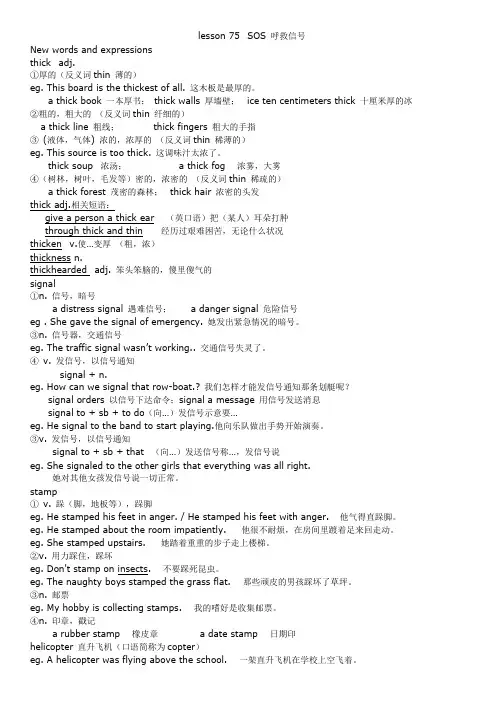
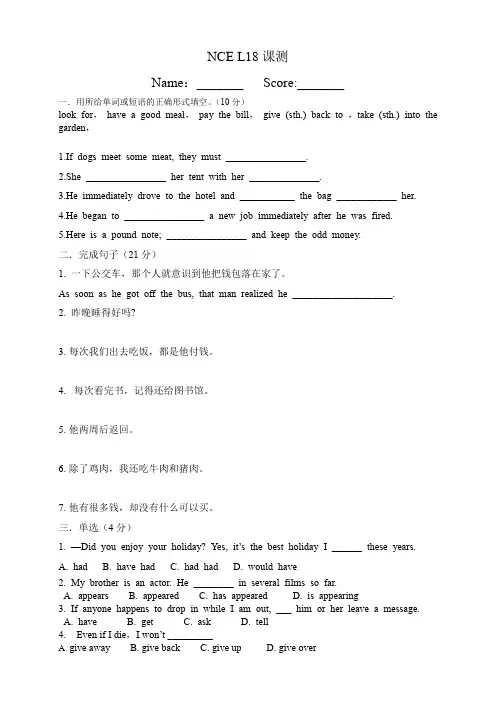
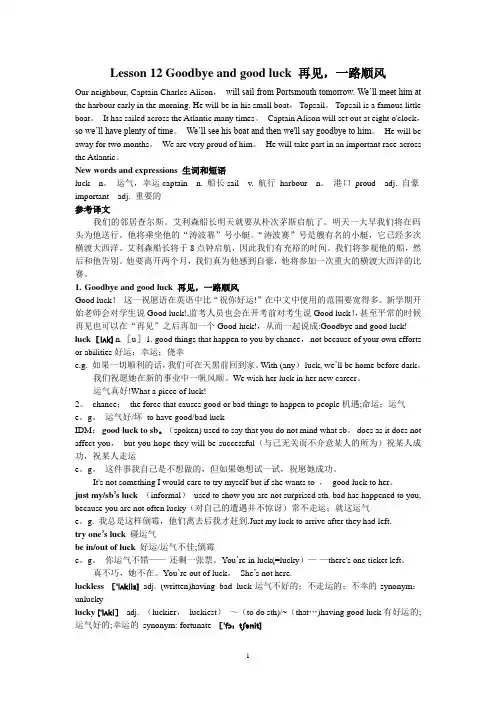
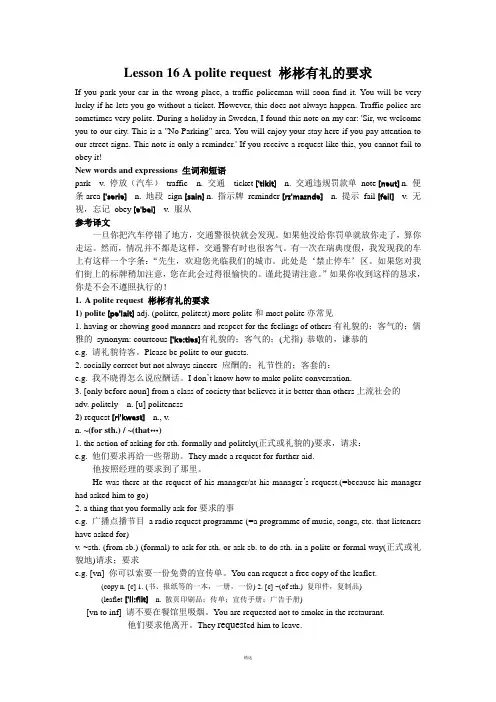
New words and expressions 生词和短语
pub n. 小酒店landlord n. 店主bill n. 帐单
参考译文
我在一家乡村小酒店吃过午饭后,就找我的提包。我曾把它放在门边的椅子上,可这会儿不见了!当我正在寻找时,酒店老板走了进来。
“您吃得好吗?”他问。
“很好,谢谢。”我回答,“但我付不了帐,我的提包没有了。”
酒店老板笑了笑,马上走了出去。一会儿工夫他拿着我的提包回来了,把它还给了我。
“实在抱歉,”他说,“我的狗把它弄到花园里去了,他常干这种事!”
1.He often does this! 他经常干这种事!
he 在这里指代的是狗。动物通常用it来代表,即被看成像东西一样。但是,指宠物、家畜或民间故事中的动物时,我们经常也用he,
she, who等,即使得它们“人格化”并具有性别。用阴性代词指某个动物或东西时尤其有一种亲切的含义: e.g. 我有一只小猫。她每天早上喝牛奶。I have a little cat. She
drinks milk every morning.
乔治的鹦鹉亨利能说几个单词。只要有灯光他就叫。
George’s parrot ['p?r?t], Henry, can speak a few words. He
always calls when there are lights.
2. After I had had lunch at a village pub, I looked for my bag.
我在一家乡村小酒店吃过午饭后,就找我的提包。
1) after
过去完成时态常同表示时间状语的从属连词after 一同使用,如:
e.g. 他把信全写完后干了些家务活。After he’d written all her
letters, she did some housework. 假如从句中先于主句谓语动词动作发生的那个动词动作很短暂,常可用一般过去时来代替过去完成时态,如:e.g. 他把猫放出去后,它就跑开钻进了灌木丛。
After she put the cat out, it ran off into the bushes.
但是,当两个分句为同一主语时,更早发生的那个动作通常用过去完成时态来表示。如:e.g. 他送走她后就锁上门,睡觉去了。(see
sb. off 1. 为…送行;送别2. (BrE)赶走,驱逐(某人))
After he had seen her off, he locked the door and went to
bed.
2)have在have lunch这个词组中是完全动词而不是助动词,因此,像其他完全动词一样,它的过去完成时要加助动词had.
3) pub [p?b] n. (also formal public house) (both BrE) a
building where people go to drink and meet their friends. Pubs
serve alcoholic [??lk??h?lik] and other drinks, and often also food.酒吧;酒馆(在英国英语的口语中较常见)
e.g. 咱们去酒吧喝杯酒吧。Let’s go to the pub for a drink.
他们下酒馆喝酒去了。They’ve gone down the pub for a
drink.
去酒吧喝酒go round to the pub for a drink
酒馆供的午餐a pub lunch 当地酒馆的老板the landlord of the local pub
bar n. a place where you can buy and drink alcoholic and
other drinks酒吧
wine bar n. a bar or small restaurant where wine is the main
drink available(主要供应葡萄酒的)酒吧;小酒馆
inn n. 1. (old-fashioned BrE) a pub, usually in the country and
often one where people can stay the night(通常指乡村的,常可夜宿的)小酒店
2. (AmE) a small hotel, usually in the country(通常指乡村的)小旅馆;客栈
e.g. 住客栈stay at an inn
4)look for (sb./sth) to try to findsb./sth. 寻找;寻求look for强调“寻找”这个动作或过程,而不涉及结果。
e.g. 我到处寻找我的钥匙,但还是没找到。
I looked for my key everywhere, but I couldn’t find it.
我正在找我的包。I am looking for my bag.
找工作to look for a job
find v. ~sth (for sb.)/~(sb.) sth. to get back sth./sb. that was
lost after searching for it/them找到;找回(强调结果,不能用于进行时态)
e.g. 你能帮我找我的包吗?Can you find my bag for me?/Can
you find me my bag?
find v. to discover sb./sth. unexpectedly or by chance(意外或偶然地)发现,碰到
e.g. 我们在办公室附近发现了一家挺好的新餐馆。
We’ve found a great new restaurant near the office.
他醒来后发现自己在医院里。When he woke up, he found
himself in hospital.
find out (about sth./sb.)/find out sth. (about sth./sb.) to get
some information about sth./sb. by asking, reading, etc.查明,弄清(情况) 强调经过研究努力之后发现、找出、搜出结果。
e.g. 我还没有发现有关他的什么情况。I haven’t found
anything out about him yet.
你能查清楚会议什么时候开始吗?Can you find out what time
the meeting starts?
后来我们才弄清楚我们是校友。We found out later that we had
been at the same school. 3. I had left it on a chair beside the door
and now it wasn't there! 我曾把它放在门边的椅子上,可这会儿不见了!
1) leave [li:v] v., n.
v. (left, left)
1. vi.& vt. to go away from a person or a place离开(某人或某处)
e.g. 离开某地to leave some place 离开去某地to leave for some
place
[v] 飞机于12:00起飞前往北京。The plane leaves for Beijing
at 12:00.
[vn] 飞机于8:00在希思罗机场起飞。The plane leaves
Heathrow at 8:00.
2. to make or allow sb./sth. to remain in a particular condition,
place, etc.使保留,让…处于(某种状态、某地等)
e.g. [vn-adj.] 请把门开着吧。Leave the door open, please.
[vn-ing] 别让她在外边雨里等着。Don’t leave her waiting
outside in the rain.
[vn to inf] 把米饭煮20分钟。Leave the rice to cook for 20
minutes.
让他们保持原样。Leave them as they are.
3. vt. ~sth./sb. (behind) to go away from a place without
taking sb./sth. with you忘了带;丢下:
e.g. 我把包丢在公共汽车上了。I’ve left my bag on the bus.